
Agenda:Alexandria calls housing panel nonpartisan. Its board, panelists and questions tell a more complicated story
Board chair says panel is balanced; press release omits panelist's role in lawsuit challenging city's zoning reforms"

Agenda:Alexandria, a nonprofit civic organization that describes itself as nonpartisan and issue-neutral, will host a panel discussion on housing affordability Feb. 23 that includes the chair of a group that lost a lawsuit challenging the city’s zoning reforms and is now fundraising for an appeal.
The organization’s press release does not name any of the four panelists, identifying them only by title. It does not mention the lawsuit, the court ruling or the appeal. Board Chair Steve Davidson told The Alexandria Brief that the CLA chair “isn’t there to represent the litigants” and was selected for his expertise on zoning issues.
The event, titled “Housing in Alexandria: Are There Solutions That We Can Agree on?” will take place at the Forum on the Minnie Howard high school campus. Agenda:Alexandria says its mission is to encourage “informed debate and discussion on a wide variety of local issues without taking a position.”
No panelist or board member represents a political party — the organization is nonpartisan in the strict sense. But Agenda:Alexandria also describes itself as “issue-neutral,” and a review of the panel’s composition, the organization’s board, its discussion questions and its programming history raises questions about whether the Feb. 23 event meets that standard.
Davidson said the organization takes the question seriously. “We can’t claim that the process is perfect (no human process is), but we take our ‘not taking sides’ motto very seriously and do all that we can to live up to that,” he wrote in response to questions from The Alexandria Brief.
The panel
The four panelists are identified in the press release as the Director of Housing for the City of Alexandria, the Director of Housing Alexandria, a Professor of Economics specializing in housing and regional economies, and the Chair of the Coalition for a Livable Alexandria. No names were provided.
Davidson said the organization normally lists panelists by name but is still waiting for confirmation from the economics professor. “If he can’t make it, we will shift to a backup choice,” Davidson wrote. The press release did not indicate that any panelist was unconfirmed.
Davidson described the panel’s balance in terms of perspective. He said the city’s housing director and the head of Housing Alexandria are “strong advocates of increasing housing supply” who “can easily represent the positions” of groups not on the panel. He described the economics professor as someone who “has no dog in the fight but can speak to the larger context and provide objective data as needed.” And he described the CLA chair as someone with “a differing perspective” who “provides balance to two of the other panelists.”
By Davidson’s account, the panel consists of two housing-supply advocates, one neutral academic whose identity is unknown and may change, and the chair of the organization suing to block the city’s housing reforms.
Housing Alexandria is a nonprofit community developer that serves more than 2,000 residents in 896 units. Its stated mission is “creating and preserving quality affordable housing” and its values include “addressing racial disparities in housing access in Alexandria.” The city’s housing director oversees the policies the panel is expected to discuss.
The Coalition for a Livable Alexandria is a 501(c)(4) social welfare organization — a tax status that, unlike Agenda:Alexandria’s 501(c)(3) designation, permits political advocacy and lobbying. Its board consists of four members and a vacancy. The organization filed suit against the City of Alexandria in January 2024, challenging the Zoning for Housing/Housing for All initiative — the package of zoning reforms City Council unanimously approved in November 2023. In its complaint, CLA described the city’s policies as “unlawful, discriminatory actions.”
Judge H. Thomas Padrick Jr. ruled in the city’s favor Nov. 12, granting summary judgment. A final order dismissing the case with prejudice was entered Nov. 26. CLA filed a notice of appeal Dec. 12.
In January, CLA announced it needs to raise $28,000 by Feb. 27 — four days after the panel — to cover a flat fee for the appeal, on top of the $252,000 the organization says it has spent on the case over nearly two years. As of Feb. 12, CLA said it still needed $22,000 to meet that deadline. CLA Chair Roy Byrd ran as an independent candidate for City Council in 2024 on an anti-Zoning for Housing platform and lost.
Mayor Alyia Gaskins told residents at a Rosemont Citizens Association meeting in January that CLA’s litigation has had practical consequences, chilling the housing production the city’s policies were designed to encourage. “A lot of people who might have taken advantage of the policy actually didn’t move and didn’t sort of move on maybe potential projects or things that they might have considered,” Gaskins said. Since the initiative was approved, only six units have been approved or are anticipated under the single-family zoning reform at the center of the lawsuit.
None of this context appears in the press release.
Who is not on the panel
Davidson said the four-panelist format is a deliberate choice. “Experience has shown that when you have too many panelists, in a roughly 75-minute discussion, you can’t cover much ground,” he wrote. He said the city housing director and the Housing Alexandria head “can easily represent the positions of the organizations you cite” — referring to renter groups, YIMBY advocates and the Alexandria Redevelopment and Housing Authority.
The panel does not include a market-rate housing developer, despite the fact that private developers build the vast majority of the city’s housing stock.
It does not include a representative specifically speaking for renters. According to figures Gaskins has presented to City Council, 57% of Alexandria households are renters — 43,000 households paying an average one-bedroom rent of $2,280. Eviction summonses in the city jumped 21% in 2025 to nearly 3,740 filings, driven in part by what Gaskins described as “a small number of corporate landlords.”
No one from a YIMBY or pro-housing advocacy organization was included. Neither was anyone from the Alexandria Redevelopment and Housing Authority, which administers public housing and whose waiting lists include more than 19,000 people.
The discussion questions
Agenda:Alexandria says panelists will be asked about the state of housing development, “the economics of housing (e.g., does increasing supply in Alexandria really lead to reduced cost),” whether the city must “maximize” density to create affordability and the “impacts on city services and city character,” how to “balance the conflicting interests of developers, homeowners, and citizens-in-need,” property tax implications and “how many affordable units will it take before we are out of the housing crisis.”
Davidson said the questions were developed by a subcommittee of four to five board members who “review published material on the subject of the panel” and “compile a set of topics and questions that are relevant to the theme of the program.” He said no panelist or outside organization was involved in drafting them. “It should not be surprising that some of the questions sound familiar since they are all pretty much ‘ripped from the headlines,’” Davidson wrote.
Several of the questions echo language CLA has used in its public advocacy. CLA’s website warns that the city’s housing reforms amount to “a blank check for developers” and that the changes “will remove existing protections and leave residents NO LEGAL SAY in development decisions.”
The listed questions do not address the effect of CLA’s litigation on housing development or the cost of delayed housing production.
The board
Agenda:Alexandria describes its board of directors on its website as “comprised of former elected officials, civic leaders, and citizens who care deeply about our community.” The board, the website says, “sets the direction for the year’s season and works to plan each program.”
Until the morning of Feb. 12, the organization’s website listed 11 board members for the 2025-2026 season: Chair Steve Davidson, Vice Chair Linda App, Treasurer Beth Seltzer, Secretary Jennifer Rohrbach, Dan Brendel, Jacqueline Bridges, Ginny Franco, Connie Hart, Amy Jackson, Rod Kuckro and Mary Wadland.
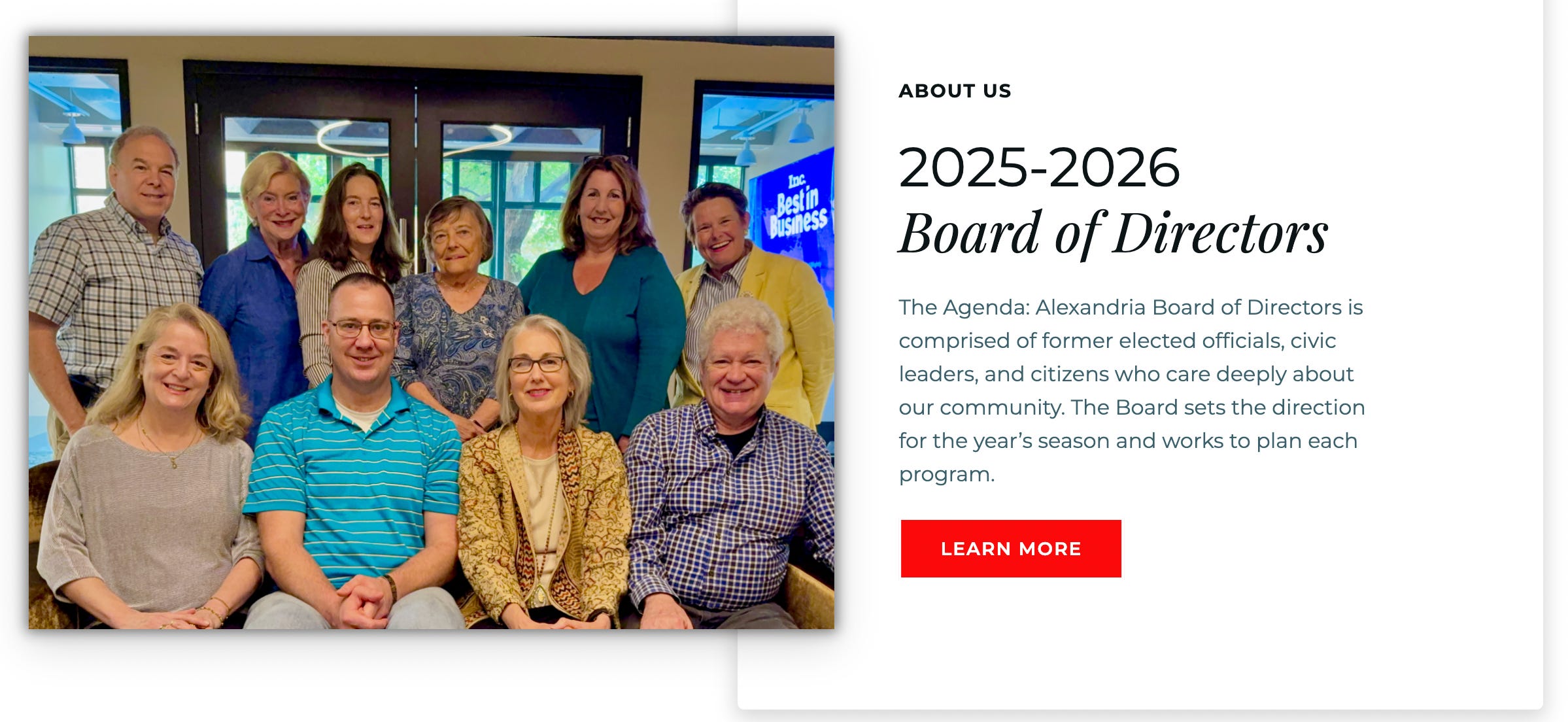
After receiving questions from The Alexandria Brief, Davidson said former Vice Mayor Amy Jackson left the board in October and that Mary Wadland, publisher of the Zebra Press, which sponsors Agenda:Alexandria, left last month. “We just realized that the Web site had not been updated to reflect this or other changes to our makeup — fixed this morning,” Davidson wrote.
Jackson, a Democrat who served on City Council from 2018 to 2024, was one of two council members who voted against portions of the Zoning for Housing package, motioning to defer the elimination of single-family zoning protections. Her motion failed 5-2. During her 2024 mayoral campaign, Jackson pointed to CLA’s lawsuit as validation of her position. “No one listened to me. Here we are,” she told the Alexandria Times. Jackson joined the board in July 2025 and left in October — a three-month tenure. Davidson said she “had zero role in this panel.”
The board includes Rod Kuckro, a former Agenda:Alexandria chair and former president of the Alexandria Federation of Civic Associations. The federation, under the leadership of Carter Flemming, publicly opposed the Zoning for Housing initiative before City Council in November 2023, urging a postponement of the vote.
Davidson said the board strives for ideological balance. “Some of our members are deeply conservative (and politically active) and others are unabashedly liberal (and also politically active),” he wrote. “People who are in, or are running for, elected office cannot be on our Board.”
Programming history
A review of past Agenda:Alexandria events shows recurring voices in the organization’s programming on housing and city infrastructure.
Carter Flemming, the Federation of Civic Associations chair who opposed Zoning for Housing, has appeared at no fewer than four Agenda:Alexandria events between 2022 and 2025: a May 2022 development panel moderated by Kuckro, an October 2022 building-heights forum, a March 2025 panel on the city’s Complete Streets program and an October 2025 panel on civil discourse.
Davidson said the organization does not track how often individual panelists appear. “Your citing four was news to us — but it sounds like we should keep statistics in order to avoid over-use of any panel candidate,” he wrote. He described Flemming as “well-known, very knowledgeable, articulate, and involved in a great many civic activities.”
Davidson said Kuckro “moderates many, if not most, of our panels” and that the moderator role is independent from panel selection — though Kuckro is sometimes part of the subcommittee that selects panelists, “statistically, maybe one out of three” times.
The October 2022 building-heights panel also featured Nate Hurto, co-founder of Save Del Ray, another group that organized against the city’s density proposals.
The housing crisis
Alexandria lost more than 14,300 affordable housing units — 78% of its supply — between 2000 and 2022. The average home in the city sold for more than $818,000 in 2025, according to regional MLS data, in a city where the median household income is approximately $114,000. More than 19,000 people are on ARHA's waiting lists for housing assistance.
Davidson described Agenda:Alexandria as “a non-profit that consists of a dozen volunteers who, in our spare time, work to provide a forum for the exchange of ideas on topics that matter to Alexandrians. The organization has no advocacy position; we only exist to provide a robust set of thought-provoking and informative programs.”
The Feb. 23 event begins at 7 p.m., with a social hour at 6:30 p.m., at the Forum on the Minnie Howard campus, 3775 W. Braddock Rd. Attendance is free for members and $10 for nonmembers. Questions can be submitted in advance to housing-questions@agendaalexandria.org. More information is available at agendaalexandria.org.
Agenda:Alexandria’s full response
The following is the complete, unedited response from Board Chair Steve Davidson to questions submitted by The Alexandria Brief on Feb. 11.
We normally list our panelists by name, but we are still waiting for positive confirmation from the Economics professor, and didn’t want to delay publication any longer. If he can’t make it, we will shift to a backup choice. The description, absent names, will not change if we have to go with the backup.
There was no omission; that panelist isn’t there to represent the litigants. He was selected because he has the expertise to speak on the issues, and provides balance to two of the other panelists.
Our format is to have four panelists — not six or eight. Experience has shown that when you have too many panelists, in a roughly 75-minute discussion, you can’t cover much ground. So, we create a panel that includes people with expertise and reflect some of the differing perspectives — even if we can’t invite every possible representative with a position. Two of our panelists (City’s Director of Housing head of the non-profit that builds affordable housing) are strong advocates of increasing housing supply, and can easily represent the positions of the organizations you cite. We have an academic who has no dog in the fight but can speak to the larger context and provide objective data as needed. And we have a panelist who is knowledgeable about zoning issues and has a differing perspective from the first two I mentioned. This is the best that can be done without turning the our program into a multi-hour “United Nations” event.
None of the panelists, nor any outside organization, was involved in the formation of the event description. Quite the opposite; the panel topic is defined first, and then we then look for panelists who can address the topics. Our process is that a small subcommittee (4-5 people) is formed from members of our Board for each topic, and they are responsible for framing the panel. We review published material on the subject of the panel, compile a set of topics and questions that are relevant to the theme of the program — including information content that provides framing for the issue, and points of controversy. It should not be surprising that some of the questions sound familiar since they are all pretty much “ripped from the headlines.”
Amy left the Board in October (and we just realized that the Web site had not been updated to reflect this or other changes to our makeup — fixed this morning). Amy had zero role in this panel. But to the larger question of balance: We try to ensure that our Board represents a cross section of perspectives. Some of our members are deeply conservative (and politically active) and others are unabashedly liberal (and also politically active). And some want nothing to do with partisan politics. People who are in, or are running for, elected office cannot be on our Board (another mechanism we use to keep us non-political). When we form teams to put together a program (see #3) we ensure that they are balanced with respect to the topic. We can’t claim that the process is perfect (no human process is), but we take our “not taking sides” motto very seriously and do all that we can to live up to that.
Mary left our Board last month, but The Zebra Press has been a sponsor of Agenda:Alexandria for many, many years. I think their editorial position is that it is “good news” to have an organization that brings together people with differing positions for respectful and informed discussion. Mary received the same bcc’ed E-mail as you (and other news outlets) did — no special treatment.
Carter is well-known, very knowledgeable, articulate, and involved in a great many civic activities — so it is not surprising that she is a good candidate as a panelist. We don’t keep statistics on panel members so your citing four was news to us — but it sounds like we should keep statistics in order to avoid over-use of any panel candidate. Rod moderates many, if not most, of our panels. The moderator may or may not be involved in program definition or panel member selection — those are independent roles (it all depends on whether or not he’s part of the team putting together the program, statistically, maybe one out of three). In answering #4 we described the process of panelist selection (key point: we strive for balance).
We hope you understand that that Agenda:Alexandria is a non-profit that consists of a dozen volunteers who, in our spare time, work to provide a forum for the exchange of ideas on topics that matter to Alexandrians. The organization has no advocacy position; we only exist to provide a robust set of thought-provoking and informative programs (that is our agenda).
Update, Feb. 14, 2026: This story has been updated to correct the average home price and household income figures cited in the housing crisis section. The original version stated the average single-family home costs approximately $940,000 and the average household income is $150,000, based on a city presentation. The corrected figures reflect 2025 regional MLS sales data (average home sale price of more than $818,000 across all home types) and U.S. Census data (median household income of approximately $114,000).
Thank you for this coverage. Agenda Alexandria has long strayed from its mission to cover issues without taking sides given the composition of recent panels on controversial local issues. This one is a pretty typical arrangement, with city staff selected to represent one side of an issue, and a community member representing the other. It's not particularly balanced since city staff are not the same as a resident or an advocate for a certain position--those voices are often not represented at Agenda Alexandria's table. It's why many who would otherwise support and attend their programs have tuned them out over the past 10 years.