
Alexandria Planning Commission approves comprehensive Green Building Plan requiring stricter energy standards
New master plan amendment mandates 30 EUI for multifamily buildings, 5% renewable energy generation, and eliminates clean energy fund option for developers

The Alexandria Planning Commission unanimously approved a comprehensive Green Building Plan on Tuesday that establishes stricter energy-efficiency requirements for new construction and significantly strengthens renewable-energy mandates for developers.
The commission voted 7-0 to recommend the master plan amendment to City Council after making several modifications that toughened the original proposal from city staff. Where staff had recommended an energy use intensity target of 38 for multifamily buildings, the commission lowered it to 30. The commission increased the on-site renewable energy requirement from staff's proposed 3% to 5%. And commissioners eliminated the proposed Clean Energy Fund, which would have allowed developers to pay up to $150,000 rather than install solar panels on their buildings.
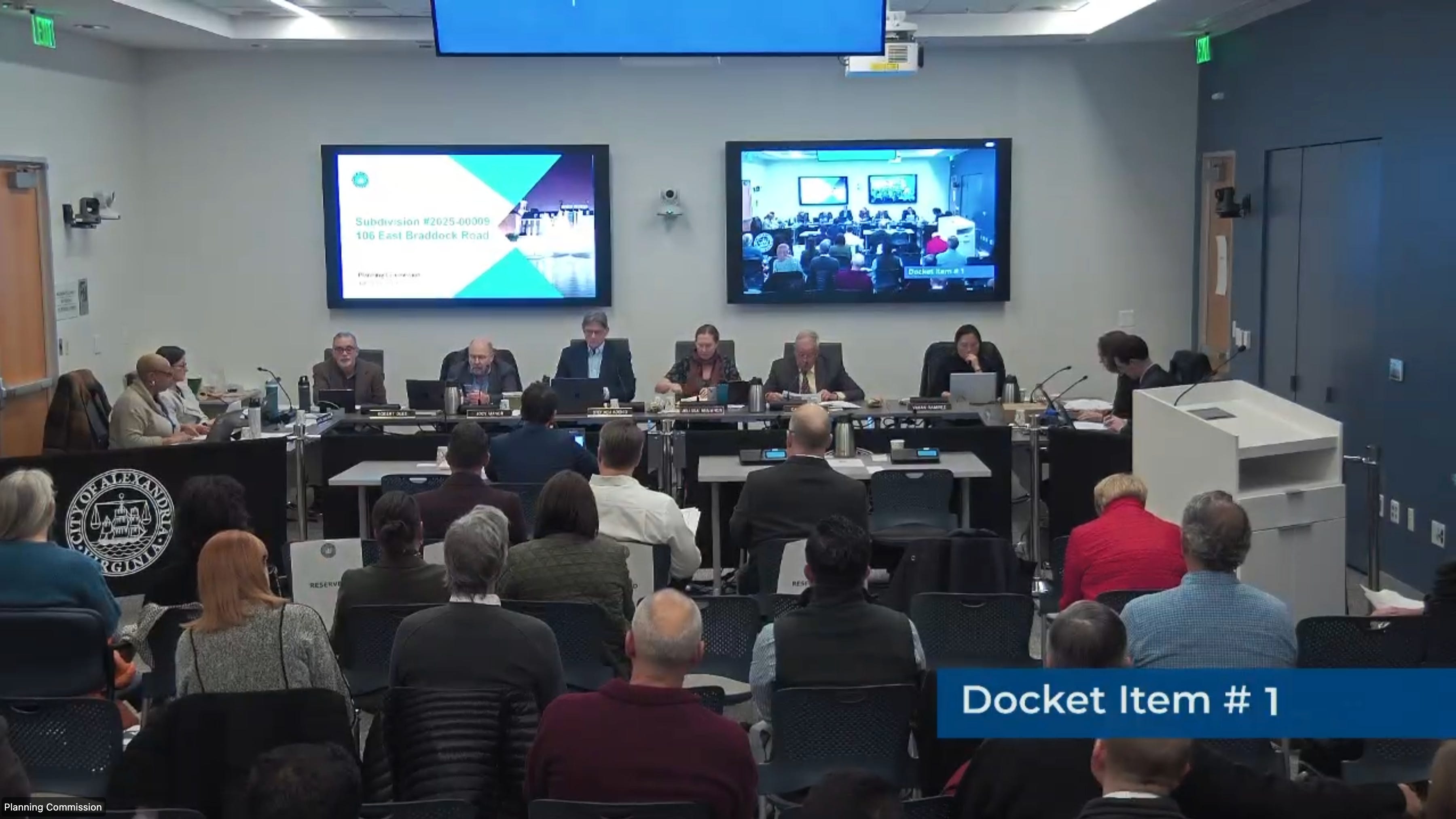
The plan represents a major shift in how Alexandria regulates building energy performance, moving away from third-party certification programs such as LEED and Green Globes to focus on specific metrics that staff believe will have the greatest impact on reducing greenhouse gas emissions. Buildings account for more than 52% of the city’s emissions, according to a Metropolitan Washington Council of Governments analysis.
Ryan Freed, the city’s Climate Action Officer, framed the proposal around both climate and grid reliability concerns during his presentation.
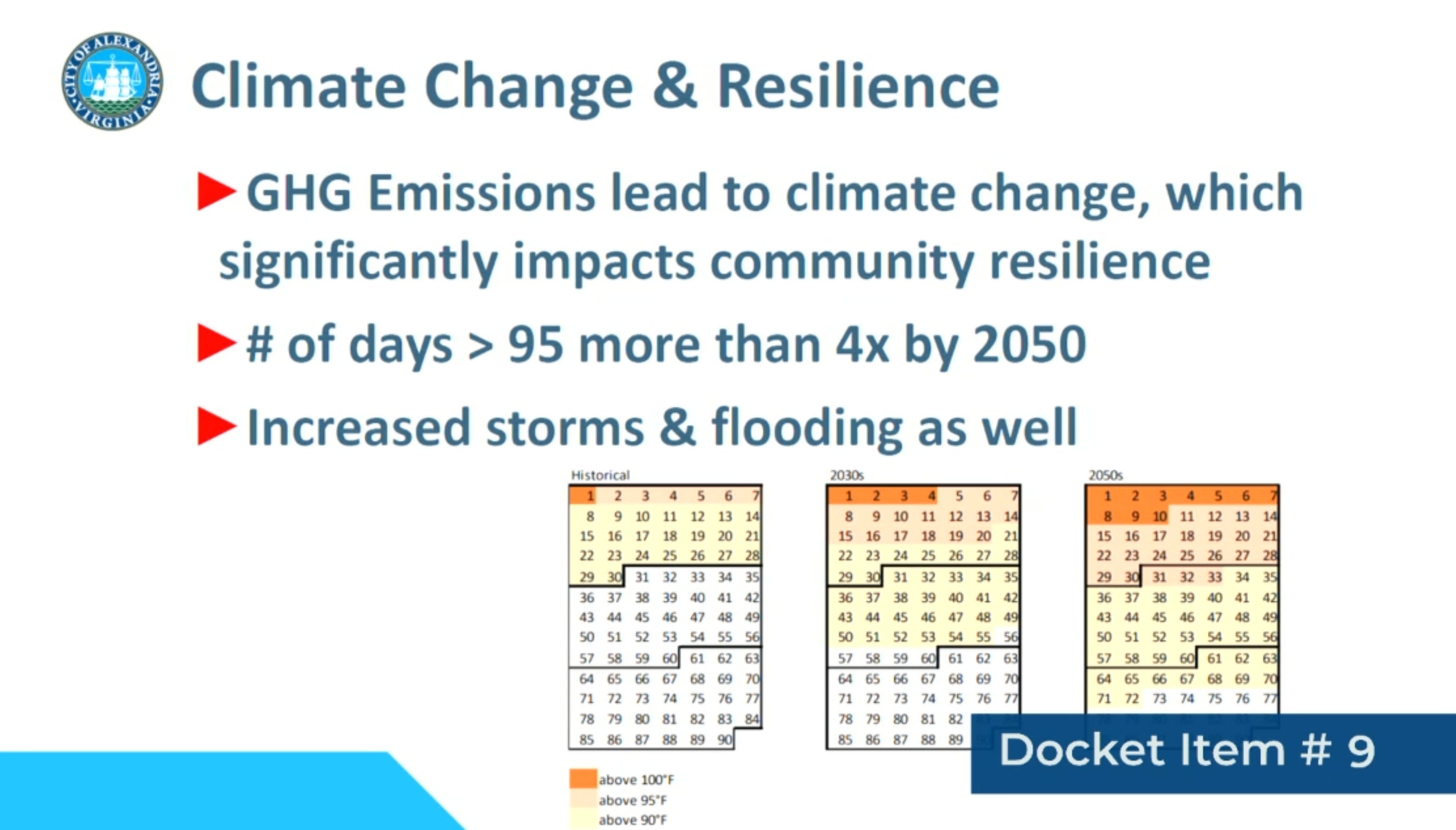
“The reality here is, is that it’s getting hotter. It’s getting measurably and noticeably hotter in Alexandria,” Freed said. “From historically having one day over 100 degrees Fahrenheit to in the 2050s, we expect to have about 10 days that are over 100 degrees and 10 times increase in the number of extreme heat days.”
Freed cited Dominion Energy’s latest integrated resource plan, which projects that the region will need to double its electrical generation capacity within 20 years, largely due to data center growth. The regional transmission operator PJM is already struggling to procure enough generation to meet reliability requirements, he said.
“This is not just an inconvenience,” Freed said of potential power disruptions. “That means we’re losing food in our refrigerator, we’re losing opportunities that we need. And that’s real money. That’s medicine, that’s rent. These are things that have a real impact on Alexandrians.”
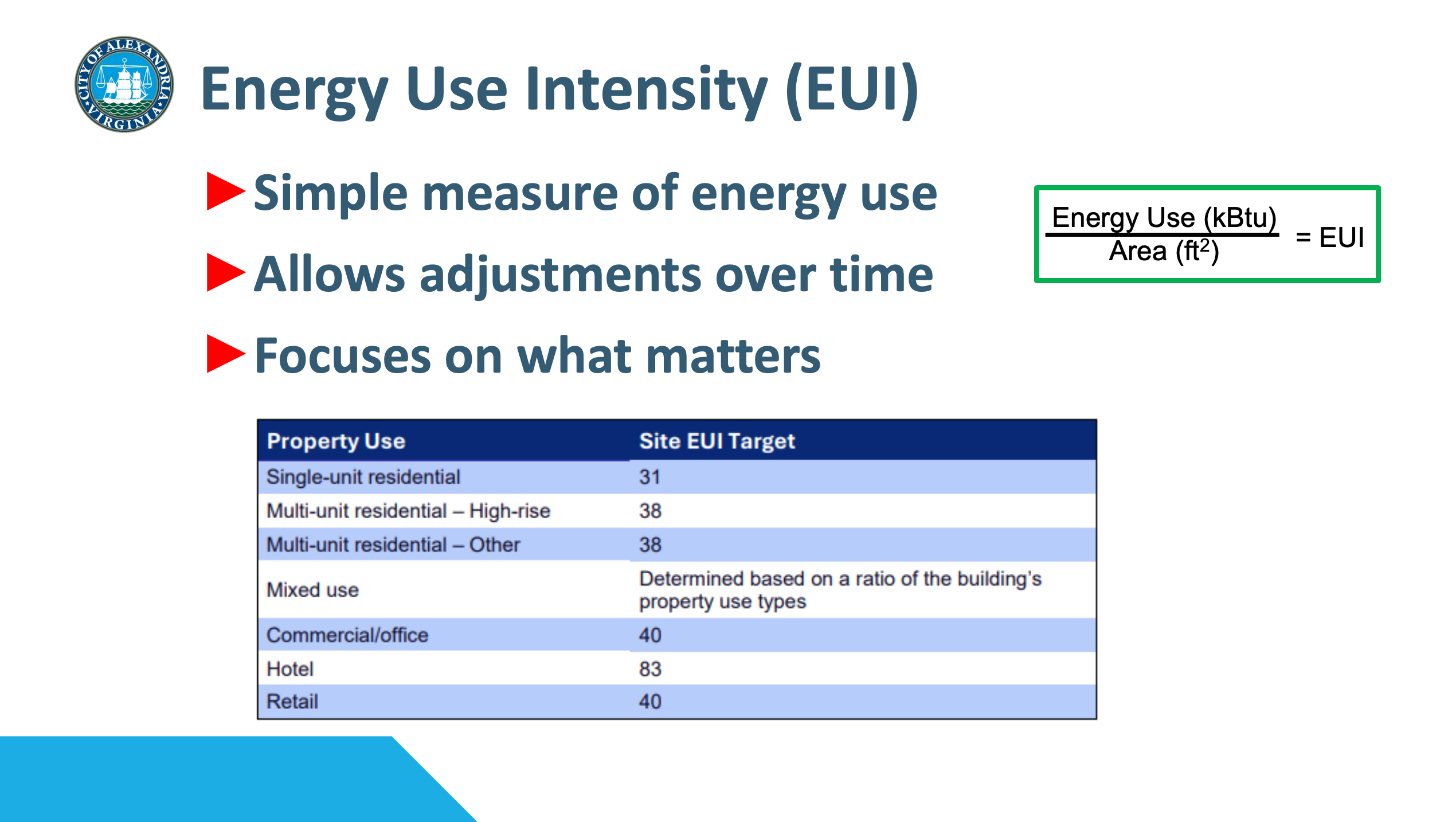
Energy use intensity, or EUI, measures how much energy a building uses per square foot. The commission’s decision to set the multifamily target at 30 rather than the staff’s recommended 38 brings Alexandria closer to what several commissioners described as necessary to meet the city’s climate goals of reducing emissions 50% by 2030 and 80% to 100% by 2050.
Vice Chair Stephen Koenig expressed frustration with the pace of progress toward those goals.
“We’re not anywhere near getting anywhere near these requirements,” Koenig said. “And we set them in 2015, and we said 2030, because of course we can get to it by then. Plus we can do something now that only gets us an inch there and spend another five years over the third or fourth time now doing that. We’re approving something two minutes before 2030 that’s not going to get us anywhere near.”
Koenig also argued for eliminating the Clean Energy Fund option, citing his experience with “solar-ready” buildings that never install panels.
“I’ve been on this commission for 10 years, and I have seen countless, I would say at least dozens of buildings that have flat roofs,” Koenig said. “They’re going to go out and stare at the sky, and they are represented as solar-ready. And the only thing solar-ready about them is that they already have a flat roof, and that there’s a conduit for a wire, and there’s enough space in the basement for a panel. And none of those buildings, to my knowledge of however many they’ve been, have ever turned out to be solar active after that.”
Chair Melissa McMahon noted how dramatically the energy landscape has changed since the commission last updated its green building policy in 2019.
“I’m quite concerned that even in 2019, when we worked on the green building policy last, we didn’t have data centers on the radar,” McMahon said. “It wasn’t even a thing. We were concerned about other stuff, but we didn’t have this sort of clear and present danger of completely running out of electricity because this other thing that we all really want.”
Commissioner Vivian Ramirez said new technology and its energy demands justified stricter requirements.
“Given the reality of our environment today, given the reality of new technology that has come online, that has seemingly overnight become the go to, it is standard and the energy consumption that it requires and the fact that our markets haven’t yet caught up to understand how to temper it,” Ramirez said. “I can only think that for us to put further constraints, tighter constraints on our green building policy would be the responsible thing to do.”
Several speakers from the development community raised concerns about the economic impact of stricter requirements. Ken Wire, an attorney representing NAIOP Northern Virginia, the commercial real estate development association, said the industry generally supports the plan’s framework but warned that uniform EUI targets could discourage high-density construction.
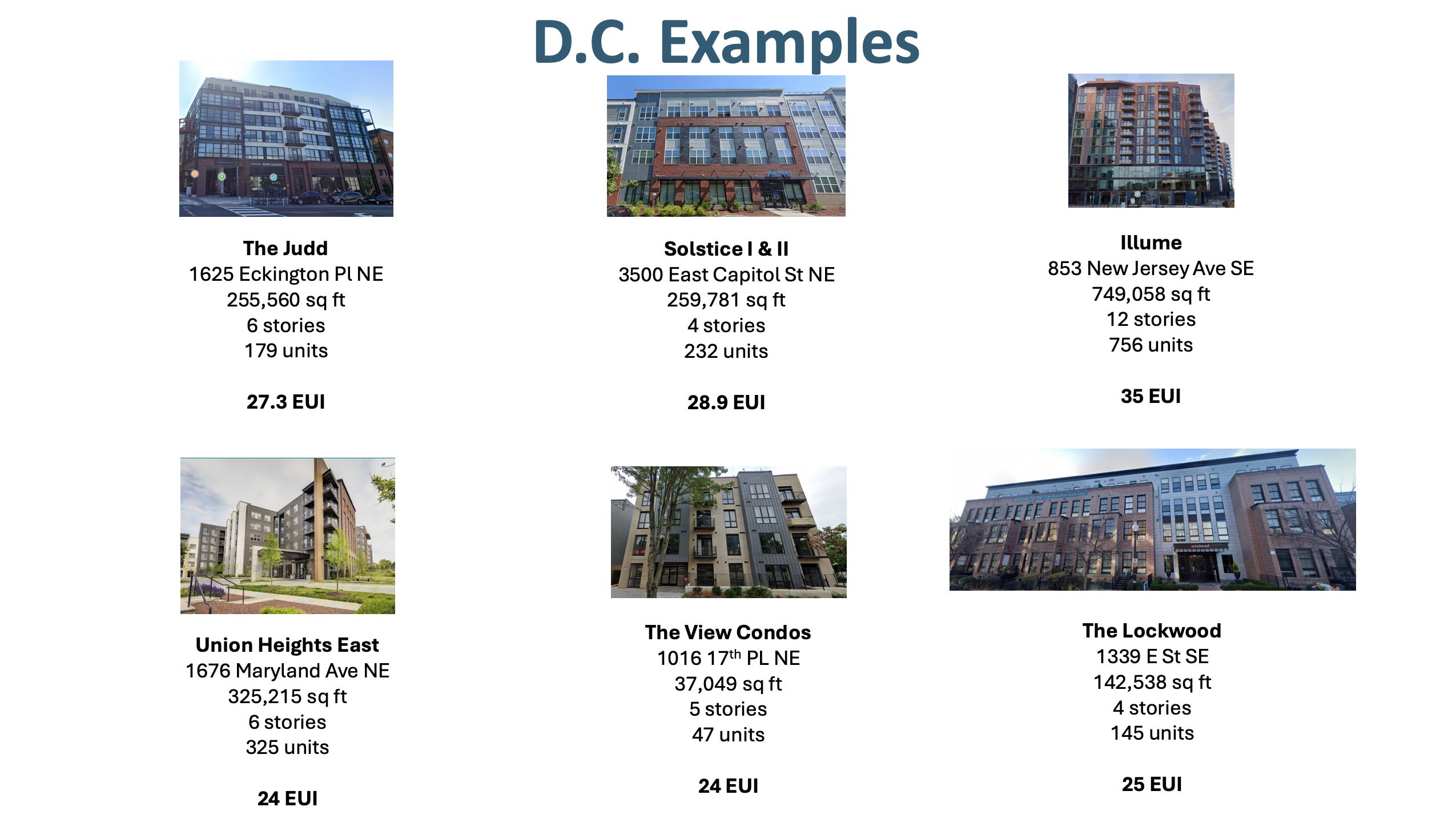
“EUI by definition is an energy use per square footage. You have a 10,000 square foot building with 10 families. It probably doesn’t have a hard time reaching a 30 EUI,” Wire said. “Same building, same HVAC equipment, same everything. Let’s double it. Let’s say it’s a more intense development. It begins to drift away from that 30 EUI as you put more people in the building. It’s just a fact.”
Wire also raised legal concerns about the plan’s compliance with Virginia’s Dillon Rule, which limits local government authority, and requested the city attorney seek an opinion from the state attorney general.
“I do not think it’s legal. I do not think it will withstand judicial review,” Wire said.
Mary Catherine Gibbs, an attorney representing Paradigm Development Company, which she described as the city’s second-largest taxpayer, argued the uniform standards don’t account for the challenges of high-rise construction.
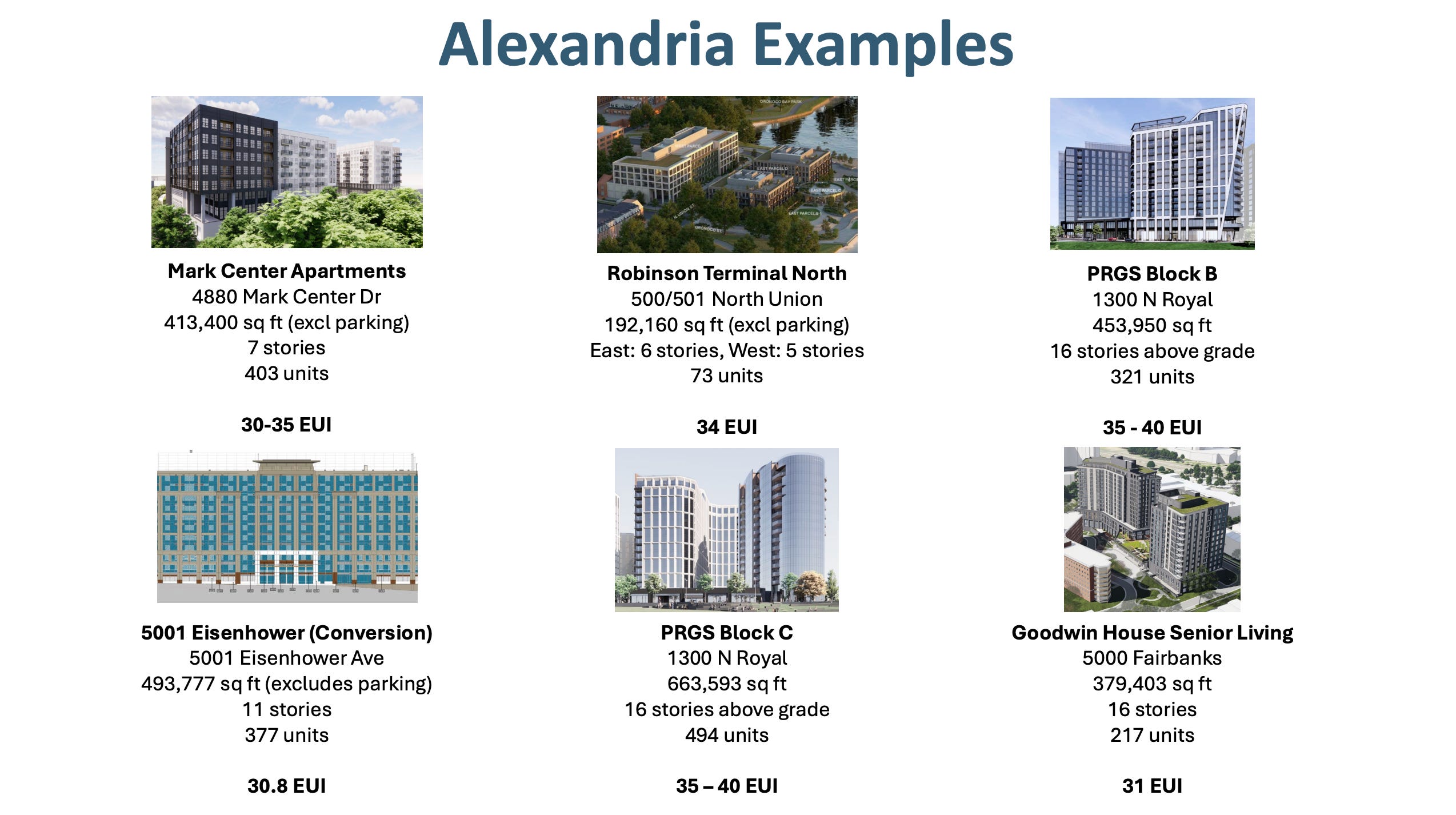
“Nothing that they’ve done in the city is anywhere close to 38,” Gibbs said of Paradigm’s existing buildings. “And they’re very concerned that specifically that you are disincentivizing high-density development in the city of Alexandria because EUIs in the high-density buildings are much harder to achieve.”
Supporters of stricter standards countered that higher-performing buildings protect residents from rising energy costs. David Peabody, an architect specializing in high-performance buildings, told commissioners that a building meeting the 30 EUI standard would save a family of four about $37 per month compared to one built to the minimum state code.
“As rates rise, that gap will grow to $75 a month for a 60% AMI family with roughly $1,500 of disposable income at month’s end,” Peabody said. “That can mean a choice between groceries or a prescription for a child.”
Peabody estimated that building a 93,000-square-foot multifamily project to 30 EUI rather than code minimum would add about 3.5% to construction costs, or roughly $1 million. A cost analysis by the Cadmus Group included in the plan found that incremental costs for energy efficiency measures would generally amount to less than 3% of typical construction costs.
Architect Deborah Belo challenged the development community’s concerns, suggesting they lack direct experience with the proposed standards.
“My question would be, for those who are worried about these costs, have they ever actually attempted to build to something like a 30 EUI rather than a 38 EUI for multifamily housing? Probably not,” Belo said. “These concerns are based on extrapolation rather than direct experience.”
Belo added that meeting the 30 EUI standard does not require passive house standards or extreme construction techniques.
“It doesn’t require unfamiliar materials, it doesn’t require huge value adds, it allows substantial flexibility in form, it allows many varieties of envelope assemblies, and it allows a variety of mechanical systems,” she said.
Commissioner Holly Lennihan acknowledged the difficulty of implementing new standards while arguing the industry has successfully adapted to similar requirements before.
“In 2020, USGBC’s LEED requirements were something that we still frowned on. VOCs were still in paints. Again, we don’t even think about it anymore,” Lennihan said. “Now, having said that, I don’t think this is simple. I mean, I’m looking around the room at three architects on this dais. And to change the way you do buildings and design them to have new wall sections with new ways of insulating and all of that stuff, it is not easy. It’s going to take a lot of time. It’s going to be very challenging. People are going to feel the pain of having to do it, but it happens.”
Commissioner David Brown drew a historical parallel to San Francisco’s building code changes after the 1906 earthquake.
“I think those builders in San Francisco that wanted to rebuild their homes, their buildings without added resiliency could say, well, we just want to rebuild them in a way that does not negatively impact the existing resilience,” Brown said. “Well, that’s an extremely low bar. And I completely commend the arguments for raising the bar.”
The plan maintains electrification requirements that prohibit on-site combustion except for specific permitted uses like emergency generators, commercial kitchens, fireplaces, and outdoor grills. It also requires new developments to install electric vehicle charging infrastructure, with market-rate multifamily projects providing chargers for at least 5% of parking spaces and wiring an additional 15% for future installation.
Commissioner Robert Dube raised concerns about EV charging infrastructure in underground parking garages, citing fire safety issues. The commission directed staff to incorporate consultation with the fire department into the development review process.
The plan includes provisions for adaptive reuse projects, recognizing the environmental benefits of converting existing buildings rather than demolishing them. Staff noted that conversion projects would have additional flexibility in meeting certain requirements.
Freed emphasized that the plan is designed to be updated regularly, with the Office of Climate Action directed to review standards at least every two years and recommend changes to the City Council.
“This framework sets it up to where through time we can adjust these down,” Freed said. “This gives us an incredible amount of flexibility as we move forward to make adjustments.”
The Green Building Plan now moves to City Council for final consideration on Jan. 24. If approved, it would apply to new construction projects requiring a Development Site Plan or Development Special Use Permit.
In other business on Tuesday, the commission unanimously approved three subdivision requests on its consent calendar at 106 East Braddock Road, 412 East Nelson Avenue, and 413 East Nelson Avenue. The commission also unanimously approved an extension of a development special use permit for an automobile repair and warehouse facility at 3120 Colvin Street, a mixed-use residential project with eight units at 220 and 224 South Peyton Street, an office-to-residential conversion at 732 North Washington Street, and a zoning text amendment establishing provisions for commercial-to-residential conversions citywide.
The commission held a work session on the draft Duke Street Land Use Plan prior to the public hearing.
Incredible reporting on the commission's decison to tighten EUI targets to 30. The pushback from developers about high-density buildings having inherently worse EUI scores is a bit misleading tho, density isn't the problem but design choices are. I consulted on a mixed-use project last year where they hit 28 EUI at 18 stories by front-loading envelope upgrades instead of trying to compensate later with mechnical systems. The real issue is that many firms still default to code-minimum walls and windows then oversize HVAC to make up for the thermal losses.