
Alexandria proposes shift from green building certifications to energy performance targets
Public hearings set for January on plan covering projects that require city development approval

City officials have released a proposed Green Building Plan that would move away from third-party certification programs and instead require new development to meet specific energy performance standards, marking a significant shift in how the city regulates building efficiency.
The 99-page proposal, which would become a new chapter of the city’s master plan, targets buildings that account for more than 52% of Alexandria’s greenhouse gas emissions, according to a Metropolitan Washington Council of Governments analysis cited in the document.
The Planning Commission will hold a public hearing on the plan Jan. 6 at 7 p.m. City Council’s hearing is scheduled for Jan. 24 at 9:30 a.m. in the City Hall Council Chambers. If adopted, the plan would take effect in early 2026.
What’s changing
The current policy, adopted in 2019, relies on third-party certification programs such as LEED and Green Globes that assign points for various sustainability measures. The proposed plan instead sets direct energy use intensity targets — a measure of energy consumed per square foot — for different building types.
The new requirements would apply to private development projects that require a Development Site Plan or Development Special Use Permit, the two approval processes for larger projects in the city. Smaller projects that don’t require these approvals would not be subject to the plan.
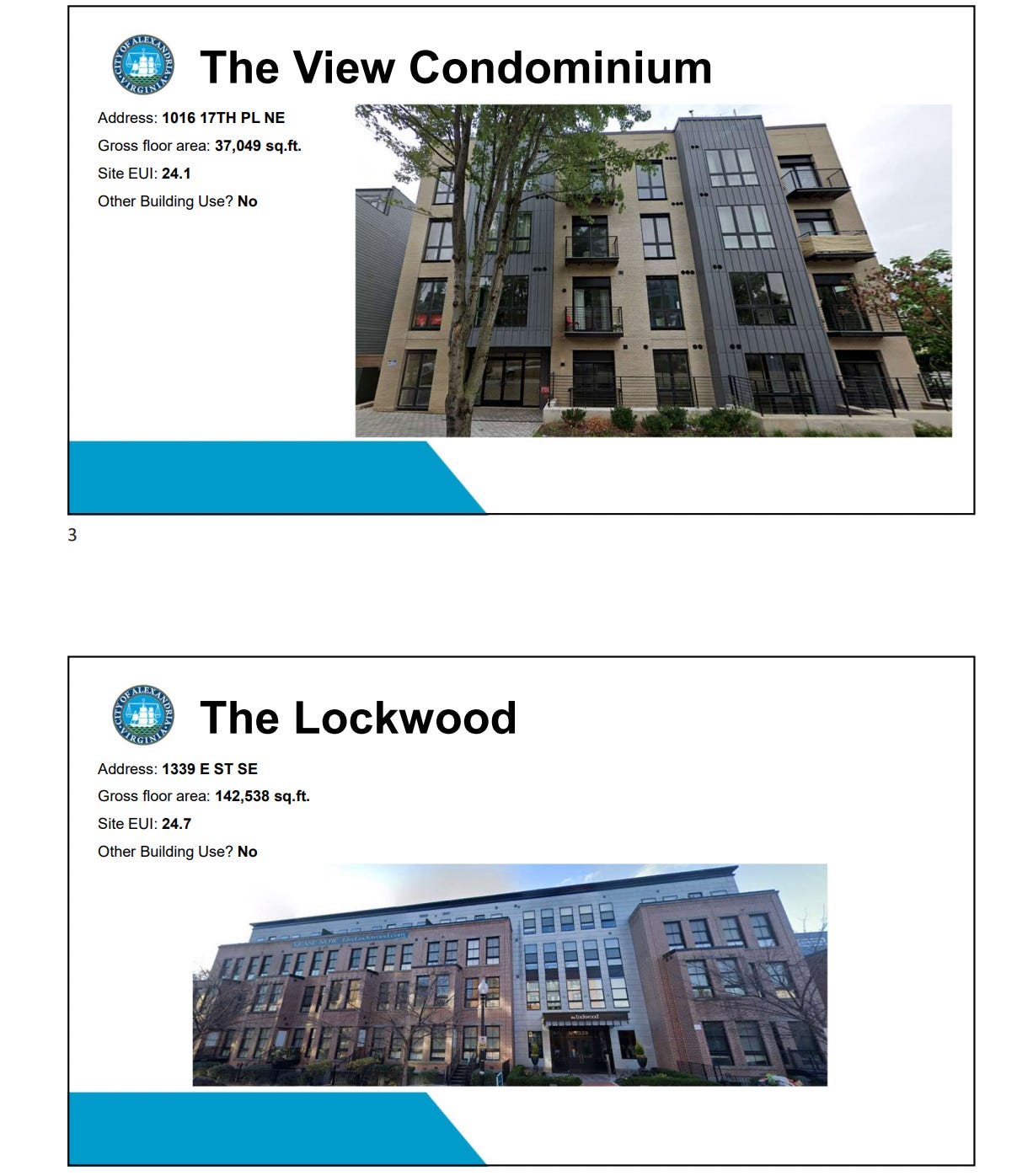
Under the standard compliance path, multifamily buildings would need to meet an EUI target of 38, commercial offices and retail would need to hit 40, and hotels would face a target of 83. The targets are based on energy modeling and regional benchmarking data from nearby jurisdictions, including Washington, D.C., and Montgomery County, according to technical analyses included in the plan.
The plan would also require buildings to generate at least 3% of their energy from on-site renewable sources or contribute to a new city Clean Energy Fund, with contributions capped at $150,000 per building. The fund would be used for projects that reduce energy use or increase renewable energy availability within the city.
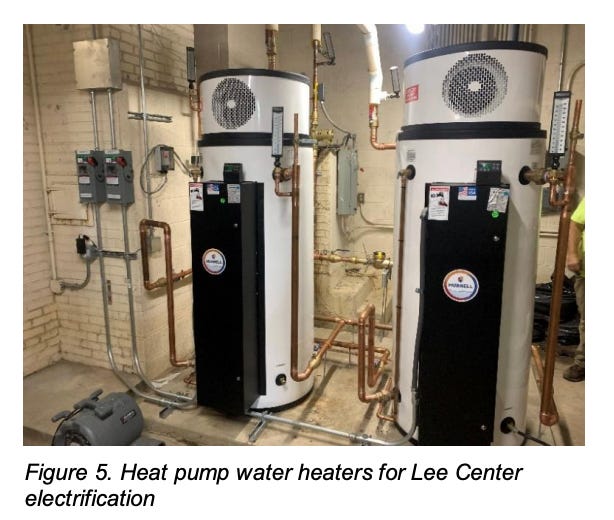
The proposal prioritizes electrification over natural gas combustion, though it allows exceptions for commercial kitchens, centralized hot water systems, emergency generators, and building amenities like fireplaces and grills.
Electric vehicle infrastructure
Transportation accounts for nearly 38% of citywide greenhouse gas emissions, the second-largest source after buildings. The proposed plan would require new development to install EV charging infrastructure to support the transition to electric vehicles.
Market-rate multifamily projects would need to provide chargers for at least 5% of required parking spaces, with an additional 15% of spaces wired for future charger installation. Affordable housing projects would face reduced requirements of 2.5% with chargers and 5% make-ready.
Commercial and hotel projects could choose between providing chargers for 5% of spaces or installing at least one DC fast charger along with Level 2 chargers for 2% of spaces. Townhouses and single-family homes with off-street parking would need to include conduit and electrical panel capacity for future charging.
Cost and feasibility
A cost analysis by the Cadmus Group, included in the plan’s technical appendix, found that incremental costs for energy efficiency and electrification measures would generally amount to less than 3% of typical construction costs in Alexandria.
Two Alexandria City Public Schools — Douglas MacArthur and Minnie Howard — have already been designed and built to net-zero energy standards using geothermal heating and cooling, with solar energy procurement underway to cover 100% of the buildings’ energy use.
Five pathways for compliance
The plan offers developers five options for meeting requirements:
The standard path requires projects to meet specific targets for energy use, renewable energy, electrification, water conservation, and electric vehicle charging infrastructure. Alternatively, projects could pursue high-level certifications such as Passive House or the Living Building Challenge.
Affordable housing projects using Low Income Housing Tax Credit financing or city Housing Opportunity Funds could follow Virginia Housing criteria with reduced EV charging requirements — 2.5% of parking spaces rather than 5%.
Small projects — residential developments with four or fewer units, or buildings under 25,000 square feet — face scaled-down standards focused on water conservation, efficient appliances, and solar-ready design.
Public buildings, including city and school facilities, would face the strictest requirements: net-zero energy and 100% stormwater treatment through green infrastructure.
Flexibility for conversions
The plan includes provisions for modifications when projects face conflicts with other requirements such as historic preservation standards or affordable housing obligations.
Adaptive reuse projects — such as office buildings being converted to residential use — would receive additional flexibility on energy and renewable energy targets. The plan describes this as recognition of the environmental benefits from preserving existing structures rather than demolishing and rebuilding, noting that construction materials and processes are carbon-intensive.
Climate context
The proposal frames the new requirements around the city’s climate goals, which call for a 50% reduction in greenhouse gas emissions by fiscal year 2030 and 80% to 100% by 2050.
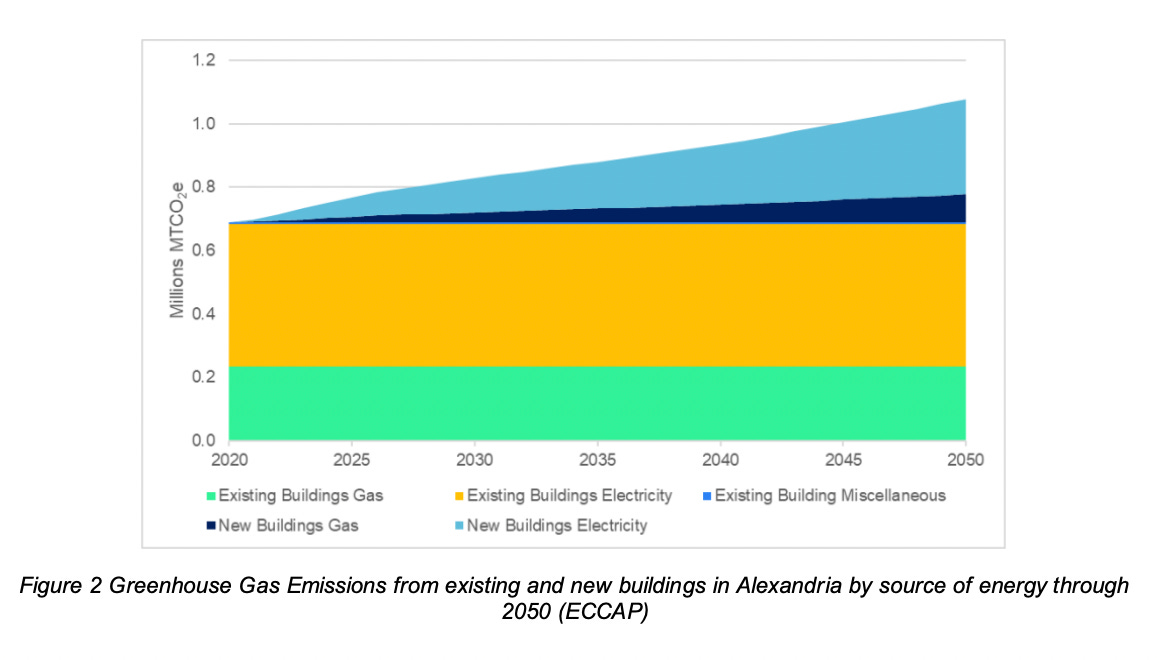
City projections show that without intervention, new construction would drive an approximately 50% increase in building emissions by 2050. The plan notes that 69% of the city’s long-term emissions reductions are expected to come from new buildings.
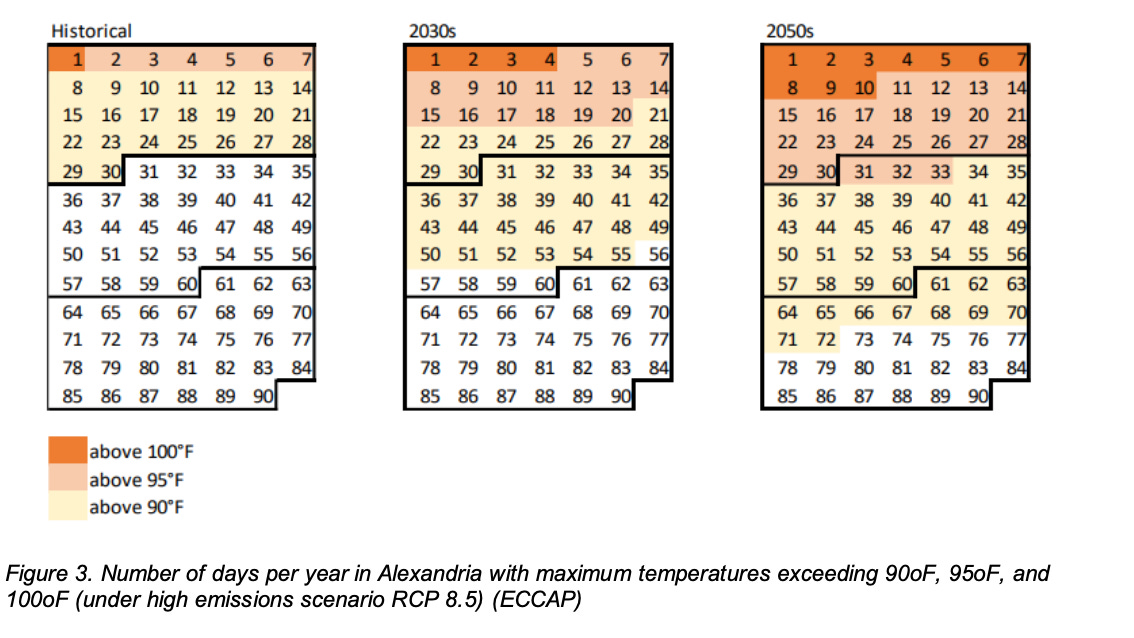
The document also cites grid reliability concerns, referencing Dominion Energy’s forecast of 4% annual growth in summer peak demand over the next 20 years.
How the plan was developed
The Office of Climate Action led development of the plan in partnership with departments including Planning & Zoning, Housing, and the City Attorney’s Office. A 14-member advisory group representing developers, architects, environmental advocates and residents met regularly starting in March 2024.
Staff released initial recommendations in April and accepted public comments through June. Following that feedback, the city commissioned additional technical analysis from Pacific Northwest National Laboratory and the Cadmus Group to refine energy targets and cost estimates.
In January 2023, the Environmental Policy Commission and Planning Commission sent a joint letter encouraging an update to the 2019 policy that would focus on metrics with the greatest environmental impact, according to the plan.
The city has reduced building-related emissions by more than 45% since 2005 and was ranked 17th nationally for LEED-certified buildings per capita in a 2025 report.
The 2019 policy remains in effect for current development applications. Projects will not be subject to the new requirements until Council adopts the plan.
More information is available at AlexandriaVA.gov/GreenBuilding.