
Alexandria school board signals support for deferring $100 million Cora Kelly project amid budget constraints
Board members debate competing approaches to address middle school overcrowding as advocacy group celebrates potential reversal of K-8 conversion plans

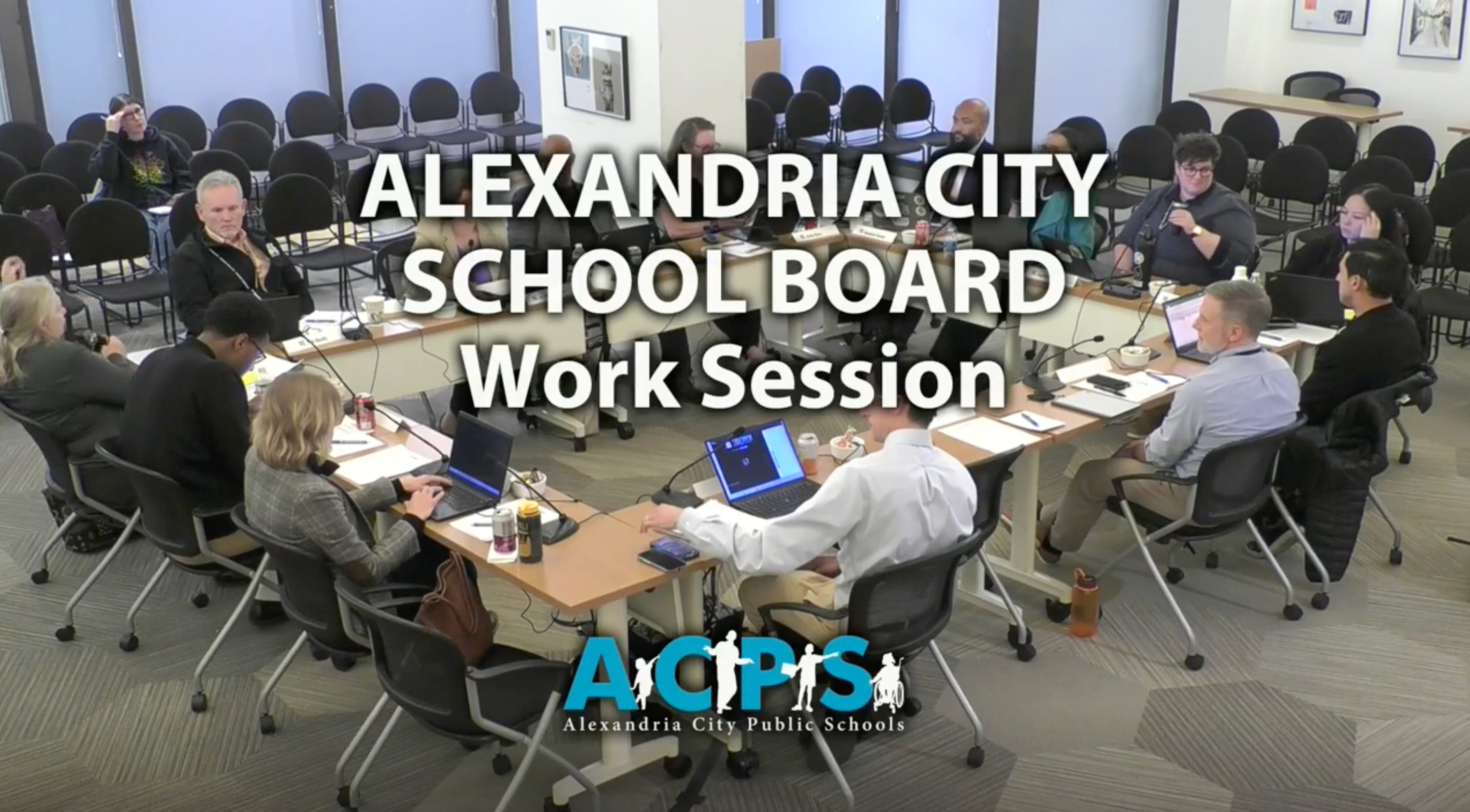
The Alexandria City School Board signaled support Thursday for deferring the planned modernization of Cora Kelly Elementary School from 2028 to 2036, a move that would free up funding to address overcrowded middle schools while staying closer to the city’s 10-year budget guidance.
The direction emerged during a nearly three-hour Capital Improvement Program add/delete work session as board members wrestled with a $55 million gap between the superintendent’s proposed $340 million 10-year capital plan and the city manager’s $285 million spending guidance.
“This is definitely the most complicated CIP I’ve been part of,” said board member Kelly Carmichael Booz, who is in her seventh year on the board. “We’re in a different fiscal climate right now, and that has added to the complexities.”
The board faces pressure to address severe overcrowding at George Washington Middle School, which operates at 130% capacity, and Francis C. Hammond Middle School, which runs at 120% capacity. Both schools exceed the district’s target utilization rate of 90% to 100%.
Two competing approaches emerged for how to solve the middle school capacity crisis.
Board Chair Michelle Rief proposed accelerating the conversions of Jefferson-Houston and Patrick Henry from K-8 schools — with Jefferson-Houston becoming a middle school and Patrick Henry becoming an elementary school — by two years to 2028, at a combined cost of approximately $39.6 million. Her plan also includes $30 million for modernizing the district’s transportation facility, which received the worst rating in facility condition assessments.
“My concern is if we embark on a $100 million school modernization in fiscal years 2028 through 2029, that’s going to increase not only the city’s debt, but also the debt service and the cash capital payments which come out of the operating budget,” Rief said.
Board member Ryan Reyna offered an alternative, proposing to delay specific middle school capacity decisions while using placeholder funding for future projects. He and Booz suggested creating joint subcommittees with City Council to explore all options before committing to specific projects.
“I really think the approach to solving our middle school capacity needs to be done in concert with city council,” Reyna said. “I believe it’s important to give ourselves the time and the space to work through that.”
Chief Financial Officer Dominic Turner framed the challenge in stark financial terms.
“Every million dollars that you finance is roughly between $70,000 and $80,000 of debt service every single year,” Turner said. “So for instance, the $100 million project, you’re talking about $7 to $8 million of debt service every single year for the next 20 years.”
Cora Kelly deferral draws opposition
Board members Abdulahi Abdalla and Christopher Harris pushed back against deferring Cora Kelly, which has been in the district’s capital plan for years.
“I’m strongly against moving back Cora Kelly that far. It’s already been pushed back in the CIP. I’m pretty sure it’s been in there when I was in high school. That was 10 years ago,” Abdalla said. “For us to keep pushing back Cora Kelly is a disservice to that community.”
Harris raised concerns about the building’s condition if modernization is delayed another decade.
“We have a school now that’s already not in the greatest condition. Imagine what the condition this school’s going to be in in eight years,” Harris said.
Board member Tim Beatty, who said he visits Cora Kelly twice a week, expressed reluctant flexibility.
“I’m a Cora Kelly fan. There are problems in that building and for many years there’s been a commitment to do something about that,” Beatty said. But he indicated willingness to defer “assuming that most of the stuff can be fixed with sort of non-capacity maintenance” and “as long as it’s clear to everybody we’re changing this to address the highest priority need in my mind, which is 6 through 8 capacity at this point.”
Advocacy group sees opening on Jefferson-Houston
The debate over how to address middle school capacity has drawn attention from Save JH, an advocacy group that has opposed converting Jefferson-Houston from a K-8 school to a standalone middle school.
In a statement Friday morning, the group applauded Reyna and Booz’s proposal for joint subcommittees, saying it “reflects responsible governance” and the principles the group has advocated.
“We therefore strongly support the direction outlined by Members Reyna and Booz and welcome the development of a new ten-year CIP that removes the Jefferson-Houston and Patrick Henry conversions,” the statement said.
The group pointed to newly released state education data showing Jefferson-Houston making progress on reading and math scores for Black students and economically disadvantaged students.
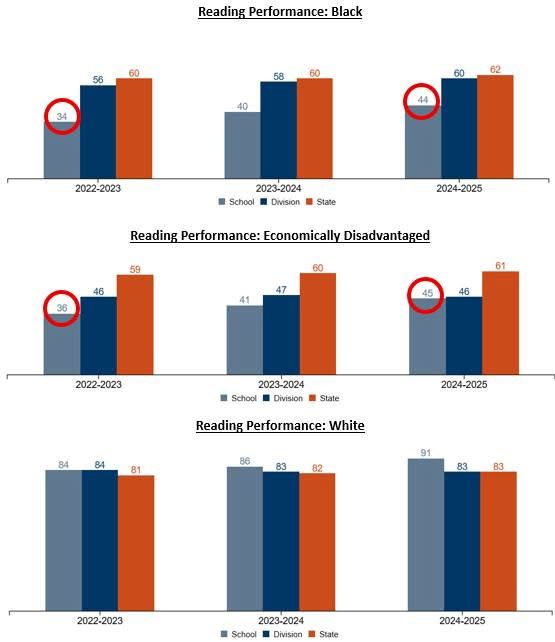
Reading pass rates for Black students at the school rose from 34% in 2022-2023 to 44% in 2024-2025, while pass rates for economically disadvantaged students increased from 36% to 45% over the same period.
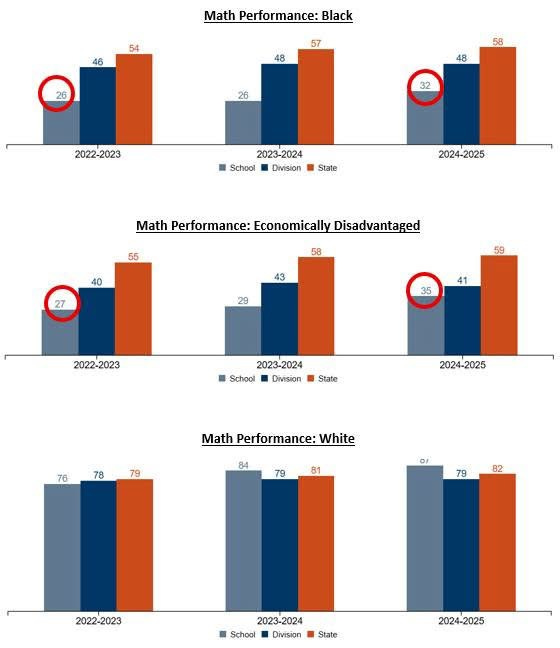
“Jefferson-Houston is Alexandria’s majority-Black, Title I elementary school, located in Parker-Gray — a historically Black neighborhood where Alexandria’s civil rights movement was born,” the statement said. “Closing JH’s elementary program at the very moment this progress is becoming visible would have been counter to equity, counter to the data, and counter to sound decision-making.”
Board member Ashley Simpson Baird pushed back against the open-ended approach, arguing the board should maintain specific project placeholders.
“I think being more specific and signaling our intentions is really important,” Simpson Baird said. “I think that we have the expertise on schools. We know what our schools need in a way that the council just can’t know because they’re not steeped in the work like we are.”
Next steps
Staff will return on Tuesday with revised budget options reflecting the board’s direction. The board will hold a second add/delete work session that evening before final adoption of the 10-year CIP is scheduled for Dec. 18.
Superintendent Melanie Kay-Wyatt presented feedback from middle school principals about operational challenges with potential modular classrooms, including supervision, security, and the logistics of students moving between buildings.
“Their biggest focus was around security and safety and supervision,” Kay-Wyatt said. “I think the ideal for them would be if they were able to keep the students in the building, but they would be flexible.”