
Alexandria secures $600K to update Vision Zero plan two years from deadline
Transportation Commission to hold first public hearing on developer-funded mobility program

Alexandria has secured a $600,000 federal grant to update its Vision Zero Action Plan, according to meeting materials released ahead of Wednesday's Transportation Commission meeting—the first to include a public hearing on the new developer-funded GO Alex transportation program.
The U.S. Department of Transportation Safe Streets and Roads for All planning grant will fund a comprehensive refresh of the city’s 2017 plan, which set a goal of eliminating traffic fatalities and severe injuries by 2028. With that deadline now two years away, the funding will support updated crash analysis, road safety audits of up to three corridors, and development of a high-risk analysis tool for prioritizing investments.
“This funding will allow staff to update the plan using current crash data and trends and to establish a clear path forward for achieving Vision Zero,” Deputy Transportation Director Hillary Orr wrote in a memorandum to commissioners.
Mixed results on safety goals
The city marked a significant milestone when 2023 ended with zero traffic fatalities—the first time Alexandria had achieved that since adopting Vision Zero. Serious injuries also declined from a five-year high of 26 in 2019 to 10 in 2022, according to the city’s FY 2024 annual report, though they rose to 17 in 2023.
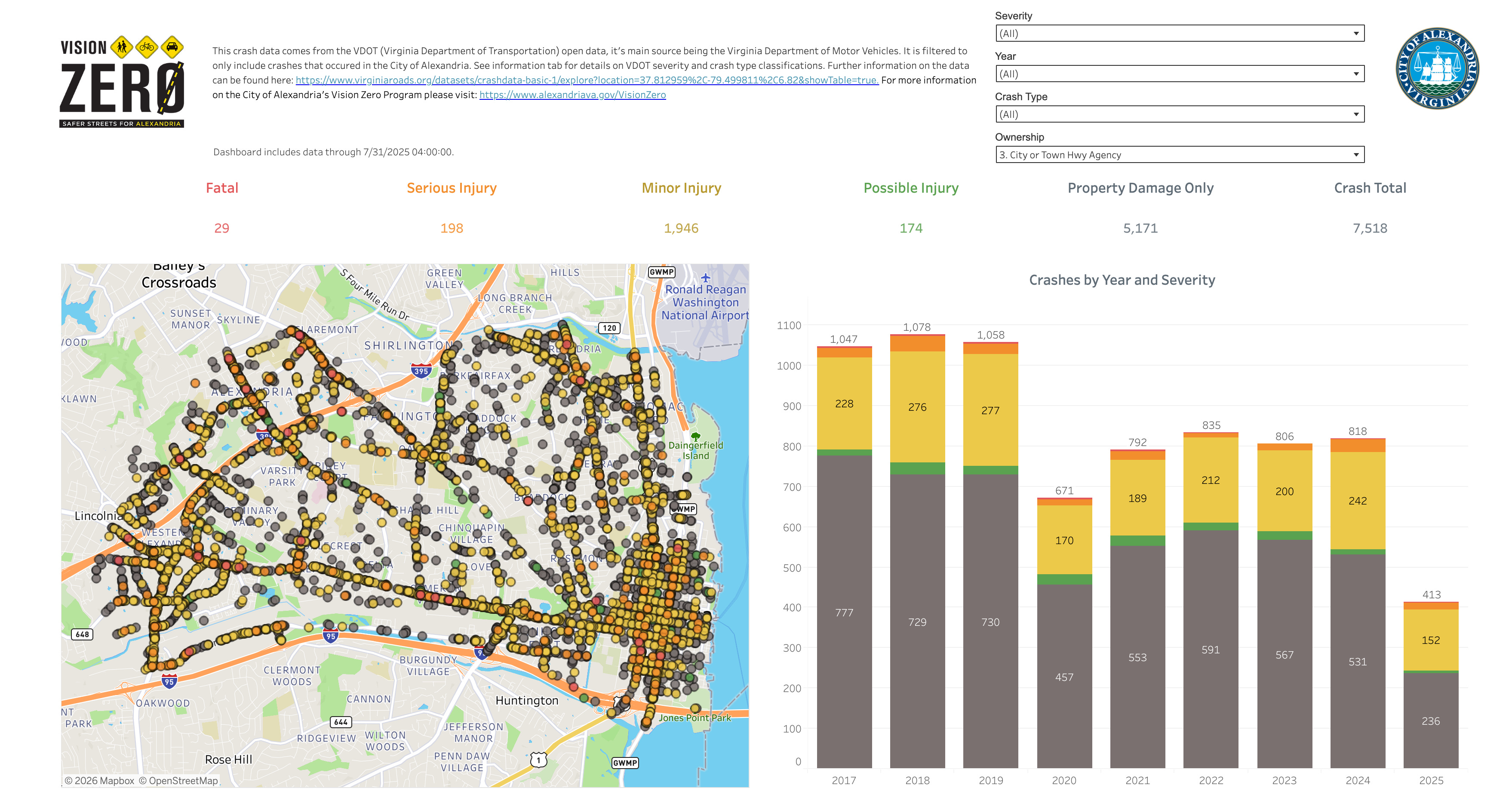
The city’s Vision Zero Crash Dashboard, which draws from Virginia Department of Transportation data, shows 29 fatal crashes and 198 serious injuries on Alexandria streets since 2017 through July 31, 2025. The city has not released an annual report covering 2024 performance.
The FY 2024 report noted that while fatal and severe crashes have trended downward since 2019, “there is still work to do to reach our goal.”
First public hearing on GO Alex Fund
Wednesday’s meeting will feature the first public hearing on the GO Alex Fund budget—a pooled transportation fund created under a policy City Council adopted in May 2023.
Under the policy, most new developments pay into the city-managed fund for 30 years rather than operating individual transportation management programs. Revenue is split evenly between citywide mobility projects and improvements within the Small Area Plan where contributing developments are located.
The fund held $535,000 as of July 1, 2025, according to the docket materials. Staff is proposing $220,000 in expenditures for fiscal year 2026, covering required surveys, grant matches, and bicycle safety education—leaving a $315,000 carryover balance.
Spending remains modest because most developments approved under the new policy have not yet been built. “Since most of the new contributions have not started, the City proposes utilizing the FY 2026 funds on operating expenses,” Orr wrote.
Potomac Yard and Potomac Greens lead the fund’s geographic allocation with $249,565, followed by Potomac West at $66,276.
Regional grants would target bike gaps, Del Ray safety
Commissioners will also hear public comment on two Metropolitan Washington Council of Governments technical assistance applications, each seeking up to $100,000.
One would fund a bicycle network gap analysis to identify missing connections and develop conceptual designs. The other targets safety improvements along Mt. Vernon Avenue between Braddock Road and West Glebe Road, a corridor staff said has experienced “several crashes” and “a high volume of resident concerns.”
The Mt. Vernon Avenue study would examine tactical improvements including painted curb extensions, intersection daylighting, and the feasibility of a business district slow zone. Applications are due February 27, with awards expected in spring.
Bus stop improvements, corridor studies underway
Staff reported that 20 solar lighting units will be installed at priority bus stops citywide in the coming weeks. The lights will activate when dark and brighten as riders approach.
The city is also rebalancing stops along the Old Town Circulator. Current stop spacing averages 598 feet—below the 1,320-foot urban standard recommended by the National Association of City Transportation Officials. Staff proposes removing eight stops and adding five, with parking modifications going before the Traffic and Parking Board this month.
Additionally, the Virginia Department of Transportation is providing technical assistance for a study of Glebe Road between the Arlington border and Potomac Avenue. The effort implements a recommendation from the Arlandria-Chirilagua Small Area Plan, with data collection beginning this spring.
Transit budget pressures noted
Minutes from the December meeting point to potential transit funding challenges. Councilmember John Chapman reported receiving a DASH budget letter citing “challenges with reductions” for the coming year.
Councilmember Kirk McPike noted that the city’s General Assembly legislative package prioritizes WMATA funding, including “significant language” about Metro’s importance to Alexandria and the regional economy.
How to participate
The Transportation Commission meets at 7 p.m. Wednesday, January 21 via Zoom. Registration is available at zoom.us/j/95028234542 (Meeting ID: 950 2823 4542, Passcode: 947959).
Written testimony on the GO Alex budget may be submitted until 3 p.m. Wednesday to Christopher.Ziemann@alexandriava.gov. Public comment will also be accepted at the start of the meeting.
The next meeting is on Wednesday, February 18.