
Autonomous delivery robots launch in Alexandria
Serve Robotics begins Uber Eats deliveries in Del Ray, Old Town North, and nearby neighborhoods

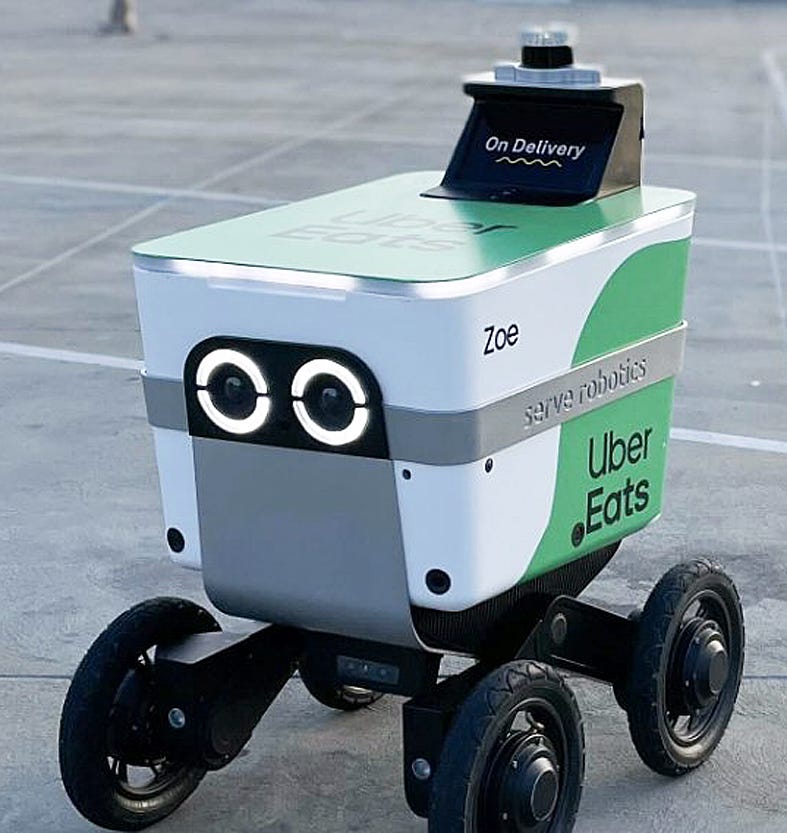
Autonomous delivery robots are now operating on Alexandria sidewalks, making the city the first stop in the company’s expansion into the D.C. region.
Serve Robotics launched this week in Northeast Alexandria, Del Ray, Potomac West, Old Town North, and surrounding neighborhoods, partnering with Uber Eats for food deliveries within a 1.5-mile radius. The robots will not operate on King Street or in certain areas of Old Town.
The company has partnered with more than 80 restaurants in the area.
“We chose Alexandria because the city and the state’s business-friendly environment, as well as the already existing legislation that allows for our delivery robots to operate,” said Yariel Diaz, director of government affairs at Serve Robotics. “That is legislation that was passed a few years back by the Virginia State Legislature and it provides an operating framework that covers the entire state.”
Limited local control
State law, passed in 2017, authorizes personal delivery devices to operate on any sidewalk in Virginia and limits what localities can regulate. Cities can prohibit devices on specific sidewalks if they post signs, but cannot impose their own licensing, registration, or insurance requirements.
The law requires the robots to travel no faster than 10 mph on sidewalks, carry a unique identification number, and yield to pedestrians. Operators must carry at least $100,000 in liability insurance.
In a statement on Friday, the city struck a cautious tone about the launch.
“At this time, the City’s ability to regulate delivery robots is limited under current state law,” said Katye North, division chief of mobility services. “However, the City is reviewing all available options to ensure PDDs operate safely within our community.”
The city created a webpage on Friday with information about what it calls “personal delivery devices” and directed residents to report any issues through Alex311 using the keyword “personal delivery device.”
‘Good neighbors’
Despite not needing city approval, Diaz said Serve proactively reached out to Alexandria’s transportation division before launching.
“Although it’s not a regulatory requirement, we want to be good neighbors,” Diaz said. “We conducted an in-person demo of our technology with the city’s transportation division.”
The company has been meeting weekly with city officials and is integrating into Alexandria’s mobility design specifications program, which will allow the city to monitor robot locations and activity through heat maps.
“We want to continue to expand in the DMV region, and we understand that how well we do in one area” affects the company’s ability to expand elsewhere, Diaz said.
How it works
The robots operate seven days a week, year-round, with exceptions for heavy snow. Each day, robots are deployed throughout the operating area and collected at the end of their shifts to return to a local depot for cleaning, maintenance, and software updates. Local field supervisors monitor weather conditions and decide whether to deploy.
When customers order through Uber Eats from a participating restaurant, they’re notified about the possibility of robot delivery. The robots travel on sidewalks and do not enter buildings or use elevators — customers must meet the robot outside and unlock its compartment using their phone or a code displayed on the robot’s screen.
If a robot completes the delivery, any prepaid tip is automatically refunded, which the company says results in savings of 15 to 20 percent for customers.
Because the company is publicly traded, Serve declined to say how many robots are currently operating in Alexandria, saying only that it deployed “a handful” at launch.
Jobs and expansion
Diaz pushed back on concerns about job displacement, saying the robots handle short-distance deliveries that human drivers often skip.
“When most folks are ordering about a 1 to 1.5-mile radius, they are either not expecting to pay a lot for their order or not expecting to tip a lot for their order,” he said. “So these were rides that were not getting picked up.”
The company also hires locally, Diaz said, including field supervisors and technicians to maintain the robots.
“Success in Alexandria looks like more bots, no or little community concerns in relation to our operations, and just like really, really good working relationship with the city, which we have so far,” Diaz said.
Serve, which spun off from Uber in 2021 and is publicly traded, says it has completed more than 100,000 deliveries nationwide. The company operates in Los Angeles, Chicago, Miami, Dallas–Fort Worth, and Atlanta.
Residents can contact the company at 1-888-711-1178 or contact@serverobotics.com. Each robot also displays a phone number for reporting concerns.
This story was updated Friday, Dec. 12, to include a comment from the city and information about state law governing personal delivery devices.