
Beyer says he'll seek reelection in redrawn 8th District as Spanberger signs redistricting referendum into law
The proposed map would stretch the Northern Virginia seat from Arlington to the Peninsula; voters could decide the map's fate April 21

Rep. Don Beyer confirmed Friday he will seek reelection in Virginia’s 8th Congressional District even as a proposed redistricting map could dramatically reshape the seat he has held since 2015.
Gov. Abigail Spanberger signed a bill Friday officially setting an April 21 referendum on a constitutional amendment that would allow lawmakers to redraw the state’s congressional map ahead of the 2026 midterms, the Virginia Mercury reported. The referendum remains contingent on the Virginia Supreme Court, which is reviewing a Tazewell County circuit court ruling that struck down the amendment last week.
Spanberger called the mid-decade redistricting proposal “temporary and responsive” but stopped short of endorsing the specific 10-1 map Democrats released Thursday evening, the Mercury reported.
In a statement Friday, Beyer acknowledged the proposed map would bring “significant changes to this district and to my constituency,” stretching it from Arlington south to Yorktown — a geographic footprint far larger and more politically diverse than the compact Northern Virginia seat he currently represents.
“Many of its voters will be people I know well and have long represented, while others live in communities I served as lieutenant governor,” Beyer said. “I will work hard to earn the trust of Virginians from Arlington to Yorktown.”
An aggressive map
The proposed map, released after Democrats missed a self-imposed Jan. 30 deadline, would tilt 10 of the state’s 11 congressional districts toward Democrats, who currently hold six seats, the Mercury reported Thursday.
The most significant changes are concentrated in Northern and central Virginia. Districts currently clustered in the state’s northeastern corner — particularly the 8th, 10th, and 11th — would be reconfigured and spread farther south and west. For 8th District voters, that means a seat currently encompassing Arlington, Alexandria, Falls Church, and parts of Fairfax County would extend to the peninsula.
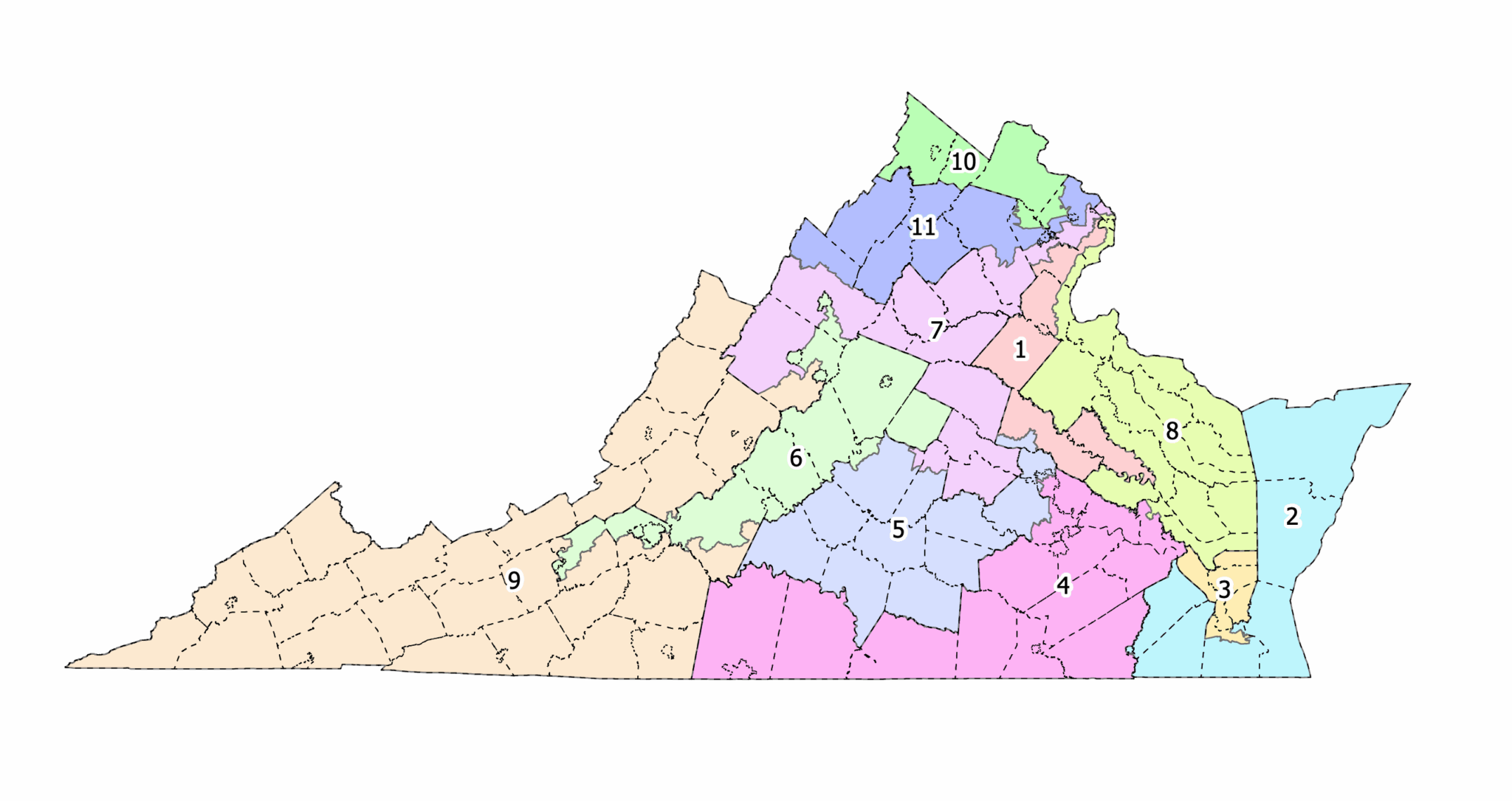
House Speaker Don Scott, D-Portsmouth, and Senate President Pro Tempore Louise Lucas, D-Portsmouth, pitched the proposal as a necessary response to Republican-led redistricting in Texas, North Carolina, Missouri and Ohio.
“These are not ordinary times and Virginia will not sit on the sidelines while it happens,” Lucas said, according to the Mercury.
Republicans denounced the plan. Senate Minority Leader Ryan McDougle, R-Hanover, said Democrats are focused on “political gerrymandering instead of focusing on affordability,” the Mercury reported. House Minority Leader Terry Kilgore, R-Scott, pointed to a cluster of compact districts tied to Fairfax County and asked, “Are we going to Fairfax the rest of Virginia?”
Political analyst Chaz Nuttycombe of State Navigate told Cardinal News the map would likely produce a 10-1 Democratic delegation in a favorable year but is more realistically an 8-3 map — meaning the net gain may be as few as two additional seats beyond what Democrats could win under the current lines.
Cardinal News also noted that five Northern Virginia districts would snake into rural areas under the proposal and that Fairfax County would be split across five districts, arguably diluting rather than expanding the region’s influence.
A tight timeline
The redistricting effort faces a compressed and uncertain calendar. Virginia politicians are barred from fundraising during the legislative session, meaning any campaigning around the April 21 referendum cannot ramp up until the General Assembly adjourns in mid-March, the Mercury reported.
Spanberger said Friday there are “certain restrictions related to our ability to fundraise” around the redistricting amendment and that it “exists in a very different manner” from the other three constitutional amendments she signed the same day — measures to protect reproductive rights, enshrine marriage equality and automatically restore voting rights for people who have completed felony sentences. Those three amendments will go before voters in November.
Scott said he believes the Tazewell County judge “overreached” and predicted higher courts would reverse the ruling. The Virginia Supreme Court is expected to hear arguments later this month.
A crowded primary regardless
Whether the current or redrawn map is in place for the June 16 primary, Beyer faces a crowded Democratic field. Five challengers — including Adam Dunigan, a former CIA case officer and Marine veteran who announced his candidacy Wednesday, along with Michael Duffin, Frank Ferreira, Daniel Gray and Mo Seifeldein — are seeking the nomination. Three Republicans are also running in their party’s primary.
Congressional candidates in Virginia are not required to live in the district they seek to represent, only in the state. It is unclear how redistricting would affect the primary field.