
City Council approves Torpedo Factory franchise ordinance, Duke & Quaker townhomes, and curbside EV charging program
All docket items passed unanimously at Saturday's public hearing

Alexandria City Council approved all items on its Feb. 21 public hearing docket, including a franchise ordinance for the Torpedo Factory Art Center, an 11-unit townhome project near Duke Street, and the city’s new curbside electric vehicle charging program.
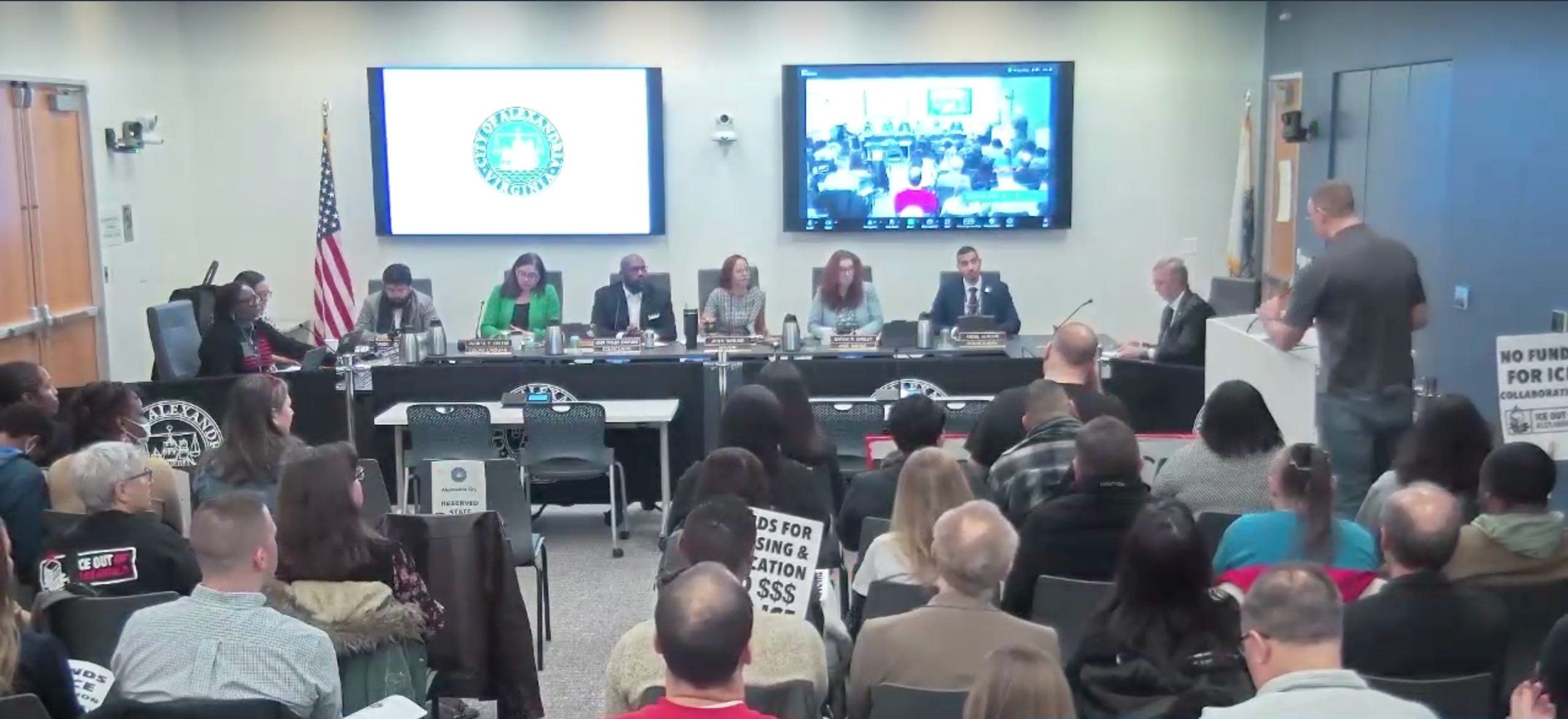
More than 30 public speakers also addressed topics mostly unrelated to docketed items. The largest group urged the council to cut the sheriff’s budget over his office’s voluntary collaboration with ICE. Others testified about conditions and ledger inaccuracies in Alexandria Redevelopment and Housing Authority properties, asked the council to protect funding for Chinese and Latin instruction in city schools, advocated against the proposed conversion of Jefferson Houston Elementary School, and requested increased funding for ALIVE and other nonprofit service providers.
Torpedo Factory franchise ordinance adopted
Council voted unanimously to adopt the franchise ordinance authorizing the city to solicit proposals for a new operator to lease, manage, and operate the Torpedo Factory Art Center at 105 Union St. (Item 15).
The city has managed the waterfront art center on an interim basis since 2016. With the ordinance now adopted, the city will issue a request for proposals with bids due April 27. Staff would present proposals to the council by May 12, with a franchise award anticipated in the third quarter.
One speaker, a Torpedo Factory artist, urged the RFP to go forward but cautioned against requiring a new operator to house the 18th-century, 50-foot ship discovered at the Hotel Indigo site. Mayor Alyia Gaskins said the solicitation does not mandate the ship’s inclusion. She said the city wanted to be transparent with potential bidders that it needs to find a home for the ship and wanted operators to be able to engage in those conversations.
Duke & Quaker townhomes approved with amended condition
Council unanimously approved a rezoning and development special use permit for the Duke & Quaker townhome project at 11 and 21 N. Quaker Lane and 3369 Duke St. (Item 17), with an amendment to the project’s public art condition.
Staff presented new details not available before the hearing. The project would construct 11 townhouse-style units — 10 market rate and one affordable at up to 100 percent of the area median income — in two four-story, 45-foot buildings with four bedrooms and ground-floor garages on a half-acre site. The Affordable Housing Advisory Committee endorsed the plan, noting it would be the first for-sale committed affordable unit with four bedrooms in the city.
The applicant agreed to dedicate approximately 30 feet of the property along Duke Street for the future Duke Street Transitway, the design phase of which is expected to be completed in fall 2027 with operations as early as 2029. The project also includes a $68,000 voluntary affordable housing contribution and $9,000 toward the public art fund.
Councilman John Chapman asked whether the public art contribution could be directed toward a nearby skate park. After discussion among the council, the applicant’s attorney, and the city attorney, the council amended Condition 83 to allow the city manager to direct the contribution toward the skate park or another purpose rather than restricting it to public art.
Gaskins said she wanted arts contributions from projects in the West End to stay in that part of the city. No members of the public spoke on the item.
Traffic was the primary concern during the discussion. The project would generate single-digit vehicle trips in peak hours — below the 50-trip threshold that triggers a traffic study — but council members and the applicant discussed turning movements at the Quaker Lane and Duke Street intersection. The applicant consolidated two southern curb cuts into one in coordination with the adjacent church and agreed to prohibit left turns out of the southern driveway. The Seminary Hills Civic Association supported the project at the Planning Commission but flagged the turning movements as a concern.
Councilman Canek Aguirre asked about connecting the site to an adjacent office complex to give residents access to a signalized intersection, but staff said an eight-foot grade difference made it impractical.
The applicant noted stormwater plans met water quantity requirements on site, but achieved only 73 percent of water quality requirements, with the remainder offset by purchasing nutrient credits. The shortfall resulted from dedicating land for the transitway right-of-way, which reduced the area available for stormwater management.
Curbside EV charging and other consent items
Council approved consent items 5 through 14 in a single vote, with Items 7 and 15 pulled for individual hearings.
That included the curbside electric vehicle charging program (Items 9 and 14), which allows private vendors to install up to 60 publicly accessible chargers on city sidewalks at no cost to taxpayers under five-year licenses. Chargers are limited to two ports per block, must be at least a quarter-mile apart, and are barred from Duke, King, Washington, Patrick, and Henry streets and Richmond Highway.
Also on consent: amendments to the Upland Park concept plan and development permits in the West End (Item 5); a permit for a single-unit dwelling at 420 E. Windsor Ave. (Item 6); the polling place change for the City Hall precinct (Item 8); the Green Building Plan implementation ordinance (Item 13); and the Old Town North rezoning, master plan amendment and commercial-to-residential text amendment (Items 10, 11 and 12).
S. Patrick Street gym approved
Council approved a special use permit for an outdoor rooftop workout space at 601 and 619 S. Patrick St. (Item 7), where a health and athletic club is converting the existing building.
A resident of the 600 block of South Henry Street, directly behind the property, raised concerns about noise, lighting and the 24-hour operation. The applicant’s attorney, Duncan Blair, said the building’s west wall facing residences would have an eight-foot solid barrier with all lighting directed downward. The rooftop would close at 11 p.m. per the noise ordinance; the 24-hour operation applies only to the indoor portion.
Legislative subcommittee and closed session
Council appointed Councilman Chapman to fill former Councilman McPike’s seat on the Legislative Subcommittee (Item 16) and convened in closed session for consultation with legal counsel on litigation and matters concerning the council’s budget authority (Item 21).