Council adopts Green Building Plan with compromise 35 EUI target
Alexandria becomes most ambitious in Northern Virginia on building energy standards; will revisit in two years

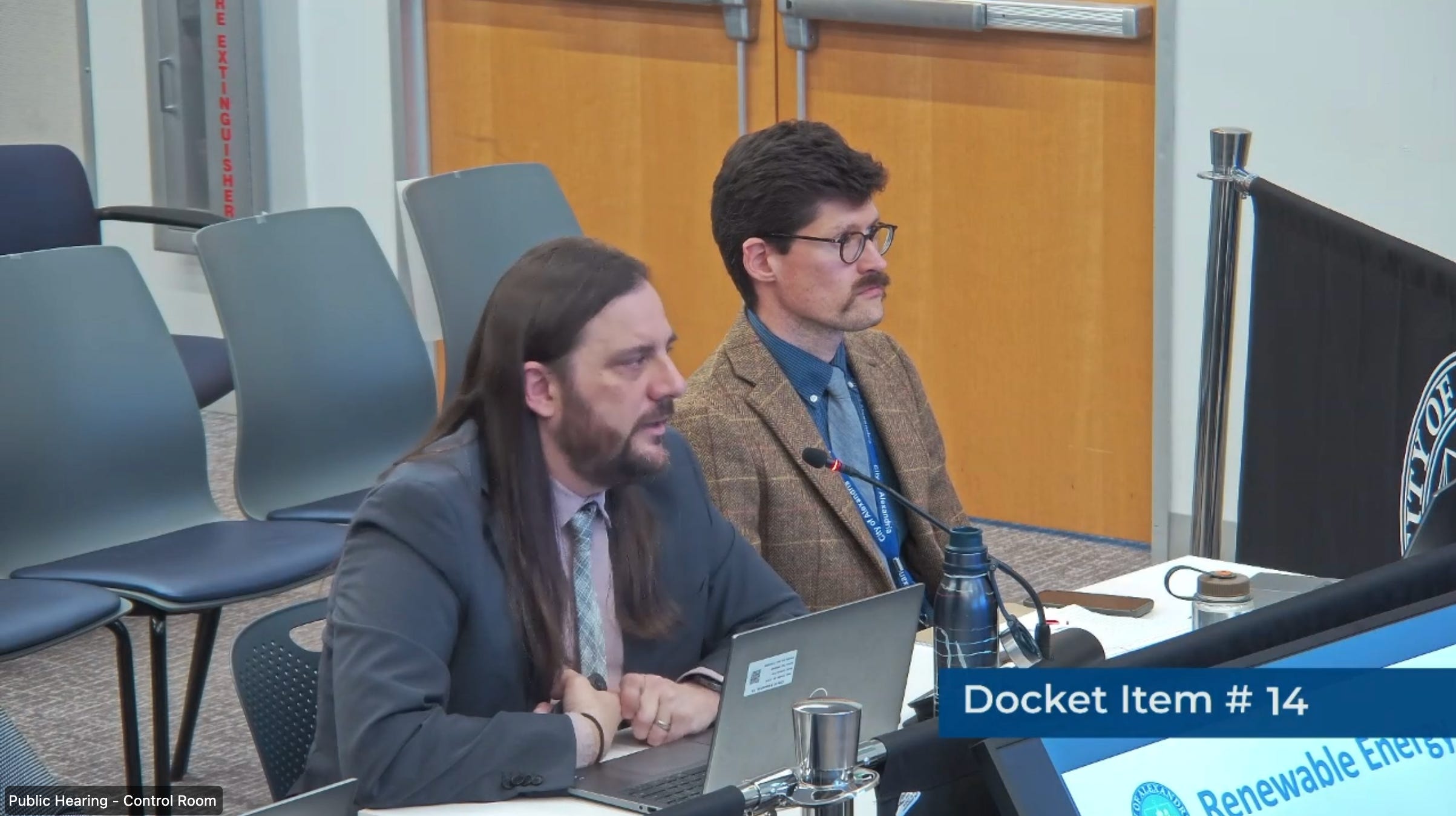
City Council adopted a new Green Building Plan on Saturday that will require new multi-family residential buildings to achieve an Energy Use Intensity of 35, a compromise between staff’s recommendation and a Planning Commission push for stricter standards.
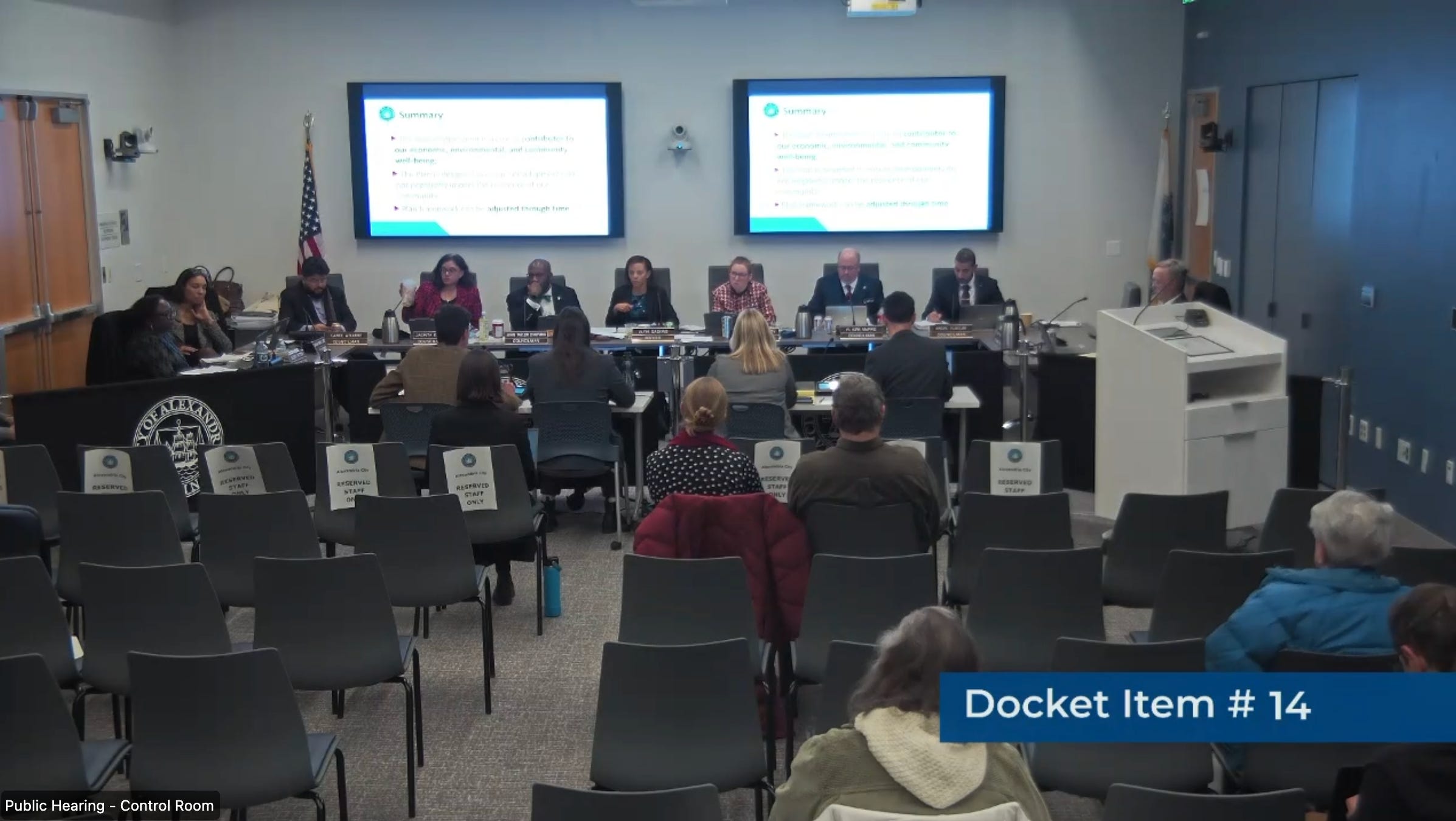
The vote capped more than three hours of public testimony from 28 speakers and extended council debate that laid bare tensions between the city’s climate goals and concerns about housing production.
“I think this is the most speakers I’ve seen in a really long time,” Mayor Alyia Gaskins said.
Staff had recommended an EUI target of 38 for multi-family buildings. The Planning Commission voted 7-0 in January to recommend 30. Council landed in the middle at 35 after Councilman Abdel-Rahman Elnoubi offered a substitute motion.
“Looking at the data, talking to advocates, talking to everyone, looking at the staff report... I came to the conclusion that 30 is very doable for the medium [rise buildings] and for the high rises it’s probably doable, but somewhere in the mid-30s is very doable,” Elnoubi said.
The plan makes Alexandria the most aggressive jurisdiction in Northern Virginia on building energy efficiency. EUI measures how much energy a building uses per square foot annually.
Vice Mayor Sarah Bagley, who had moved the original motion at the staff-recommended 38, acknowledged the compromise after the vote.
“The motion I put on the table was not a loss and would still be relatively bold action decided upon by our staff after two years of analysis,” Bagley said. “38 and a new approach to building in the city is a win.”
But she ultimately supported the substitute motion. “I would not want to see all of this work not move in the direction that I think we want to go.”
Climate vs. housing
The debate exposed a fault line that several council members said they did not want to see become permanent: pitting climate goals against affordable housing.
Councilman John Chapman said he wanted standards that developers could meet without having to trade off other community benefits.
“I do not want to have to have discussions on whether or not we’re looking at an EUI versus affordability and affordable housing set aside,” Chapman said. “That is for me personally, that’s a core.”
Environmental advocates and two high school students urged the council to adopt the Planning Commission’s stricter 30 EUI target, arguing that more efficient buildings protect residents from rising energy costs.
“A recently approved 93,000 square foot affordable multifamily building built to the minimum statewide energy code — 42 EUI — will cost a family of four about $37 more per month in energy than would a 30 EUI building,” said a member of the Faith Alliance for Climate Solutions. “As rates rise, that gap will grow to $75 per month.”
Scott Barstow, a North Old Town resident, criticized the methodology behind staff’s cost estimates, saying they failed to account for air-tight building envelopes that can dramatically reduce energy use without expensive add-ons.
“Without a 30 EUI requirement, they won’t try,” Barstow said of developers. “They’ll just continue giving us gas powered cars with slightly better aerodynamics.”
Developer concerns
Representatives from JBG Smith, one of the region’s largest developers with major investments in Potomac Yard, raised concerns about the achievability of the targets.
Kim Pexton, JBG Smith’s senior vice president of sustainability, said the studies supporting the EUI targets relied on data that was not third-party verified and did not account for current building code requirements, including full electrification and EV charging mandates that increase energy use.
“While targets are set beyond what is practically achievable, the outcome is not better housing, it is less housing,” said Samantha Martineau, also of JBG Smith.
Land use attorney Mary Catherine Gibbs, representing Paradigm Development Company, had warned at the Planning Commission hearing that none of Paradigm’s existing buildings — the city’s second-largest taxpayer — are “anywhere close to 38.”
What passed
Beyond the 35 EUI target for multi-family residential, the council adopted several Planning Commission recommendations:
Lowering the small projects exemption threshold from 25,000 to 10,000 square feet
Directing Planning and Zoning to create a streamlined development review process
Committing to biennial reviews of the standards
Including electrification requirements and EV charging provisions
Council went with staff’s recommendation on renewable energy: requiring 3 percent of a building’s anticipated annual energy use from on-site sources, or a contribution to a Clean Energy Fund capped at $150,000. The Planning Commission had recommended 5 percent with no fund option.
Councilman Elnoubi unsuccessfully sought to remove the $150,000 cap, arguing it would discourage large projects from installing on-site solar.
Council also struck a proposed requirement for pre-occupancy building flushes to address indoor air quality, though it kept requirements for low-emitting materials.
Path forward
Mayor Alyia Gaskins, who guided the discussion but could not make motions, acknowledged the difficult landing.
“I wish we were at a different ending. I don’t like how we got to this ending, but policymaking happens in different ways,” Gaskins said. “In two years, we’ll revisit it and see what happens.”
She added: “If we find out sooner than two years that we have a problem, then I think we need to open it up to figure that out sooner.”
The plan applies to new construction requiring a Development Site Plan or Development Special Use Permit. Buildings account for more than 52 percent of Alexandria’s greenhouse gas emissions.
Climate Action Officer Ryan Freed framed the urgency around both climate change and grid reliability, noting that Dominion Energy projects the region will need to double electrical generation capacity within 20 years.
“Climate change and community resilience are extraordinarily important parts of why the Green Building Plan exists,” Freed said. “It’s getting hotter in Alexandria.”