
Council advances program for up to 60 curbside EV chargers
Private vendors would install and operate chargers at no cost to taxpayers

City Council approved on first reading Tuesday night a new program allowing private vendors to install electric vehicle chargers on city sidewalks — at no cost to taxpayers.
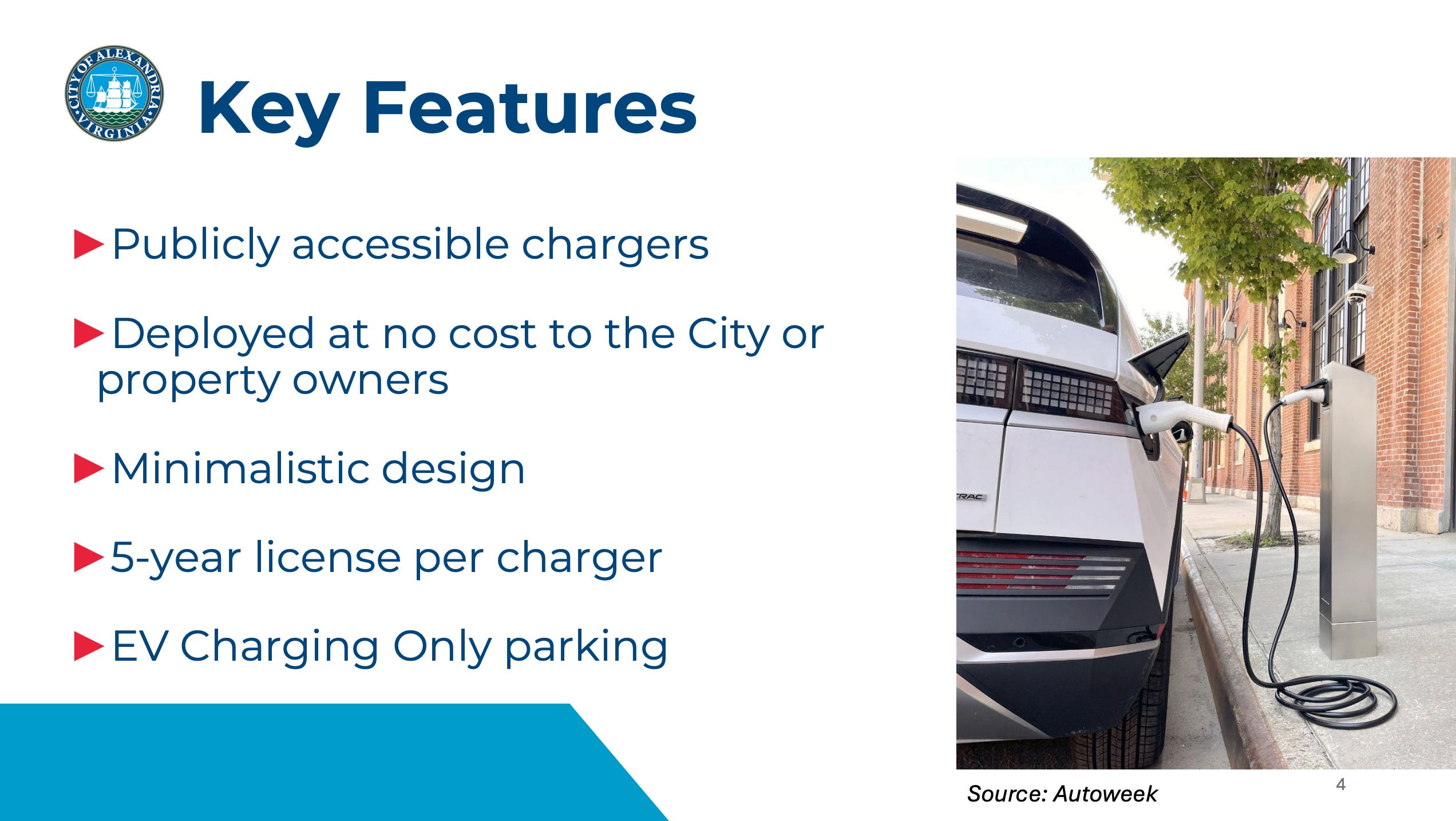
The curbside charging program would allow up to 60 publicly accessible chargers across the city, with a maximum of 20 per vendor. The chargers would have a minimalist design to fit existing streetscapes, with designs in historic districts requiring approval from the Board of Architectural Review.
“The curbside charging program will complement those already ongoing programs,” said Amy Posner, the city’s electric vehicle planner.
The program implements a recommendation from the city’s 2021 Electric Vehicle Charging Infrastructure Readiness Strategy to expand charging options for residents without driveways or garages. U.S. Department of Energy studies show 80 percent of EV charging occurs at home — but that’s not an option for many apartment dwellers.
Alexandria residents are adopting electric vehicles faster than the national average, but the city doesn’t have enough public chargers to meet demand, according to staff. The program is part of the city’s broader effort to meet climate goals: 50 percent of car sales will be electric by 2030 and 100 percent by 2050.
How it works
Vendors would finance, own, and operate the chargers under five-year licenses. The city would charge $1.50 per square foot of occupied sidewalk and $140 per EV charging-only parking space — fees modeled after the public parklet program.
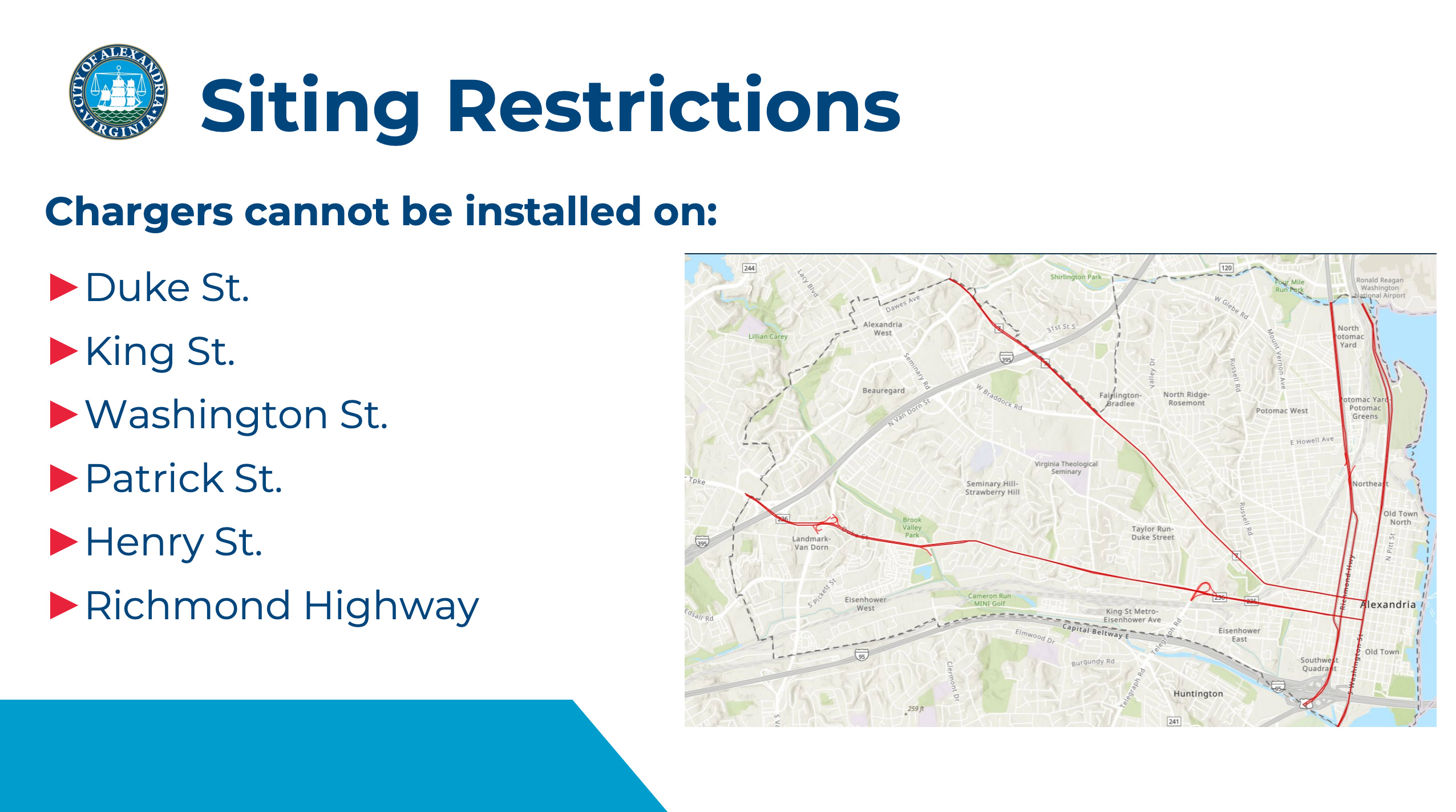
To prevent chargers from clustering in high-traffic areas, the program includes siting restrictions:
Maximum two charging ports per block
Chargers must be at least a quarter-mile apart
Chargers cannot be installed on Duke Street, King Street, Washington Street, Patrick Street, Henry Street, or Richmond Highway
Vendors can request one EV charging-only parking space per charging port. Vehicles must have a charging cable plugged in to use the space, with a $25 fine for violations — the maximum allowed under state code.
Vendors must obtain a letter of support from the property owner or occupant fronted by the proposed space. The city will post a sign for 14 days and provide notice on its website to invite public comment. If concerns are received, the Traffic and Parking Board may hold a public hearing.
Oversight and maintenance
Mayor Alyia Gaskins asked about the city’s ability to hold vendors accountable if chargers malfunction.
Posner said the license agreements include requirements for response times and availability, with termination clauses if vendors fail to meet standards.
“If the vendors are not meeting those requirements, then there are termination clauses for default and there’s remedies we can take with respect to that,” Posner said.
Councilman Abdel-Rahman Elnoubi asked whether top-performing vendors might receive preference for future expansion.
Posner said the city will collect quarterly data on utilization, session times, unique users, and error reports. After issuing licenses for two years, the city will pause to evaluate the program before deciding whether to expand.
Complements other EV efforts
The curbside program joins several other city initiatives:
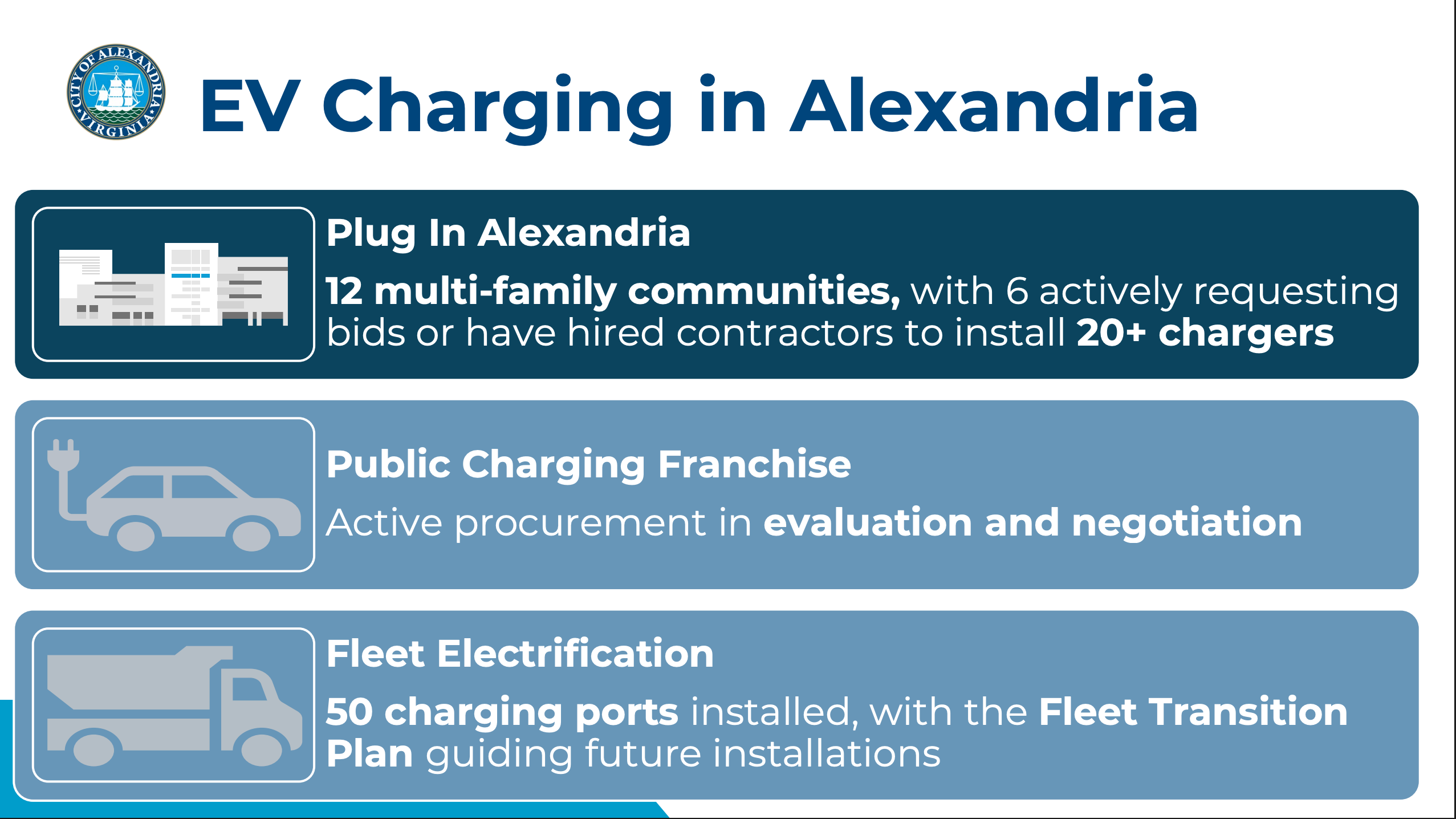
Plug-in Alexandria: Provides incentives to help multifamily buildings install chargers. Twelve communities are participating, with six actively requesting bids or hiring contractors to install more than 20 chargers.
Public charging franchise: Under negotiation, would allow a vendor to install chargers at city parking lots, rec centers, and libraries at no cost to the city.
Fleet electrification: The city has installed 50 charging ports for its own vehicles.
Councilman Canek Aguirre thanked staff for working to standardize charger designs.
“The more we could try and standardize, hopefully the industry will try and do the same,” Aguirre said. “It doesn’t make sense if we have a 15-foot charger and a 5-foot charger and everything in between.”
The Traffic and Parking Board reviewed the program requirements in December. The ordinance is scheduled for second reading and public hearing on Feb. 21.