
Council candidates back Braddock Road project, bike safety investments
Five Democrats competing in Feb. 21 firehouse primary respond to BPAC questionnaire

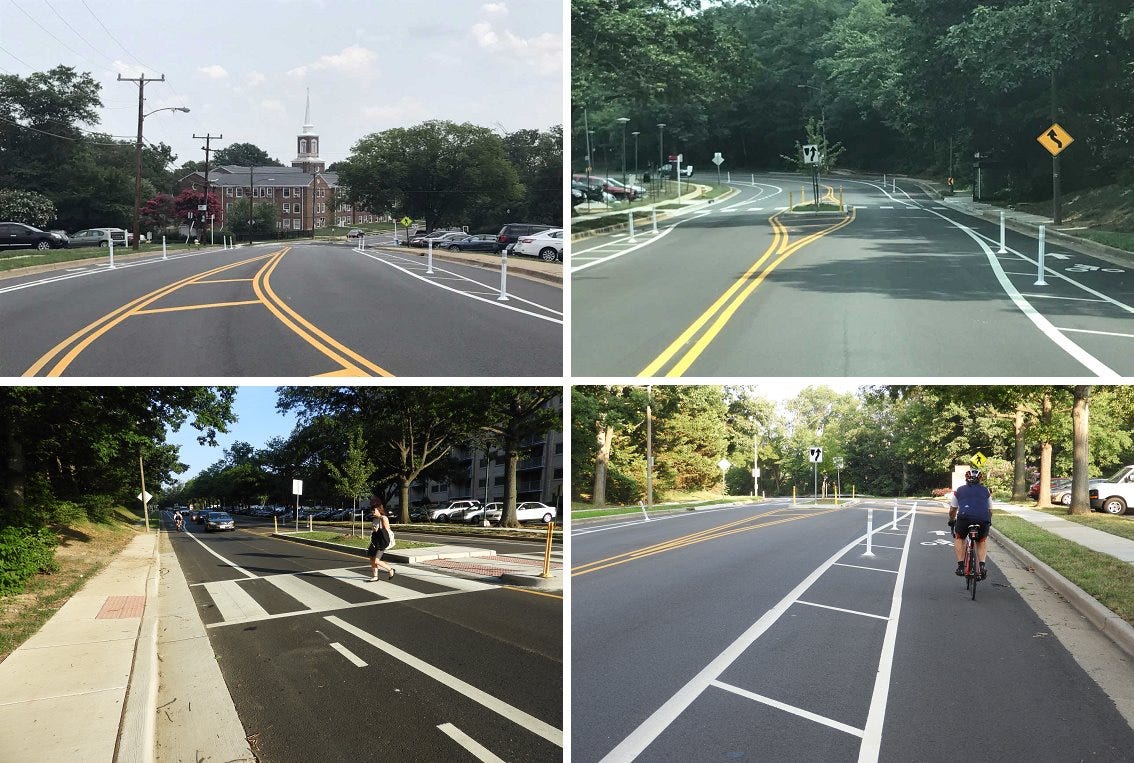
All five candidates for Alexandria City Council say they support the planned Braddock Road Complete Streets project and would back investments in pedestrian and bicycle infrastructure, according to questionnaire responses submitted to the Alexandria Bicycle and Pedestrian Advisory Committee.
BPAC is a volunteer-run nonprofit that promotes walking and biking in Alexandria. The organization does not endorse candidates but invited all five to respond to its questionnaire.
The candidates — Sandy Marks, Tim Laderach, Roberto Gomez, Charles Costen-Sumpter and Cesar Madison Tapia — are competing in a Feb. 21 firehouse primary for the Democratic nomination to fill the seat vacated by Kirk McPike, who won election to the House of Delegates on Tuesday.
The Braddock Road project, which would add protected bike lanes and safety improvements, requires tradeoffs between parking and vehicle capacity. Mayor Alyia Gaskins said at a Rosemont Citizens Association meeting last month that the project would not come before the City Council unless appealed after the Traffic and Parking Board's decision.
All five candidates said they would support the project.
“Prioritize life over convenience,” Laderach wrote. “Approve the plan as proposed.”
“Keeping Alexandrians safe and alive has to be the primary goal,” Marks wrote.
“Safety for people walking and biking must be a core priority,” Costen-Sumpter wrote.
“I support moving forward with safety improvements on Braddock Road,” Gomez wrote, noting that VDOT has designated the corridor as a top statewide priority for pedestrian and bicycle safety upgrades.
Tapia said he would “approach it thoughtfully, looking closely at the safety data, listening to residents, and keeping the long-term goal in mind: a corridor that works for everyone, not just for cars passing through.”

Speed cameras
All five candidates said they would support expanding automated speed camera enforcement beyond school zones to corridors like Duke Street and Seminary Road, though several emphasized the need for transparency and equity.
“Speed is one of the biggest factors in serious injuries and fatalities,” Tapia wrote. “I do think it’s important that they’re used transparently, with a clear focus on safety, not revenue.”
Gomez said he would want to see “a data-driven approach that targets the most dangerous stretches where speeding is a documented problem.”
Laderach said equity is “top of mind” and that he would want cameras implemented “in a way that is strictly data driven, not income driven.”
Connected bike network
All five candidates identified the lack of a connected bike network as a significant barrier to more cycling in Alexandria.
“A lot of people would bike more if they didn’t feel like the route suddenly drops them into traffic,” Tapia wrote.
“Most people aren’t going to bike if they have to navigate high-speed traffic on dangerous roads to complete their trip,” Gomez wrote, adding that “safety shouldn’t depend on which neighborhood you can afford to live in.”
“A great sidewalk or bike lane that suddenly disappears isn’t just inconvenient — it can be unsafe, especially for new riders or families,” Marks wrote.
Laderach said the lack of connectivity “makes biking a hard-sell idea to everyday people, because people can’t see themselves biking with existing conditions.”
Personal experiences
The candidates shared personal experiences that shaped their views on pedestrian and bike safety.
Marks wrote that her younger son “was hit by a slow-moving car in our neighborhood a few years ago — even though he did everything right, even though he was being careful, even though adults were nearby. That experience stays with you.” Her 17-year-old, she said, “bikes everywhere and has put off driving because he feels more confident navigating Alexandria on a bike than behind the wheel.”
Costen-Sumpter, who does not currently own a bike, wrote that he walks the Holmes Run Trail about four times a week. He grew up in New York City, where “walking and public transportation were simply how you got around,” but felt he needed a car after moving to Alexandria in 2010 because transit options were limited.
Laderach, who lives in Del Ray, wrote that he lives “next to a large paved intersection that has a poorly designed crosswalk and where bikes have been hit by cars.”
Gomez, who runs the Cornerstone Craftsman youth trades program, wrote that he has “walked with students from our program who don’t have cars and seen how hard it is to get around safely.”
Tapia wrote that his experience depends on location: “In some areas, walking feels calm, well-designed, and welcoming. In others, especially along wider or faster roads, it can feel uncomfortable and even risky.”
What’s next
The firehouse primary is Saturday, Feb. 21, from 8:30 a.m. to 7 p.m. at Beatley Library and Chick Armstrong Recreation Center. Only registered Democrats who live in Alexandria may vote.
The special election is expected to be held April 21, the same date as a statewide redistricting referendum. The Alexandria Republican City Committee has not yet announced a candidate.
The full questionnaire responses are available at alexandriabpac.org.
People can still drive. This will calm traffic for all on a road with speeding, which is inherently dangerous even if we were fortunate in one 4 year period (we require smoke detectors even in buildings that never had a fire) Some prefer driving on traffic calmed roads.
I dont know of any evidence saying most Alexandrians believe that everyone is entitled to a parking space right in front of their home. Thousands do not have that, whether they live in apartments (where parking spots are typically further) or in historic townhouses. I dont have data on it, but id suspect that less than 50% have such a proximate space. Im also not aware of any City policy suggesting every unit must have one.
It appears the candidates did not review City safety data before responding to questions about the Braddock Road Corridor Improvements Project. Between Russell Road and Commonwealth Avenue, there were zero crashes between 2018-2022. The existing shared bike lanes have been working well for that section of Braddock Road.
https://www.alexandriava.gov/sites/default/files/2023-11/SRTS%20-%20Walk%20Audit%20-%20Report%20-%20GWMS%20-%20final.pdf
Everyone is in favor of safety, but there are considerations on the other side of the equation. Residents should be able to park near their homes. Good Shepherd Lutheran Church should have handicap parking spaces that are proximate to the church entrance. No one wants to sit in traffic.
It is disappointing that the candidates do not respect the overwhelming majority of Alexandria residents who say they do not and will not ride bikes.
According to 2023 Resident Transportation Needs Assessment, 80% of residents effectively never use a bike (75% "Never", 5% "One Time") and
50% of residents explicitly agreed with the statement: "I do not want to use a bicycle as a means of transportation".
In contrast, 73% of residents rely on a private vehicle as a driver on a weekly or daily basis.
There are lots of good reasons why not everyone can or wants to ride bikes: age, children, need to transport lots of large or heavy items and many more.
When the streets get backed up and gridlocked, cars burn more fuel and emissions go up, too.
Candidates should dig deeper into the Braddock Road issues and not simply repeat ideas floating across the city.