
Court of Appeals affirms dismissal of challenge to 48-unit Old Town residential project
Published opinion holds Alexandria zoning ordinance does not require commercial use for higher-density special use permit; second court defeat for density opponents in three months

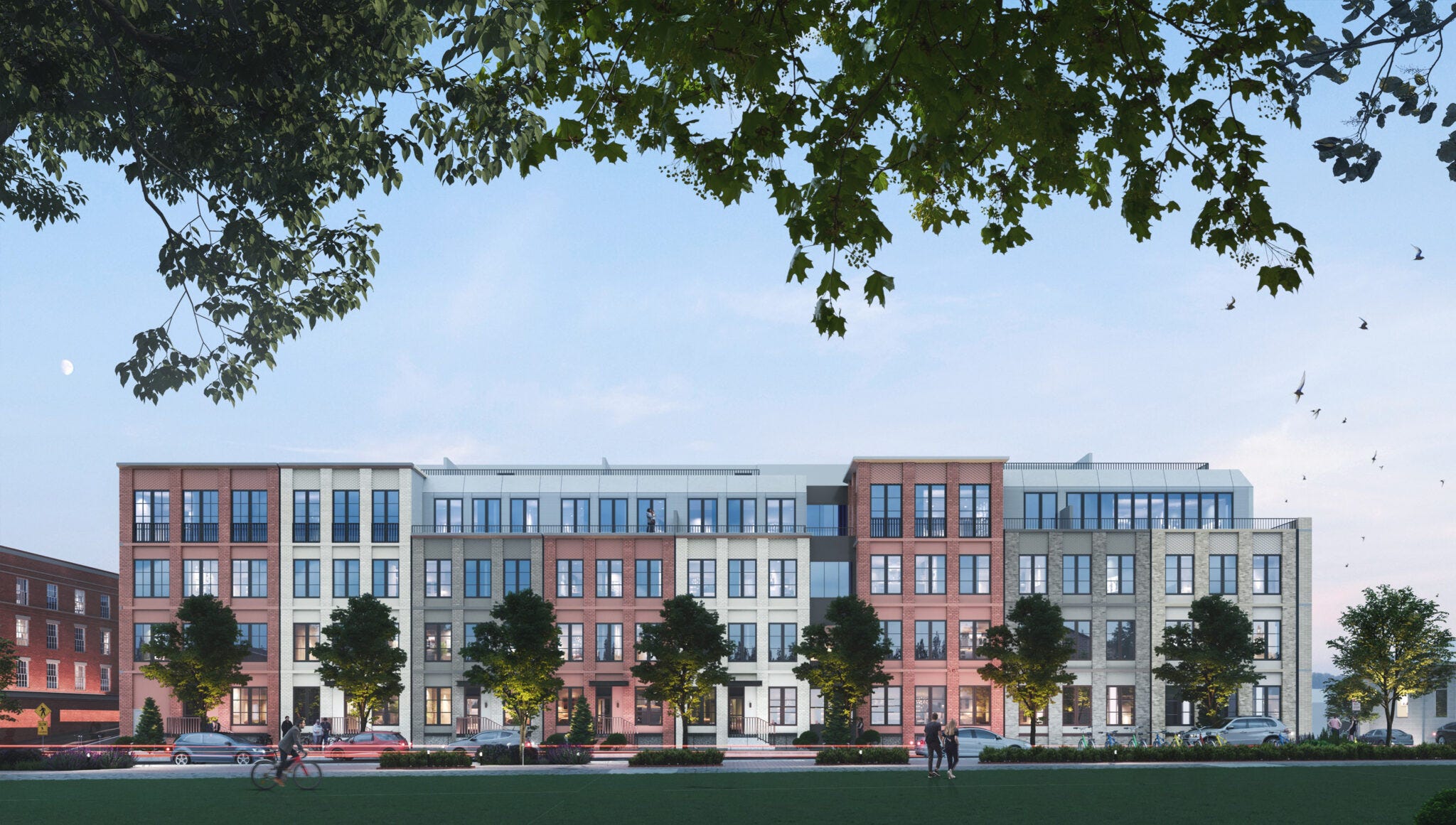
The Court of Appeals of Virginia ruled Tuesday that Alexandria’s City Council acted within its authority when it approved a special use permit allowing a 48-unit residential building at 301 North Fairfax Street with a floor area ratio of 2.5 — double the baseline permitted for single-use developments.
The opinion by Judge Vernida R. Chaney, joined by Chief Judge Marla Graff Decker and Judge Daniel Ortiz, affirms a circuit court decision dismissing a complaint brought by neighboring landowner Scott Corzine and six other property owners who argued the City Council exceeded its authority under Alexandria Zoning Ordinance § 5-305.
The ruling marks the second time in less than three months that a court has sided with Alexandria against residents challenging the city’s approach to housing density. In November, Circuit Court Judge H. Thomas Padrick Jr. granted summary judgment in favor of the city in a separate lawsuit challenging the Zoning for Housing initiative’s elimination of single-family-only zoning. The plaintiffs in that case, Burks v. City of Alexandria, filed a notice of appeal in December and are currently fundraising to cover legal costs.
Tuesday’s opinion is designated as published, giving it precedential value — meaning it will guide future cases interpreting similar zoning provisions across Virginia. The court noted the case presents a matter of first impression.
The dispute
The case centered on whether Alexandria Zoning Ordinance § 5-305 permits a wholly residential development in the city’s Commercial Residential Mixed Use High zone to receive an SUP authorizing a FAR of up to 2.5.
The property at 301 North Fairfax Street, at the corner of Queen Street in Alexandria’s Old and Historic District, currently contains a three-story office building constructed in 1977. The property owners, William Thomas Gordon III and his son William Thomas Gordon IV, purchased it for $4.6 million in 2014. The developers, 301 N. Fairfax LLC and 301 N Project Owner LLC, proposed demolishing the office building and replacing it with a four-story, 48-unit residential building with 67 below-grade parking spaces and a rooftop terrace. The project contains no commercial use.
More than two years after the City Council approved the project, the project’s architect, Winstanley Architects & Planners, still describes it as “proposed.”
City Council voted 6-1 in January 2024 to approve the SUP and rezone the property from Commercial Downtown to CRMU-H. Councilor John Chapman dissented. An online petition opposing the project had drawn more than 900 signatures, and the council deferred its initial vote from December 2023 to January 2024 after the opposition triggered a protest petition requiring a supermajority for approval.
Corzine and neighboring property owners filed suit in February 2024, represented by Blankingship & Keith, P.C. They argued that § 5-305 limits wholly residential developments to a FAR of 1.25 under subsection (A) and that subsection (C) — which allows a FAR of up to 2.5 with an SUP — applies only to developments that include commercial use.
Alexandria Circuit Court Judge Lisa Kemler sustained the defendants’ demurrers and dismissed the complaint with prejudice in May 2024. Corzine appealed, with new counsel — Michael J. Finney and Monica T. Monday of Gentry Locke — representing the appellants before the Court of Appeals.
The court’s reasoning
The Court of Appeals found that the structure of § 5-305 makes the answer clear.
The ordinance’s opening sentence states that the permitted FAR “depends on whether a single use or mixture of uses is proposed and whether a special use permit is sought.” The court found this sentence provides a “clear roadmap” based on two considerations: the type of use and whether an SUP is sought.
Under that framework, subsection (A) applies to single-use developments that do not seek an SUP, limiting FAR to 1.25. Subsection (C) applies when an applicant seeks an SUP to exceed that baseline. The court held that once the developers obtained the SUP, subsection (A) no longer controlled.
The owners argued that subsection (C)’s reference to “the commercial use” presupposes the existence of commercial use and therefore excludes wholly residential projects. The court disagreed, finding that subsection (C) sets three eligibility criteria: at least 50% residential floor space, commercial FAR not exceeding 1.25, and an approved SUP.
“A commercial FAR of 0 does not exceed 1.25,” the court wrote. “The second eligibility criterion is therefore satisfied.”
The court also found that the subsection’s introductory phrase — “Mixed use or residential/SUP” — reinforces its interpretation, whether treated as operative text or merely a heading used as an interpretive aid. The owners had argued the phrase should be disregarded, but the court noted that the owners simultaneously relied on a parallel italicized phrase in subsection (D), “Continuum of care facility,” as informative — making their position internally inconsistent.
The owners additionally argued that a separate ordinance provision requiring compliance with the “most restrictive” zoning requirement in cases of conflict should limit the FAR to 1.25. The court found no conflict exists between the subsections, as they apply to different situations: subsection (A) to single-use developments without an SUP, and subsection (C) when an SUP is sought.
Broader context
The decision arrives amid an aggressive push for housing production in Alexandria and across Virginia.
In November 2023, the City Council unanimously approved the Zoning for Housing/Housing for All initiative, eliminating single-family-only zoning and allowing buildings with up to four units in any residential neighborhood. That decision drew its own lawsuit from a group of Old Town residents. Judge Padrick ruled in the city’s favor in November 2025, and the Coalition for a Livable Alexandria — which organized opposition to the changes and reported $252,000 in total litigation expenses — filed a notice of appeal in December. The coalition announced in January that it needs to raise $28,000 by Feb. 27 to fund the appeal.
Mayor Alyia Gaskins told residents at a Rosemont Citizens Association meeting last month that the Zoning for Housing initiative’s implementation has been slower than anticipated, in part because the litigation deterred property owners from pursuing projects under the new rules.
At the state level, the 2026 General Assembly session is underway with housing as a top priority for Governor Abigail Spanberger’s administration. Two Spanberger-backed housing bills passed the House of Delegates on Monday. Senator Schuyler VanValkenburg, D-Henrico, has introduced legislation that would legalize residential development in commercially zoned areas and set housing production targets for localities. Delegate Josh Thomas, D-Prince William, has proposed addressing how neighbors can legally challenge new developments — the kind of challenge that consumed more than two years and multiple levels of court proceedings in this case.
It was not immediately clear Tuesday whether Corzine and the neighboring owners plan to seek further review from the Supreme Court of Virginia.
Travis S. MacRae, senior assistant city attorney, represented the City Council and City of Alexandria. Matthew A. Westover of Walsh, Colucci, Lubeley & Walsh represented the developers.