
Every major metro in America is adding jobs except the one Alexandria calls home
New federal data shows DC region alone in decline as city where 1 in 5 workers are feds enters budget season

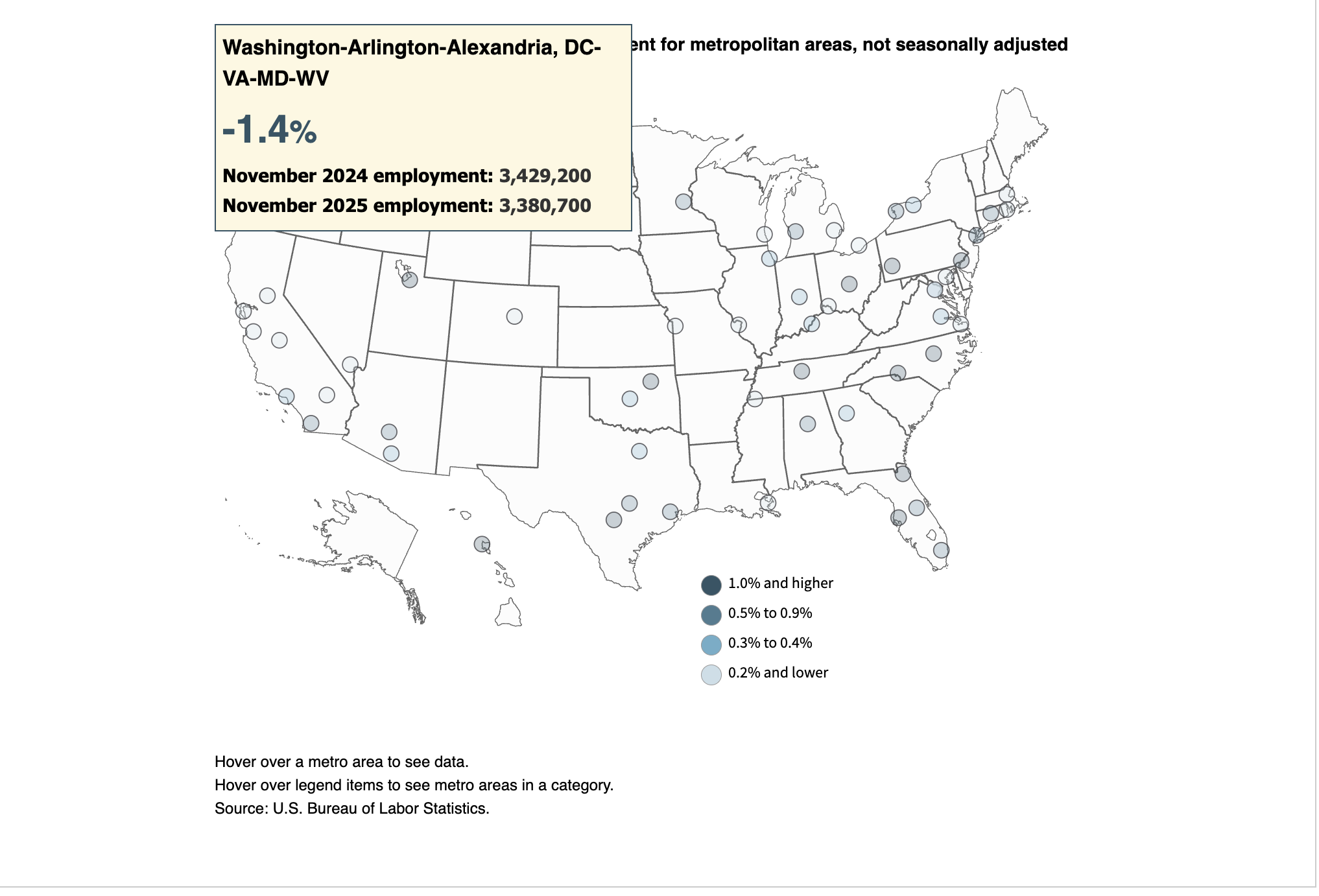
Two weeks after City Manager James Parajon warned Alexandria’s City Council about accelerating federal job losses, new data from the Bureau of Labor Statistics confirms the worst: the Washington-Arlington-Alexandria metropolitan area is now the only large metro in the United States experiencing job decline.
The BLS reported Tuesday in its Metropolitan Area Employment and Unemployment release that the DC metro lost approximately 48,500 jobs between November 2024 and November 2025 — a 1.4 percent drop. Among the nation’s 56 metropolitan areas with populations exceeding one million, it was the sole region to post a decline. Every other large metro was either growing or flat.
The BLS also released state-level employment data showing the District of Columbia lost 32,400 jobs over the year — a 4.2 percent plunge that made it the only jurisdiction in the country to see employment fall. DC’s unemployment rate now stands at 6.7 percent, the highest in the nation, up 1.4 percentage points from a year ago. Maryland’s unemployment rose 1.1 percentage points to 4.2 percent, and Virginia’s climbed 0.7 percentage points to 3.6 percent.
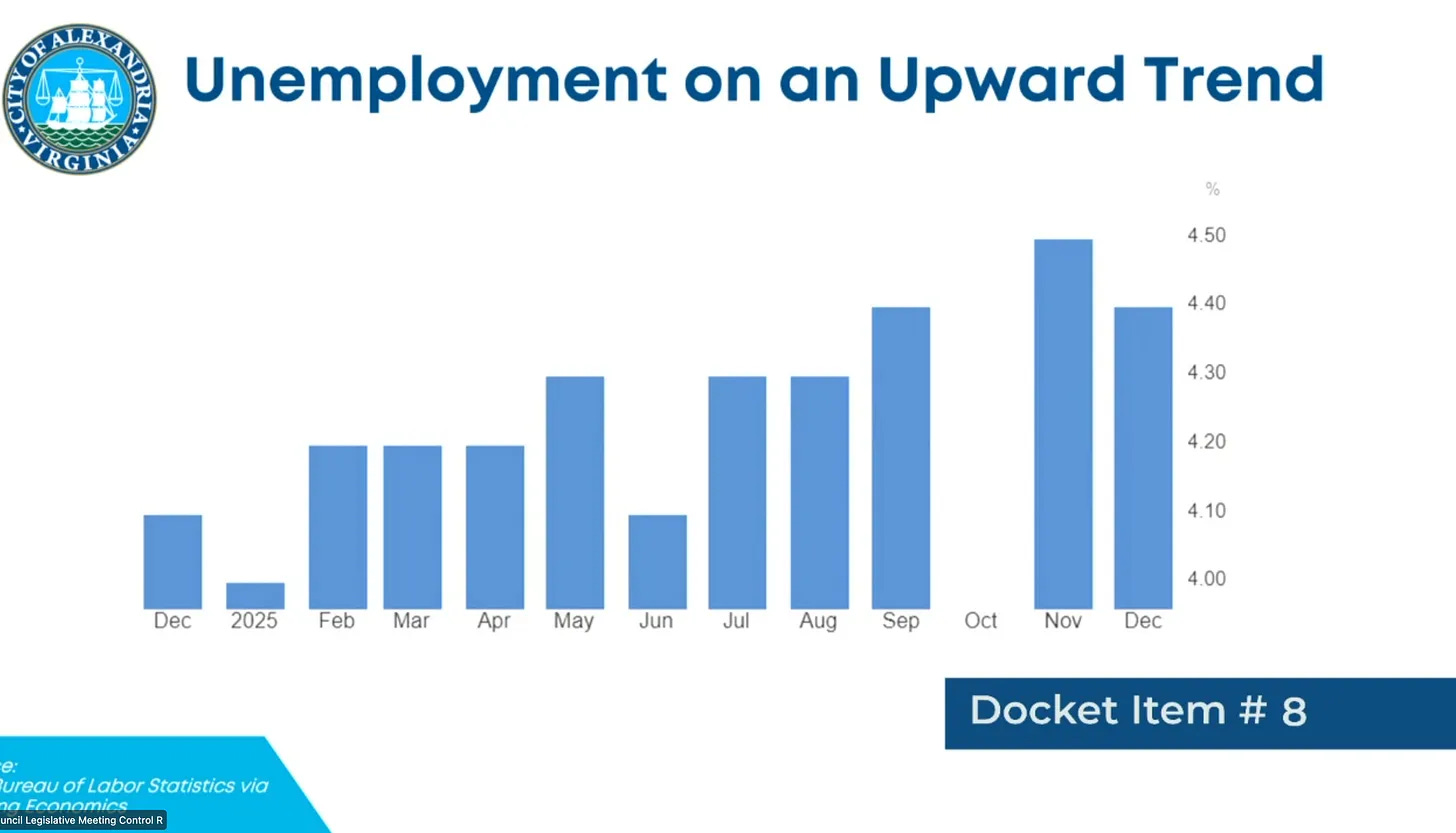
A third BLS release, the Job Openings and Labor Turnover Survey, showed Virginia experienced one of the nation’s largest increases in worker separations, with 37,000 additional separations in November — the third-highest figure nationally behind Georgia and Tennessee.
Alexandria’s exposure
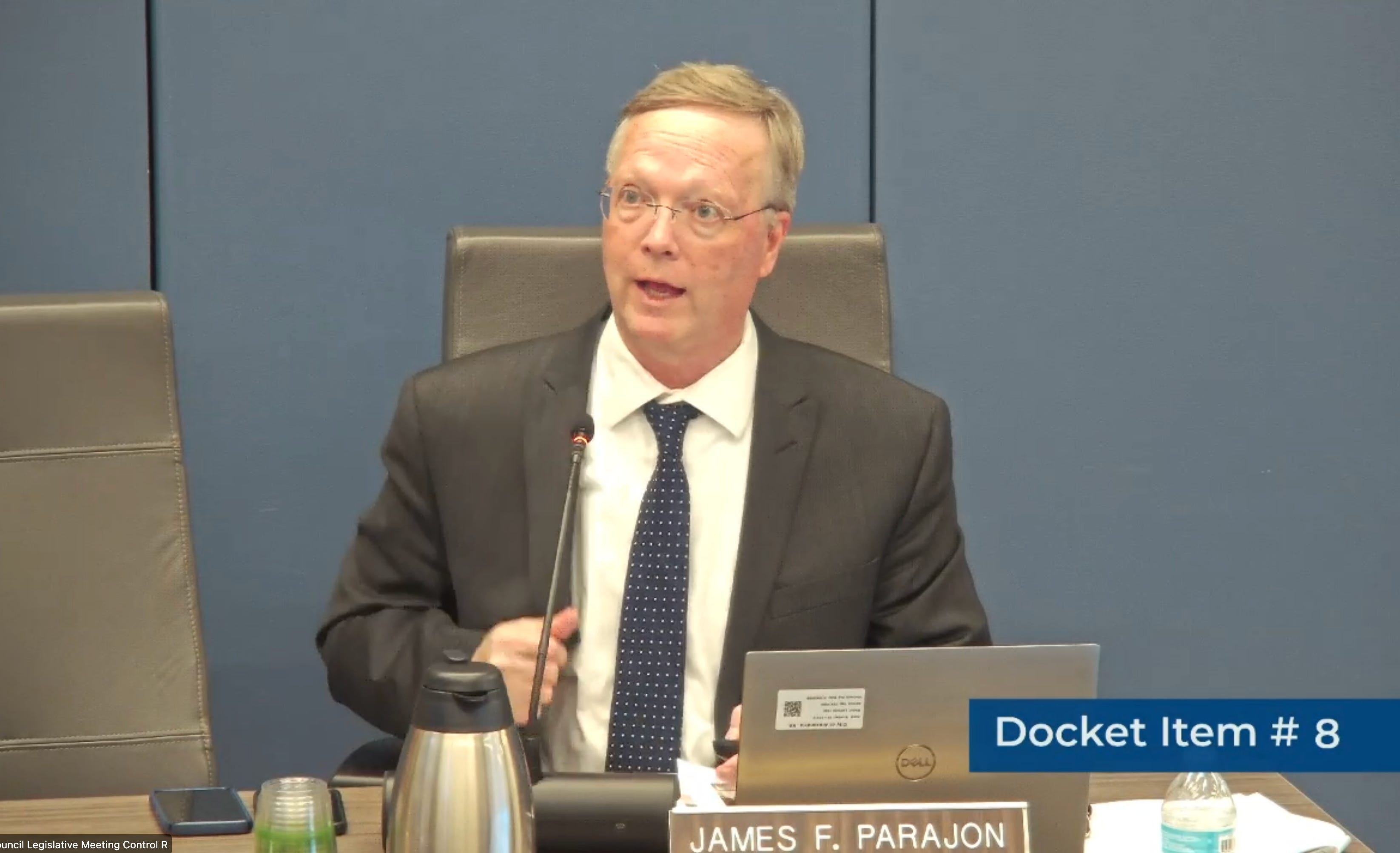
The data validates concerns Parajon raised on January 13, when he reported federal employment had fallen by 277,000 positions nationally — roughly 9 percent — since January 2025.
“There is continued uncertainty, primarily related to some of the federal administration policies and practices,” Parajon told the Council. “That uncertainty has manifested itself particularly in the money markets, the capital markets that really fuel much of our economy.”
Alexandria faces outsized risk. Clark Mercer, executive director of the Metropolitan Washington Council of Governments, told the City Council last March that 20 percent of the city’s workforce holds federal jobs — well above the Northern Virginia average of 12.5 percent. Approximately 13,000 federal employees call Alexandria home.
The ripple effects extend beyond government paychecks. Mercer reported that the Northern Virginia Chamber of Commerce found 70 percent of regional hospitality business is tied to the federal government. The Restaurant Association of Washington reported that 40 percent of its members anticipated going out of business in 2025, and Mercer noted a 10 percent federal workforce reduction would deal a $300 million blow to the restaurant industry alone.
Housing and budget pressure
Signs of stress are already visible in the local housing market.
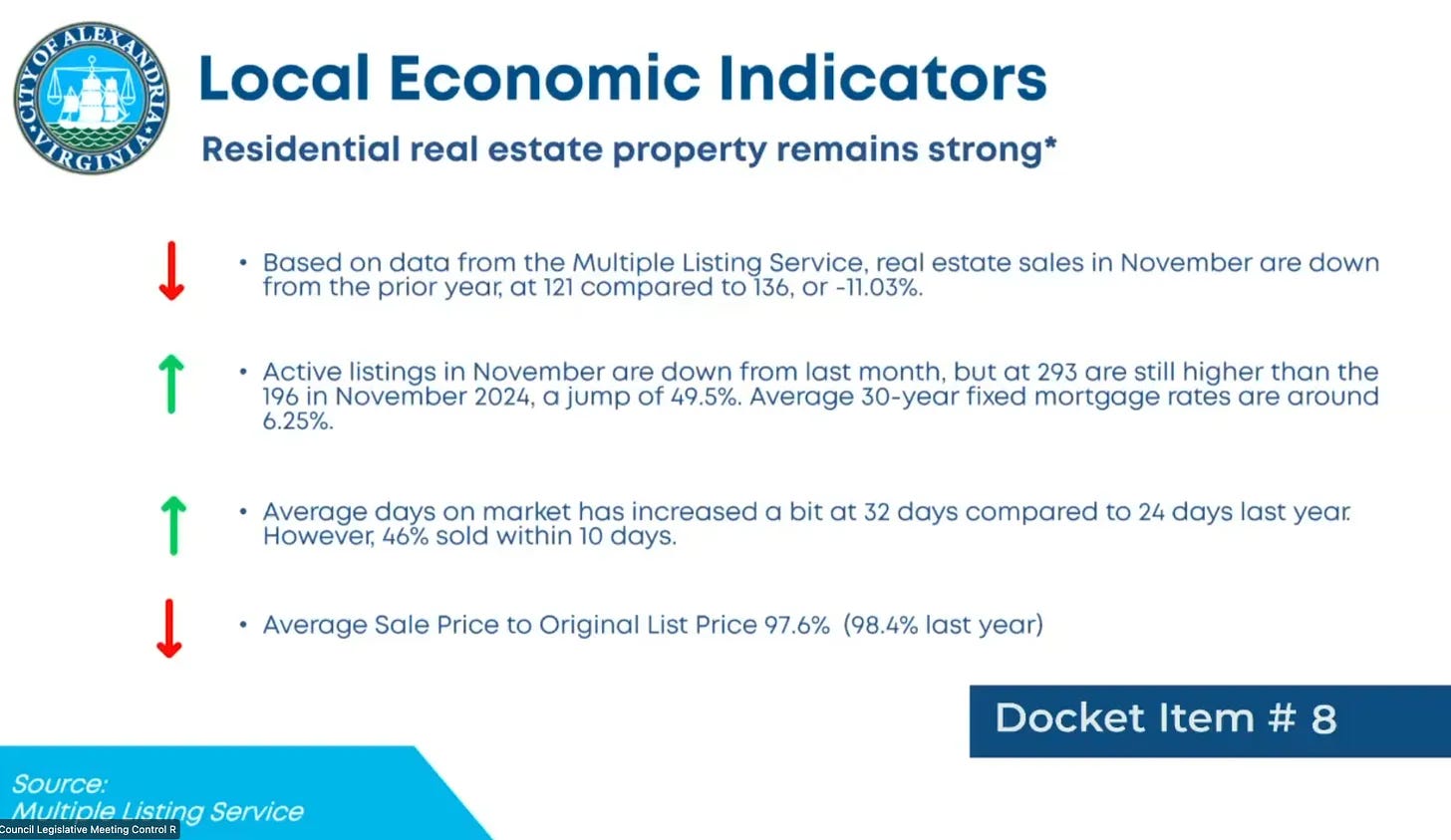
Parajon reported earlier this month that November home sales fell 11 percent year over year, while active listings jumped nearly 50 percent. Homes are sitting on the market longer — averaging 32 days compared to 24 days a year ago — and selling for less relative to the asking price.
That trend carries direct budget implications. More than 60 percent of Alexandria’s operational revenue comes from property taxes, with residential properties accounting for roughly 80 percent of that total.
“People particularly are concerned about their financial well-being and their job prospects or job security,” Parajon said. “That to me is one of the key elements because that’s where locally we’ll see less spending.”
National context
The federal workforce reductions stem from the Trump administration’s Department of Government Efficiency initiative, which has overseen the departure of more than 300,000 federal employees since January 2025. Devin O’Connor, a senior fellow at the Center on Budget and Policy Priorities, told KCUR it represents the largest peacetime workforce reduction in over 75 years. “You’d have to go back to the demobilization that followed World War II to see a faster reduction of federal workers of this scale,” he said.
The Richmond Federal Reserve reported that federal unemployment insurance spending increased 215 percent in Virginia and 543 percent in Washington, D.C., compared to the same period in 2024.
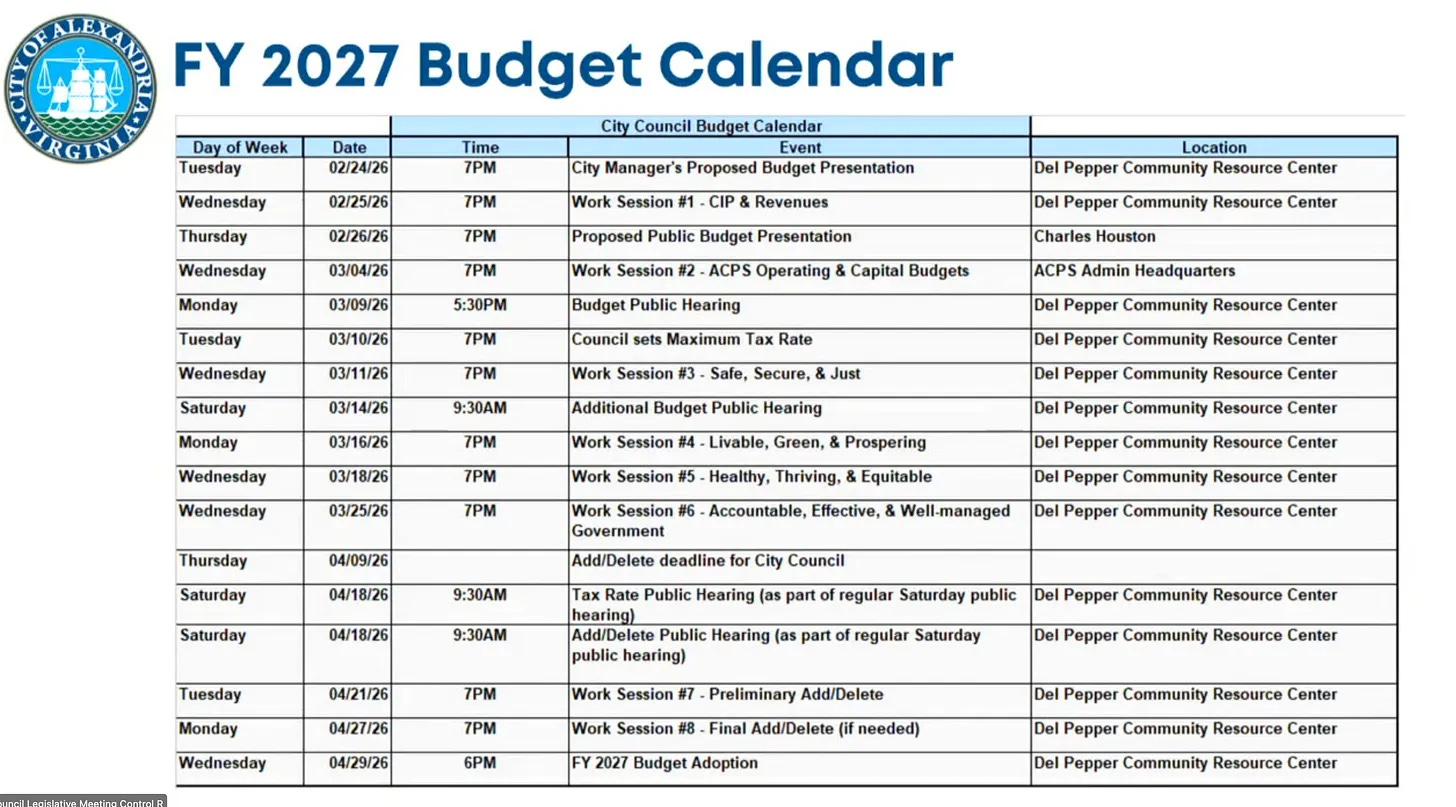
Parajon is scheduled to present his proposed FY 2027 budget on February 24, with final adoption set for April 29.
Residents affected by federal workforce changes can contact the city at FedImpact-AlexTax@alexandriava.gov. The city’s Workforce Development Center offers job coaching, resume assistance, and retraining resources.
The 20% federal workforce concentration in Alexandria is the real story here. Most labor market analyses treat geographic employment shifts as isolated data points, but this one shows cascade effects through housing velocity and hospitalty demand. When property tax revenue is 60% of operations and 80% of that is residential, even moderate home price softening from extended market timeswill compound budget pressure faster than the headline job loss numbers suggest.