
GMU-Alexandria partnership aims to turn walkability into public health strategy
Ben Brenman Park project, shaped by 400+ resident surveys, designated a state case study

What if the path to better public health ran right through your neighborhood park?
That’s the idea driving a collaboration between George Mason University researchers and the Alexandria Parks and Recreation Department, which has produced a community-shaped plan to upgrade Ben Brenman Park — and a model that could inform future city projects.
“Walkability is public health,” said Iulia Fratila, an assistant professor in GMU’s Department of Global and Community Health, in a story published today by GMU News. “Imagine living in a place where you can comfortably send your child and their friends on a safe route to your local library on foot or by bike.”
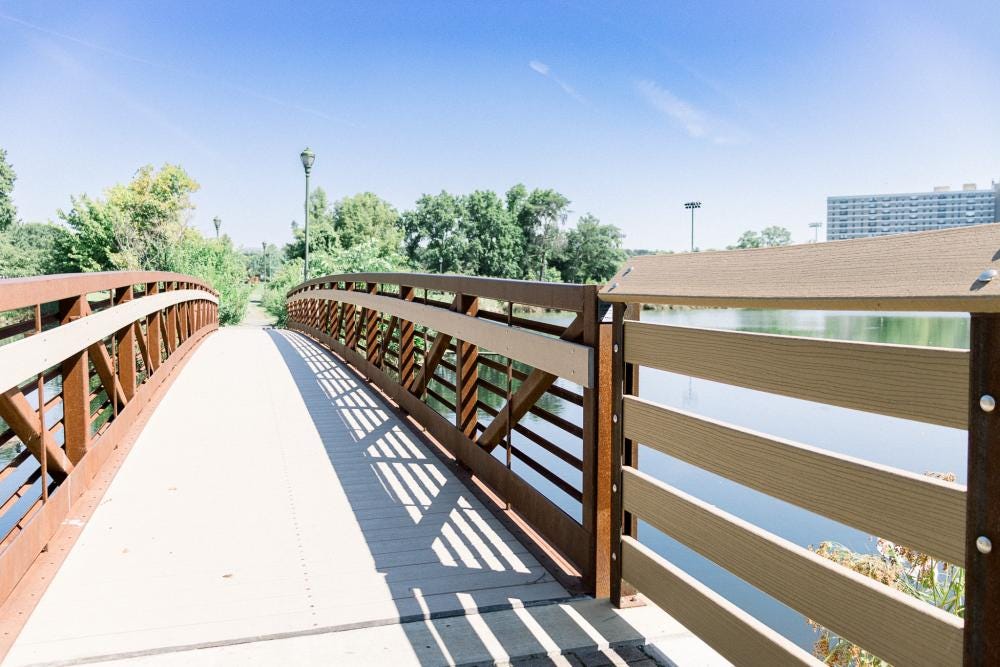
Fratila joined the 2025 Virginia Walkability Action Institute, a state program that trains participants in pedestrian-friendly planning, and secured $9,000 in grant funding to enhance an underutilized trail segment on Ben Brenman Park’s south side. She partnered with Bryce Neuman, a third-year GMU social work student, and the city’s Parks and Recreation Department to design and execute the project.
Community-driven from the start
Rather than impose an academic blueprint, the team built the project around resident input. Neuman designed a survey, Fratila distributed QR codes at the park’s farmers market, and Parks and Recreation pushed it through their newsletter.
More than 400 Alexandrians responded, identifying priorities that included native trees and plants and adult fitness equipment.
“We need to make sure we are creating and enhancing built environments and infrastructure that make healthier habits like walking and biking a possibility for all,” Fratila said.
A model worth replicating?
Fratila emphasized that the partnership structure itself may be as valuable as the physical upgrades.
“Academic researchers bring knowledge and expertise on the science that shapes health outcomes and the potential prevention efforts,” she said, “and the governmental agencies can bring resources and design structures that support health-promoting landscapes and decision-making.”
The Virginia Walkability Action Institute apparently agrees — the organization has designated the Ben Brenman Park project as an official case study.
Neuman, who joined the project to explore connections between the built environment and public health, said she’s eager to see the results.
“I’m particularly excited about the addition of native wildlife around the park, and I hope the people who live near and visit the park also appreciate the changes,” she said.
The park enhancements are expected to be completed in early 2026.