
Mayor Gaskins endorses state housing bills as General Assembly advances compromise, kills ADU measure
Alexandria mayor joins Falls Church, Arlington officials in op-ed backing parking and ADU reforms — but House waters down one bill and shelves another

Alexandria Mayor Alyia Gaskins joined the mayors of Falls Church and Arlington County’s vice chair on Friday morning in endorsing state legislation to eliminate parking mandates and allow accessory dwelling units statewide — but within hours, the House of Delegates had already weakened one of those bills and killed another for the session.
In an op-ed published on Blue Virginia, a progressive political blog, Gaskins, Falls Church Mayor Letty Hardi, and Arlington County Board Vice Chair Maureen Coffey called on state lawmakers to pass SB354/HB262, which would ban localities from requiring minimum parking spaces for new construction, and SB531/HB611, which would require localities to permit accessory dwelling units in single-family zones.
“It’s simply gotten too hard to build homes,” the officials wrote. “Policies that make it easier to build apartments on commercial corridors above businesses, or next to office buildings and near bus stops have proven effective where adopted.”
But the legislation faced a rocky reception in the House Counties, Cities and Towns Committee on Friday morning.
ADU bill shelved
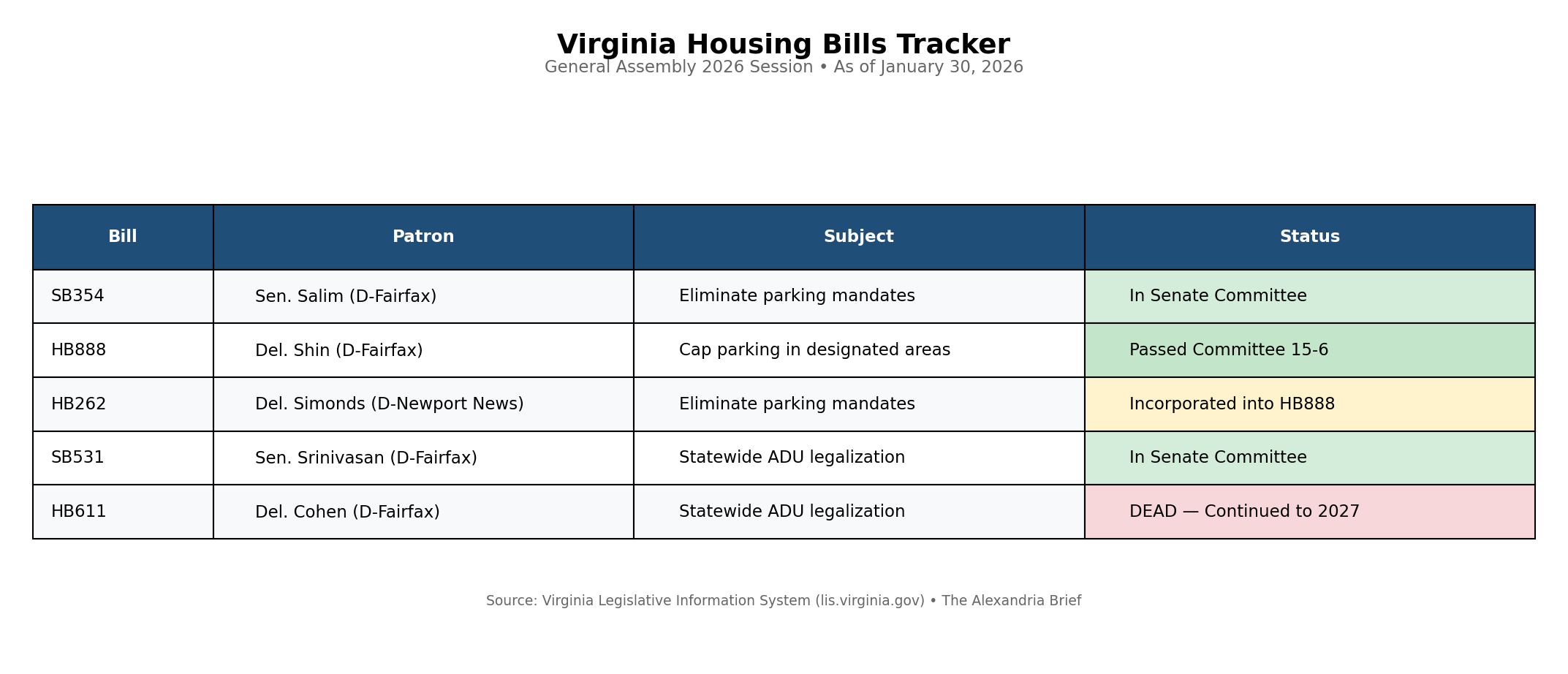
HB611, the House version of the ADU bill sponsored by Del. Laura Jane Cohen (D-Fairfax), was continued to the 2027 session on a voice vote, according to the Virginia Legislative Information System — effectively ending its chances this year. The Senate companion, SB531, remains in the Senate Local Government Committee after a 15-0 vote to rereferral on January 21, per legislative records.
Parking bill weakened
HB262, the House bill to eliminate parking mandates statewide, was incorporated into HB888, a more limited measure sponsored by Del. Irene Shin (D-Fairfax), according to House records. The committee then reported HB888 with a substitute on a 15-6 party-line vote, with six Republicans opposed: Delegates Morefield, Hodges, McNamara, Wyatt, Tata, and McLaughlin.
Unlike the outright ban the mayors endorsed in their op-ed, HB888 as introduced would cap — not eliminate — parking requirements, and only in “designated areas.” Under the bill text filed January 13, those areas include:
Parcels within one mile of a transit station
Revitalization areas under small area plans
Zones allowing floor area ratios of 1.0 or greater
Areas subject to affordable dwelling unit ordinances
Under HB888, localities could require no more than 0.5 parking spaces per unit for multifamily housing and one space per unit for single-family homes and townhouses in designated areas. Localities with populations over 20,000 would also be required to offer 20 percent administrative reductions on parking requirements elsewhere.
The committee reported a substitute on Friday; that text was not yet available on LIS as of publication.
Senate bill remains intact
SB354, the Senate version of the parking mandate ban sponsored by Sen. Saddam Azlan Salim (D-Fairfax), remains in the Senate Local Government Committee. According to the bill text prefiled January 13, that bill would prohibit localities from requiring minimum parking for any new construction approved after September 1, 2026, or buildings undergoing renovations costing at least 25 percent of assessed value — closer to the blanket approach the mayors endorsed.
The bill preserves localities’ authority to regulate the design and location of voluntarily provided parking, and does not affect ADA or electric vehicle charging requirements.
Alexandria implications
Given the city’s Metro stations at King Street, Braddock Road, Eisenhower Avenue, and Van Dorn Street, much of Alexandria would likely fall within HB888’s “designated area” definition if the bill passes in its current form.
The city has already taken steps to ease apartment construction, according to the mayors’ op-ed, which noted that Alexandria and Charlottesville “have made it easier to build apartments” while “Roanoke and Falls Church allow accessory dwelling units” and “Arlington County has changed zoning to allow up to six units by-right in all residential districts.”
The mayors argued that regional action is necessary because local efforts alone are insufficient. They cited research from The Pew Charitable Trusts finding that regional housing supply affects local rents four times more than a locality’s own housing supply.
“No city, town, or county can solve the high cost of housing on its own,” they wrote.
The median cost of a home in Virginia has risen from $258,000 in 2017 to $405,000, and median rent has increased from $1,300 to over $1,700, according to figures cited in the op-ed.
Bill tracker
This story may be updated.