
Parents, teachers continue push against language program cuts at ACPS budget hearing
Union president opposes proposed shift in healthcare costs; administration says budget is essentially flat outside collective bargaining funds

Parents and students continued to oppose proposed cuts to Latin and Chinese language programs at a virtual public hearing on the Alexandria City Public Schools budget Tuesday night, while the teachers union signaled it will fight a proposed increase in employee healthcare costs.
The School Board held its public hearing and first work session on the $406.5 million FY 2027 budget proposal virtually due to winter weather emergencies declared by Governor Abigail Spanberger on Jan. 22 and City Manager Jim Parajon on Jan. 24.
Only five of six scheduled speakers appeared at the hearing—a sharp contrast to the more than 20 speakers, many of them middle schoolers, who packed the Jan. 22 meeting when Superintendent Melanie Kay-Wyatt first presented the budget. Four residents also submitted written comments.
Language program opposition continues
Three of the five speakers and three of the four written comments opposed the proposed elimination of two Latin teaching positions and one Chinese position at the district’s two middle schools.
“There is a big difference between thoughtful resource allocation and cutting programs that are actually working,” said Emily Turner, a George Washington Middle School parent. “Latin and Chinese aren’t failing programs that need to be phased out. They’re rigorous, inclusive, academic options that serve different kinds of learners.”
Turner noted that the budget book states there were no changes in secondary staffing—a discrepancy also raised in a detailed written comment from parent Liz Chien.
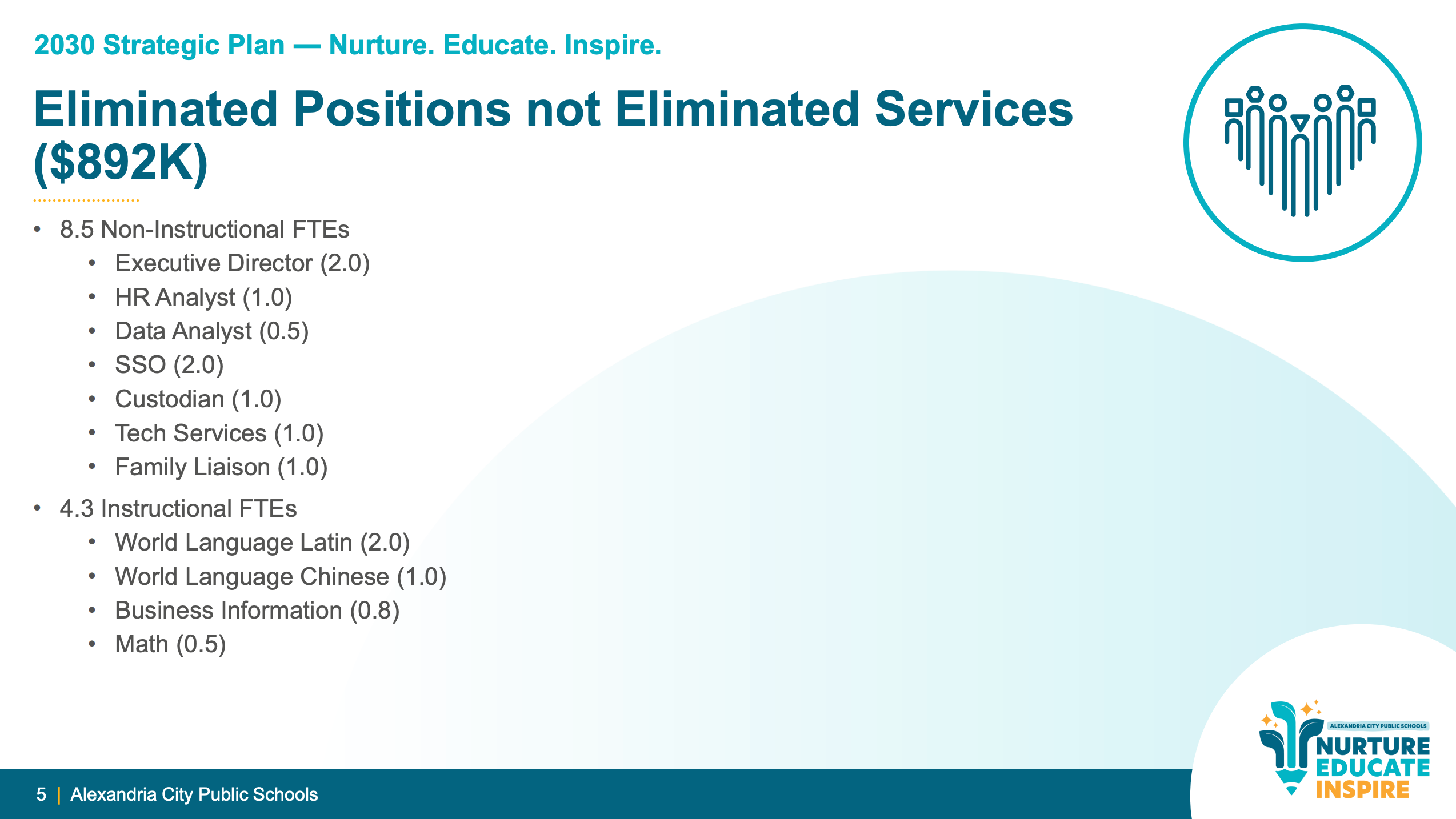
Stacey Rudolph, a Hammond Middle School parent and scientist, said her son in Chinese 1A “speaks of his class and his teacher constantly” and was “heartbroken” when he learned of the proposed changes. She praised teacher Ningwei Li, saying her son told her, “Everyone thinks it’s so hard, but it’s not the way Ms. Li teaches it. It is so fun and easy.”
Li, who has taught Chinese at Hammond for 11 years, submitted written comments saying she was informed her position would be eliminated at year’s end. She claimed low enrollment resulted from counselors discouraging students from taking Chinese, telling them “it’s too hard,” and encouraging Chinese 1 students to switch to Spanish rather than continue to Chinese 2.
Two GW students—Elizabeth Lahr and Nora LaVolpe—also spoke in support of keeping their Latin teacher, Ms. Eisenberg.
Enrollment data revealed
During the work session, Chief Academic Officer Paret Finney shared current enrollment figures, which she said have declined since an October board brief.
At George Washington Middle School: 27 students in Chinese 1A, 22 in Chinese 1B, and 8 in Chinese 2; 26 students in Latin 1A, 21 in Latin 1B, and 18 in Latin 2.
At Hammond: 10 students in Chinese 1A, 9 in Chinese 1B, and 6 in Chinese 2; 7 students in Latin 1A, 3 in Latin 1B, and 2 in Latin 2.
Under the proposal, Latin instruction would move entirely online at the middle school level—it is already only offered online at the high school. Chinese would shift to a hybrid model with one teacher covering both middle schools, with some students taking classes online depending on scheduling.
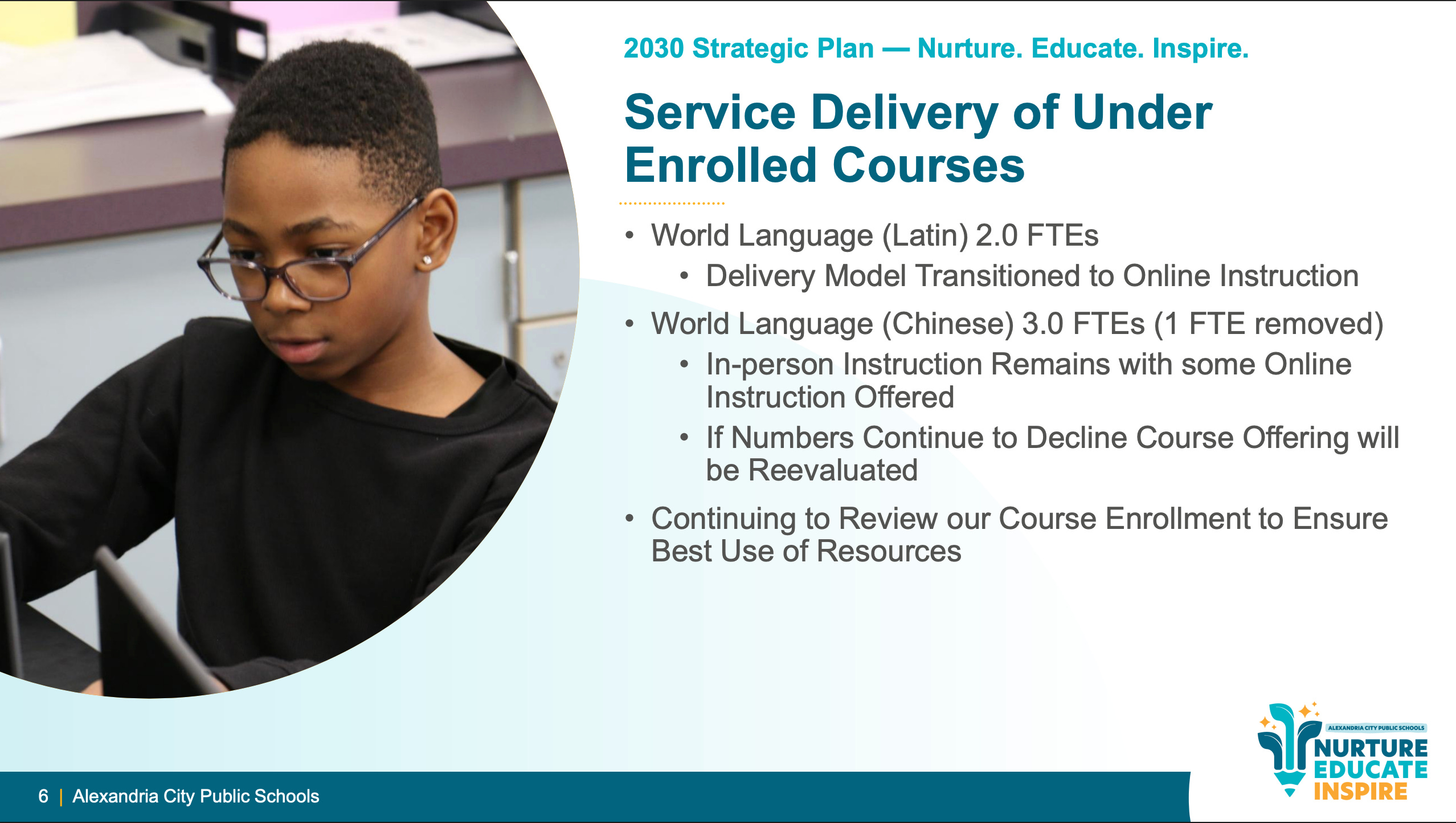
“If numbers continue to decline, course offerings will be reevaluated,” according to the presentation.
Board member Ashley Simpson Baird asked whether the district considered keeping some in-person Latin instruction. Finney said that approach “is always open for consideration,” but noted that since Latin is already online-only at the high school, Chinese was prioritized for in-person instruction because AP Chinese is not available online.
Union opposes healthcare shift
Dawn Lucas, president of the Education Association of Alexandria, used her time to advocate for competitive compensation—and signaled the union’s opposition to a key cost-saving measure in the budget.
The proposed budget includes a 5% shift in healthcare premium costs from employer to employee, which would save the district $2 million to put toward salary increases in the first collectively bargained agreement. Currently, most staff pay 20% of premiums while the district pays 80%; the proposal would shift that to 25/75. Support staff would go from 10/90 to 15/85.
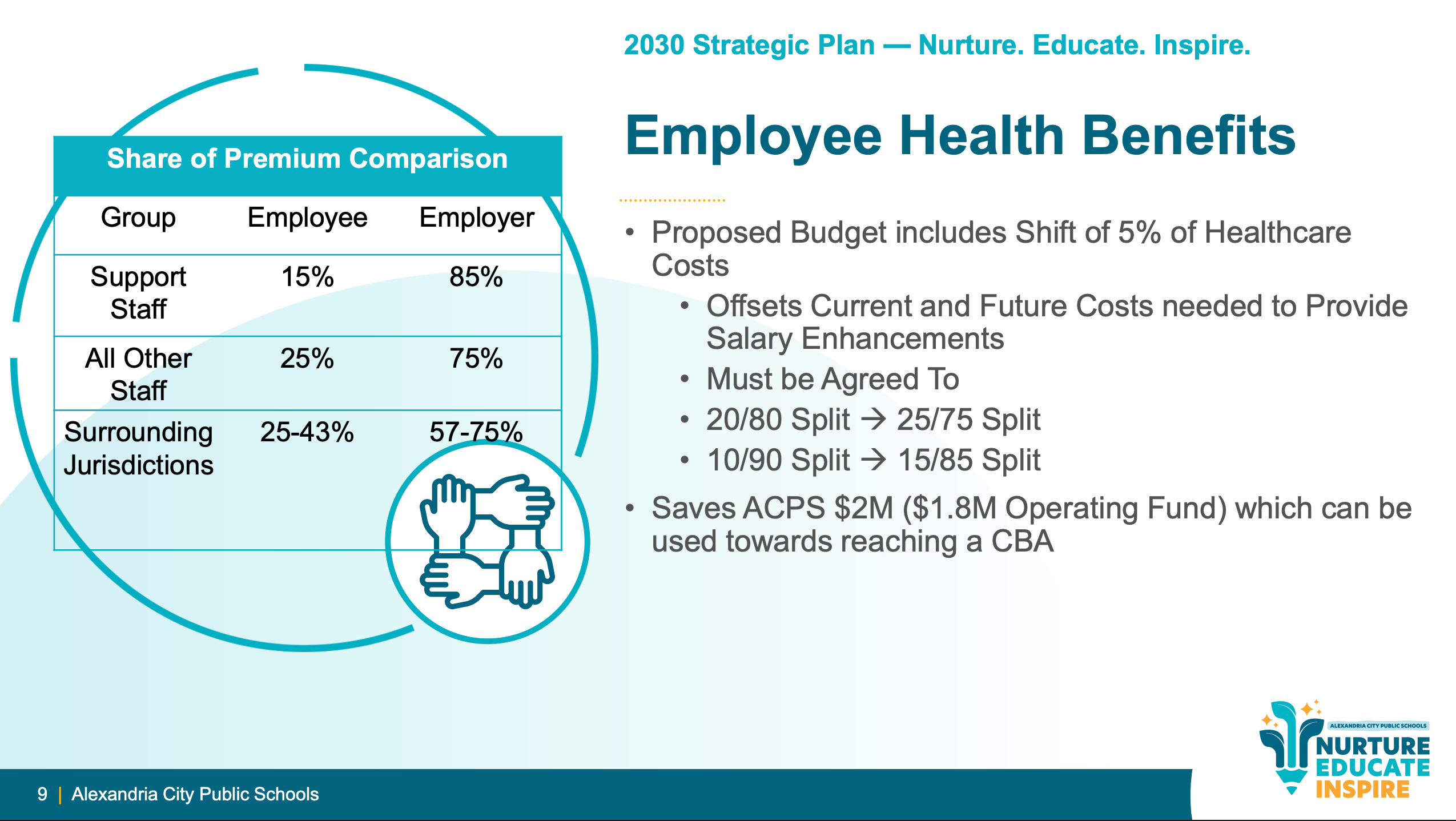
Lucas said EAA’s priorities include step increases, market rate adjustments, longevity bonuses, and “no change in the healthcare premium split.”
“EAA aims for ACPS employees to thrive, not just survive,” she said, adding that “a larger salary reserve is necessary to support reasonable outcomes in the collective bargaining process.”
Budget context
Chief Financial Officer Dominic Turner walked board members through the budget proposal, emphasizing efforts to minimize the request from the city while preserving funds for collective bargaining.
Board member Ryan Reyna noted that, excluding funds set aside for the CBA, the budget is essentially flat or even decreased from last year.
“The dollars that we are asking for that may go above what the original signal was sent from the city manager are purely for us getting to a collective bargaining agreement, purely for the staff in our buildings,” Reyna said.
The city has indicated funding may be limited to a 1.5% increase. Turner said if the district had not made cuts, it would be requesting a 5.5% to 7.5% increase, which he noted some neighboring jurisdictions are requesting.
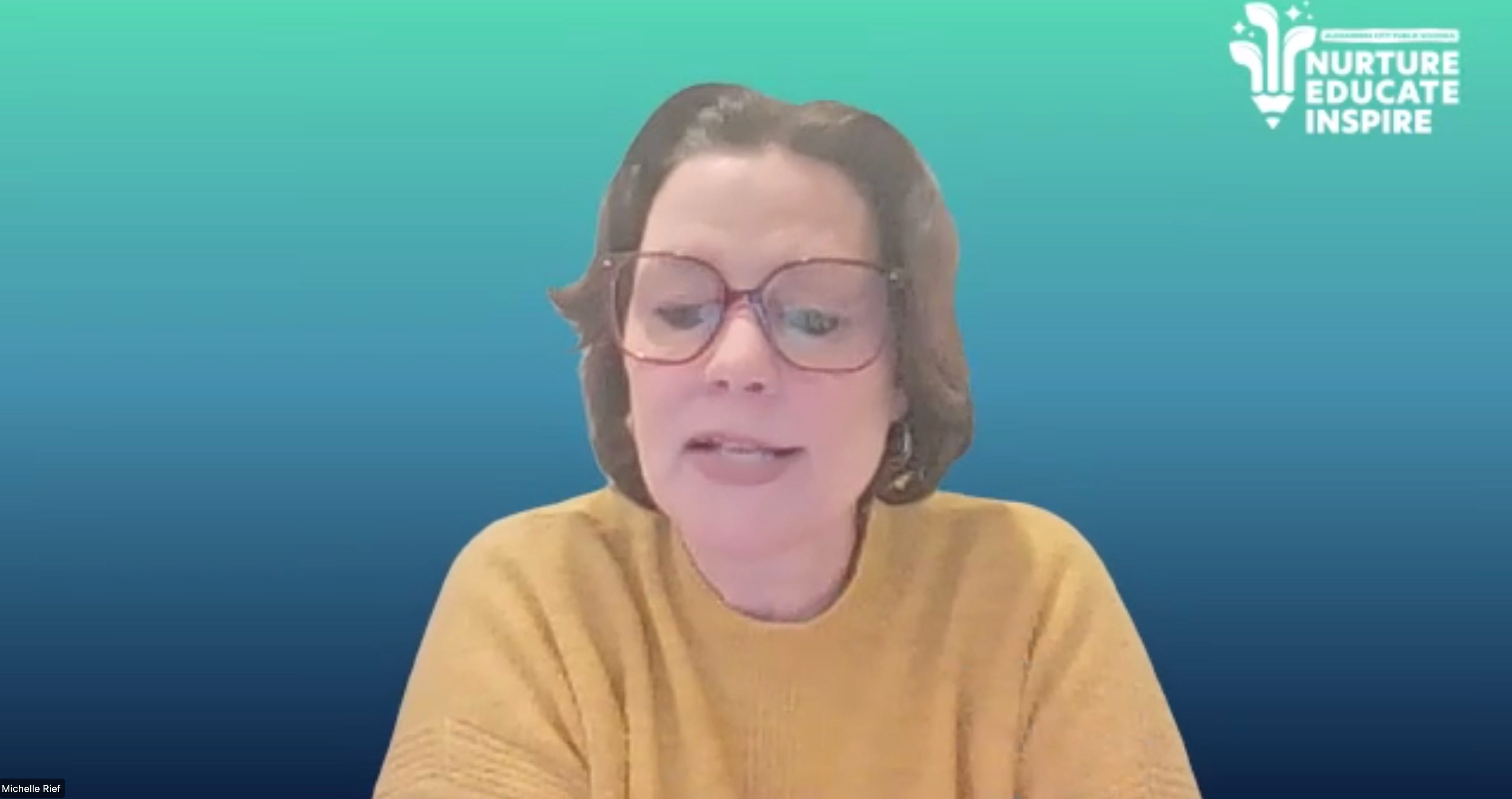
Chair Michelle Rief highlighted the challenge of staying competitive, noting that data from a neighboring division showed ACPS entry-level teacher pay on the master scale went from second-highest in Northern Virginia to first, then dropped to seventh out of eight divisions over the past three years.
“This just shows how challenging it is to really try to stay competitive from a compensation standpoint,” Rief said.
Afghan family support ending
Rief also asked about support for Afghan families, which speakers raised at the Jan. 22 meeting. Turner confirmed that the federal refugee resettlement grant funding for those positions is ending.
“Because these are grant-funded positions, as the grant expires, we can’t continue to pick up those services,” he said. “Any services that we are providing will have to be assumed by positions that we already have here within the school division.”
What’s next
The board may hold an additional work session on Thursday, following a special meeting on school improvement plans. Written budget questions from board members are due Monday at noon.
The ACPS Parent Teacher Association Council will host a budget forum on Feb. 3 at Douglas MacArthur Elementary School from 6:30-7:30 p.m., with interpretation available in Amharic, Arabic, Dari, and Spanish.
The board is scheduled to adopt the budget on Feb. 19. City Manager Parajon will present his proposed budget on Feb. 24, and City Council typically approves its budget in late April—at which point the district said it can finalize collective bargaining negotiations.