
Planning Commission approves townhomes, gym rooftop in nearly 3-hour meeting; Brown bids farewell
All voted items pass unanimously as departing commissioner's last meeting draws extended tributes

The Alexandria Planning Commission unanimously advanced a slate of development proposals Tuesday night, approving 11 townhomes at Duke Street and Quaker Lane, a rooftop workout area for a Scandinavian-inspired gym on South Patrick Street, and a Del Ray lot subdivision, while deferring a contested North Columbus Street townhouse project at the applicant’s request.
The nearly three-hour meeting at the Del Pepper Community Resource Center, which adjourned at 9:52 p.m., also served as the final hearing for Commissioner David Brown, who is relocating to the Pacific Northwest. Brown received a mayoral proclamation recognizing nearly two decades of city service and emotional tributes from fellow commissioners and staff.
All items that went to a vote passed 7-0. Items approved by the commission will advance to City Council on Feb. 21.
Duke & Quaker townhomes advance despite traffic concerns
The commission’s longest discussion centered on a proposal by 614 Westbrad LLC to build 11 townhouse-style units at 11 and 21 N. Quaker Lane and 3369 Duke Street, on a vacant lot shared with the New Apostolic Church in Seminary Hill. The site has sat undeveloped for more than 40 years.
The project required removing a 1982 proffer that limited the property to office use, and the applicant sought bonus density under Section 7-700 of the Zoning Ordinance in exchange for one affordable housing unit. The developer also agreed to dedicate approximately 30 feet of property along Duke Street for the future Duke Street Transitway, the design phase of which is expected to be completed in fall 2027.
Traffic dominated the discussion. Stephen Morris, president of the Seminary Hill Civic Association, said his group supports the project but recommended the city install physical delineators on Quaker Lane to prevent drivers from ignoring the planned “no left turn” signage at the southern driveway exit.
“People ignore no left turn signs,” Morris said, citing past experience at the bottom of Yale Drive. “What we foresee potentially happening is people coming out trying to make a left turn and wedging into the Quaker Lane traffic coming down the hill.”
Luana Russell, a resident at 151 N. Quaker Lane, opposed the project outright, citing traffic congestion and incompatibility with the neighborhood’s single-family character. “There are literally times that it takes me 20 minutes just to get out of my driveway to go left on said Quaker Lane,” she said.
Attorney Cathy Puskar, representing the applicant, said the project had been coordinated with the church, consolidating two existing curb cuts into one and restricting left turns out of the southern entrance. She argued the low volume of anticipated traffic — just a few trips per peak hour — would have minimal impact.
“Once they try it once or twice during rush hour, they’re going to go up to that top access,” Puskar said of residents attempting the left turn. “And coming home, they’re going to find a way to get back to their townhouse that doesn’t create that left turn.”
Chair Melissa McMahon noted that the site sits along the planned Duke Street Transitway corridor and said new residents may be more inclined to use transit than current neighbors. “Folks living in these townhouses could actually just walk around the corner and hop on a high capacity bus,” she said. Both the rezoning and development special use permit passed 7-0.
Neighbors raise noise, light concerns over gym rooftop; commission approves
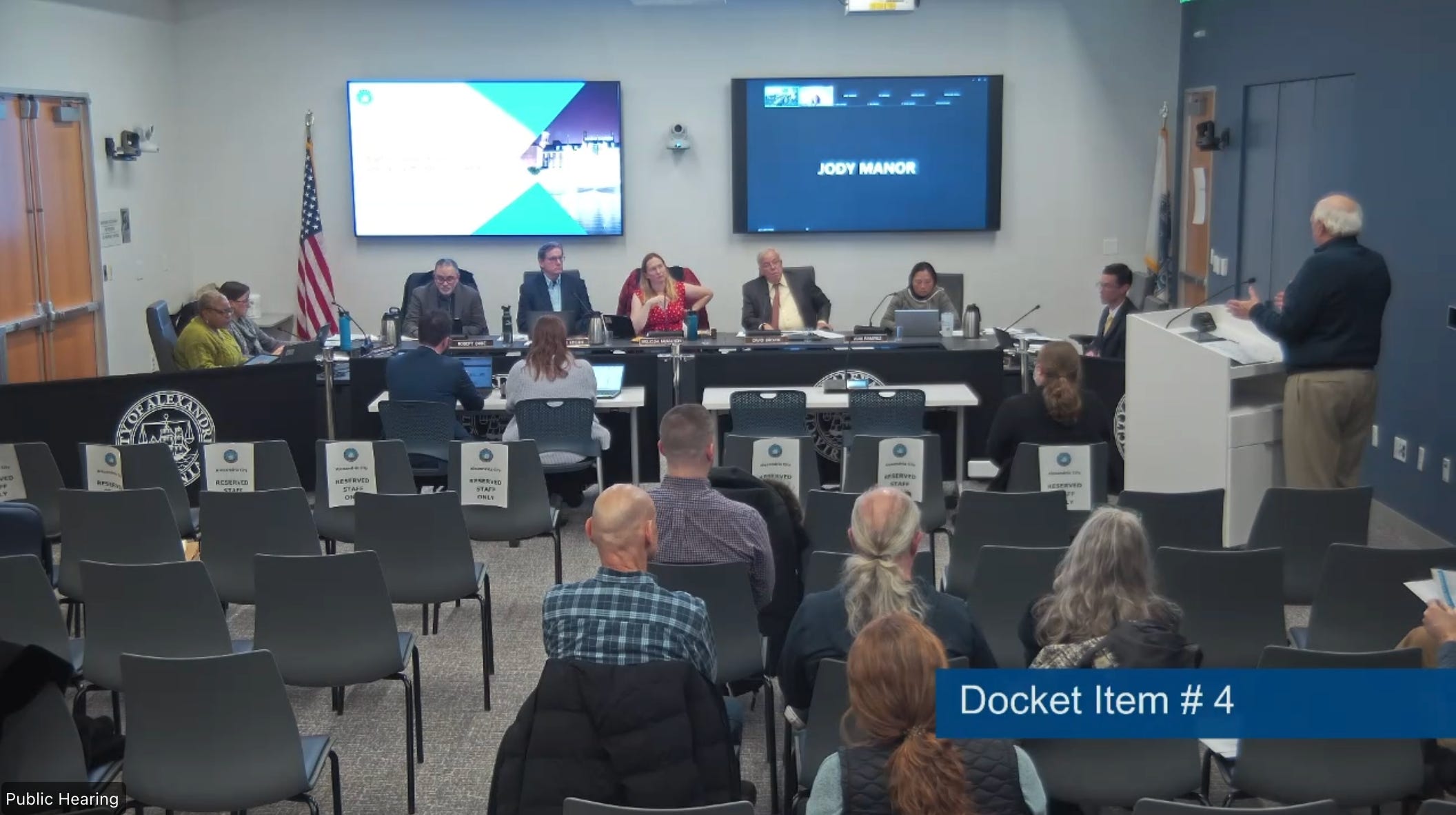
Four residents from the block behind 601 and 619 S. Patrick Street turned out to voice concerns about Valhall Property Holding LLC’s plan for a rooftop workout area at its planned Scandinavian-inspired gym in the former West Marine building.
The gym itself is a by-right use, but the rooftop space — featuring battle ropes, tire flipping stations, push-pull sleds, and a walking track — requires a special use permit as an outdoor recreation and entertainment use.
Samuel Brandt, who lives at 600 S. Henry Street directly behind the property, said his wife’s home office is about 50 feet from the proposed rooftop area. “Even though there won’t be amplified sound or instruction, the activity itself, with equipment and just members themselves kind of expressing their ambition through exercise, will be quite loud,” he said. He also recommended making the alley behind the building one-way to reduce cut-through traffic.
Shelley Castle, whose bedroom window is at the same elevation as the proposed rooftop, said she was concerned about noise from power-lifting activities and light pollution filtering into residents’ backyards until 11 p.m. “I don’t want to have light filtering in from another from that building,” she said. “I’m going to be listening to people grunt, yell and have lights spotlighting right into my backyard.”
Jeff Erickson, Castle’s husband, suggested the glass barriers on the rooftop be frosted rather than clear to prevent gym-goers from looking down into backyards, and recommended the barriers be made taller to further reduce noise.
Attorney Duncan Blair, representing the property owner, said the glass barriers are intended to be taller than human height — serving as wind and sound barriers, not just safety railings. He said the facility is not intended to be a high-intensity, large-membership club, and offered to consider translucent glass on the west-facing wall adjacent to residents. Blair also said a fence along the alley separating the parking lot from the residential properties could reduce concerns about security and access.
McMahon said she was comfortable with the use, citing the design features that orient activity and lighting away from the residential side, the height of the glass barriers, and the ability to monitor the SUP’s conditions over time. Staff had recommended a condition requiring the rooftop close by 11 p.m. and prohibiting instructor-led classes with amplified sound outdoors.
“This is also the kind of thing that staff monitor,” McMahon said. “If there are issues with the performance of the SUP or they’re unable to meet standards ... SUPs can be reevaluated and can come back to us or can come back to council.”
The staff report had recommended conditions requiring the rooftop to close by 11 p.m. and prohibiting instructor-led classes with amplified sound outdoors. The permit was approved 7-0 based on the staff report and advances to City Council.
Columbus Street townhomes deferred after Brown critique
The most pointed moment of the evening came before any public testimony, when Commissioner Brown laid out his objections to a proposal for three townhouses at 806 N. Columbus Street before the item was formally deferred at the applicant’s request.
Brown argued the project runs afoul of Section 12-1,1000 of the zoning ordinance, which he said limits buildings on substandard lots of record to a maximum height of 35 feet — a threshold the application exceeds. He said the staff report made only a “bleak reference” to this requirement and did not discuss its significance.
“In my view, that provision is fatal to this application unless the lot width minimum is corrected by a resubdivision of the three lots into two lots,” Brown said, adding that the project should return as “a simple consent item to build two townhomes on two lots.”
Brown, who said he would not be around for the eventual vote, offered to provide a detailed memorandum to the chair and planning director explaining his position. “If it comes back as three, I will provide staff with a detailed explanation of why this application must be denied,” he said.
The deferral passed 7-0 with no date certain for the item’s return.
Del Ray subdivision approved amid flooding concerns
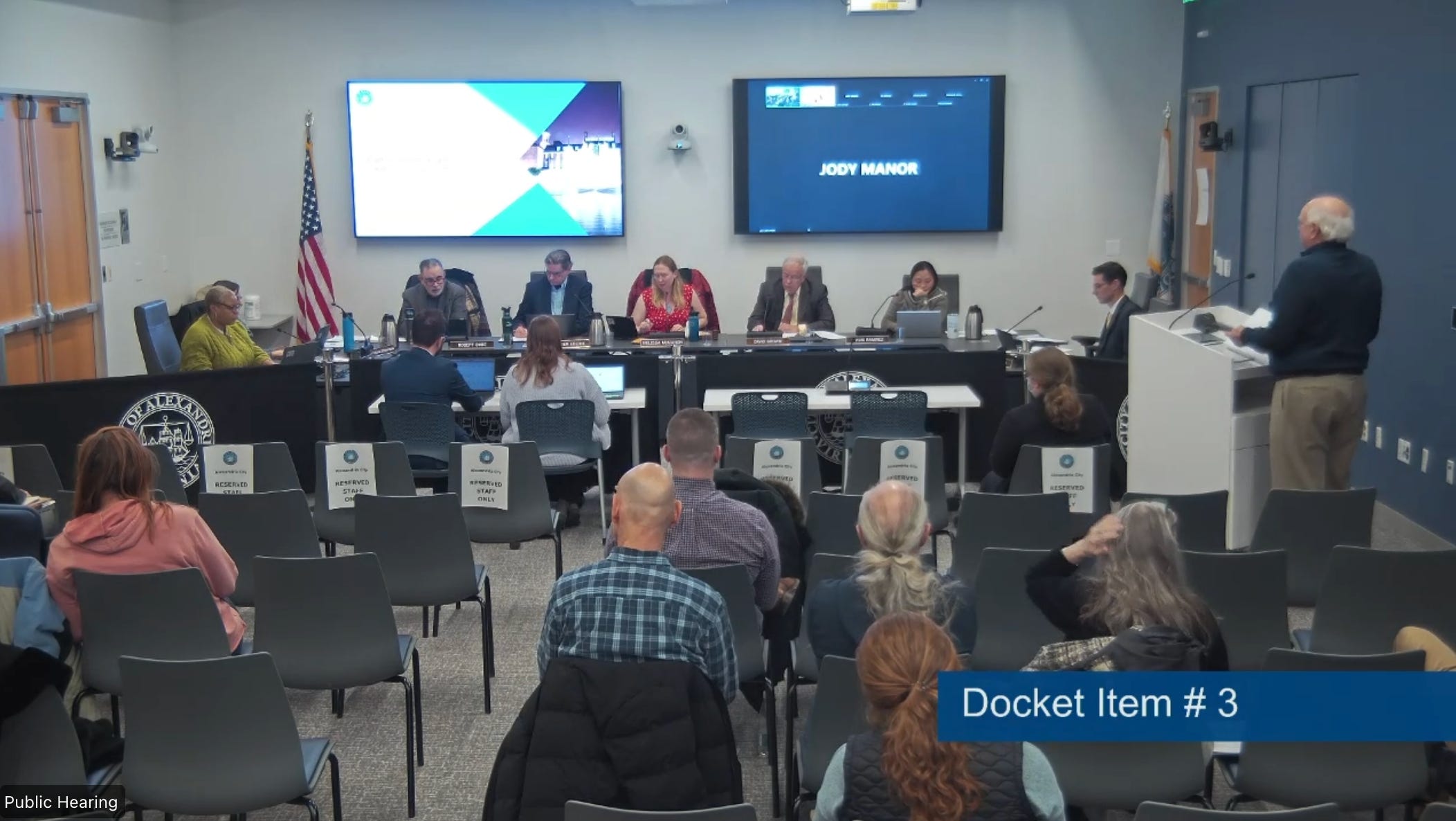
Two neighbors from the area around 102 E. Monroe Avenue spoke against a subdivision to divide one residential lot into two, citing recurring flooding and the loss of permeable ground.
Barbara Mancini, who lives next door at 100 E. Monroe, said she has experienced tens of thousands of dollars in flood damage and lost her car to flooding. “There’s no land left for the water to go,” she said.
Planning Director Paul Stoddard addressed the flooding concerns broadly, noting that all development projects undergo stormwater review to ensure no increase in peak flow, and that the city has approximately 20 active stormwater projects, including one near the subject property. He also cited the city’s forthcoming first flood resiliency plan.
Chair McMahon noted the subdivision meets all R-2-5 zoning requirements and said the commission’s evaluation criteria are narrow. “Subdivision evaluation is not that subjective,” she said. “We have a much more, I should say, stricter set and smaller set of things that we’re considering.”
The subdivision was approved 7-0.
Consent calendar
Two items passed on the consent calendar without discussion:
Upland Park (Docket Item 2): A three-year extension for the 92-unit townhouse development on a 9.6-acre site bounded by Foster Avenue, Seminary Road, and Fairbanks Avenue, along with an amendment to Coordinated Development District #21 and a development site plan for a public park.
420 E. Windsor Avenue (Docket Item 5): A special use permit to construct a single-unit dwelling on a developed substandard lot.
Brown’s farewell
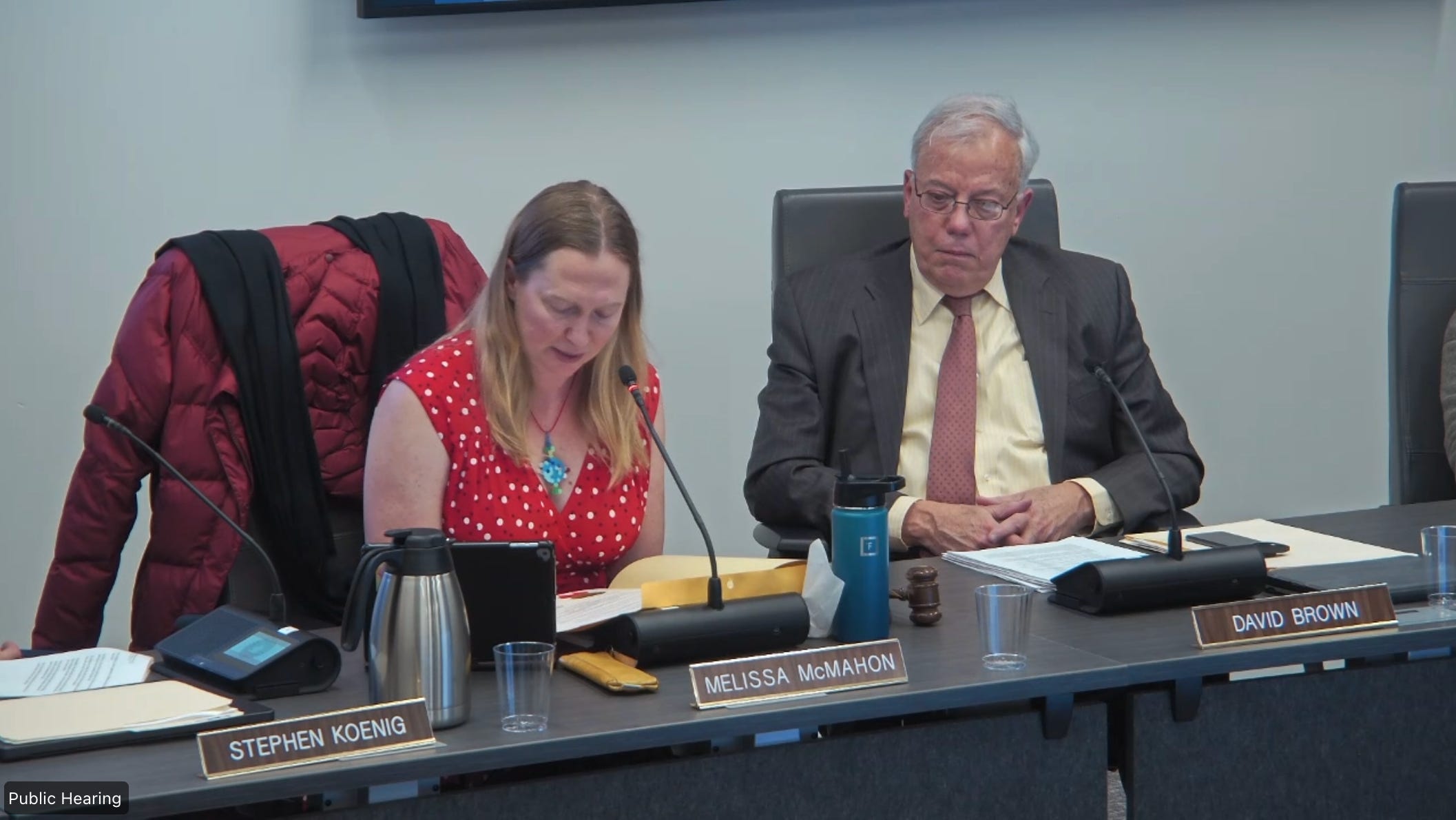
The final hour of the meeting was devoted to recognizing Brown’s service. McMahon read a proclamation from Mayor Alyia Gaskins noting that Brown had participated in more than 1,100 docket items during his tenure, which began with his appointment to the Residential Infill Task Force in 2007 and included three terms on the Planning Commission starting in 2014. He also served on the Transportation Commission, the Bicycle and Pedestrian Advisory Group, and the Open Space Steering Committee, and provided guidance on eight small area plans.
Each commissioner offered personal reflections. Vice Chair Stephen Koenig praised Brown’s evolution on housing policy, noting that his conclusions during the Zoning for Housing process “were not necessarily to be expected by someone who might just be observing you from the outside” and called them “fundamentally inspirational.”
Brown credited reading The Color of Law around the time the city began its Zoning for Housing initiative with changing his perspective on neighborhood protections. “I’m kind of proud of myself for changing my mind,” he said.
Commissioner Jody Manor, participating remotely while ill, thanked Brown and reflected on his own experience as a restaurant owner who was once denied a special use permit. “I’m the only one who’s ever been down in front and been denied for an SUP for my cafe,” Manor said, “which turned out to be sort of the community clubhouse in town.”
Attorneys Duncan Blair and Kathy Puskar also addressed Brown from the podium, with Blair wishing him “fair seas and a trailing wind” and Puskar recalling working with him on a townhouse project when he was a civic association leader in the late 1990s.
Planning Director Stoddard noted that Brown’s approach to dissecting land use problems had a lasting impact on staff. The commission presented Brown with handwritten notes from staff and an original drawing by Deputy Director Jeff Farner.
Brown said his moving trucks are scheduled for March 5. He also disclosed that he has recruited Manor to join a working group exploring a replacement for the Monumental Sports Entertainment complex, a project he intends to continue following from the West Coast.
Director’s report
Stoddard briefed the commission on several items, including the fact that the Green Building Plan was approved unanimously by the City Council, with final provisions setting an EUI target of 35 for multifamily development and a 3% on-site renewable energy generation requirement (or off-site equivalent capped at $150,000). He said development review procedures implementing the plan could be finalized by fall, with the first projects subject to the new requirements potentially reaching the commission by late 2027.
Stoddard also introduced a new five-year outlook publication projecting approximately 2,600 residential units under construction between 2026 and 2028 — a 3% increase in the city’s housing stock — with roughly 1,000 of those being affordable units. An additional 8,500 approved units, including 1,700 affordable, are in the pipeline for 2028 and beyond.
Looking ahead
The March 3 Planning Commission docket includes a proposal for a 365-foot residential tower at 2425 Mill Road in Eisenhower East. The commission will also elect a new chair and vice chair at that meeting. The next community planning meeting is scheduled for March 17.
Items approved by the Planning Commission will go before City Council at a public hearing on Feb. 21 at 9:30 a.m. at the Del Pepper Community Resource Center.
Great coverage of a packed agenda. The Section 12-1,1000 issue Brown raised about the Columbus St project is a classic case of zoning code interpretation that can make or break aproposal. I've followed similar disputes in my area and the lot width requirements always catch developers off guard. Intresting to see how thoughtful departing commisioners can shape the record even when they won't be around to vote.