
Student representatives urge ACPS board to preserve language programs; petition reaches 120 signatures
High schoolers, teachers speak at Feb. 5 meeting as budget vote approaches

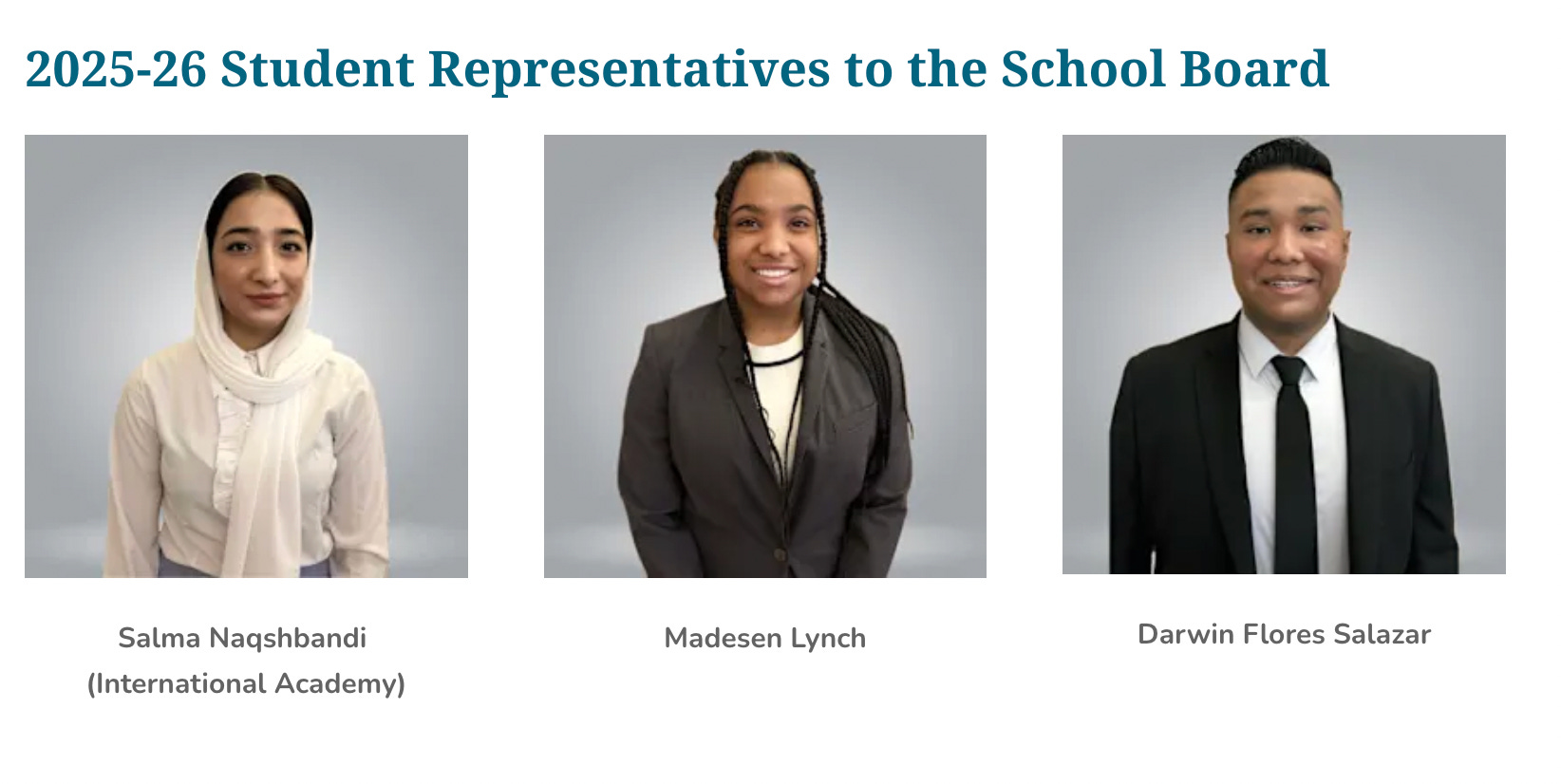
Alexandria City High School student representatives have sent a formal letter to the School Board and superintendent asking for alternatives to proposed cuts to middle school Latin and Chinese programs, citing a petition with more than 120 signatures from students, parents, and staff.
“We earnestly hope that the School Board and Central Office will consider alternative solutions that can address budgetary constraints without sacrificing these valuable language programs,” the letter reads. “We are committed to collaborating on creative and sustainable solutions that ensure all students benefit from a well-rounded education.”
The letter, signed by student representatives Salma Naqshbandi, Madesen Lynch, and Darwin Flores Salazar, acknowledges the district’s financial challenges but emphasizes their duty to advocate for programs their peers value.
“We fully understand and acknowledge the logical reasons behind these budget-related decisions,” the letter states. “We appreciate the complexities and challenges involved in managing the district’s finances. However, as Student Representatives, it is our duty to advocate for the educational experiences that our peers deeply value.”
Flores Salazar announced the letter during Thursday’s meeting, noting it was sent in response to a petition received on February 3. The petition included a slideshow with signatures and letters from community members explaining why Latin and Chinese instruction should remain in-person. Flores Salazar also submitted a separate letter in his individual capacity.
Four speakers addressed the board in support of the programs—continuing a pattern from previous meetings where students, parents, and teachers have urged the board to reconsider the cuts.
Students speak
Daniella MacArthur, an ACHS senior who has studied Chinese for seven years, told the board the program opened doors she never expected.
“Chinese has opened countless opportunities for me, including the chance to actually go to China and study abroad for a month last summer,” MacArthur said. “This is an experience I would have never had without studying Chinese in sixth grade.”
MacArthur urged the board to focus on building enrollment rather than cutting programs.
“Instead of eliminating a class because of low numbers, what we should be doing is trying to increase the number of students who take the class,” she said. “We should be putting our efforts into marketing this language to others.”
Merrill Plotkin, also an ACHS student who has studied Chinese since sixth grade, warned that virtual instruction would set students back.
“In eighth grade, the middle school I attended required that I learn Chinese virtually, and I can say that this method requires more resources than most students have at their disposal,” Plotkin said. “If students are not given a strong foundation in middle school, it will be much more difficult to retain Chinese as a language once they’re in high school.”
Teachers respond
Yan Huang, the Chinese teacher at ACHS, noted that both the Chinese and Latin programs have existed for two decades.
“As the saying goes, Rome wasn’t built in one day,” Huang said. “We built our programs through the support of our administrators, teachers, and our determined students.”
Huang, who has taught for 16 years, said many teachers invest their own money in classroom materials, holiday celebrations, and culture projects.
“And now some of them might not even have a job next year,” she said.
She argued that enrollment data alone is insufficient to evaluate a program.
“In educational research, evaluating a program using numbers alone is widely considered insufficient because it involves human learning, motivation, culture, identity, and classroom experience,” Huang said. “Our voices matter.”
Paige Warren, a Latin teacher at Francis C. Hammond Middle School, said she and GW Latin teacher Ms. Eisenberg took 35 students to the Virginia State Latin Convention last fall.
Warren said enrollment dropped after the pandemic because students were discouraged from taking Latin.
“An elementary school counselor told the president of our Latin club not to take Latin because the program was too small,” Warren said. “Sixth graders have told me they want to take Latin, but the Latin 1A and 1B classes that were offered to the seventh and eighth grades were cut and I was never informed.”
Budget context
The proposed FY 2027 budget would eliminate two Latin teaching positions and one Chinese position at the district’s two middle schools. Latin instruction would move entirely online, while Chinese would shift to a hybrid model with one teacher covering both schools.
The administration has cited declining enrollment as the reason for the changes. At Hammond, Latin classes have as few as 2-7 students; Chinese classes have 6-10 students.
The district faces a $15.1 million budget shortfall and has been limited to a 1.5% funding increase from the city. Eighty-seven percent of the budget goes to personnel costs.
The board is scheduled to adopt the budget on Feb. 19. Board member add/delete proposals are due Monday, and a budget work session is scheduled for Feb. 17.

Strong reporting on student advocacy here. The tension between enrollment-based metrics and programmatic value is tricky, especially when low numbers might be partly caused by discouragement from counselors rather than lack of interest. The point about evaluating programs beyond raw enrollment is solid since language acquisition is inherently long-term and culturally embedded. Thefact that students went to state conventions shows real engagment despite low enrollment numbers.