
Three Democrats debate ahead of Tuesday's Senate primary
Candidates address affordability, energy and Gaza before packed house at Charles Houston Rec Center


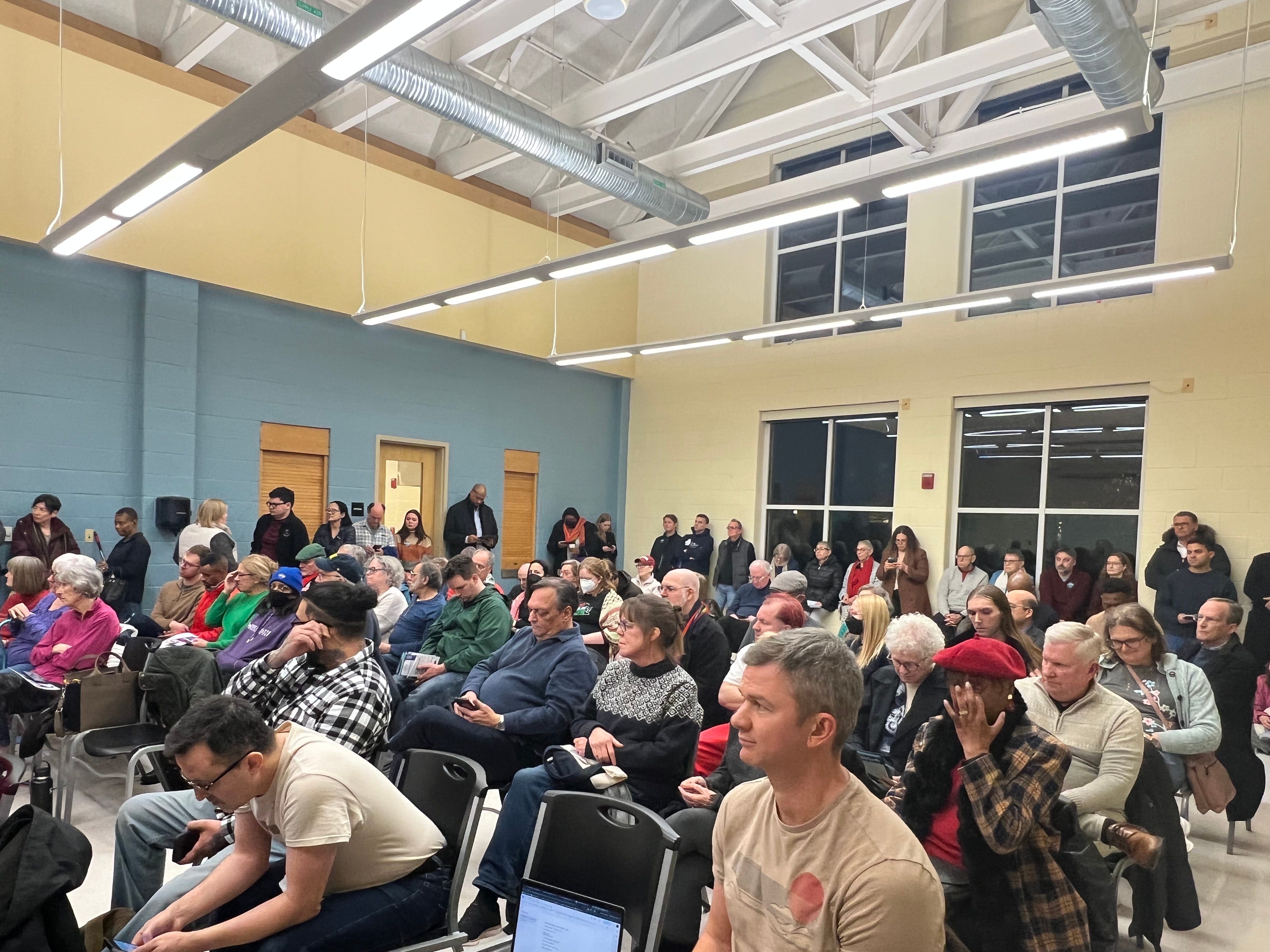
Three out of the four Democratic candidates for Virginia Senate District 39 faced off before a standing-room-only crowd at Charles Houston Recreation Center on Monday night, giving voters a final chance to compare the contenders before Tuesday’s firehouse primary.
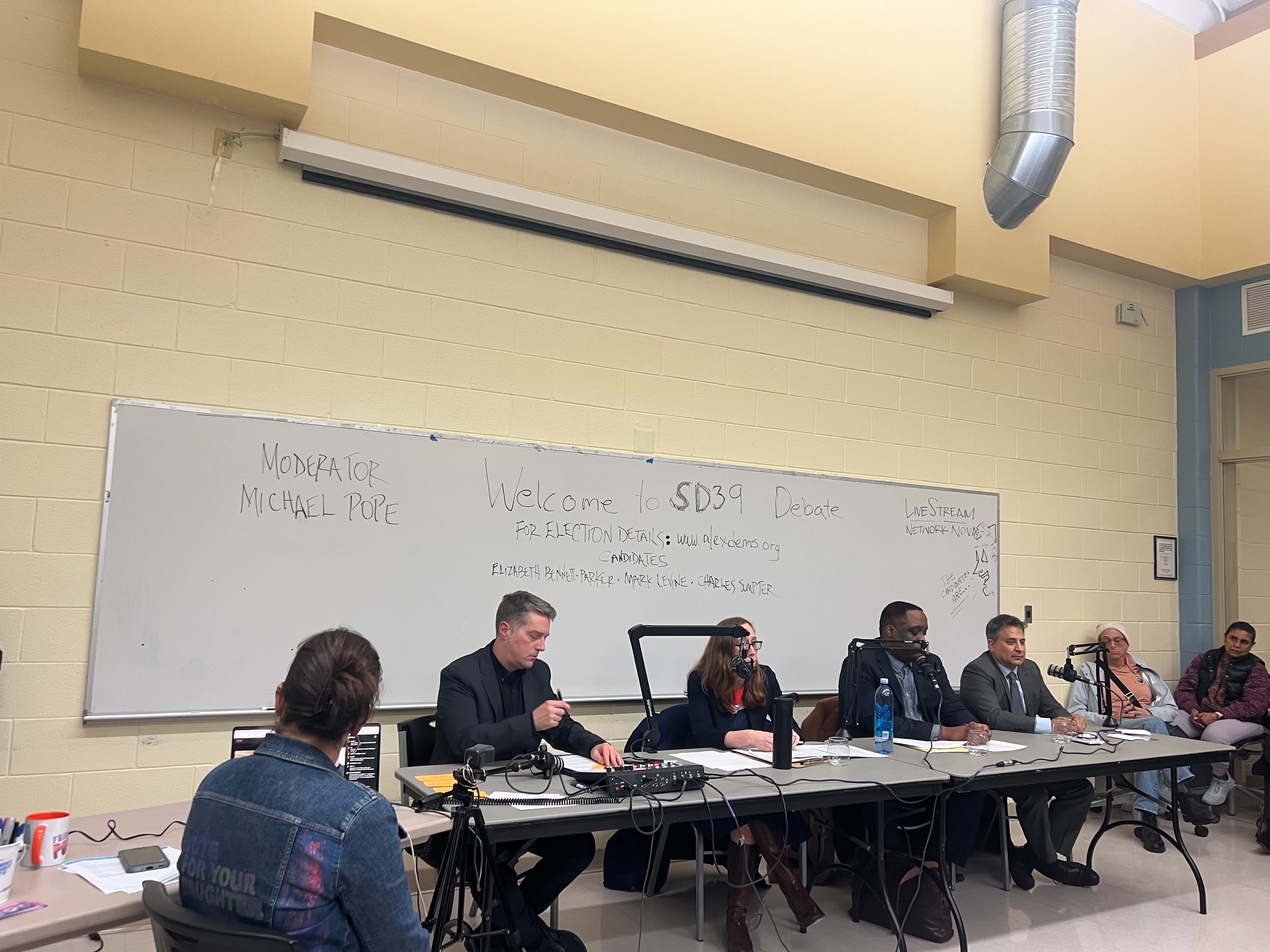
Del. Elizabeth Bennett-Parker, former Del. Mark Levine, and activist Charles Costen-Sumpter addressed about 100 attendees, with another 125 to 200 watching a live stream. The fourth candidate, former Vice Mayor Amy Jackson, did not attend but had a campaign representative present in the audience.
The debate, moderated by Virginia Public Radio reporter Michael Pope, was organized on short notice by Network NoVA and Grassroots Alexandria. It comes less than a week after state Sen. Adam Ebbin announced Jan. 7 that he would resign to join Gov.-elect Abigail Spanberger’s administration.
Bennett-Parker left the event early at approximately 7:45 p.m. due to childcare responsibilities, stating she had requested that the 7 p.m. start time be moved earlier but was denied.
“I am upset that I have to leave early, but I thank you all for your understanding of those circumstances,” she said.
Election timing draws criticism
All three candidates criticized Virginia’s election law for allowing such a rapid special election timeline.
“This is a travesty of democracy,” Costen-Sumpter said, noting that residents he encountered while canvassing were unaware an election was taking place. “Every door that I knocked on, no one knew there was an election. I barely knew and I’m connected.”
He called for at least 30 days’ notice before special elections. “People have to go to work. People work odd hours,” he said.
Bennett-Parker called the process “pure chaos,” which has been difficult for candidates, voters, and local party organizers.
“State law mandates a very quick turnaround in the case of vacancies that occur right before or during session,” she said. “In the particular case of this election, we have a one-seat Democratic majority in the state Senate. And so I think it’s important to the values of Alexandria, Arlington, and Fairfax that that seat is filled.”
Levine proposed three solutions: requiringa 60-day notice for resignations, implementing ranked-choice voting for special elections, or allowing legislators to designate acting replacements.
“If you are elected to serve the commonwealth and you want to resign to do something else, all right, you give a 60-day notice,” he said.
Affordability takes center stage
The candidates outlined different approaches to addressing rising costs for residents.
Bennett-Parker highlighted three housing affordability bills she plans to introduce, including one that has been included in Spanberger’s affordability agenda.
“We have an affordable housing crisis right now with the inventory that we have and we can’t afford to lose any more units,” Bennett-Parker said. She also emphasized childcare and tax reform: “I’m interested in how we pay for some of these things. I have passed bills and am carrying more bills this year to make sure that the ultra wealthy pay their fair share.”
On healthcare, Bennett-Parker pointed to federal policy changes under the Trump administration.
“Trump is destroying our economy. The loss of the Affordable Care Act premium subsidies is something that we need to address at the state level,” she said.
Levine focused on healthcare transparency, proposing that hospitals provide upfront pricing for non-emergency procedures.
“If you are going to get an operation, not an emergency operation, but maybe a hip replacement or a knee, you should have the right to shop around,” he said. He also emphasized unions: “The last and most important way to help affordability is unions. Unions, unions, unions, unions. They are the key to the middle class.”
Costen-Sumpter, who grew up in New York City public housing, drew on personal experience to discuss affordability.
“I was born and raised in the New York City housing project to two parents who worked blue collar jobs,” he said. He called for rent control measures and eliminating the Dillon Rule to give localities more autonomy.
“Credit checks, when people have bad credit, can’t rent, they pay these exorbitant fees, so they can’t rent. Where are they supposed to go? No one is talking about that,” he said.
He also raised concerns about potential federal cuts to HIV/AIDS funding.
“A lot of my friends who I talk to know that I’ve worked in HIV, AIDS work for a long time,” he said. “There are potential cuts to Ryan White funds which will hurt Virginians. People can’t pay for their medications, which means they’re going to die.”
Data centers and energy costs
The candidates addressed rising electricity bills, with particular focus on data centers’ impact on the grid.
Costen-Sumpter used a personal anecdote to illustrate the crisis.
“I have a thing with my friends where we put a bill on a thing. You spin it and you say, which one are you going to pay this month?” he said. “Because you just don’t know because they are so expensive.”
Drawing on his work at the World Wildlife Fund, Costen-Sumpter proposed creating a state-funded climate corps for students to develop clean energy expertise and job skills.
Levine, who noted he has never accepted money from Dominion Energy, argued data centers should pay for the costs they impose on other ratepayers.
“The data centers need a lot of electricity and it raises everybody else’s cost up,” he said. “If they want to come and they want to use Northern Virginia’s terrific infrastructure, they need to pay all the increase of everything they cost.”
Bennett-Parker, who also emphasized she has never taken Dominion money, announced plans to introduce legislation requiring energy efficiency standards for new buildings.
“We are in a climate emergency,” she said.
Labor and right-to-work
All three candidates said they support repealing Virginia’s right-to-work law — putting them at odds with Spanberger, who opposes repeal.
“I have strongly supported repealing the right to work. I have co-patroned that bill in the past. I will continue to do it going forward,” Bennett-Parker said. She noted her endorsements from the American Federation of State, County, and Municipal Employees and Alexandria Firefighters Local 2141.
Levine was blunt in his disagreement with the incoming governor.
“I have always supported it. Sorry, Governor Spanberger, I like you in most ways. I disagree with you on this,” he said. “I would call it the right to freeload.”
He emphasized unions’ role in workforce development: “What unions do is they teach people how to work and they pay them while doing it. Now everyone else, you pay to learn a trade, you pay to go to community college. They pay you, they give you a good job.”
Costen-Sumpter noted the law dates to 1947.
“Times have changed. Times have changed. The Commonwealth needs to do it too,” he said. “Although companies have seen record profits over the last couple of years, workers have not. They perceive the short end of the stick.”
Levine, who was planning his wedding in Nashville when Ebbin announced his resignation, noted the compressed timeline made securing endorsements difficult.
“It’s a lot easier to get endorsements when you know about an event in the past,” he said.
Constitutional amendments
While all three candidates support four pending constitutional amendments — on redistricting, abortion rights, voting rights and marriage equality — they differed on whether to place three of them on an April ballot alongside the required redistricting vote.
Bennett-Parker, who is carrying the voting rights amendment, expressed concern about ensuring adequate voter education and turnout.
“I have the honor of carrying the amendment to provide a fundamental right to vote, as well as to automatically restore voting rights after incarceration,” she said. “I want them to get done as quickly as possible. I also want them to get done. We need to make sure that the voters are informed.”
Levine and Costen-Sumpter favored the earliest possible timeline.
“I support them all so strongly. I want them all done as soon as possible,” Levine said.
“Absolutely. Yes. As soon as possible,” Costen-Sumpter said.
Israel and Palestine
The candidates addressed the most-asked question from the audience: Virginia’s relationship with Israel and the ongoing conflict in Gaza.
Bennett-Parker was direct in her criticism.
“The loss of civilian life in Israel and Palestine is heartbreaking, and it’s absolutely unacceptable that Israel is refusing to let humanitarian aid into Gaza,” she said. “We have a responsibility to make sure that our economic development efforts align with our values, including respect for human rights, international law, and the protection of civilians.”
She expressed caution about recent legislation defining antisemitism: “I believe that we should not be codifying into law a definition. We need to be careful around how we do that.”
Levine defended the International Holocaust Remembrance Alliance definition of antisemitism and argued for consistent standards across countries.
“I think denying the Holocaust is wrong. And I think it’s anti-Semitic,” he said. “We cannot say that we’re only against racism and we’re only against homophobia, and we’re only against Islamophobia, but Jew hatred is okay. All hatred is wrong.”
On the Virginia Israel Advisory Board, Levine said every country should be held to the same standard: “When people say divest from Israel, I’m like, let’s talk about that. Let’s also talk about divesting from Sudan, where hundreds of thousands of people are being murdered. Let’s talk about China and the horrific things they do to the Uyghurs.”
He also distinguished between criticizing leaders and criticizing countries: “I hate the current Prime Minister of Israel, Prime Minister Netanyahu. I think he’s doing a terrible job. I also hate the current President of the United States, Donald Trump. That doesn’t mean I hate America. It means I hate the government.”
Costen-Sumpter took a personal approach.
“I would just say it was terrible, the genocide that occurred in Palestine. This thing has been going on for so long. So many lives have been lost, and it’s just heartbreaking,” he said.
He acknowledged the limits of his perspective: “I have many friends who are Palestinian and many friends who are Jewish. What I don’t do is pretend to understand their life, their story. I can listen, I can be an ally.”
On the Virginia Israel Advisory Board, Costen-Sumpter said he had never heard of it until this week. “This board seems to be the only one of its kind. And so why is that?” he said. “I don’t have all the answers. I would look into it and be an ear to people who have concerns about it.”
Immigration
Bennett-Parker had departed by the time this question was asked. Both Costen-Sumpter and Levine opposed local cooperation with federal immigration officials — and Levine called out Alexandria Sheriff Sean Casey by name.
Levine said he authored Virginia’s current law that allows, but doesn’t require, local law enforcement to work with Immigration and Customs Enforcement. He wants to go further.
“There are 131 sheriffs, including Sheriff Casey in Alexandria, who I think are wrong and who are cooperating with ICE and shouldn’t be,” Levine said. “If you bring me to Richmond, I will write a law requiring him not to cooperate.”
He also said he recently secured a commitment from Alexandria police to require ICE agents to identify themselves before making arrests.
Costen-Sumpter called for requiring ICE agents to obtain judicial warrants, not administrative warrants, and for restricting their access to DMV records.
“We can’t ban ICE, unfortunately, but we don’t have to then work with them. We don’t have to help them do their job,” Costen-Sumpter said. “They’re here already. They’re going to, if they want to do it, they’re going to have to fight with us to do it.”
Student journalism
The candidates were asked about an Alexandria School Board proposal that would have revoked journalism privileges for students who wrote for local news outlets.
Levine said he was “horrified” and supports the New Voices Act, which would prohibit school boards from retaliatory censorship.
“Anyone who proposed censoring students for telling the truth, I want to know who’s on that school board, because I’m not going to elect them anymore,” he said. “Criticizing the government is the heart of what journalism is.”
Costen-Sumpter agreed.
“We should never retaliate against student journalists,” he said. “Our media today is in such disarray that we need more bright young voices contributing to that with their ideas, their thoughts.”
He framed it as a workforce issue: “This is about jobs. How you do a job right, you tell the facts, you learn the story, you walk the beat. That’s how you develop a skill set.”
Closing arguments
In her closing, Bennett-Parker emphasized her legislative record before departing for childcare.
“I’m proud of the record that I’ve had over the past four years in the House. I was named the most progressive legislator last year by the Virginia Progressive Viewpoint,” she said. “I am hard working. I am dedicated to this community. I was out knocking doors before I came here.”
Bennett-Parker left at 7:45 p.m. The remaining questions on immigration and healthcare were answered by Levine and Costen-Sumpter.
Levine opened his closing by praising the crowd for showing up.
“This is democracy. I am so proud of all of you for caring so much and filling this room and showing you care about democracy,” he said. “This is what it looks like.”
He shared that he learned of the race while in Nashville planning his wedding — a Jewish-Muslim ceremony with his fiancé Brian.
“We are our own Israel-Palestine, you know,” Levine said.
He positioned himself as someone willing to challenge party leadership.
“We need Virginia legislators who are willing not just to do good, small stuff, but really fight for the big stuff, to make big changes,” he said. “I’m the guy that sometimes goes against the leadership, and that’s okay because I will work for you. I don’t work for leadership. I don’t work for a boss. You are my boss.”
Costen-Sumpter reflected on his unlikely path to running for office.
“I am not a politician. I’m someone from the neighborhood who saw problems and fixed it,” he said. “I grew up where I grew up and never thought in my wildest imaginations as a kid that I’d be running for office. But I am.”
Primary details
The firehouse primary is Tuesday from 8:30 a.m. to 7 p.m. at four locations:
Beatley Central Library, 5005 Duke St., Alexandria
Charles Houston Recreation Center, 901 Wythe St., Alexandria
Aurora Hills Library, 735 18th St. South, Arlington
John Calvin Presbyterian Church, 6531 Columbia Pike, Annandale
District 39 voters may cast ballots at any location. The winner will be the Democratic nominee in the Feb. 10 special election to fill Ebbin’s seat.
The Alexandria Republican City Committee canceled a party canvass that was scheduled for Tuesday from 6 to 8 p.m. at the Alexandria GOP headquarters, 221 S. Henry St., to select their nominee. Instead, announcing in an email to supporters just after 11 p.m. on Monday that Julie Robbens Lineberry would be their nominee.
Dear Alexandria Gop Chairman,
In accordance with the Official Call of the Special Party Canvas announced on Saturday, I am announcing the cancellation of the January 13, 2026, canvas, which was scheduled to take place at our party headquarters in Old Town.
I am happy to announce that local realtor and community volunteer Julie Robbens Lineberry will be our Republican nominee for the February 10, 2026, Special Election in Virginia State Senate District 39. The seat currently is held by Adam Ebbin, who resigned effective February 18 to take a position in Governor Abigail Spanberger’s administration.Julie knows the district well. She is a long-time Alexandria resident and has been helping others find their homes in Alexandria, Arlington, and Fairfax for more than 40 years. Her extensive community involvement includes leading Girl Scout troops, service units, associations, and trainer positions; TWIG (Inova Alexandria Hospital Auxiliary); and civic associations as well as serving 10-years on the Alexandria Electoral Board.
The winner of the Feb. 10 special election will join a Senate with a one-seat Democratic majority as the legislative session begins Wednesday.