
'We're trying to tread water': Mayor, author discuss Alexandria's housing challenges
Lyceum forum explores zoning's origins, federal policy impacts and the city's loss of 12,000 affordable units

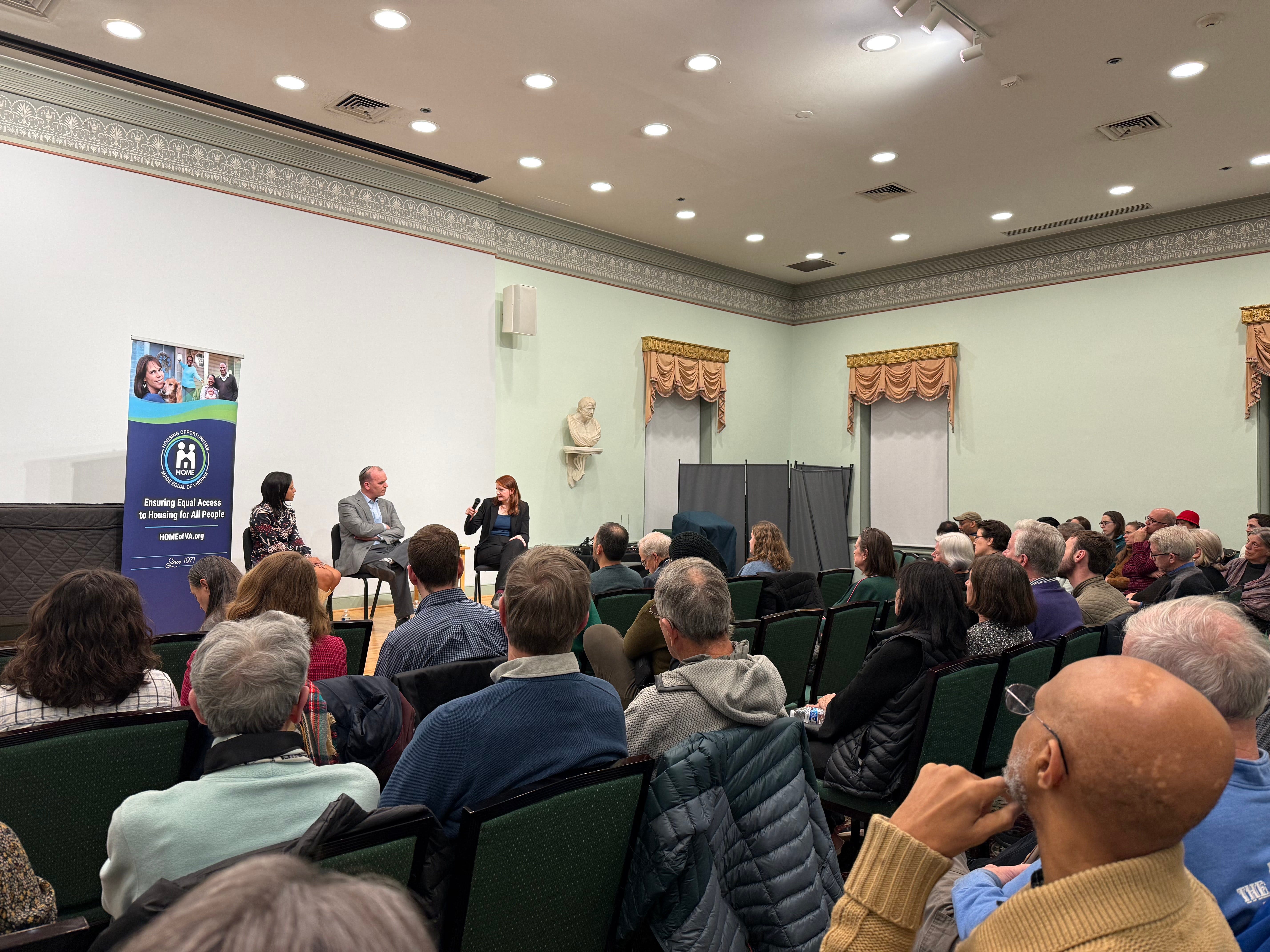
About 100 people filed into the second-floor hall of the Lyceum on Monday evening, escaping 30-degree temperatures to hear Mayor Alyia Gaskins and author Yoni Appelbaum discuss the roots of America’s housing crisis.
The forum, titled “Let’s Talk About Housing: Zoning For Justice and Affordability,” explored how zoning laws originally designed to enforce racial segregation continue to shape housing outcomes today.
Gaskins opened with her personal housing story. Her mother worked two and sometimes three jobs, she said, but still struggled to keep a stable home.
“I watched my mom constantly have to choose between whether or not she was going to pay the rent or pay her medication or make sure that her daughter had something to eat,” Gaskins said.
That instability followed her into adulthood. The mayor said she and her husband now work a combined five jobs to afford living in Alexandria and have repeatedly been outbid when trying to purchase a home.
Appelbaum, deputy executive editor at The Atlantic and author of “Stuck: How the Privileged and Propertied Broke the Engine of American Opportunity,” traced zoning’s origins to Modesto, California, in the 1880s. City officials there passed an ordinance restricting laundry businesses to a single area — the block labeled “Chinatown” on city maps.
“Zoning originates in the United States as a legal mechanism for enforcing racial segregation through laws that are facially neutral,” Appelbaum said.
Similar patterns played out in New York, where early zoning aimed to push Jewish workers back into the Lower East Side, and in Baltimore, which enacted explicitly segregationist ordinances, he said.
The cumulative effect has reversed a defining feature of American life. For 200 years, people moved from poorer areas to richer ones in search of opportunity. Over the past two decades, that pattern has flipped — Americans now leave prosperous communities for places where housing is cheaper.
Alexandria faces its own version of this challenge. The city had approximately 18,000 naturally occurring affordable units in 2000 but now has fewer than 6,000, according to Gaskins. Those units typically serve residents earning $60,000 or less annually.
“If we’re building more housing, but we’re also losing the housing we have that’s affordable to those who need it most, then in my opinion, we’re trying to tread water,” she said.
Federal policy is compounding local difficulties. Gaskins pointed to affordable housing projects sitting idle due to financing uncertainty, workforce shortages from immigration policy changes and rising construction costs tied to tariffs. She also cited recent cuts to Housing and Urban Development funding.
On community engagement, Gaskins described lessons learned during planning efforts in Arlandria. Traditional public meetings failed to reach vulnerable residents, so city staff began conducting Ethiopian coffee ceremonies, apartment meetings held entirely in Spanish and parking lot gatherings where staff wore headphones to listen in residents’ native languages.
“You can’t ask people to set a vision for their entire community when they’re worried about whether or not they will be a part of this community tomorrow,” Gaskins said.
She acknowledged that public discourse around development has grown more hostile during her time in office. Emails that once began “Dear Councilwoman” now often start with “Dear incompetent,” she said.
Appelbaum suggested reframing how communities talk about housing. Ask people whether they want young families to be able to move in or seniors to age in place, he said, not whether they want an apartment building in their backyard.
“You get a really different response,” he said.
Laura Dobbs, policy director for Housing Opportunities Made Equal of Virginia, moderated the discussion, presented in partnership with the Office of Historic Alexandria.
Gaskins closed with conversations she’s had with pastors of historic Black churches whose congregations have largely been displaced from the city.
“Almost every single one of them said, ‘Don’t nobody live here no more. We’ve all had to move out,’” Gaskins said. “The only thing they’re able to do is to drive in from Maryland for church on Sunday and then to drive back out.”