Table of Contents
ALEXANDRIA, Va. — Alexandria's public license plate reader page began showing two things Tuesday that it did not show a day earlier: the number of searches run over the past 30 days, and the full list of law enforcement agencies allowed to search the city's cameras.
The list runs to 161 agencies. All of them are Virginia entities. No federal agency appears on it, and no out-of-state department.
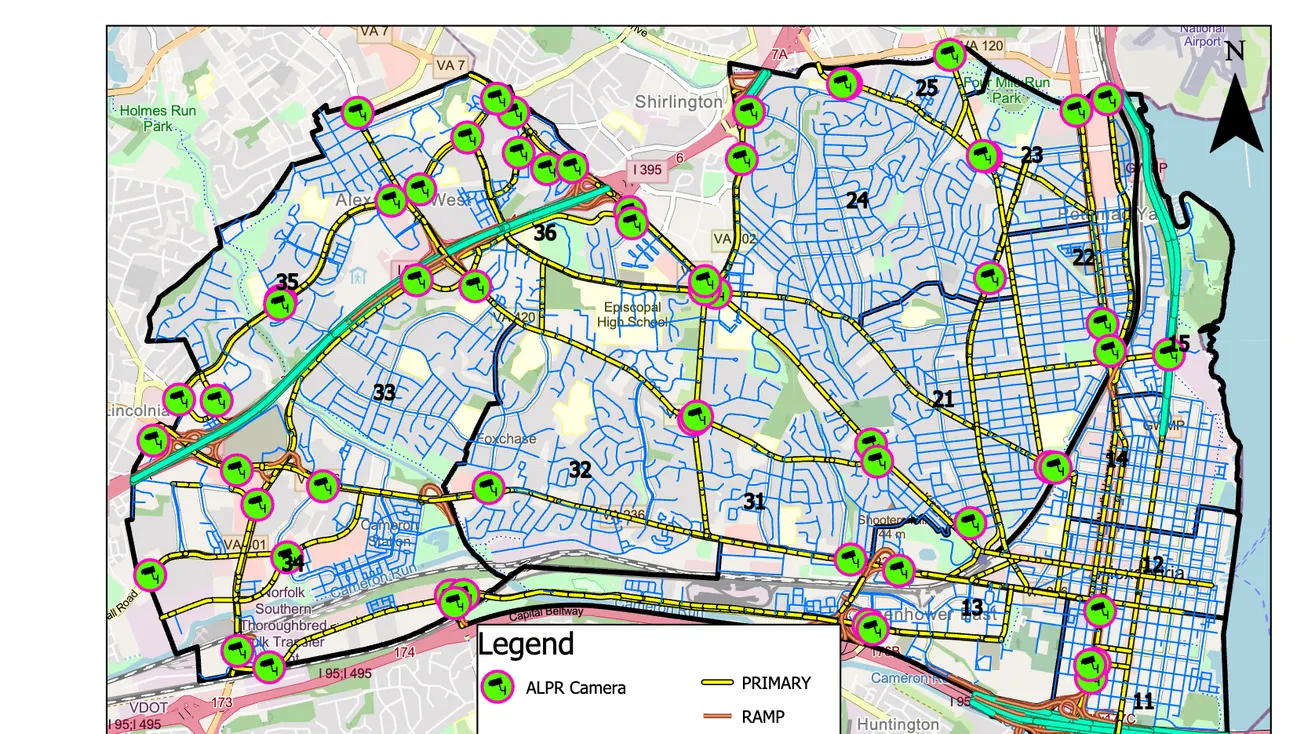
Two days earlier, Mayor Alyia Gaskins said she had asked Police Chief Tarrick McGuire and City Manager James Parajon to publish exactly that information, along with camera locations, and to switch on a set of new privacy controls announced last week by Flock Safety, the company behind the 61 cameras the Police Department operates.
"I have reached out to the Chief and the City Manager to express my desire for a public conversation about the use of Flock cameras and other surveillance tech, including the types of technology, budgets, civil rights, criteria for placement decisions or disclosure of their use, current policies, etc.," Gaskins wrote Sunday in response to questions from The Alexandria Brief.
What prompted the change is not clear, and more than one thing could account for it. Flock urged agencies last week to publish sharing partners and search activity. The Alexandria Brief asked the Police Department on Friday why those fields did not appear on Alexandria's page. Gaskins told The Alexandria Brief on Sunday that she had asked the chief and city manager to publish them; she did not say when she made the request.
A police spokesperson Monday said the questions would go to the lieutenant who oversees the program, and said that she expected answers once he was in Tuesday morning. At the time of publication the department had not responded, and has not said what changed or when. Flock Safety did not respond to questions.
What the list shows
The 161 agencies range from Virginia Beach and Fairfax County to departments in towns of a few hundred people. Fifty-nine are sheriff's offices. Eleven are neither municipal police nor sheriffs: Virginia State Police, the Department of Corrections, the Department of Wildlife Resources, the Metropolitan Washington Airports Authority, the Norfolk Redevelopment and Housing Authority, and campus forces at George Mason, Virginia Tech, Virginia Commonwealth, Old Dominion, Northern Virginia Community College, Hampden-Sydney and Hampton University.
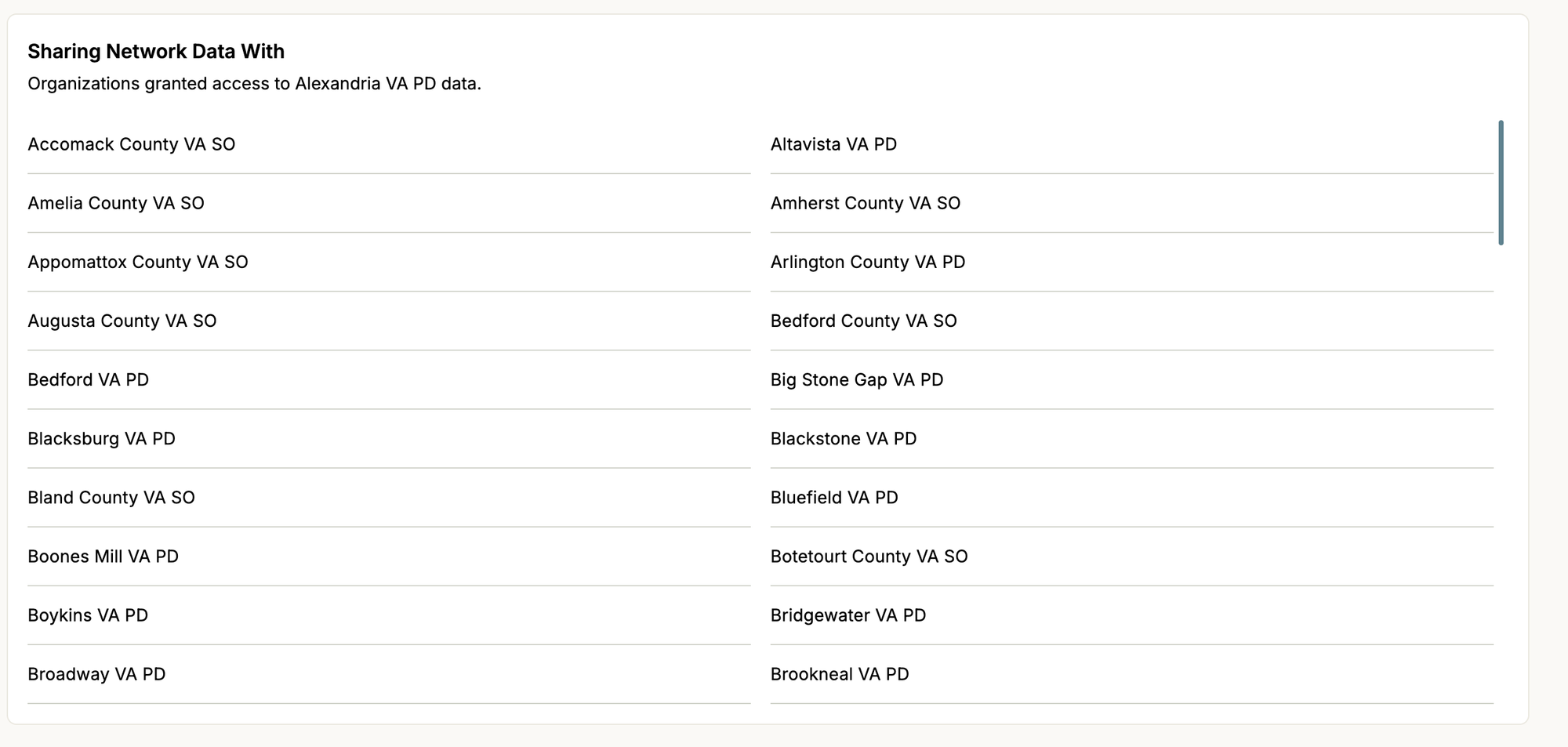
Twenty-one are in the Washington region, among them Arlington County, Fairfax County and Fairfax City, Loudoun County, Prince William County, Leesburg, Herndon, Vienna and the Airports Authority, which polices Reagan National and Dulles.
The list appears to be less a set of partners Alexandria chose than a reflection of how broadly the department shares. Fairfax County publishes its own list of agencies that can search its data, and the two overlap almost entirely — roughly 144 names in common, with the remaining differences mostly small departments on one list and not the other. Alexandria's includes Virginia State Police, which Fairfax's does not. Fairfax's includes Alexandria, confirming the access runs both ways.
That is consistent with what city officials have said for nearly a year. Gaskins told residents in September that police had worked with Flock to disable national data sharing, and said last week that Alexandria does not and will not share the data in civil immigration cases. McGuire told City Council in March that state law bars sharing with federal law enforcement and that violators would face prosecution.
It is also what state law requires. Virginia prohibits agencies from sharing license plate data with federal, out-of-state, private or commercial databases, and allows sharing with another Virginia agency only for defined purposes: criminal investigations with reasonable suspicion, missing and endangered persons, human trafficking, outstanding warrants, and stolen vehicles or plates. Willful violation is a Class 1 misdemeanor.
The list does not answer every question it raises. It shows which agencies can search Alexandria's cameras, not which ones have, or why. It would not reveal whether a Virginia agency ran a search on behalf of a federal one — the practice at issue in a January letter from Sens. Mark Warner and Tim Kaine, who asked the Department of Homeland Security's inspector general to examine whether federal immigration operations were misusing surveillance tools.
The Alexandria Sheriff's Office does not appear. It runs two Flock cameras at the entrances to the city jail under a separate policy and account, and the sheriff is independently elected, outside City Council's authority.
How other Virginia departments report
What a Virginia department publishes about its license plate readers is largely up to the department. State law sets a floor that does not take effect until 2027, and Flock's hosted portals offer a menu of optional fields agencies can switch on. The result is that neighboring jurisdictions disclose different things.
Fairfax County does not use a Flock-hosted page at all. Its Police Department publishes license plate reader information on the county website, last updated Aug. 7, before Flock's announcement. Fairfax breaks out its searches by crime type over the past 30 days: warrants and fugitives account for the largest share at 22.4%, followed by larceny and theft, homicide and death investigations, and motor vehicle theft. It reports cumulative results since November 2022 — 546 stolen vehicles recovered, 898 people arrested, 57 missing persons located. It discloses that it runs 84 Flock cameras alongside 712 Axon readers mounted on cruisers.
It also publishes its audit process in detail. Every search requires a case number and crime type. An audit team reviews all searches for anomalies, an AI tool separately flags patterns, and both feed a monthly report to a commander who is himself barred from running searches. Users who break the rules are removed from the system and must retrain in person.
Alexandria's page lists its retention period, camera count, hot lists, prohibited uses, search count and now its sharing list. It does not break searches out by offense type or describe the audit process, and its two featured case examples are from 2023. Fairfax, in turn, does not publish a portal-style page with prohibited uses and hot list sources laid out the way Alexandria's does.
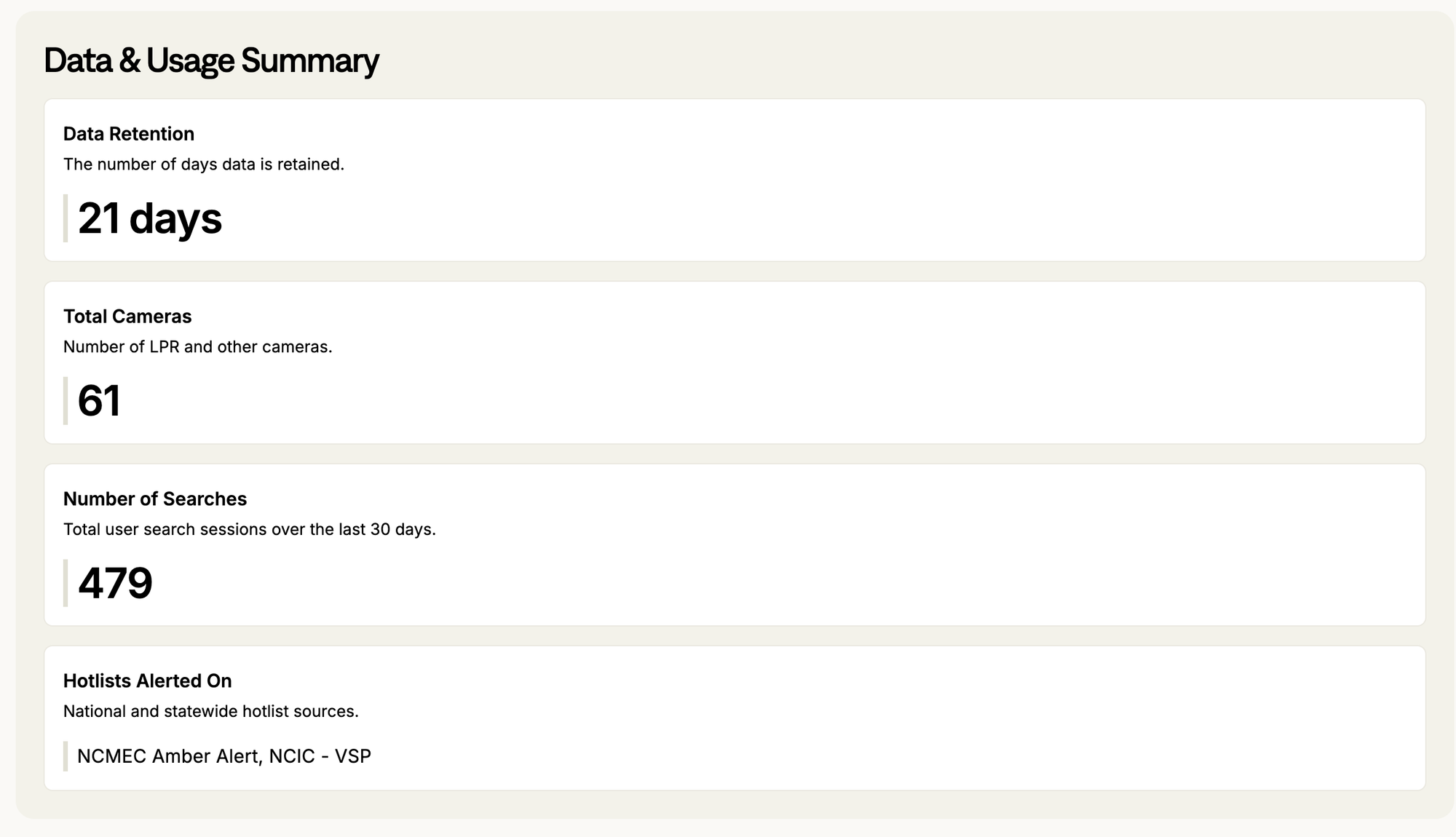
The two search figures are not directly comparable. Fairfax counts individual searches; Alexandria's page reports 479 "search sessions," a unit the portal does not define. Arlington County's page, also hosted by Flock, reports 276 sessions and 41 cameras but no sharing list.
Whether Alexandria audits every search or a sample is among the questions the department has not yet answered. Both Gaskins and McGuire have described a weekly review; Directive 10.40, which McGuire signed in October, requires an internal audit once every 30 days, which is also the minimum state law sets. An earlier version of the directive required a weekly audit.
What hasn't changed
Retention remains 21 days, the maximum Virginia allows. Flock announced Thursday that it was cutting its recommended default from 30 days to seven while letting existing customers keep their current periods, and adding a feature to preserve records tied to an active case.
The company also said it will let agencies block other departments from searching their cameras for particular categories of offense — its example was permitting stolen vehicle and violent crime searches while blocking immigration-related ones. Alexandria's directive already lists immigration enforcement as a prohibited use, as does the portal. The department has not said whether it will enable the filter, which would block such searches technically rather than by policy.
Camera locations, which Gaskins also asked to see published, are still not listed.
The case for the cameras, and against
The department began deploying Flock cameras in 2023 after a rise in car thefts, and has used license plate reader technology for more than two decades in cases involving stolen vehicles, missing persons and illegal firearms. Both examples on its page are from 2023: a stolen car whose driver turned out to be an escaped Wisconsin prisoner, and a stolen car whose driver was a missing juvenile from Fairfax County, returned to her family. McGuire has argued the department needs more technology rather than less, citing staffing pressures, and told a Del Ray community meeting this month that he wants to be constitutionally sound and responsible while acknowledging not everyone will agree.
The American Civil Liberties Union, which runs a national campaign against license plate readers, rejected Flock's announcement the day it was made. Senior policy counsel Chad Marlow wrote that the retention cut may be a step in the right direction but that its value turns on how the new preservation feature works in practice. The organization also says Flock tried offense-based restrictions in June 2025 and that officers defeated them by entering meaningless text in the required reason field.
ICE Out of Alexandria, a coalition of local organizations, called last week for a citywide ban. Charlottesville's City Council ended its Flock contract in January after a one-year pilot.
State law will eventually require every agency to publish an annual report listing which agencies were granted access, how many queries were run and for what purposes, and how many third-party requests for data were received. The first is not due until April 1, 2027.
Ryan Belmore is the founder and publisher of The Alexandria Brief, Alexandria's independent daily community news source. Send news, tips, and feedback to ryan@alexandriabrief.com.
The Alexandria Brief runs solely on reader support — no ads, no corporate owner. Become a monthly or annual supporter or make a one-time contribution.
6,250+ Alexandria neighbors get The Alexandria Brief free in their inbox every weekday morning. Subscribe here.