Table of Contents
Alexandria is navigating one economic storm while a second one forms on the horizon.
The city entered 2026 already reeling. The Washington-Arlington-Alexandria metropolitan area was, as of late 2025, the only large metro in the United States losing jobs — shedding approximately 48,500 positions between November 2024 and November 2025 while every other major American city was growing or flat, according to the Bureau of Labor Statistics. A Brookings Institution analysis presented to the Alexandria City Council last month found that the city's private sector shed 1.1% of its jobs in 2025, one of the steeper declines in the entire DMV region. Inflation-adjusted home prices fell 25% — the sharpest drop of any local jurisdiction. Personal bankruptcy filings rose 28%. Venture capital in the metro collapsed 25%, even as national investment climbed 17%.
"This is a five-alarm fire from an innovation economy perspective," Tracy Hadden Loh, a Brookings fellow who leads the institution's DMV Monitor project, told the City Council in March.
Now comes the second alarm.
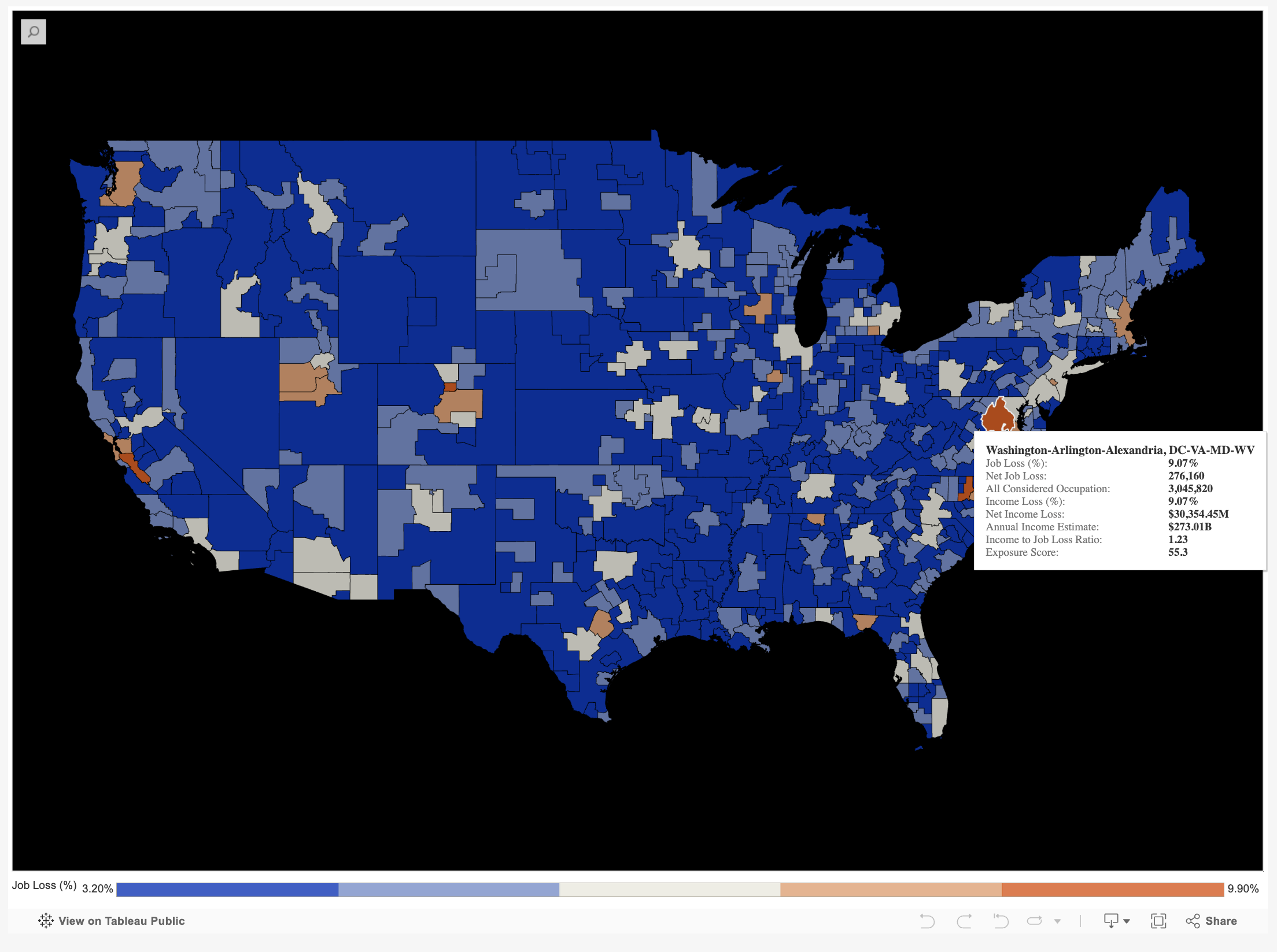
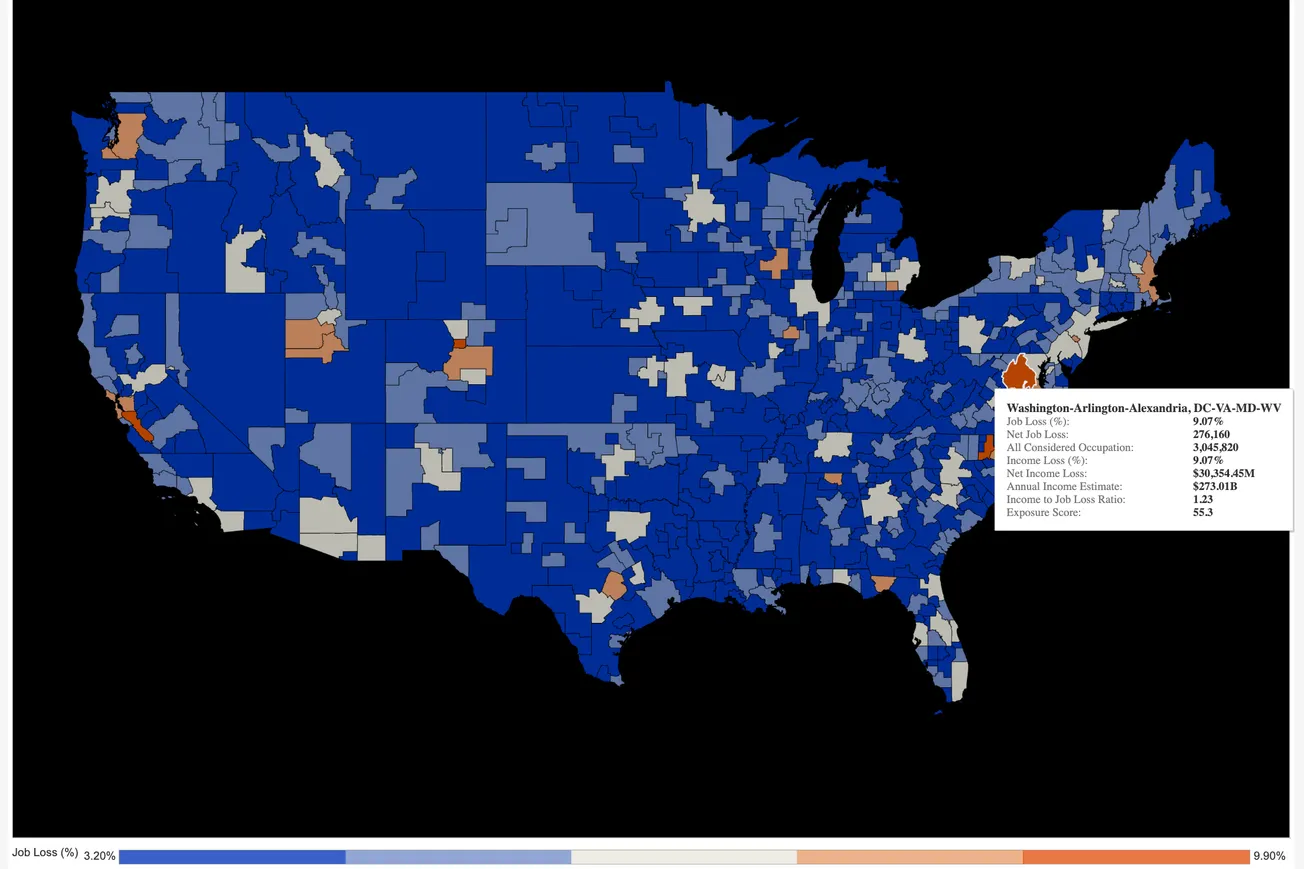
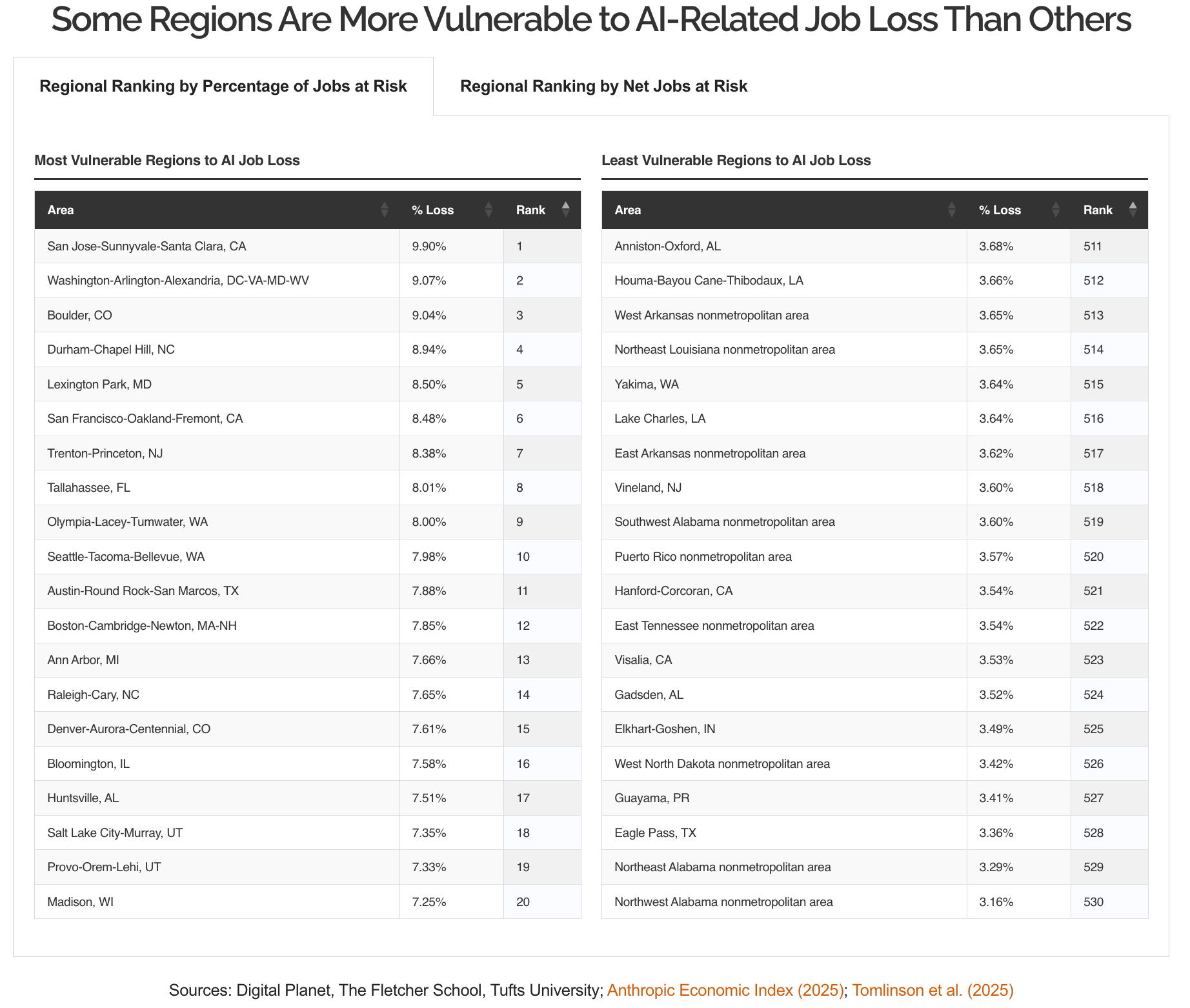
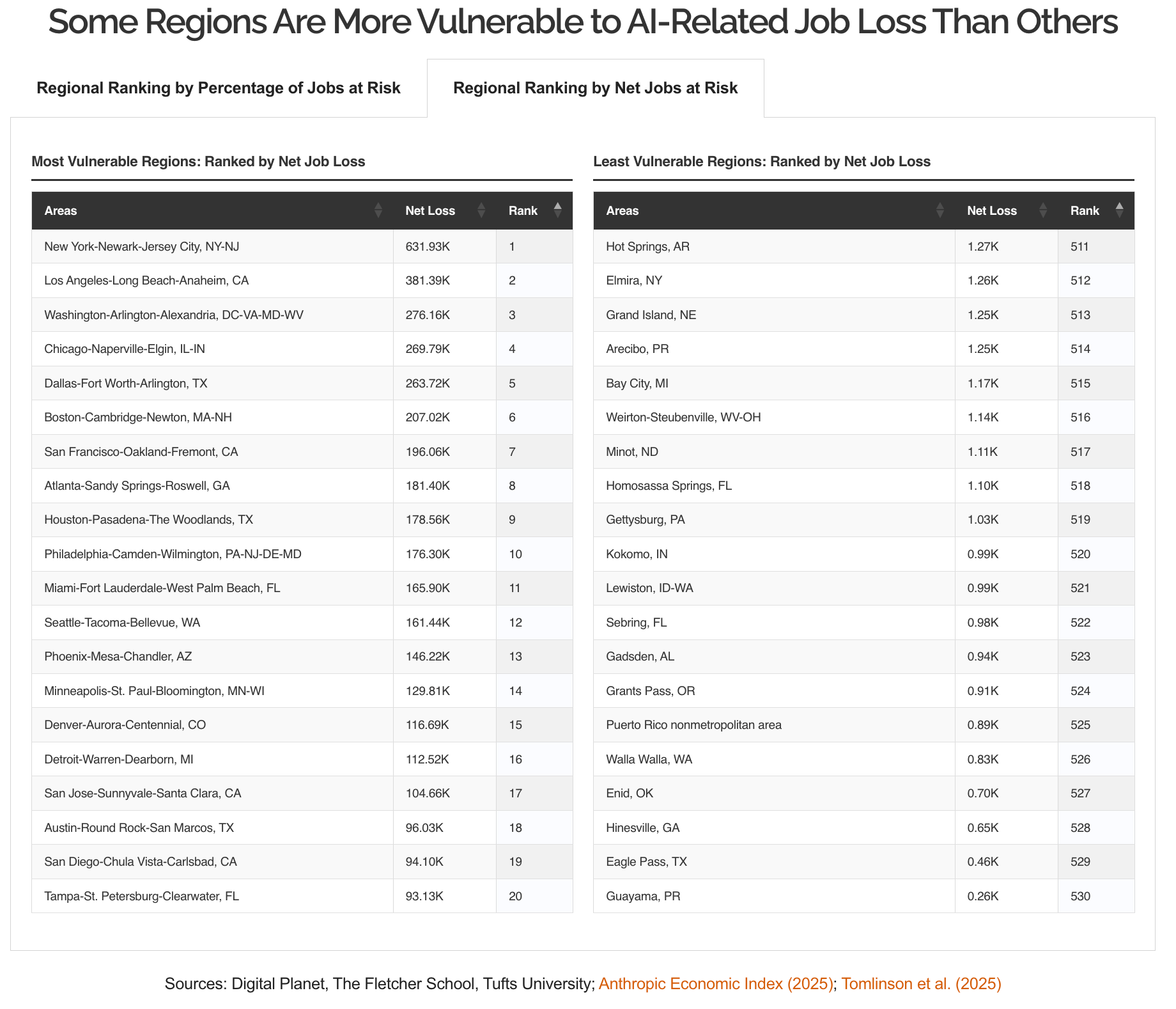
The Washington-Arlington-Alexandria metro ranks second in the country for AI-related job vulnerability, behind only San Jose, according to the American AI Jobs Risk Index released this week by the Digital Planet research program at Tufts University's Fletcher School. The metro faces a projected 9.07% job loss rate across a workforce of more than 3 million positions — translating to an estimated 276,160 jobs at risk and $30.4 billion in annual household income potentially lost to artificial intelligence over the next two to five years.
Only Silicon Valley, at 9.9%, ranks higher. The full report is available at digitalplanet.tufts.edu.
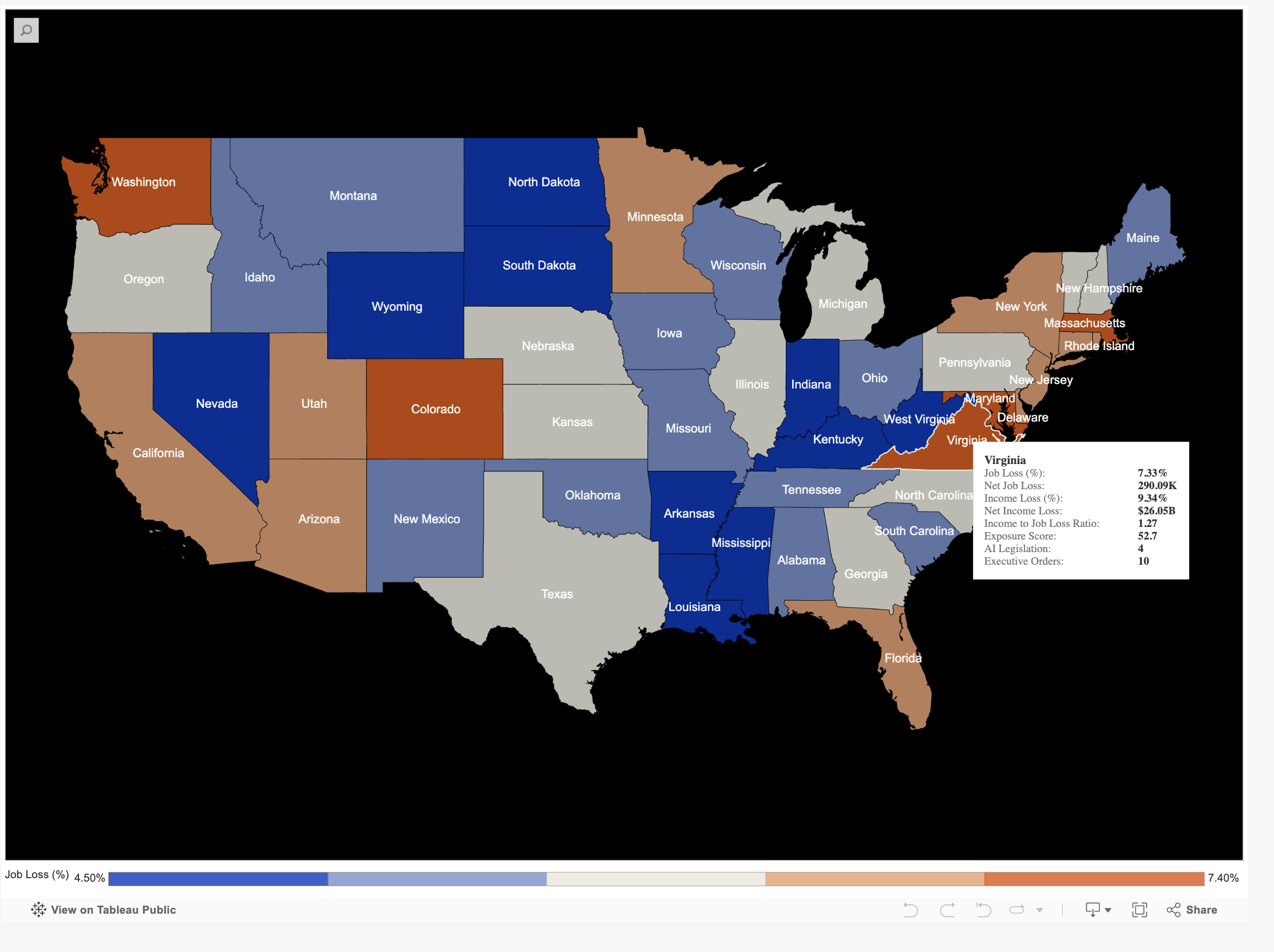
On a national map accompanying the index, where most of the country appears in cool blue, the Washington metro glows a deep amber-orange — the same color reserved for the country's most vulnerable labor markets.
The two threats are distinct in their mechanics but overlapping in their targets. The federal cuts have been sudden and visible, driven by the Trump administration's Department of Government Efficiency initiative, which oversaw the departure of more than 300,000 federal employees nationally since January 2025. AI displacement, by contrast, is gradual and harder to attribute — but the Tufts researchers project it will fall hardest on the same kinds of knowledge-intensive, white-collar workers who populate Alexandria's professional economy.
When researchers filtered the Tufts occupation-level data specifically to the Washington metro, management analysts topped the list of projected AI-driven job losses by a significant margin, with software developers close behind. Also among the most exposed: business operations specialists, public relations specialists, market research analysts, customer service representatives, computer systems analysts, lawyers, and operations research analysts.
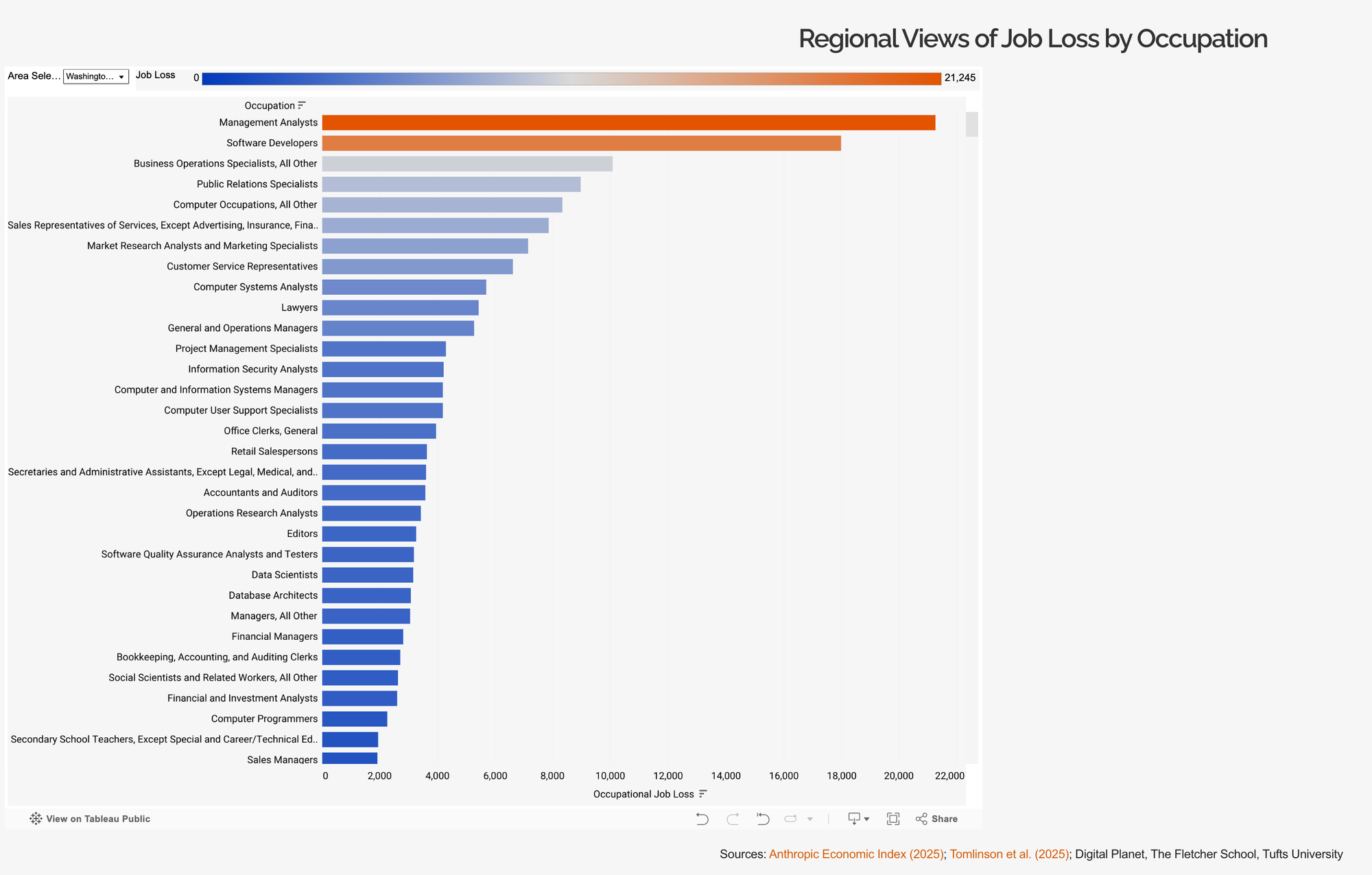
Those are not abstract categories. They describe the résumés of the federal contractors, consultants, and communications professionals who fill Alexandria's office buildings — and who are already under pressure from the federal workforce reductions rippling through the city's private sector.
City Manager Jim Parajon warned the City Council as recently as January that uncertainty tied to federal policy was "manifesting in the money markets and capital markets that really fuel much of our economy." More than 20% of Alexandria's workforce holds federal jobs — well above the Northern Virginia average of 12.5% — and federal contract obligations in the city fell 16% from late 2024 to late 2025. The ripple effects have reached the retail corridor: resident spending at brick-and-mortar stores dropped 7.77% in the year ending September 2025, the sharpest decline among core DMV counties.
At the state level, Virginia faces a 7.33% projected AI job loss rate and $26.05 billion in net income loss — ranking among the six most vulnerable jurisdictions in the country alongside the District of Columbia, Massachusetts, Maryland, Washington state, and Colorado. Virginia's income-to-job-loss ratio of 1.27 indicates that the positions most at risk are disproportionately higher-paying ones, compounding the budget pressure on a city that draws more than 60% of its operating revenue from property taxes.
Virginia's congressional delegation has made efforts to address artificial intellignece and the work force over the last several months.
Rep. Don Beyer, who represents Alexandria in the House, co-chairs the Congressional Artificial Intelligence Caucus and is pursuing a master's degree in machine learning at George Mason University — in part, he has said, to better inform his work on AI policy. On March 26, he introduced the bipartisan AI Foundation Model Transparency Act alongside Reps. Mike Lawler (R-NY) and Sara Jacobs (D-CA), which would require companies behind powerful AI tools — including ChatGPT, Claude, Gemini and Grok — to disclose how their models are built and what data they are trained on. Days earlier, he introduced the GUARDRAILS Act to repeal President Trump's executive order that critics say amounts to a moratorium on state AI regulation. "In today's lawless, Wild West artificial intelligence environment, states have been leading the charge to implement safeguards," Beyer said. "The Trump White House aims to kill state AI laws without setting even minimally acceptable federal guardrails."
In the Senate, Mark Warner has focused on the workforce dimension. In March, he introduced the bipartisan Economy of the Future Commission Act with Sen. Mike Rounds (R-SD), which would convene policymakers, academics and industry experts — including leaders from George Mason University, Northern Virginia Community College, UVA, Virginia Tech and James Madison University — to develop legislative recommendations on reskilling and unemployment policy for an AI-disrupted economy. "The question isn't whether these changes are coming," Warner said. "It's whether we are prepared." Warner has also pressed the Labor Department and Bureau of Labor Statistics to expand data collection on AI's workforce effects, warning that policymakers are making decisions without reliable federal statistics on a disruption already underway.
The political environment for responding at the federal level remains, as Beyer put it, a "Wild West." The Trump executive order targeting state AI regulation is currently under legal challenge. Virginia has passed four pieces of AI-related legislation and issued ten executive orders on the topic — but faces federal pressure to scale back precisely as the economic stakes are rising. The Tufts report notes that states most at risk from AI job displacement legislate on AI at four times the rate of the least-affected states, a collision of economic anxiety and political constraint playing out in real time in Richmond and in Washington.
Locally, there are early attempts to build on the region's strengths rather than simply absorb the disruption. In February, Alexandria and Arlington jointly launched the National Innovation Quarter — a nonprofit backed by Amazon, Northrop Grumman, Virginia Tech and others — aimed at becoming "connective tissue" for the region's defense tech and startup ecosystem, with a $5 million budget over three years. The following month, the Alexandria Economic Development Partnership issued a request for proposals for a new business accelerator targeting startups in AI, robotics, cybersecurity, quantum computing and defense — the first time AEDP has earmarked direct support for those industries. "We know these startups are here. We know they are succeeding. And we know they want and need this support to grow in Alexandria," said Philomena Fitzgerald, AEDP's small business and entrepreneurship manager. Brookings' Loh had noted the region possesses the raw ingredients of a major innovation hub; both initiatives represent a bet that those ingredients can be activated before the window closes.
There is one irony embedded in the Tufts data worth noting for a region that has long oriented its economy around stability and government proximity: the 38% of American jobs considered essentially AI-proof are, by and large, the country's lowest-paid positions — manual, physical roles in construction, food service, and elder care. "The safe zone," the researchers write, "is the near-poverty zone."
The American AI Jobs Risk Index will be updated as new labor market data becomes available. The full report is at digitalplanet.tufts.edu. The Brookings DMV Monitor is at brookings.edu/dmv-monitor.