Table of Contents
ALEXANDRIA, Va. — On June 18, 1856, a horse-drawn omnibus left the corner of King and Washington streets every 15 minutes, carrying Alexandrians northwest along King Street to the formal dedication of Ivy Hill Cemetery. The ceremony featured hymns and prayers on a hillside above Timber Branch, on a 22-acre tract that had been a family burial ground for nearly half a century. By the day of the dedication, almost 80 burial lots had already been sold to Alexandria residents.
Ivy Hill was Alexandria's first cemetery designed in the garden style — and the first to be situated, by intent, outside the dense urban grid of the city. It would remain in continuous use from that day forward.
The Rural Cemetery Movement
The dedication of Ivy Hill placed Alexandria within a national movement that had been reshaping American burial practices for more than two decades. The Rural Cemetery Movement, as historians later named it, began with the founding of Mount Auburn Cemetery in Cambridge, Massachusetts, in 1831 — a sprawling, landscaped burial ground that broke from the centuries-old American tradition of crowded churchyards in the middle of towns. Laurel Hill in Philadelphia followed in 1836; Green-Wood Cemetery in Brooklyn in 1838.
The movement responded to two concerns. The first was practical: as American cities grew, their churchyards filled, and overcrowded burial grounds in the urban core were increasingly seen as a public health threat. The second was aesthetic and philosophical. Reformers argued that the dead deserved more dignified resting places than packed lots behind sanctuaries, and that the living deserved peaceful, contemplative landscapes in which to mourn. The new cemeteries — sometimes called "garden cemeteries" or "rural cemeteries" — were laid out with winding paths, ornamental plantings, scenic views and gracefully placed monuments. In some cases, they doubled as the closest thing many cities had to public parks before the parks movement of the later 19th century.
By the mid-1850s, the model had spread south. Alexandria's own city council had prohibited the opening of new cemeteries within the city limits earlier in the 19th century, which is why most antebellum burials in Alexandria took place in the cluster of church-affiliated burial grounds along Wilkes Street. Beyond city limits, a small family graveyard on a hilly tract owned by Alexandria merchant Hugh C. Smith had been quietly accumulating burials since 1811.
From farm to cemetery
After Smith's death in 1854, his executor sold two parcels of the family land — 21 acres and a smaller 1.7-acre tract — to a group of 30 Alexandrians who organized a stockholder cemetery company. The price was $2,000, and the founders' plan was to use the sale of additional lots to fund improvements: a keeper's house, a chapel, a receiving vault and the landscaping that would mark Ivy Hill as a place apart. In March 1855, the stockholders met and elected a president and board. The company was formally chartered in 1856.
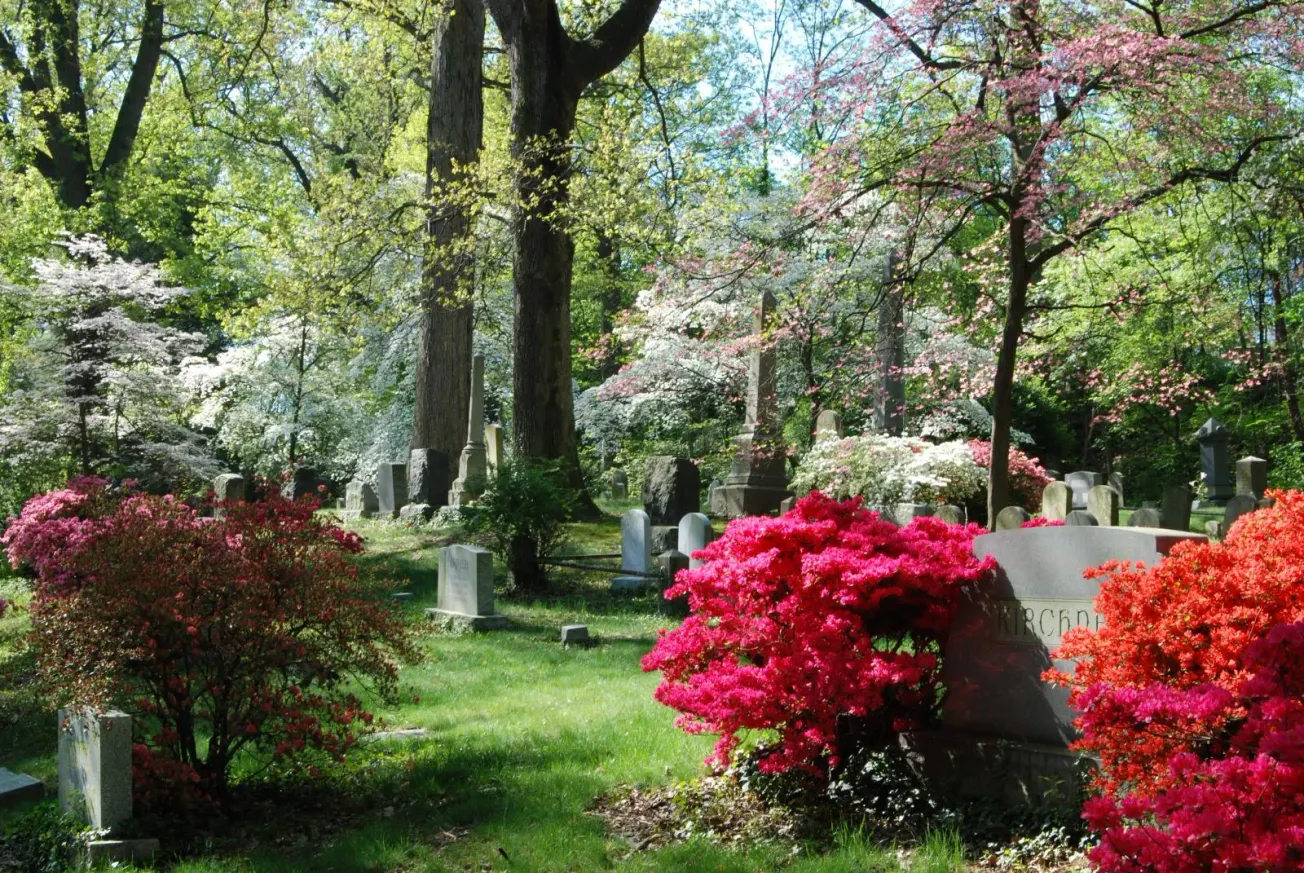
The site they had purchased ran along Timber Branch, a small creek that still winds through the property today, and gently sloped down from a high ridge. The cemetery's founders kept the natural stream as a feature of the landscape, laid winding driveways through the grounds, and built two structures that still stand: the Keeper's Lodge near the King Street entrance and the Receiving Vault for temporary storage of remains when the ground was frozen or burials had to be delayed.
Firemen, war and recognition
Five months after the dedication, on November 17, 1856 — the first anniversary of a deadly warehouse fire — Ivy Hill held a second major ceremony to dedicate the Firemen's Monument, a marble obelisk just inside the King Street gate, in memory of seven Alexandria volunteer firefighters who had died fighting that blaze. The monument is still there. So are the graves of many of the firefighters and their successors over the next century and a half.
The Civil War damaged the grounds. Federal troops, who occupied Alexandria from May 1861 through the end of the war, caused enough harm to the cemetery that a postwar committee sought compensation from the federal government. In May 1866, the cemetery raised subscriptions to enclose the grounds with fencing — both for security and to restore the sense of a deliberately bounded landscape that the Rural Cemetery Movement had always emphasized.
In the years since, Ivy Hill has become the resting place of figures whose lives crossed Alexandria's broader history: descendants of George Washington's family; Harry H. Vaughan, the military aide to President Harry S. Truman; Charles M. Goodman, the modernist architect who helped reshape mid-century residential design in Northern Virginia; and members of the Burke, Herbert and other prominent Alexandria families. The cemetery's grounds were listed on the Virginia Landmarks Register in December 2024 and on the National Register of Historic Places in April 2025, recognizing both the site itself and its place in the national Rural Cemetery Movement.
The cemetery today
Ivy Hill remains active and open daily, sunrise to sunset, at 2823 King St., on the same hillside above Timber Branch that Hugh C. Smith's family had used as a burial ground when the site sat well beyond Alexandria's outer edge. The streetcar suburbs that grew up around it in the early 20th century — Rosemont chief among them — turned the cemetery's "rural" setting into something different than its founders imagined. But the landscape Smith's heirs and a group of 30 civic-minded Alexandrians shaped for the dedication on June 18, 1856 is still there to walk through: the winding driveways, the gentle slope, the small stream, the marble obelisk to the seven firefighters, and the 22 acres of trees and quiet that the Rural Cemetery Movement believed every American city ought to have.
Information via the City of Alexandria's Office of Historic Alexandria, the Virginia Department of Historic Resources, the National Register of Historic Places, the Alexandria Times and Ivy Hill Cemetery Co.