
Alexandria City Council Recap: City Hall design, union contracts dominate first meeting at temporary home
Council modifies Board of Architectural Review conditions in 5-2 vote, approves nearly $32 million in labor agreements

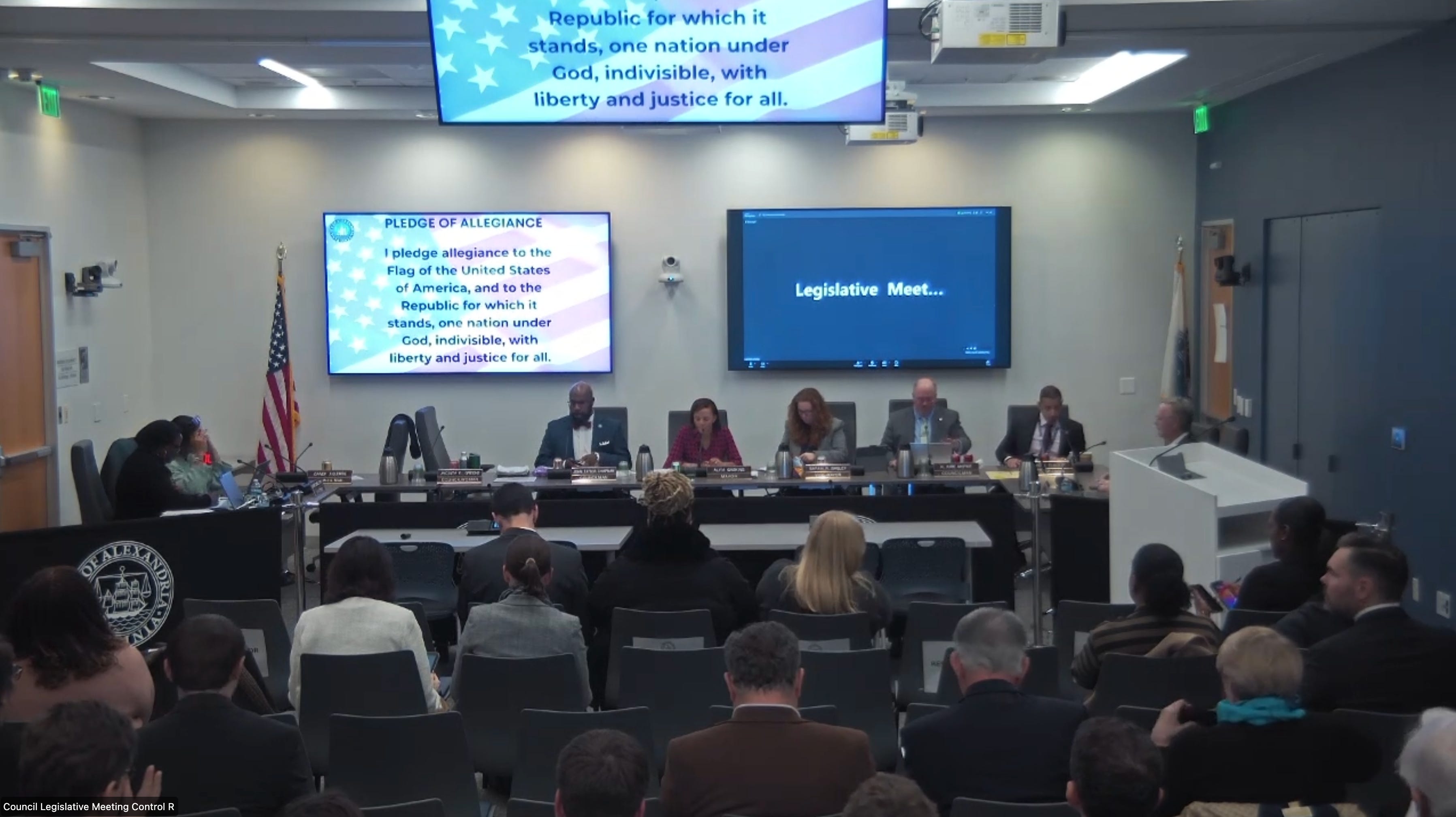
The Alexandria City Council concluded a four-and-a-half-hour meeting shortly before midnight Tuesday at its temporary home in the Del Pepper Community Resource Center, somewhat overruling the Board of Architectural Review on City Hall renovation designs and approving union contracts covering police, fire, and administrative workers.
The meeting marked the council’s first legislative session at the Mark Center Drive facility while City Hall undergoes a $123.6 million renovation. Construction mobilization begins January 20.
City Hall appeal
In a 5-2 vote, the council sided with city staff over the Board of Architectural Review, rejecting requirements for decorative chimneys and stone pilasters on the building’s south facade while affirming most other conditions from the BAR’s November approval.
The decision came after extensive testimony from preservation advocates urging the council to uphold the BAR’s conditions and city staff arguing that those requirements would violate federal preservation standards and jeopardize historic tax credit eligibility.

Jeremy McPike, director of General Services, told the council that the BAR’s conditions would create “a false sense of historical development” regarding the 1961 addition to the historic 1871 building. He said the Virginia Department of Historic Resources reviewed the BAR’s proposed design and indicated the project would not qualify for tax credits.
“We have concerns that an approved design for the south new construction will not meet the requirements of standards three and nine,” McPike said, quoting the state’s response. “In essence, the state would not approve this project should the city decide to move forward with a tax credit application process.”
BAR Chair Andrew Scott defended the board’s November decision, explaining that the conditions resulted from seven months of collaborative review with the city.
“This is not some kind of Franken motion,” Scott said. “Each of these conditions is a discrete condition unrelated to the others that we had previously discussed with the appellant. The board worked very hard to approve something that the city itself asked us to approve.”
Scott noted the BAR consistently requires property owners throughout the historic district to maintain chimneys. “We require citizens of this great city 15 times a year to rebuild their chimneys,” he said. “This is not some special rule we’re applying to the city.”
Council members split on how to balance historic preservation with cost and design intent.
Councilman Canek Aguirre opposed the chimneys, citing the estimated $200,000 cost. “Every penny counts,” he said. “$200,000 is something we could use to bring on staff. $200,000 is another program that we can create. $200,000 is something we could send to the schools who are desperately asking us for more money.”
Councilman John Chapman, who voted to uphold the BAR’s conditions, pushed back on cost arguments. “If we were worried about money for this project, we would not be moving city chambers,” he said, referencing other expensive design decisions the council had already approved.
Chapman supported brick pilasters over stone, arguing the Market Square entrance should remain understated. “The Market Square entrance of City Hall has always been the back door of City Hall,” he said. “I think it should remain that.”
Vice Mayor Sarah Bagley emphasized that the building’s historic significance comes from its 1871 core, not the 1960s addition. “What makes us special is we’re older than the country,” she said. “What makes us historic is not the 1960s. What makes us historic is the 1870s.”
Preservation advocates urged the council to defer to the BAR’s expertise. Al Cox, a former city employee who has served on architectural review boards for 40 years, said the BAR was established 80 years ago as the nation's third such board.
“Design review is often a messy process, but in my experience, many property owners thanked me and said how much the process had improved their project,” Cox said.
Christine Roberts, representing the Historic Alexandria Foundation, argued the city should follow the same standards as private applicants. “I would just like to reiterate that the Historic Alexandria Foundation would really like to see this applicant treated like all the other applicants before the BAR,” she said.
The council’s approved design uses brick pilasters instead of stone, removes the decorative chimneys, allows simpler window designs, and permits safety lighting on the fifth floor that the BAR had prohibited. Several BAR conditions were retained, including requirements that restoration materials match historic materials and that the fifth-floor exterior blend with adjacent slate roofs.
Construction mobilization begins January 20, with completion targeted for the third quarter of 2028.
Union contracts and economic report
Council unanimously approved collective bargaining agreements with three employee unions, totaling nearly $32 million in wage increases and benefits for police, fire, and administrative workers through fiscal year 2029.

City Manager James Parajon also delivered a State of the Economy report showing federal employment down 9 percent nationally since January 2025, with 277,000 positions eliminated. His proposed FY 2027 budget presentation is scheduled for February 24.

Economic development strategy
Council unanimously adopted ALX Forward, a strategic framework for economic growth developed over three years by the Alexandria Economic Development Partnership.
“We need to make more money as a city,” said Stephanie Landrum of AEDP. “And the easiest way for us to do that is to grow the economy.”
The framework, the city’s first comprehensive economic development plan in more than 15 years, aims to attract business investment and diversify the tax base. Councilman Chapman secured an amendment ensuring community partners will work directly with the city manager during implementation, not just through AEDP.
Torpedo Factory lease process
Council approved the first reading of an ordinance initiating the solicitation process for the Torpedo Factory Arts Center’s lease, management and operations. A public hearing is scheduled for January 24, followed by a 60-day advertising period if approved.
“This solicitation has been prepared with maximum flexibility,” said Deputy City Manager Emily Baker. “We want to write this solicitation in a way that allows interested parties to come to us and tell us what their vision is.”
Vice Mayor Bagley, who pulled the item for discussion, acknowledged the significant public interest in the facility’s future. “There is a lot of love and a lot of history,” she said.
Other business
Council approved an amendment to the Tall Ship Providence Foundation’s franchise agreement, with Mayor Alyia Gaskins recusing herself due to a potential conflict of interest related to her employment.
The meeting opened with a proclamation recognizing January as Alexandria Mentoring Month.
Council’s next legislative meeting is January 28.