
Alexandria school board advances capital improvement plan, setting up Thursday vote
Plan defers Cora Kelly modernization eight years, converts Jefferson-Houston and Patrick Henry to address middle school overcrowding

The Alexandria City School Board moved forward Tuesday night with a 10-year capital plan that defers the Cora Kelly School modernization from 2028 to 2036 and converts two K-8 schools to address overcrowded middle schools.
The board is scheduled to formally adopt the $282.3 million plan at its meeting Thursday evening.
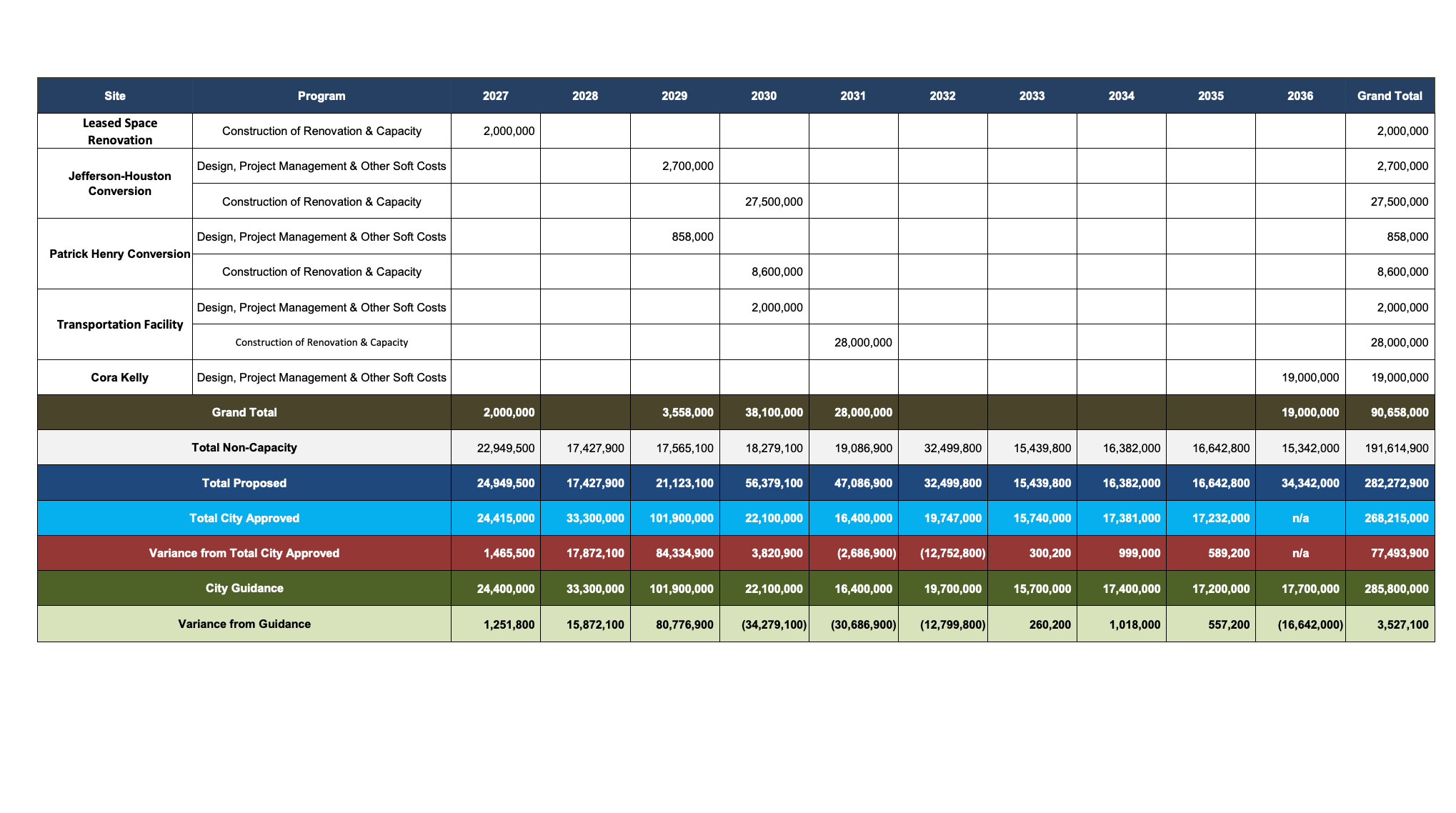
The plan comes in under the city manager’s $285.8 million spending guidance, a significant reduction from Superintendent Melanie Kay-Wyatt’s original $340.4 million proposal in November, which had included $105 million for the Cora Kelly modernization beginning in 2028.
The board voted 6-3 to advance Kay-Wyatt’s revised proposal over an alternative that would have delayed specific project decisions. Board members Michelle Rief, Tim Beaty, Christopher Harris, Alexander Crider Scioscia, Ashley Simpson Baird and Kelly Carmichael Booz supported the plan. Abdulahi Abdalla, Ryan Reyna and Donna Kenley voted against it.
“This was a creative solution that we had,” Chief Financial Officer Dominic Turner said. “We had the constraint of dollars. We don’t have the dollars, so to be creative, this was an option that was a third of the cost of a brand new middle school.”

Conversions address overcrowding
The plan converts Jefferson-Houston to a middle school and Patrick Henry to an elementary school, with both opening in their new configurations in 2030. The Jefferson-Houston conversion is budgeted at $30.2 million, while the Patrick Henry conversion is budgeted at $9.5 million, for a combined cost of approximately $39.7 million.
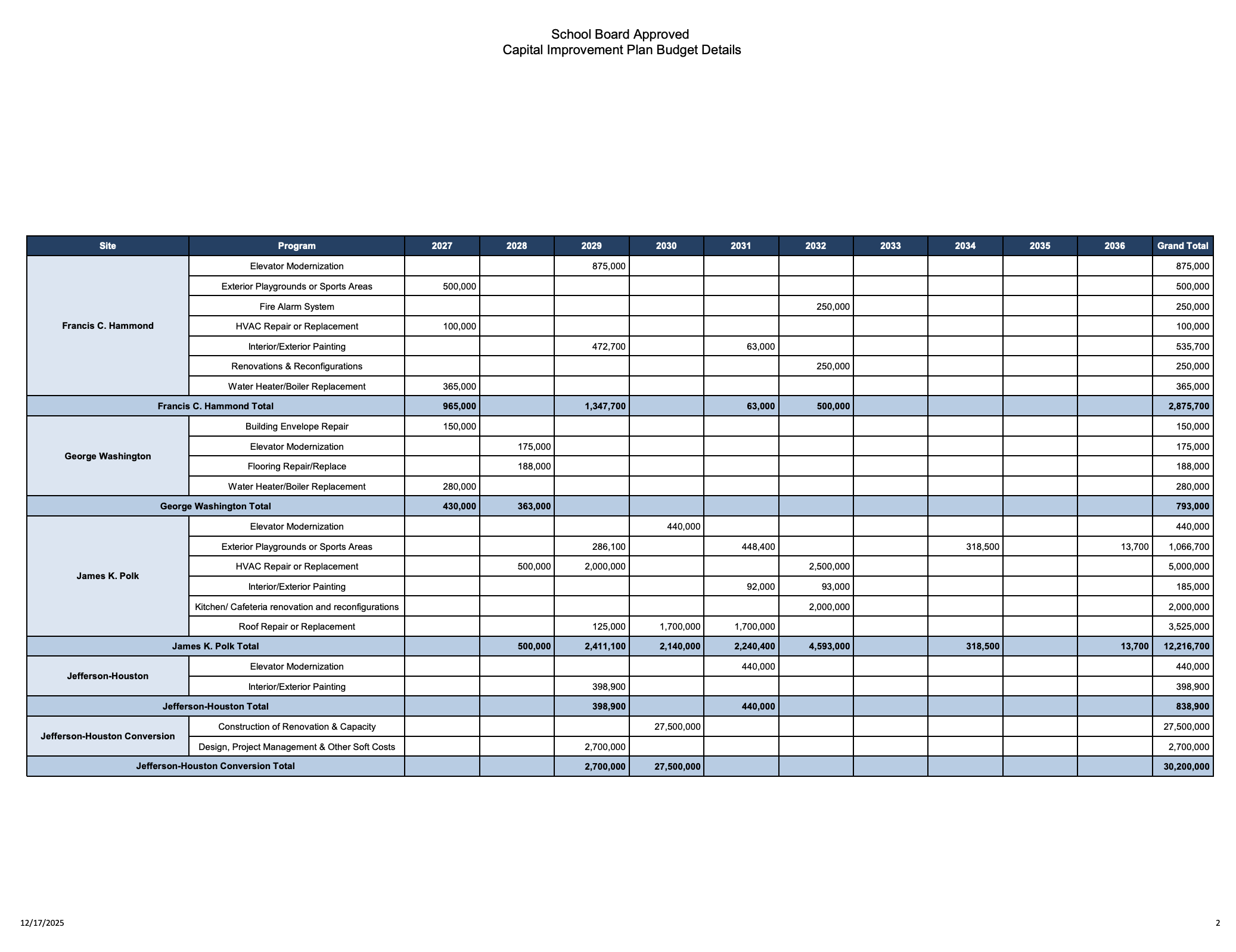
The conversions address severe overcrowding at George Washington Middle School, which operates at 126 percent capacity, and Francis C. Hammond Middle School at 113 percent capacity. Together, the two middle schools house roughly 400 more students than they were designed to serve.
The conversions implement a December 2024 board decision to phase out the K-8 educational model. That vote passed 7-2.
Cora Kelly pushed back
The plan defers the Cora Kelly modernization eight years, from fiscal year 2028 to 2036. The project, originally estimated at nearly $100 million, would cost approximately $8 million annually in debt service payments over 20 years.
The board allocated funding for maintenance and non-capacity improvements to the building while the modernization waits.
“If we are going to build a new building for Cora Kelly in 36 and 37, we don’t want to put tens of millions of dollars in there because then you’re throwing good money after bad,” Turner said.
Cora Kelly is one of four ACPS elementary schools designated as needing intensive support under Virginia’s new school accountability framework.

Alternative rejected
Reyna proposed an alternative that would have removed specific school names from the plan, instead allocating $60 million for “middle school capacity” to be determined through a joint subcommittee with City Council.
“My core proposal is to allow us to have the time and the space to look at those things collectively and come up with an option that we feel both balances the cost issues and our ability to position capacity places,” Reyna said.
Turner warned that $60 million would be insufficient to build a new middle school, meaning any alternative would still require converting an existing building.
Simpson Baird pushed back on the placeholder approach.
“Once we take it off the table, it’s not coming back,” she said. “We’re getting ourselves into a situation where we’re giving them power to make more of a decision for us, and we’re getting into something that’s more expensive, hands down.”
The board also rejected a compromise proposal to change the project language to “middle school capacity (proposed K-8 conversion or new solution)” by a 5-4 vote. Abdalla, Reyna, Kenley and Booz supported the language change.
Regrets on process
Several board members who supported the plan acknowledged concerns about how the Jefferson-Houston conversion was decided.
Booz said the redistricting process taught her lessons about community engagement that were not applied to the Jefferson-Houston decision.
“While there was a conversation about K-8 in general leading up to our decision in December, we never had the community engagement that we had with redistricting about converting Jefferson-Houston to a middle school,” Booz said. “And so that’s the piece that I regret.”
She added: “We saw firsthand how hard it is for families to hear that their children might be moving schools. It’s personal. That approach helped families understand not just the outcome, but the reasoning behind it, even if families didn’t like the outcome.”
Booz said she regretted “specifically naming Jefferson-Houston during our CIP as a middle school without meaningful community engagement and without city council at the table,” though she maintained that ending the K-8 model was the right decision.
Harris, who voted for the plan, expressed concerns about the long-term implications.
“We’re not building a school for the next two years. We’re building a school for the next 50 years,” Harris said. “I just want to make sure that we’re doing our due diligence and making the right decision based off good data, good information and good feedback from the communities that’s going to be impacted.”
Community opposition
Save JH, an advocacy group that has opposed converting Jefferson-Houston from a K-8 school to a standalone middle school, criticized the board’s decision.
In written comments submitted to school board members ahead of Thursday’s vote, Salomea Fredericks cited gains in reading and math scores for Black students and economically disadvantaged students at Jefferson-Houston. A copy of the comments was provided to The Alexandria Brief.
“At the very moment this success is coming into focus, the Board is proposing nearly $40 million more to dismantle the elementary program that made it possible,” Fredericks wrote.
The group has pointed to state data showing reading pass rates for Black students at Jefferson-Houston rose from 34 percent in 2022-23 to 44 percent in 2024-25, while pass rates for economically disadvantaged students increased from 36 percent to 45 percent over the same period.
Fredericks also raised concerns about deferring the Cora Kelly modernization to fund the conversions.
“It is especially troubling that, in order to fund this conversion, the Board chose to defer the long-promised modernization of Cora Kelly, another Title I school serving a vulnerable community,” she wrote.
In separate comments also provided to The Alexandria Brief, David Robbins urged the board to study the impact on Alexandria Redevelopment and Housing Authority families who rely on Jefferson-Houston as a walkable elementary school.
“Eliminating Jefferson-Houston as a neighborhood elementary school removes key capacity in high-growth areas of Old Town and disproportionately harms ARHA families who rely on its central location and established community,” he wrote.
Other projects
The plan includes $30 million for modernizing the district’s transportation facility, which has water damage and needs upgrades to accommodate an expanding electric bus fleet.
It also reduces funding for relocating the Chance for Change alternative education program from $5 million to $2 million by moving it to district-owned space at 1703 North Beauregard Street instead of leasing external space.
Financial picture
Turner emphasized that every $1 million financed costs roughly $80,000 annually in debt service for 20 years.
“By making tough choices here on the capital improvement program, hopefully we can have some easier options for us on the operating side,” Turner said.
The board will formally vote on the plan at 6 p.m. Thursday at 1340 Braddock Place.

This story has been updated to reflect the release of official CIP documents. The Alexandria Brief requested copies of the proposed plan on Wednesday; ACPS did not respond but posted the materials to the public agenda after 5 p.m. that day.