
Publisher's note: Clean the mirror
On monks, mirrors, and what thousands of Alexandrians stood in the cold to hear

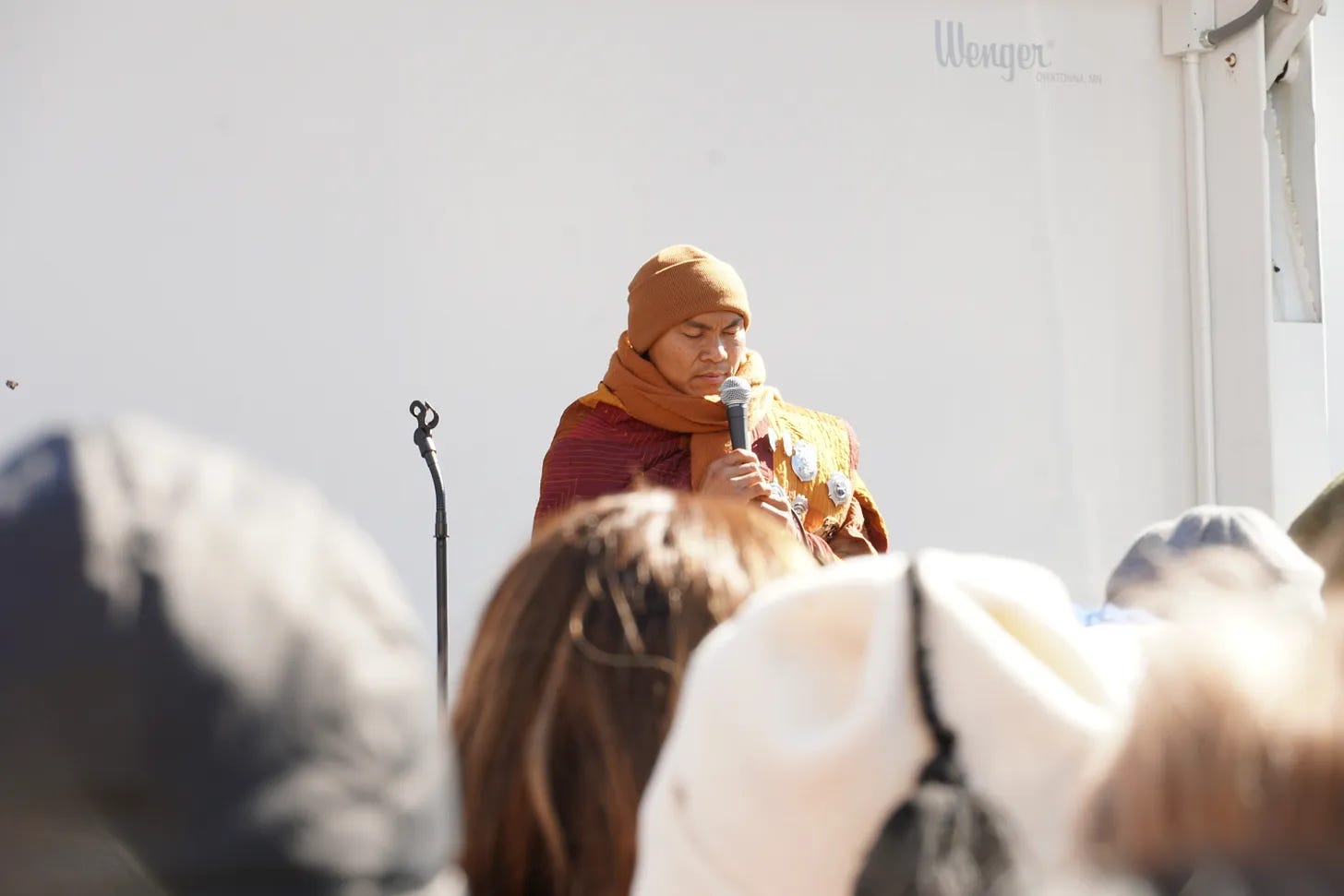
Yesterday, I stood outside Christ Church for several hours with thousands of people in 33-degree weather, watching a Buddhist monk who has been walking for 107 days, tell us to brush our teeth.
Not exactly. But sort of.
Just before the program began, at least two bald eagles circled overhead. The crowd looked up and cheered. It was 33 degrees on a Monday morning in front of a church where George Washington once worshipped, and nobody was leaving.
Venerable Bhikkhu Paññākāra — the leader of the Walk for Peace, a 2,300-mile pilgrimage from Fort Worth, Texas, to Washington, D.C. — spoke for nearly an hour on the steps of one of Alexandria’s oldest landmarks. He talked about mindfulness, about suffering, about teenagers showing up to his temple in depression. He talked about people who threw things at his monks as they walked down the highway. He talked about sticky rice.
But the thing I haven’t been able to shake is the mirror.
He asked the crowd: when you brush your teeth in the morning, do you clean the toothpaste and water spots off the mirror right after? Not many raised their hand. He smiled. Lazy, he said. We’re always rushing.
His point was simple. Every time something happens to us — someone cuts us off, someone says something cruel, we read something that makes our blood boil — we record it. We store it. We replay it. And each time we do, it’s another spot on the mirror.
He said don’t record it at all. When it happens, deal with it right then. React with kindness, let it pass through you, move on. Sound comes in one ear and goes out the other — don’t keep it. Clean the mirror the moment the spot lands. Because if you wait a week, if you wait a month, the spots have hardened. Now you need chemicals and tools to scrub it off. Why would you do that to yourself when you can just wipe it right away?
Then someone in the crowd needed medical attention. There was a ripple of concern, people shifting, murmuring. A monk who has been walking for 107 days didn’t flinch. He asked thousands of strangers to put their left hand over their heart, close their eyes, and feel their heartbeat. Thousands of people did it. No questions. The whole crowd went still.
That was the mirror in practice. Something happened, and instead of recording it as panic, he dealt with it right in that moment. Acknowledged it. Let it pass. Came back to the breath.
I looked around during his talk. I saw people crying — on stage and off. I saw couples of all ages holding each other. I saw people who looked like they hadn’t exhaled in months finally standing still. What I kept thinking was that every person in that crowd was looking for the same thing: any hope they could find.
I think that’s why thousands of people showed up on a Monday morning. Not because of Buddhism specifically. Because people are exhausted. Exhausted by the noise, by the outrage cycle, by the weight of carrying everything all the time. And a man who has walked 2,200 miles in a robe stood in front of them and said: you can put it down. Right now. Today.
He asked the crowd to say it out loud: today is going to be my peaceful day.
Thousands of people said it together, on a freezing Monday, on a sidewalk in Old Town, and for a moment it felt like something shifted.
I don’t know how long that feeling lasts. I know the news cycle moves fast. I know by the time you read this, there’s probably something new to react to. But I keep coming back to what he said about the mirror.
Don’t wait a month. Don’t wait a week. Wipe it off now. It’s easier that way.
Today is going to be my peaceful day.
— Ryan Belmore, Publisher

Beautifully said.
Right on point, Ryan. Thank you.