Table of Contents
City Manager James Parajon presented a proposed $977.3 million General Fund budget Tuesday night that holds Alexandria's real estate tax rate steady for fiscal year 2027 — but most homeowners will still pay more, because their properties are worth significantly more than they were a year ago.
The proposed budget, unveiled to City Council at its regular legislative meeting, closes a $22.9 million budget gap without raising the real estate or personal property tax rates. It proposes $9.0 million in efficiency savings and vacant position reductions, funds the city's first collective bargaining agreements with police, fire, and administrative employees, and increases the transfer to Alexandria City Public Schools, though by less than the school board has requested.
What homeowners will pay
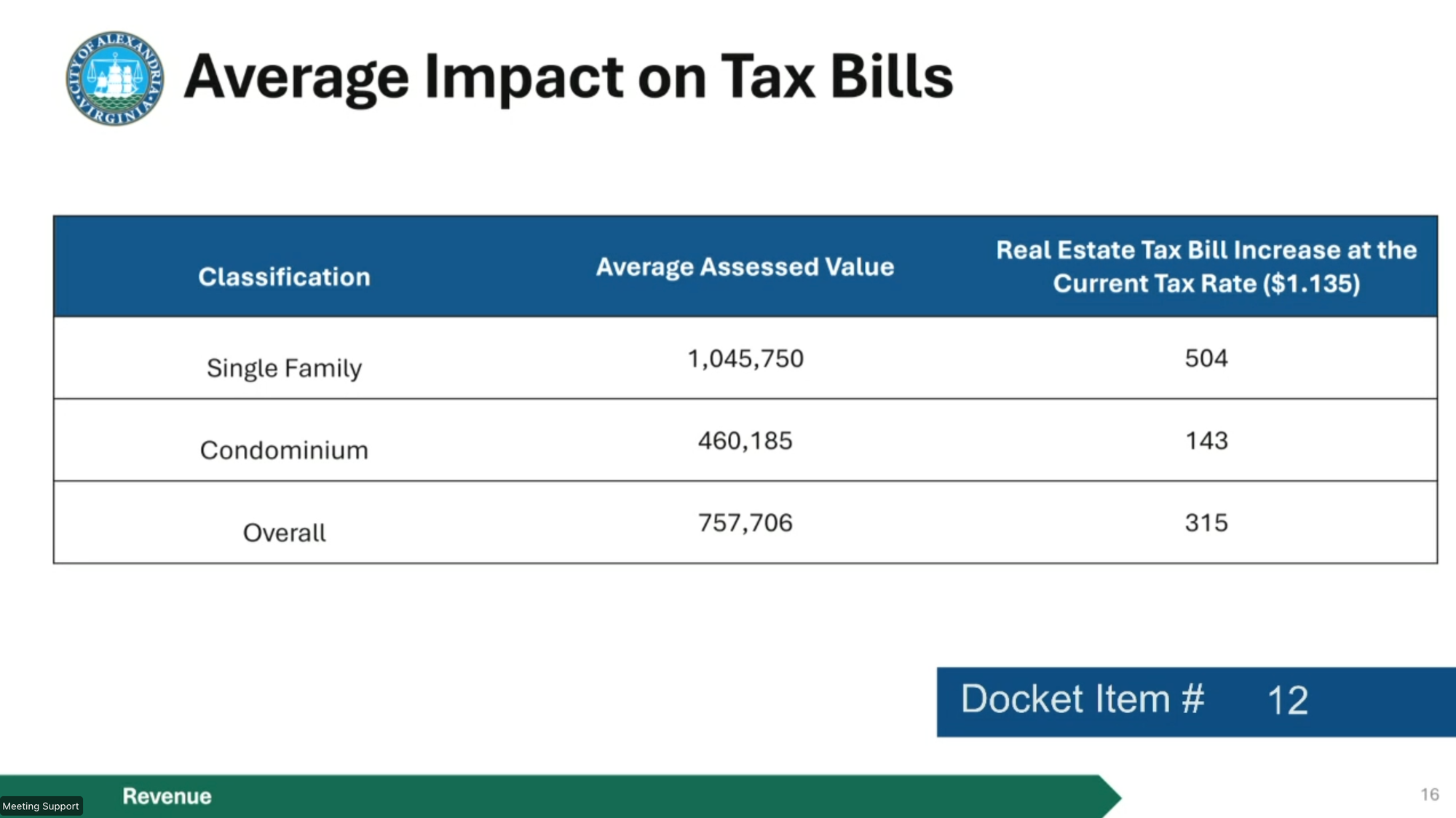
The proposed real estate tax rate remains $1.135 per $100 of assessed value — unchanged from the current rate. But with the city's residential tax base rising 4.40% this year, that rate applied to higher assessments means larger bills. The average single-family homeowner faces a $504 annual increase; the average condominium owner faces a $143 increase. Across all residential properties, the average tax bill would rise by $315 per year.
Separately, the stormwater utility fee rises $17.10 to $357.40 per year for the average single-family home, continuing a previously planned 5% annual increase to fund future infrastructure projects. Sanitary sewer and refuse rates are unchanged.
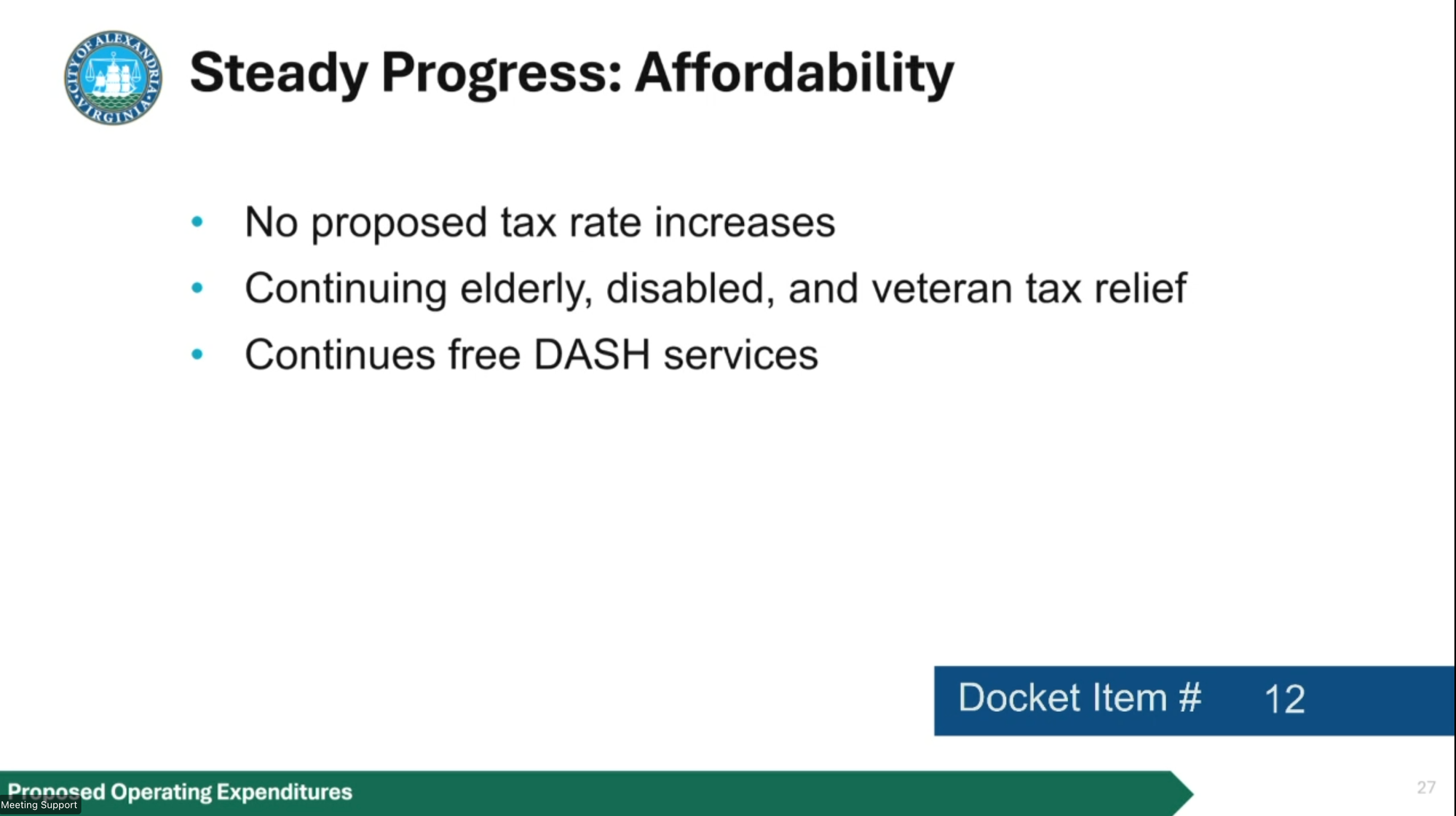
For those most vulnerable to cost increases, the budget maintains $12 million in tax relief for older adults, residents with disabilities, and veterans, with an April 15 application deadline. Free DASH bus service also continues under the proposal.
The $22.9 million gap
Parajon described the budget as the product of difficult tradeoffs against modest revenue growth. Rising costs from new collective bargaining agreements, school funding requests, and debt service on capital projects created a $22.9 million gap that required both new efficiencies and careful prioritization.
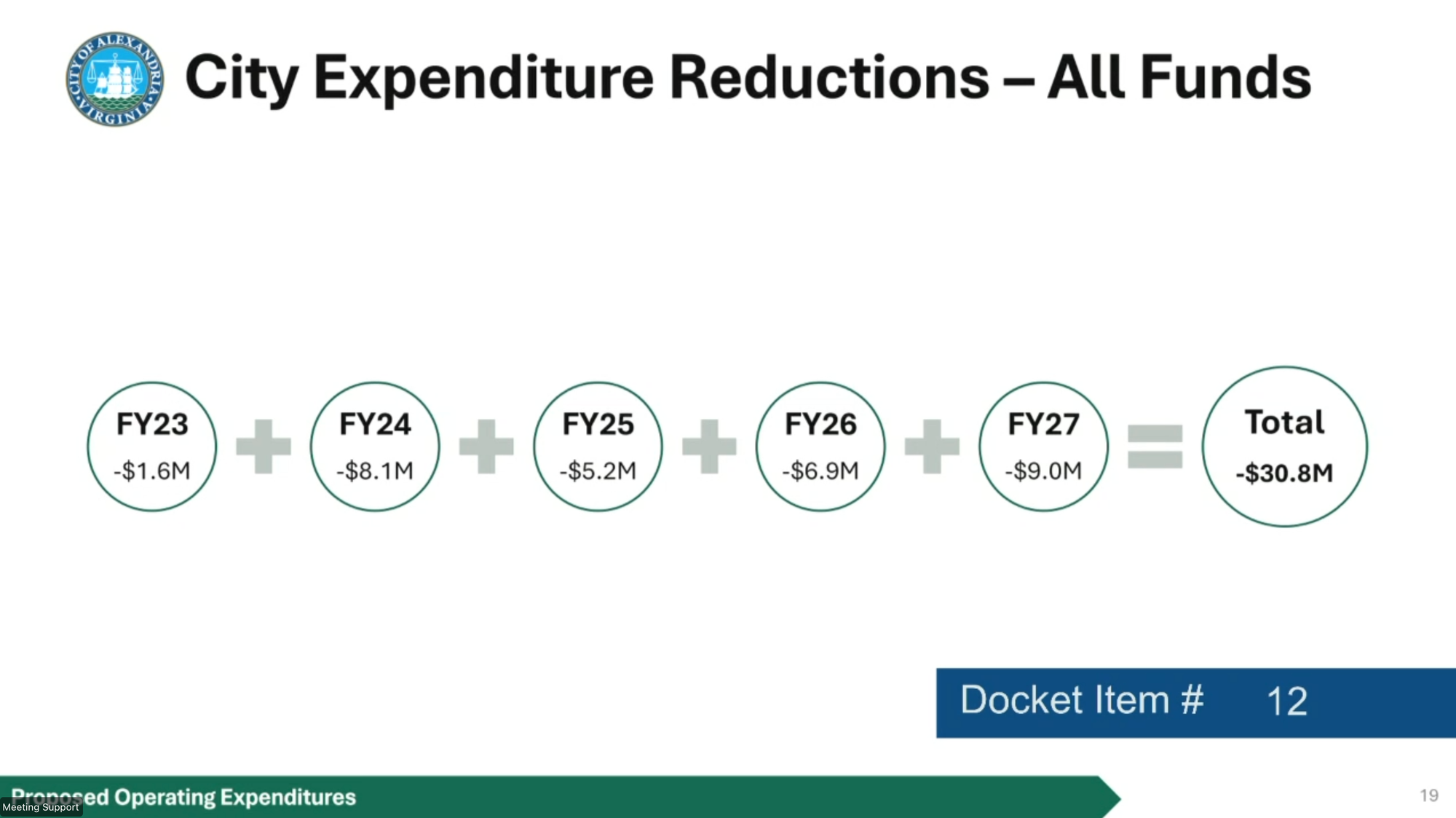
To close it, the proposed budget eliminates 45.06 positions — all vacant, with no layoffs of current employees — while adding seven new roles, for a net reduction of 38.06 full-time equivalents. The proposed city workforce stands at 2,837.16 FTEs, down from 2,875.22 in FY 2026. The $9.0 million in FY 2027 cuts brings the city's total savings across five consecutive budget cycles to $30.8 million since FY 2023.
Schools: 1.5% vs. 3.5%
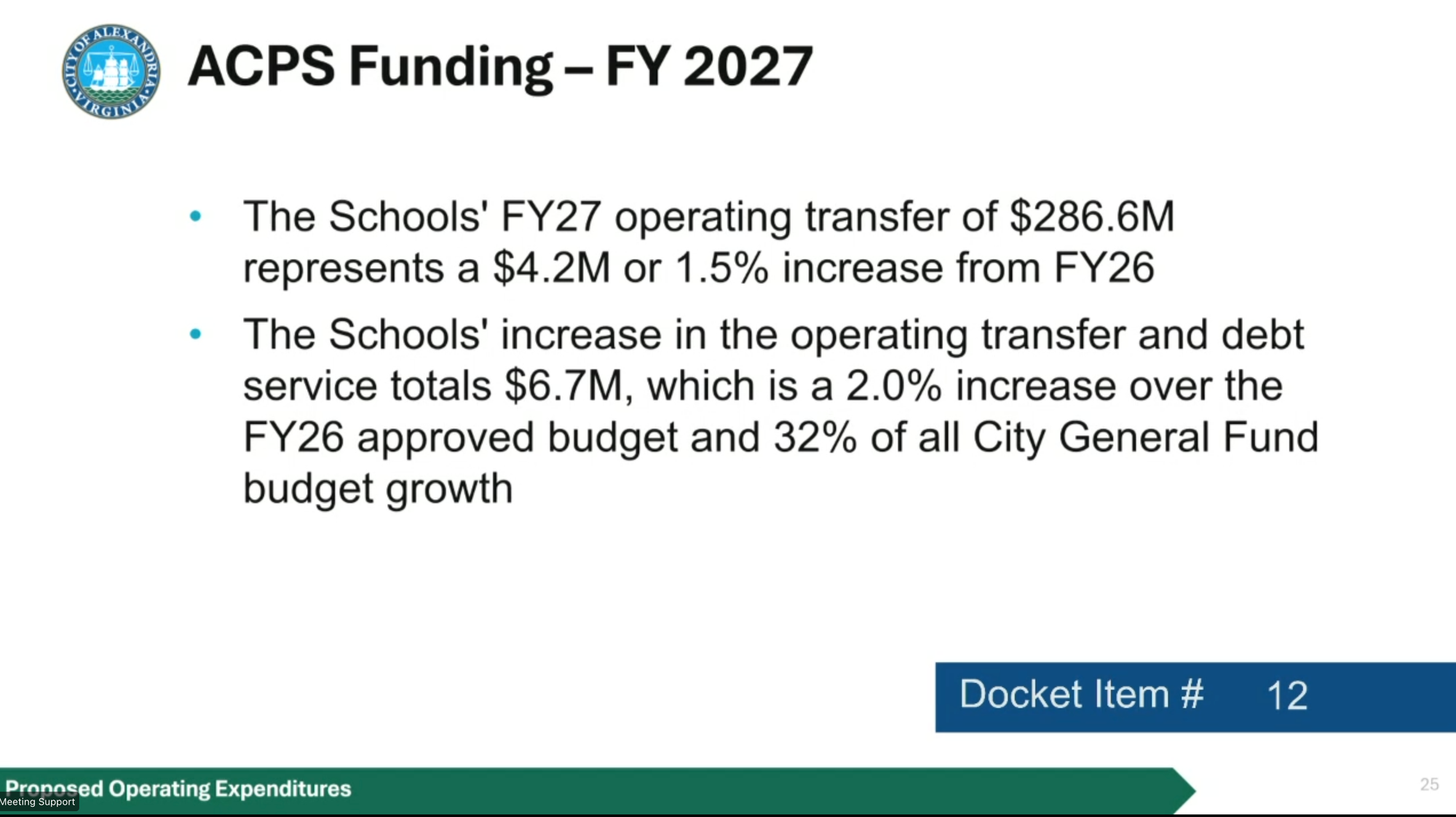
The most contested element of the proposal is the Alexandria City Public Schools operating transfer. Parajon's budget proposes $286.6 million for ACPS — a $4.2 million, or 1.5%, increase from FY 2026 — the same guidance he provided to the school division at the start of the budget cycle.
That falls $5.6 million short of the 3.5% increase the School Board unanimously adopted Feb. 19 in its $408.2 million budget request. School Board Chair Michelle Rief warned after that vote that the 1.5% figure would not cover a basic step increase for ACPS staff and would force additional position cuts, larger class sizes and difficulty retaining teachers to neighboring jurisdictions.
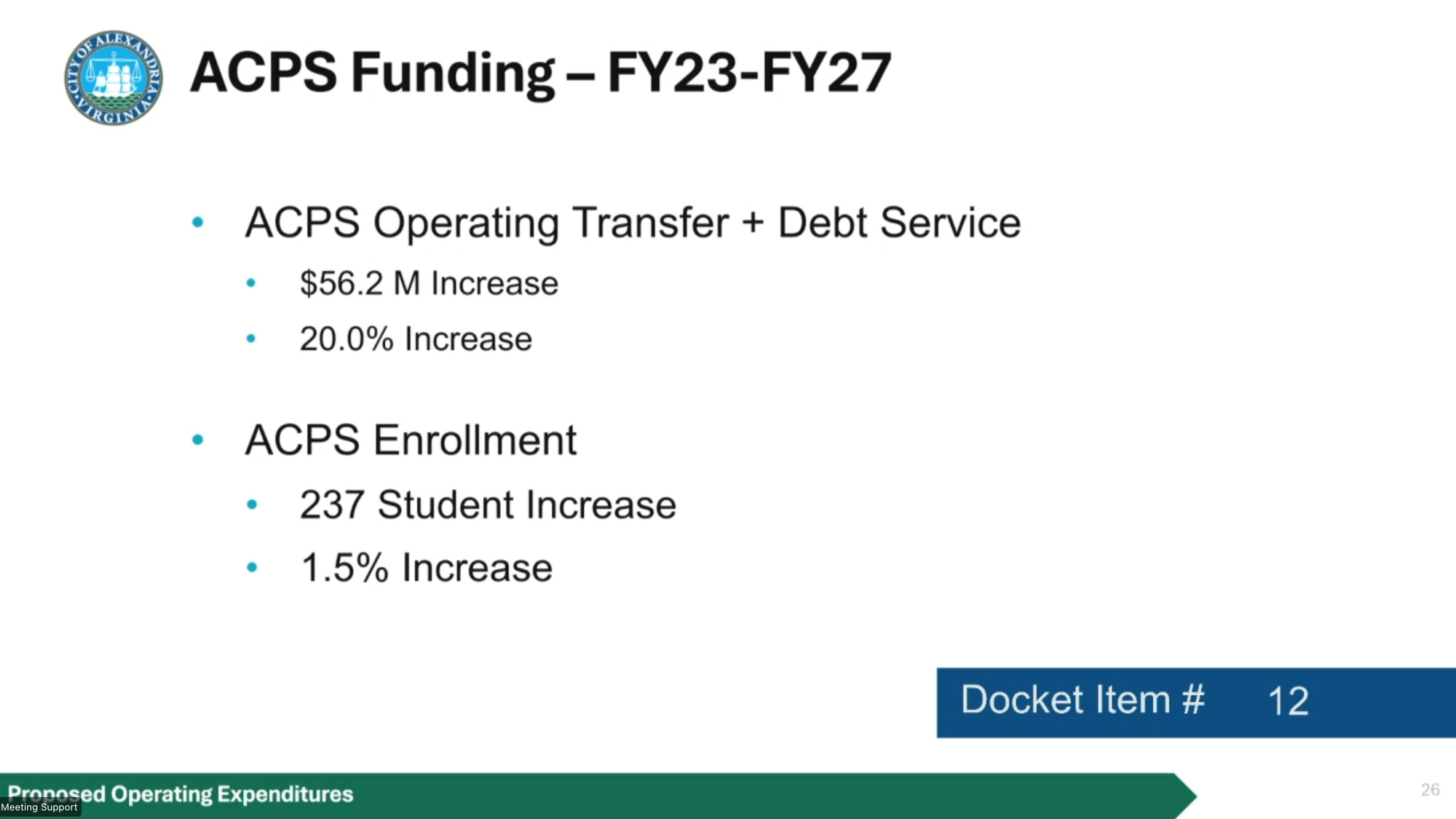
Parajon offered a five-year funding record as context. Since FY 2023, total city support for ACPS through the operating transfer and debt service has grown by $56.2 million — a 20% increase — while enrollment has grown by only 237 students, or 1.5%. Schools and ACPS capital combined account for 32% of all General Fund budget growth in FY 2027, he said, and total city investment in youth — including ACPS funding and city programs across police, human services, libraries, and parks — reaches $365.4 million.
Parajon also pointed to the state's underfunding of Alexandria's constitutional officers and state-mandated positions as structural pressure on the city budget. The state reimburses just $11.3 million of the $41.4 million cost of those positions, leaving a $30 million net subsidy from the city.
"With assistance from the state in a fair way in supporting the state positions and the constitutional officers, this will relieve some of the pressure on our budgets in order to be able to fund some of the things that we're not able to fund in this budget, including perhaps additional supports for our public school system," Parajon said.
A joint city council and school board work session is scheduled for March 4.
Capital: a conditional commitment on schools
The proposed 10-year Capital Improvement Program totals $2.01 billion — a 3.1% decrease from last year's approved CIP — with $238.7 million allocated in FY 2027 alone. Transportation accounts for the largest share at $629.3 million over 10 years, followed by public buildings at $248.5 million, stormwater management at $230.1 million, community development at $201.6 million and schools at $193.6 million.
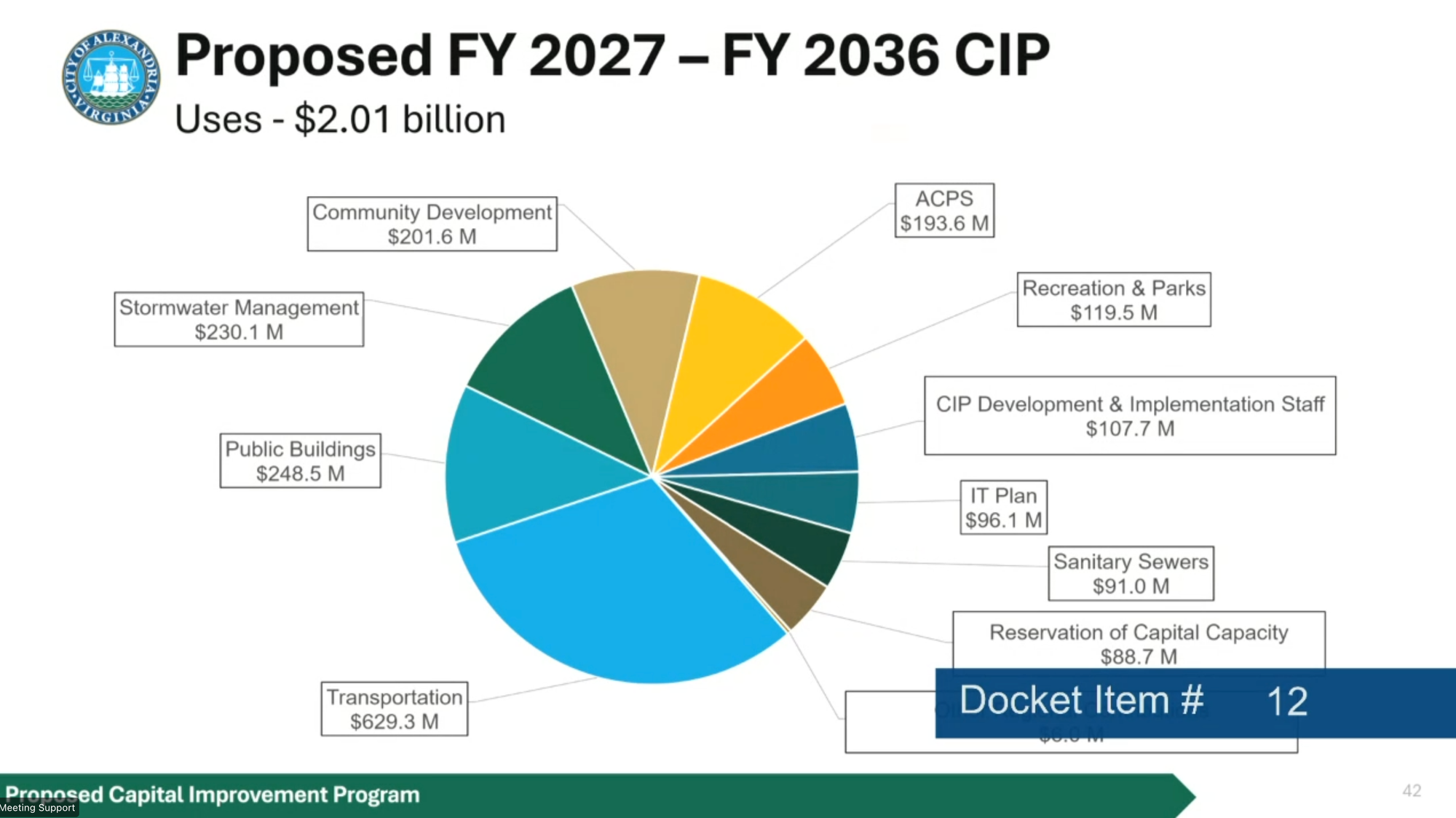
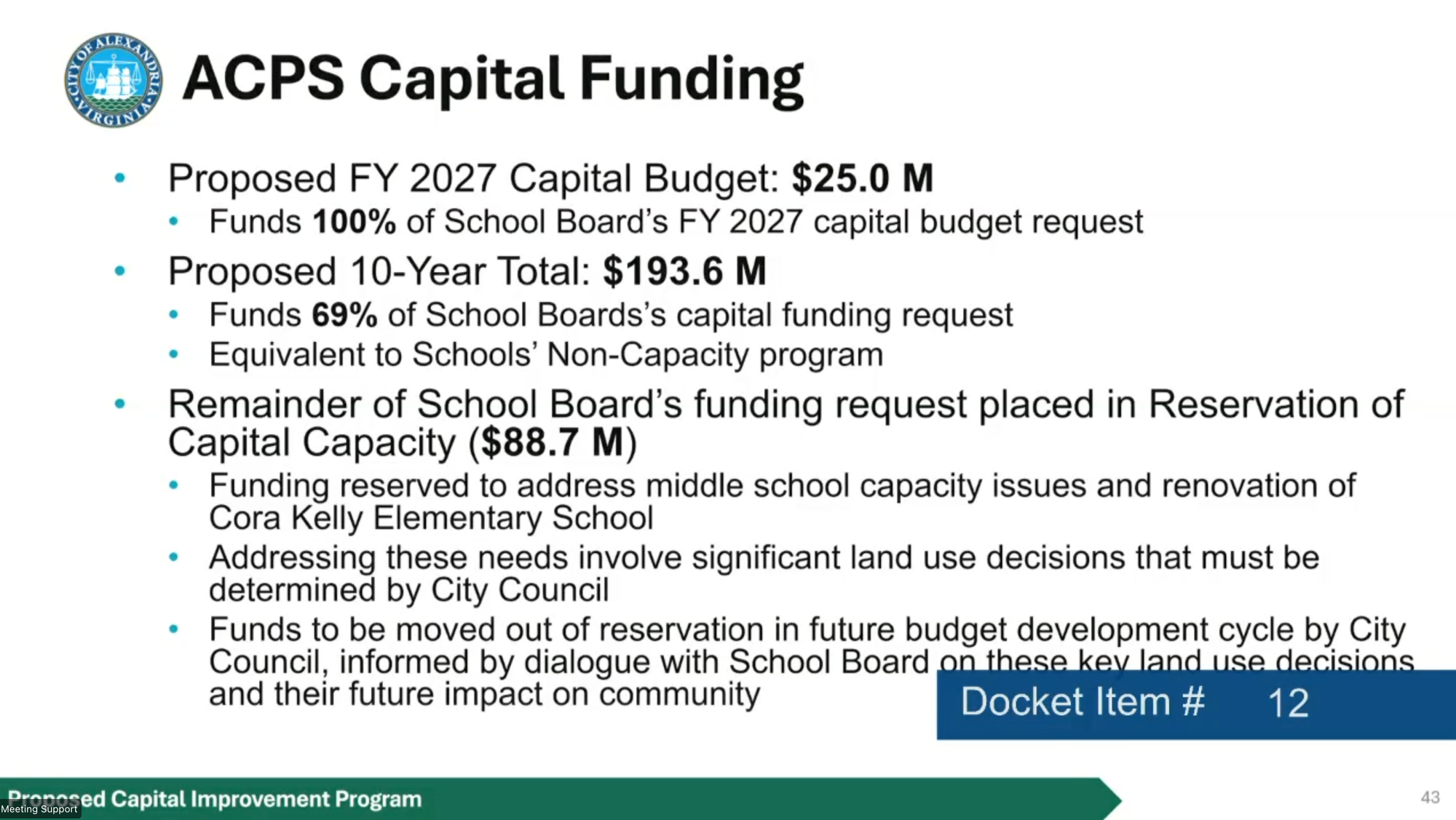
The proposal fully funds the school board's FY 2027 capital request of $25 million. Over the full 10-year window, however, the CIP covers only 69% of the school board's capital funding request. The remaining $88.7 million — earmarked by the city for middle school capacity expansion and the renovation of Cora Kelly Elementary School — is placed in a Reserve of Capital Capacity rather than the active CIP, pending the council's land use decisions.
Notably, that reservation does not include funding for improvements to Jefferson-Houston and Patrick Henry elementary schools, which the school board had sought. The school board voted 5-4 in December to approve a CIP that city officials were expected to reject, according to community advocates who have spent more than a year opposing what they characterize as a plan to close Jefferson-Houston's elementary program.
Several school board members, including Chair Dr. Michelle Rief, attended Tuesday's meeting.
Parajon said the reserved funds are contingent on land-use decisions, which only the council can make. "These are such significant land use decisions. These are catalytic changes that can happen in our community, and they require the city council, which has the ultimate authority around land use and how our city is built and how our city grows," he said. Together, the active CIP and the reservation equal the school board's full $282.3 million 10-year capital request.
The Save Jefferson-Houston advocacy group praised the proposal in a statement Tuesday night. "We commend the Alexandria City Manager, Mayor, and City Council for once again rejecting funding for the School Board's attempt to close Jefferson-Houston's elementary program," the group said, adding that "major capital decisions — particularly those that would eliminate an elementary school against the recommendations of their own report — must be grounded in data, known development implications, and attendance forecasts."
Jefferson-Houston is a Title I school in the historic Parker-Gray neighborhood, where Alexandria's civil rights movement was born. The group urged the school board to "reset the process — to work collaboratively with the City, engage impacted communities, review updated enrollment and housing data, and pursue solutions that preserve Jefferson-Houston's elementary program while acting to solve middle school capacity."
Councilman Abdel-Rahman Elnoubi asked Tuesday that the council and school board form a joint subcommittee — two members from each body — to work through the middle school capacity question and produce proposals for both bodies. Councilman John Chapman cautioned against attaching that process to the current budget cycle, and Elnoubi agreed the decisions could extend into the next budget year. Mayor Alyia Gaskins noted the city-schools committee had been scheduled to take up a related letter in January and February but was canceled both months due to snow, and suggested March would be the opportunity to advance the conversation.
What's driving new spending
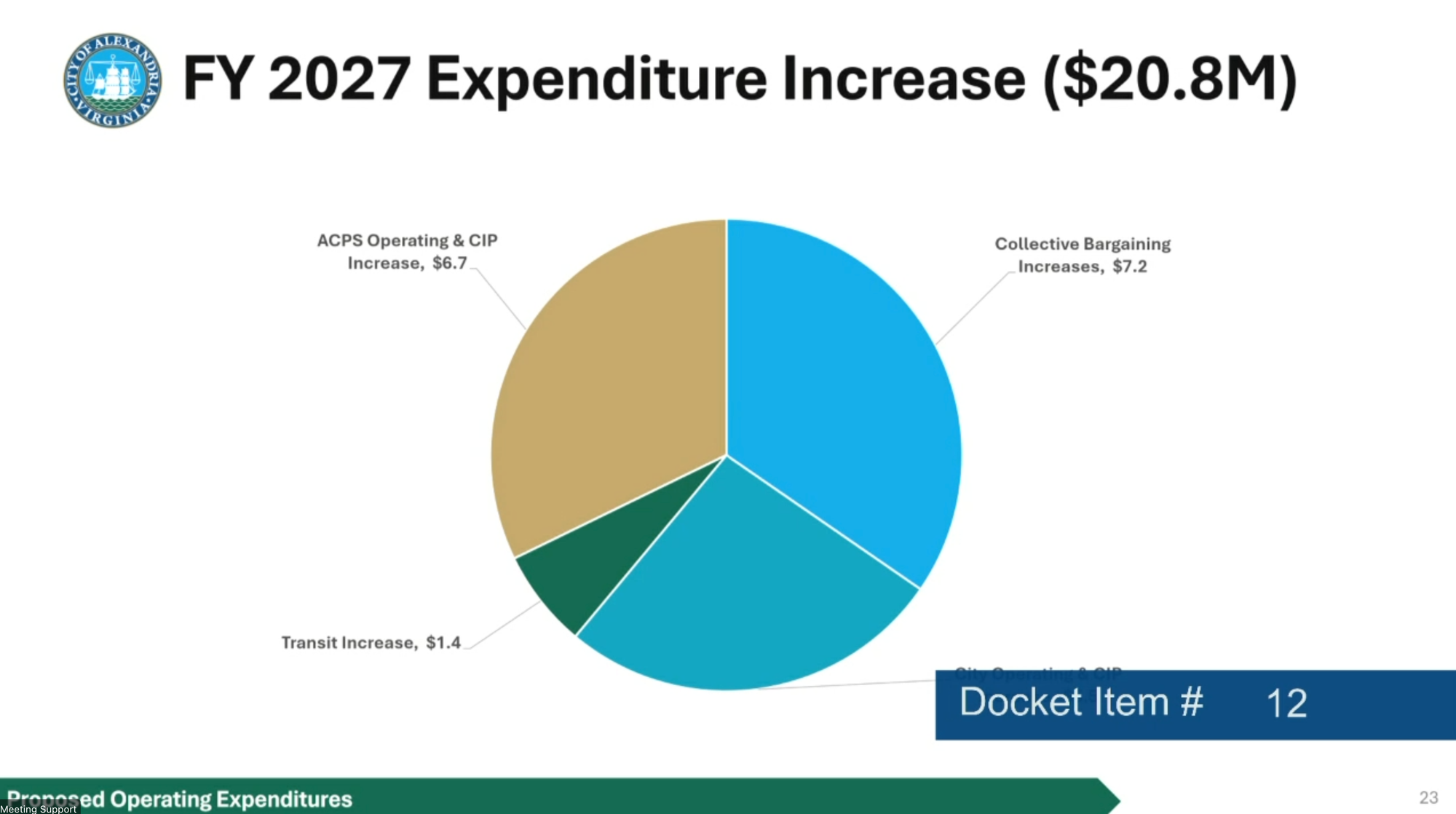
Of the $20.8 million increase in the General Fund from FY 2026 to FY 2027, the largest driver is $7.16 million in new collective bargaining costs — covering the third year of the Labor and Trades agreement and the first year of contracts with administrative and technical employees, firefighters, and police. The fire contract includes funding for four new firefighter positions to reduce weekly work schedules from 49 to 46 hours. ACPS operating and capital accounts for $6.7 million of the increase, and transit adds $1.4 million.
Non-collectively bargained city employees receive step increases and a 1.5% cost-of-living adjustment. Pension savings from lower-than-projected Virginia Retirement System contribution rates helped offset some of the compensation costs, Parajon said.
Bracing for federal uncertainty
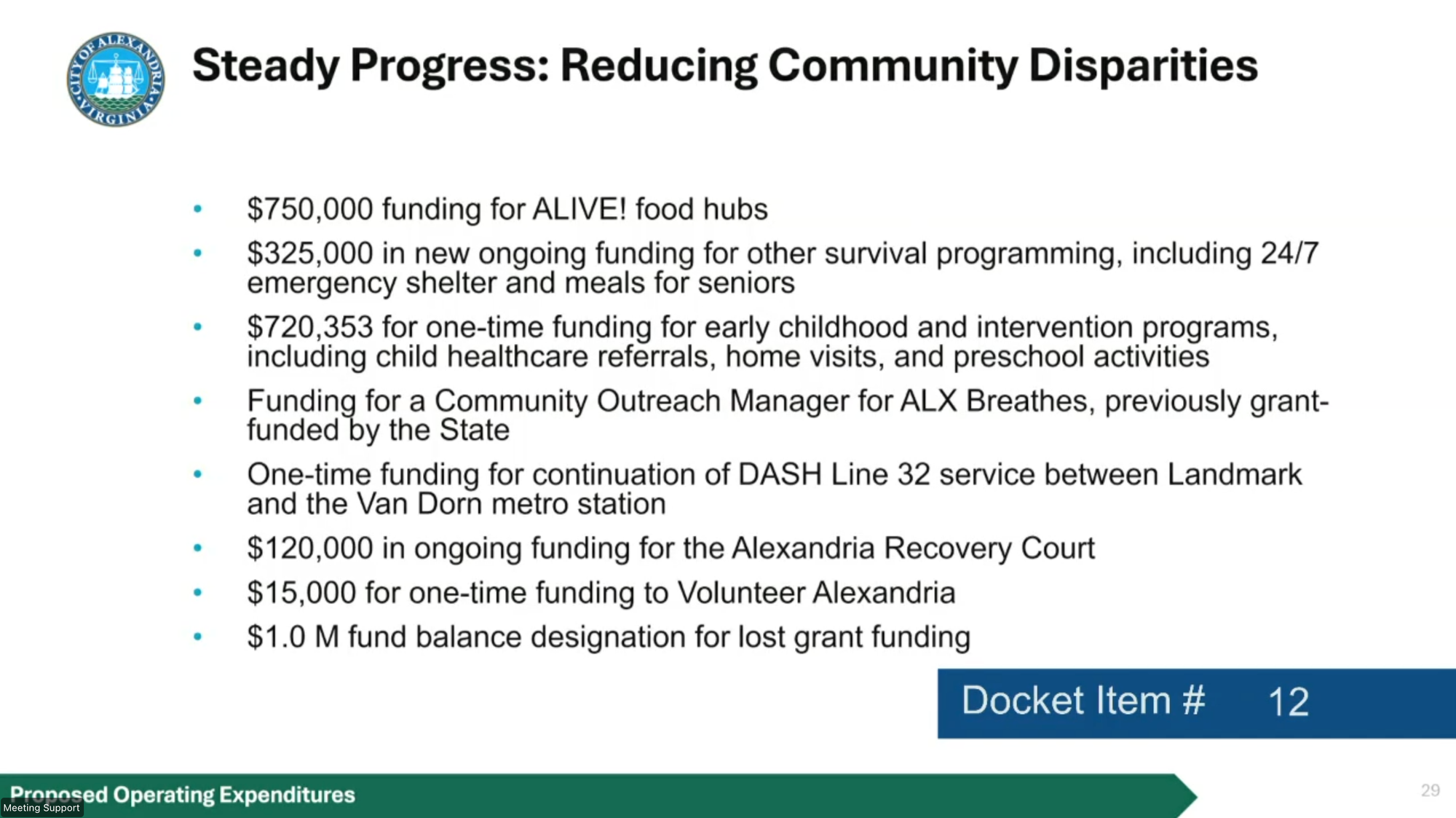
The budget includes $5 million in combined fund balance designations that signal the city is preparing for fiscal disruption: $1 million for lost grant funding, $1 million for economic incentives, and $3 million for emergencies.
Parajon was direct about the intent of the grant reserve. "I call this the protection against some of the poor decisions that the federal government could make," he said. "These are typically grant programs that really provide the sole support, the sole safety net for some of our community."
The budget also absorbs into the city payroll the Community Outreach Manager position for the ALX Breathes air quality program, which had previously been funded by a state grant.
Housing, disparities and economic development
The proposed budget allocates $33.8 million for housing support and opportunities, including $18 million through the Office of Housing, with $10.6 million dedicated to affordable housing, funded through a dedicated 1-cent real estate tax, 1% meals tax, and an additional $1 million city commitment. The Sansé & Naja affordable housing project in Del Ray is specifically named as a supported investment. Parajon noted that every city dollar in the $11.6 million development and preservation fund leverages roughly four to five dollars from outside sources.
Other investments targeting community disparities include $750,000 for ALIVE! food hubs, $325,000 in new ongoing funding for 24/7 emergency shelter and senior meals, $720,353 in one-time funding for early childhood programs including healthcare referrals, home visits, and preschool activities, $120,000 in ongoing funding for the Alexandria Recovery Court, and one-time funding to continue DASH Line 32 service between Landmark and the Van Dorn Metro station.
On economic development, the budget includes $750,000 for ALX Forward — the city's newly adopted economic development strategy, which includes $300,000 in small business support — plus $200,000 for Visit Alexandria to expand tourism marketing, including for historically marginalized neighborhoods, and $1 million in fund balance designation for economic incentives.
Looking ahead: FY 2028 already in view
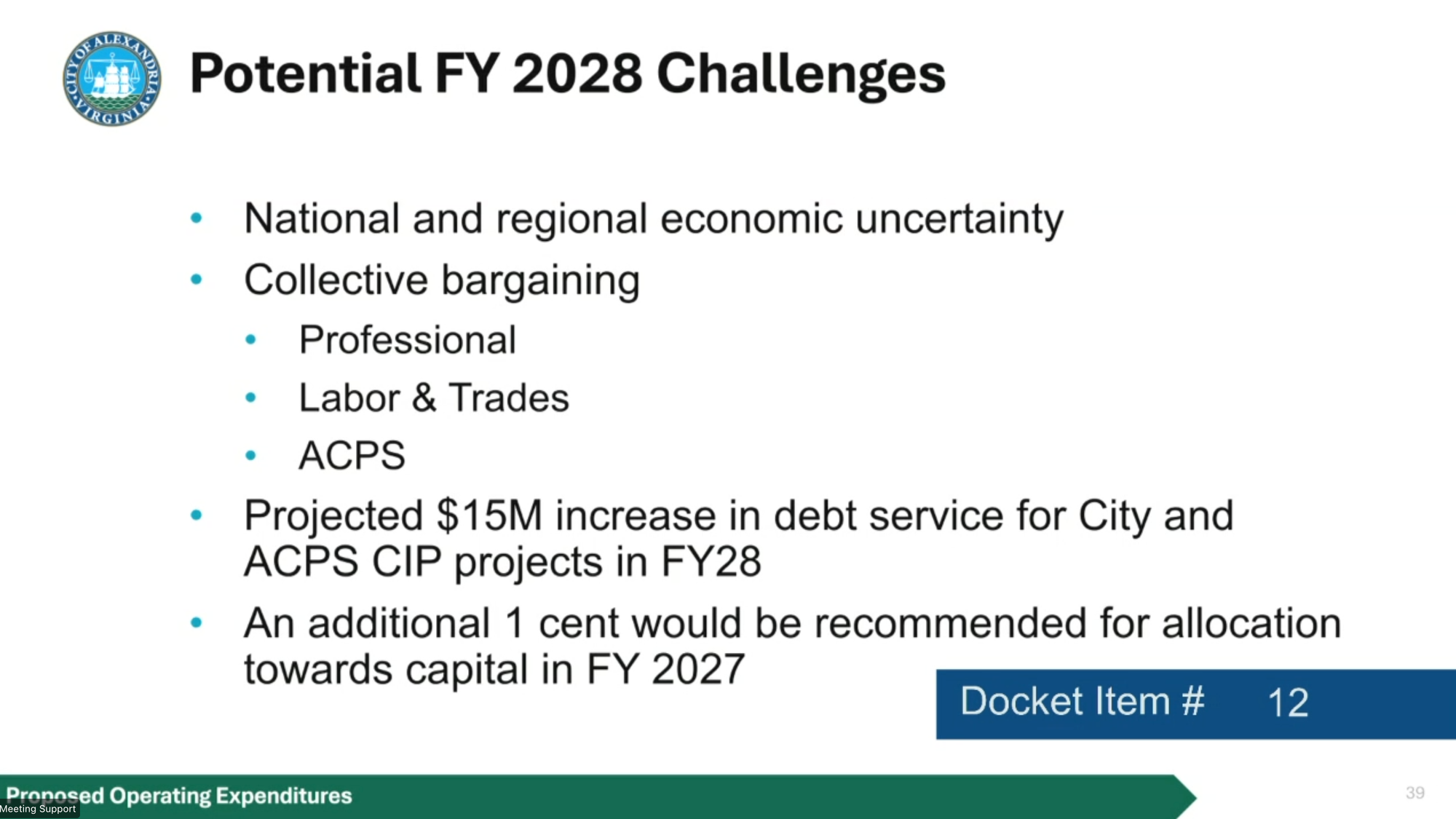
Parajon used Tuesday's presentation to flag mounting pressure for next year. A projected $15 million increase in debt service for city and ACPS capital projects is expected in FY 2028, along with three additional collective bargaining negotiations — professional employees, labor, and trades, and ACPS. He recommended the council consider designating an additional 1 cent of the real estate tax rate toward capital in FY 2027 to manage that coming burden.
Six members will vote on the budget
The April 29 budget adoption vote will take place with a vacancy on the seven-member council. Councilmember Kirk McPike recently won a special election to serve in the Virginia House of Delegates, creating an open seat. A special election to fill McPike's seat is scheduled for April 21 — eight days before the budget vote. Mayor Gaskins said Tuesday the earliest the winner could be seated is May 2, meaning the budget and tax rate will be adopted by a six-member council.
The reduced council raised an immediate procedural question. Councilman Chapman asked whether a 3-3 tie on an add/delete item would kill the motion. The City Attorney confirmed it would. Mayor Gaskins said the council would circulate documentation to ensure all members are on the same page.
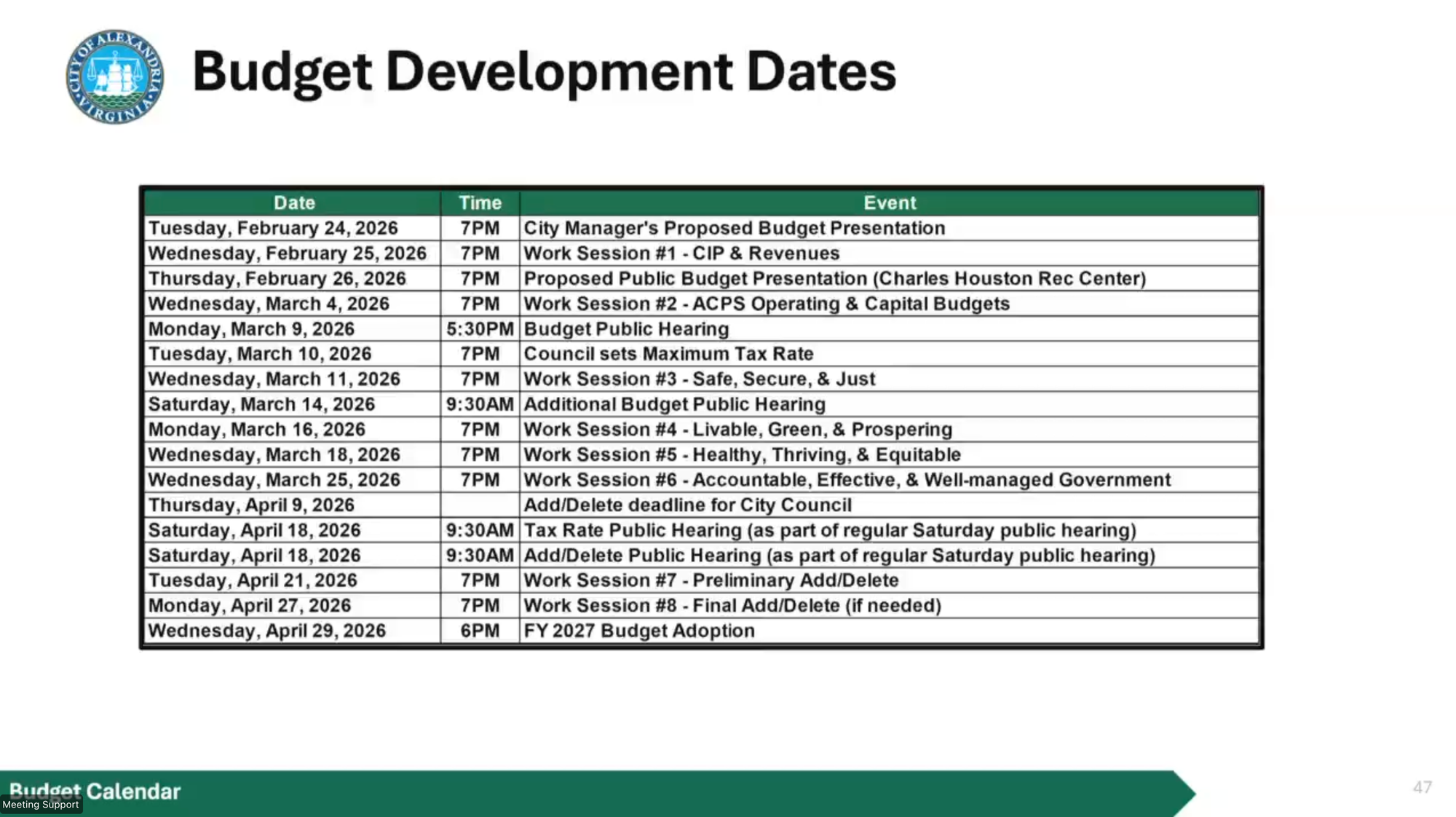
Vice Mayor Sarah Bagley urged residents to note that the council add/delete deadline is Thursday, April 9. "Over the years, we've tried to make sure that the community knew when the add/delete deadline was so that the advocacy that happened after that point was keyed to those add/deletes," she said.
What comes next
The council holds its first budget work session on Wednesday, Feb. 25, focused on CIP and revenues. Parajon will present the budget to the community on Thursday, Feb. 26, from 7 to 9 p.m. at the Charles Houston Recreation Center.
Public hearings are scheduled for March 9 at 5:30 p.m. and March 14 at 9:30 a.m. The council will set a maximum tax rate on March 10, a ceiling that will define the options available at final adoption. Additional work sessions on public safety, housing, equity, and government operations run through late April. Budget and tax rate adoption is scheduled for April 29 at 6 p.m.
Residents can submit questions and engage with the budget through the city's online portal at alexandriava.gov.