Table of Contents
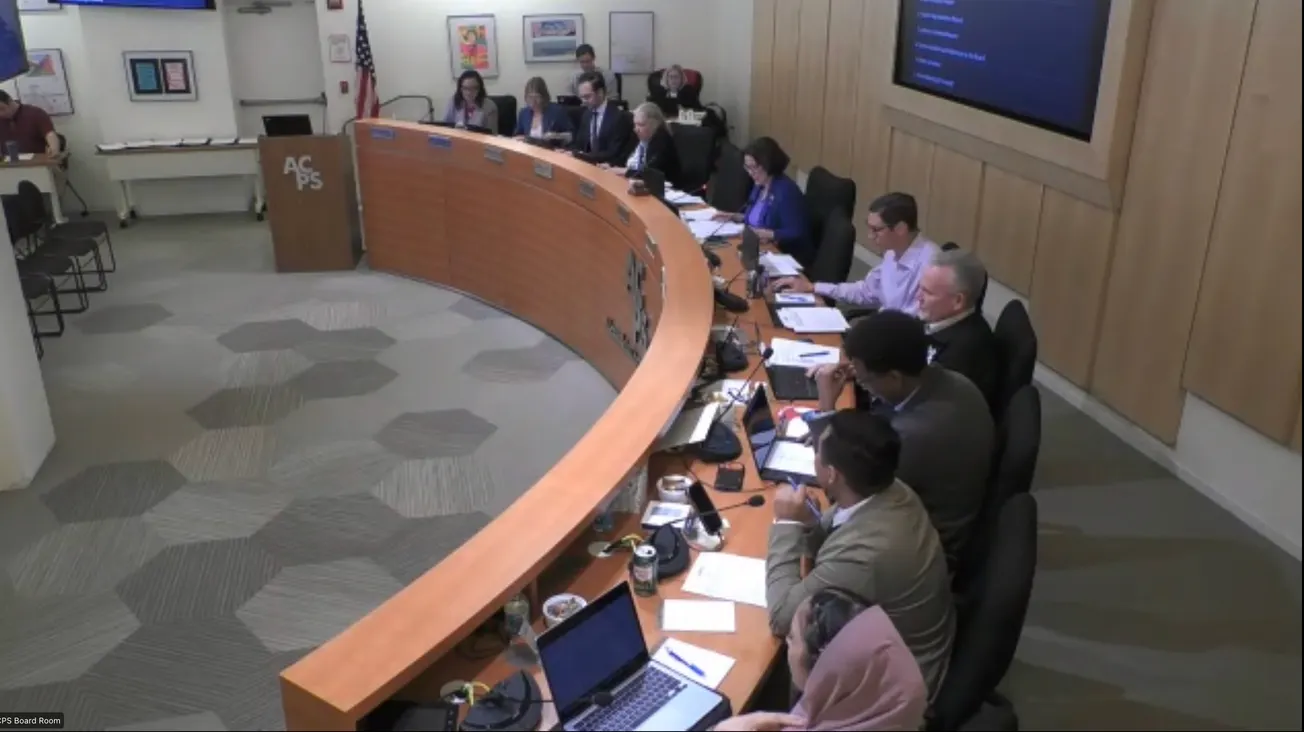
The Alexandria City School Board met Thursday night for nearly three hours, with significant time spent on the draft agreement governing School Resource Officers — a document nearly a year in the making that now heads to a public hearing next week.
Board Chair Michelle Rief briefly acknowledged Superintendent Dr. Melanie Kay-Wyatt's impending retirement at the top of the meeting, noting the board is actively working on selecting an executive search firm and will keep the community updated. Kay-Wyatt, who announced her Oct. 1 retirement just before spring break, said she still has work to do. "I'm still here," she said.
What changed — and what's still in dispute
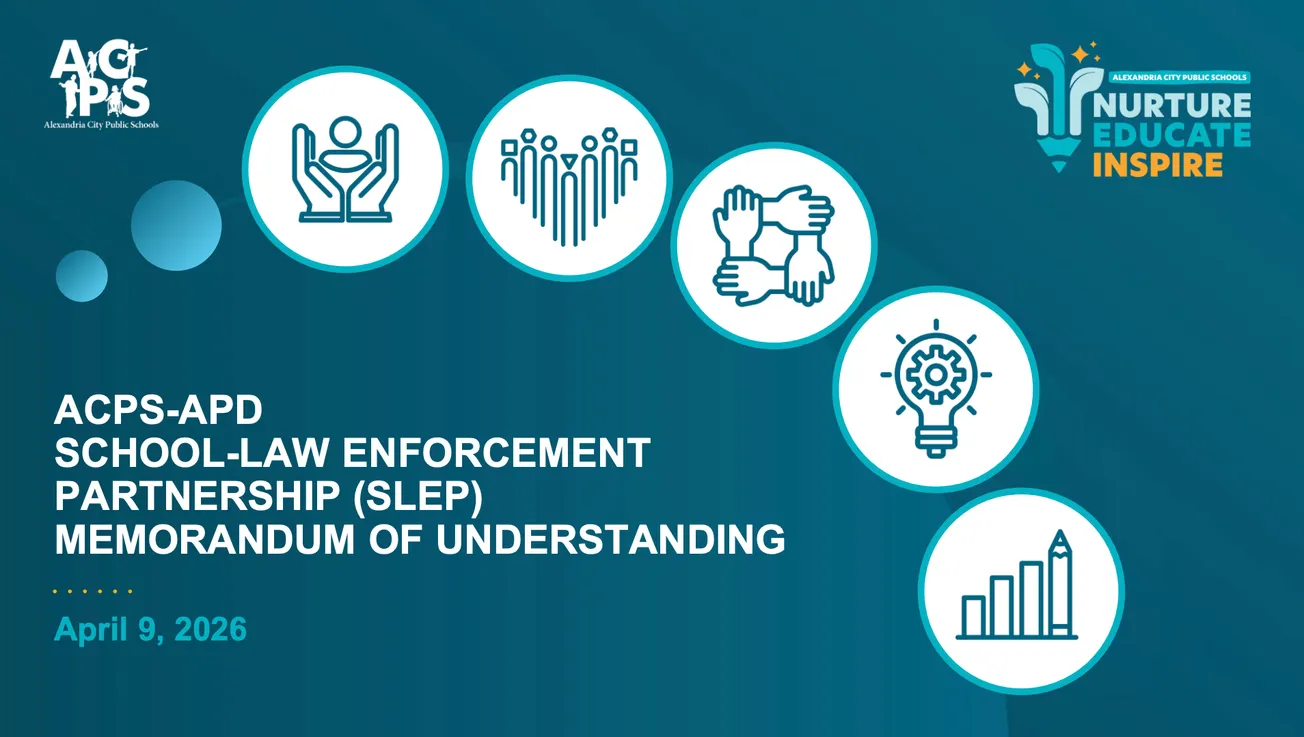
The 2026-28 draft MOU — formally called the School-Law Enforcement Partnership Memorandum of Understanding — was publicly available for the first time Thursday after the board's Governance Committee completed its review and the City Attorney's Office cleared it. The document must be adopted or replaced with another extension by June 30, when the current agreement expires.
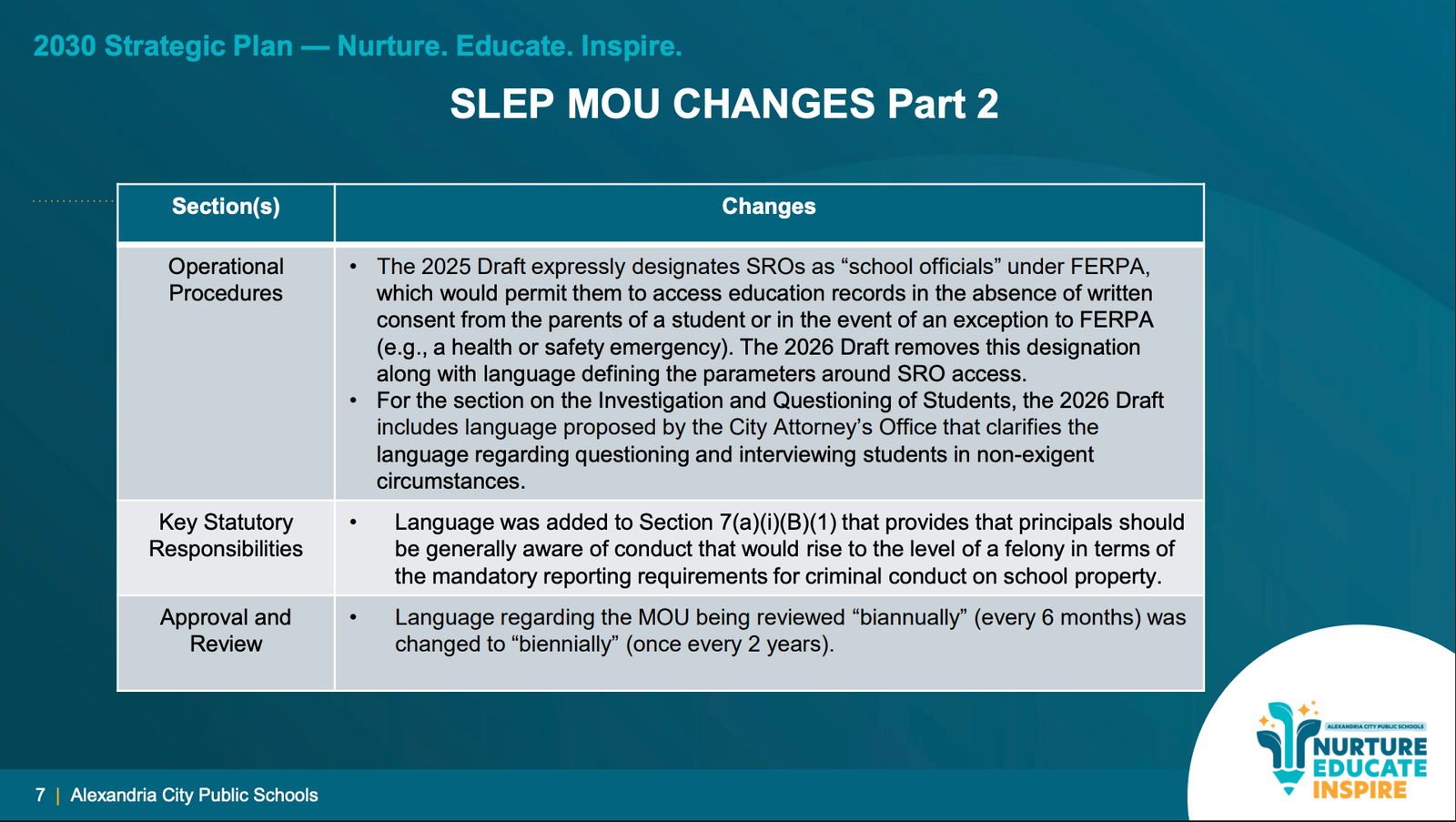
The most significant change from the 2025 draft that stalled the process: the new agreement removes the designation of SROs as "school officials" under the federal Family Educational Rights and Privacy Act. That designation, included in the state model MOU, would have allowed SROs to access student education records without written parental consent — for example, to maintain physical safety and security. Community members who spoke at a May 2025 public hearing objected strongly to the provision. The board extended the existing agreement twice rather than adopt that version. The 2026 draft strips the designation and its related language entirely.
Other changes include the removal of all references to the National Association of School Resource Officers, updated statutory citations, new City Attorney language clarifying how SROs may question students in non-emergency situations, and a correction of the review period language from "biannually" — every six months — to "biennially" — every two years, consistent with state law. The draft also draws a clearer distinction between exigent questioning, where law enforcement has always had the right to ask questions without parental consent, and non-exigent interviewing, where parental consent remains required.
 Ryan Belmore
Where board members raised questions
What drew pointed questions on Thursday was newly added language in the Key Statutory Responsibilities section requiring principals to be generally aware of conduct that would rise to the level of a felony, tied to mandatory criminal reporting obligations on school property. Board member Ryan Reyna said he was uncomfortable with how the draft handles alcohol possession, noting it is not a felony under any scenario he could identify and questioning whether the language could lead to unnecessary law enforcement involvement. "No student should be drinking on school grounds, to be very clear," Reyna said. "And yet I don't know that that in my mind needs to rise to the level of connection to law enforcement."
Board members Abdulahi Abdalla and Alexander Crider Scioscia raised similar concerns. Abdalla pressed on training — whether it would be annual, required or part of onboarding — and on how administrators would determine in real time whether drug possession reached felony level. "Even that is still a gray area," he said. Scioscia said he appreciated the additions around mandatory reporting training while acknowledging the same discomfort about the felony language.
Division Counsel Robert Falconi acknowledged the underlying state law is "very poorly written" and said the plan is to provide administrators with a one-page reference document outlining the most common scenarios and clearly noting which situations do not constitute mandatory reporting obligations. He committed to confirming definitively whether alcohol possession can constitute a felony and reflecting that in training materials. "If it could not possibly constitute a felony, the obligation is not there," he said.
Board member Tim Beaty offered historical context, noting that the two school board members who served on the joint City Council-School Board subcommittee that reviewed an earlier draft — both of whom have since moved to City Council — had themselves rejected portions of that draft. The Governance Committee developed the current version independently. Chair Rief clarified that the state model MOU has evolved over time and that some language in the current draft reflects changes APD sought to incorporate from the updated state model.
Board member Ashley Simpson Baird, who chairs the Governance Committee, said the committee landed on training rather than explicit bright-line rules given the vagueness of state law. "We don't want to send any overly permissive messages about what's okay for student behavior," she said, "but we're also trying to show that we are adhering to a law that is very poorly written." Rief suggested the board consider legislative advocacy to push for clearer statutory language at the state level. Student Representative Darwin Salazar also weighed in, asking for clarification on whether students' rights against feeling pressured to submit to questioning apply in both exigent and non-exigent scenarios — which Falconi confirmed they do.
Falconi cautioned that reopening the document to further changes at this stage would likely require another six-month extension of the current agreement. If adopted as written, the new MOU would take effect July 1, 2026, and run through June 30, 2028, signed by Police Chief Tarrick McGuire and the superintendent on behalf of the School Board.
The public hearing is on April 16 at 5 p.m. at 1340 Braddock Place. Sign-up to speak closes at noon on April 15. The Governance Committee meets on April 17 at 8 a.m. via Zoom to discuss the MOU one day after the hearing. The board is expected to vote on final approval at its April 23 meeting.
Ryan Belmore
Region 4 Teacher of the Year — second straight year for ACPS
Kay-Wyatt opened her superintendent's report with a significant recognition: Deidre Robinson, an AVID leader and veteran science educator at Jefferson-Houston PreK-8, has been named Virginia Regional Teacher of the Year for Region 4 by the Virginia Department of Education — the second consecutive year an ACPS teacher has won the regional honor. Robinson was surprised at a school event attended by VDOE Superintendent of Public Instruction Jenna Conway and a representative from Abbott's national headquarters. "We're going to go three for three," Kay-Wyatt said.
Ryan Belmore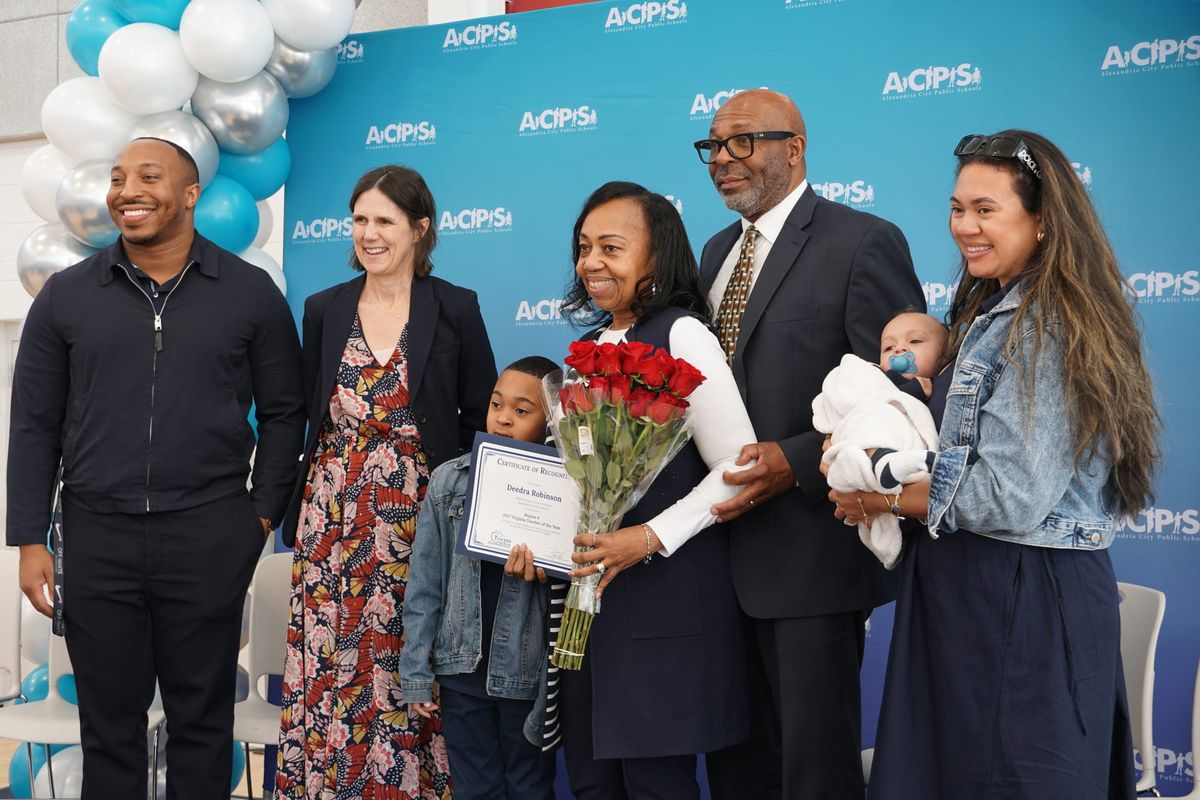
State education leaders visit ACHS
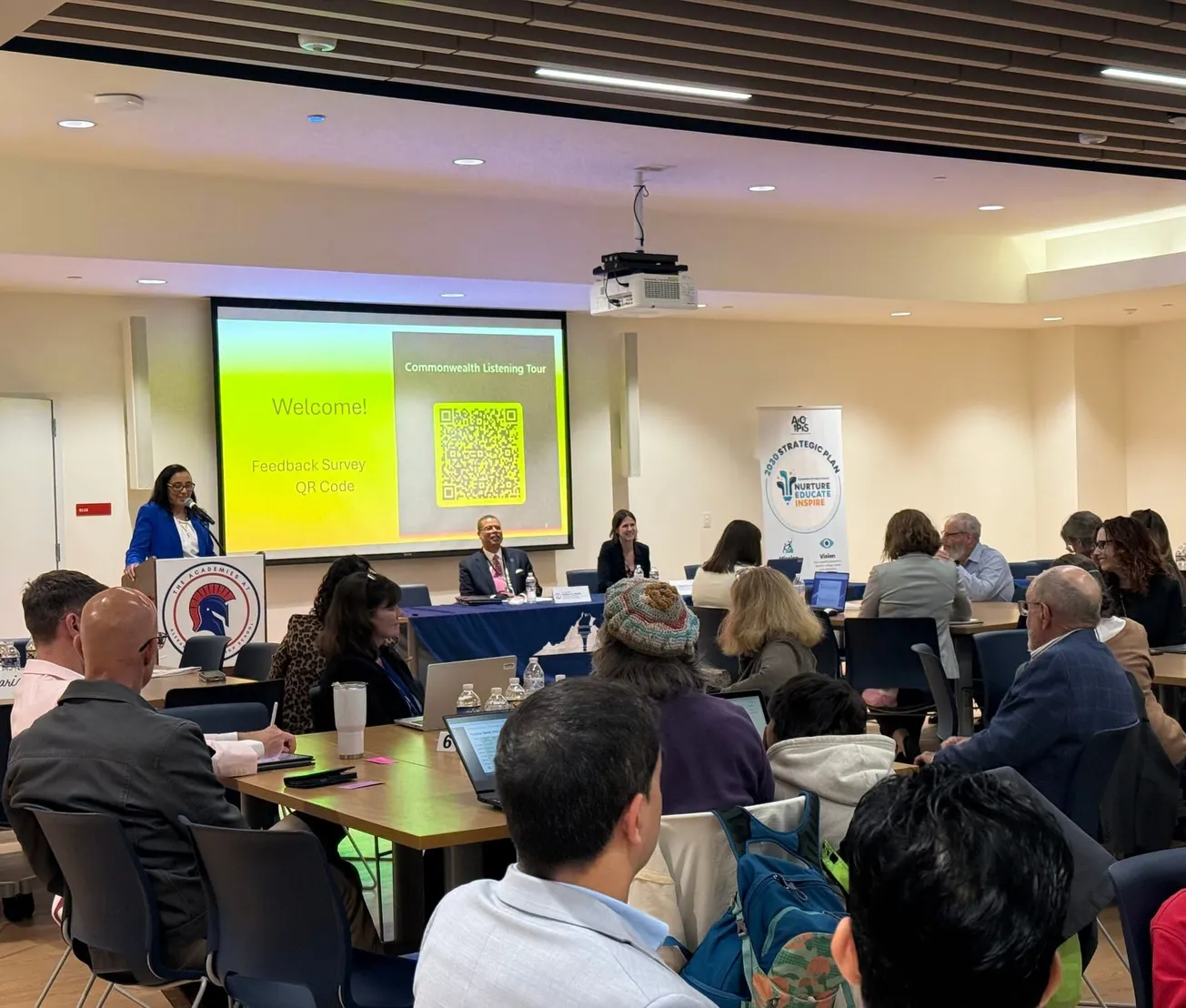
Earlier this week, Virginia Secretary of Education Dr. Jeffrey Smith and Superintendent of Public Instruction Conway visited Alexandria City High School's Minnie Howard campus for the Commonwealth Listening Tour, with a roundtable that afternoon that included Majority Leader Charniele Herring, staff from Delegate Alfonso Lopez's office, Mayor Alyia Gaskins, board members Rief and Harris and student representatives. Alexandria was the final stop on the tour. "Save the best for last," Kay-Wyatt said.
Ryan Belmore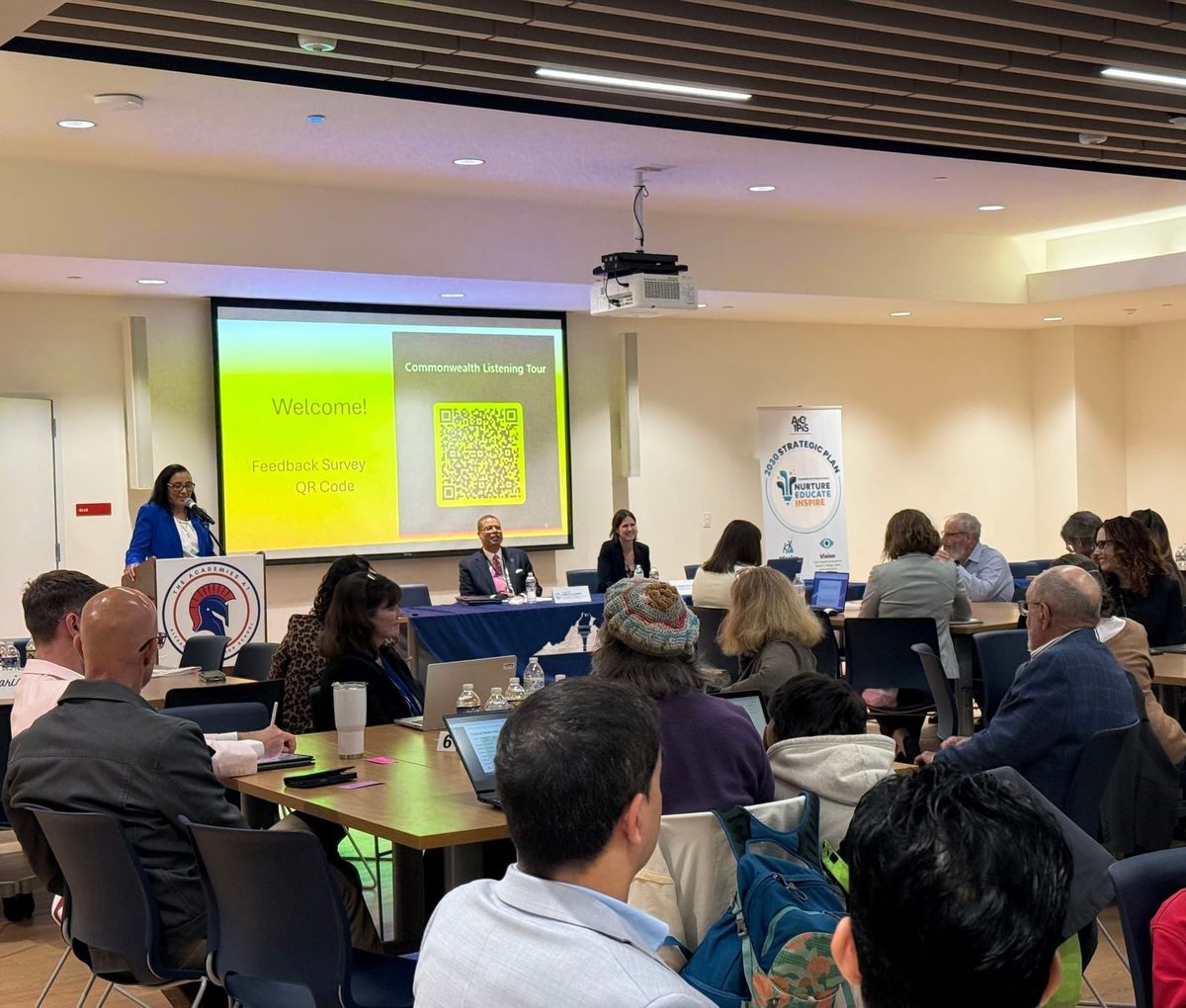
Other highlights
The board recognized advisory committee members across more than a dozen boards in a group ceremony. On policy, a routine batch of revisions was presented for future adoption, including one related to relations with law enforcement that adds parental notification language for scenarios where no MOU is in place — a gap identified during the current review process. The board confirmed schools will be closed for students April 21 due to the special City Council election, with that day serving as a staff work day. The student representative selection process is underway, with a selection board set for May 7.
The board's next meeting is April 23.