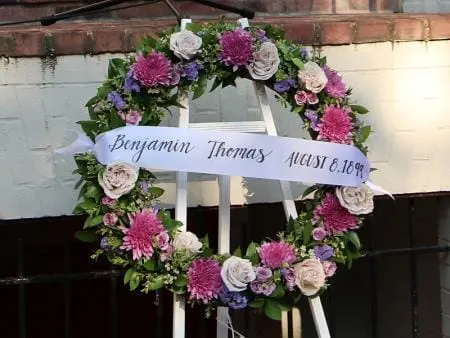
ALEXANDRIA, Va. — The Alexandria Community Remembrance Project will hold an evening in remembrance of Benjamin Thomas on Friday, Aug. 28, at Shiloh Baptist Church, 1401 Jamieson Ave.
The program runs from 7 to 8 p.m., with doors opening at 6:30 p.m. It is free and open to the public.
The evening centers on a conversation titled "Civil Rights in Uncertain Times" with Myesha Braden, deputy general counsel for the NAACP. Charles E. Miller will perform, and Mayor Alyia Gaskins is scheduled to give remarks.
In announcing the event, the city said the conversation would address what it characterized as renewed challenges to civil and political liberties, including disputes over voting rights and over how history is presented at national institutions.
The speaker and the performer
Braden, a graduate of Tulane Law School, has spent her career in civil rights work, including leadership positions at the Department of Justice, in the Obama White House and in the nonprofit sector. According to the city, her work with the NAACP includes state and national voting rights litigation.
Miller, a performer and educator, has sung genres ranging from classical to gospel and has performed with the Washington National Opera and the Maryland Lyric Opera.
Historic sites open before the program
Two sites tied to the city's history will be open to visitors beforehand.
The sanctuary of the historic Shiloh Baptist Church at 1400 Duke St., where the 1899 memorial and mass meeting for Thomas were held, will be open from 5:30 to 6:30 p.m. The Freedom House Museum at 1315 Duke St., which interprets the building's role in the domestic slave trade, will be open until 6:30 p.m.
The 1899 lynching and mass meeting
Thomas, a native Alexandrian, was 16 when a white mob of Alexandria residents attacked the city jail at Princess and St. Asaph streets around midnight on Aug. 8, 1899. He was dragged a half-mile to the southwest corner of King and Fairfax streets, opposite Market Square, and lynched from a lamppost.
According to the Office of Historic Alexandria, Thomas was accused of assault by the 7-year-old daughter of his next-door neighbor and was arrested on the child's testimony alone. He maintained his innocence, and both Black and white Alexandrians believed him in the aftermath. Local Black leaders had warned authorities of a threat to lynch him. News of the killing prompted work stoppages around the region.
On Aug. 28, 1899, more than 600 people filled Shiloh Baptist Church for a mass meeting to memorialize Thomas and protest the lynching. Church leaders from Alexandria and Washington called for an economic boycott of any business connected to those who took part in the mob. The remembrance is held annually on that date in recognition of the gathering.
The account of the lynching was researched by the remembrance project's 13-member research committee, which the city credits with more than 3,000 hours of work on narratives of Alexandria's lynchings. The committee's narrative of the Thomas lynching and a map of the events of Aug. 8, 1899, are posted on the city's website.
Two documented lynchings in Alexandria
Thomas is one of two people documented to have been lynched in Alexandria. Joseph McCoy was lynched on April 23, 1897.
Between 1877 and 1950, 99 Virginians were lynched, including at least 11 in Northern Virginia, according to the city. Those killings were among about 6,500 reported nationwide over the same period. Lynching did not become a federal offense until March 29, 2022.
The remembrance project has established memorial scholarships in the names of McCoy and Thomas, awarded to Alexandria City High School students in partnership with the Scholarship Fund of Alexandria.
The Alexandria Community Remembrance Project is a citywide initiative that works to help residents understand the city's shared history and to foster a culture of belonging.
Requests for reasonable disability accommodation can be directed to Nicole Quinn at historicalexandria@alexandriava.gov or 703-746-4554, Virginia Relay 711.