Table of Contents
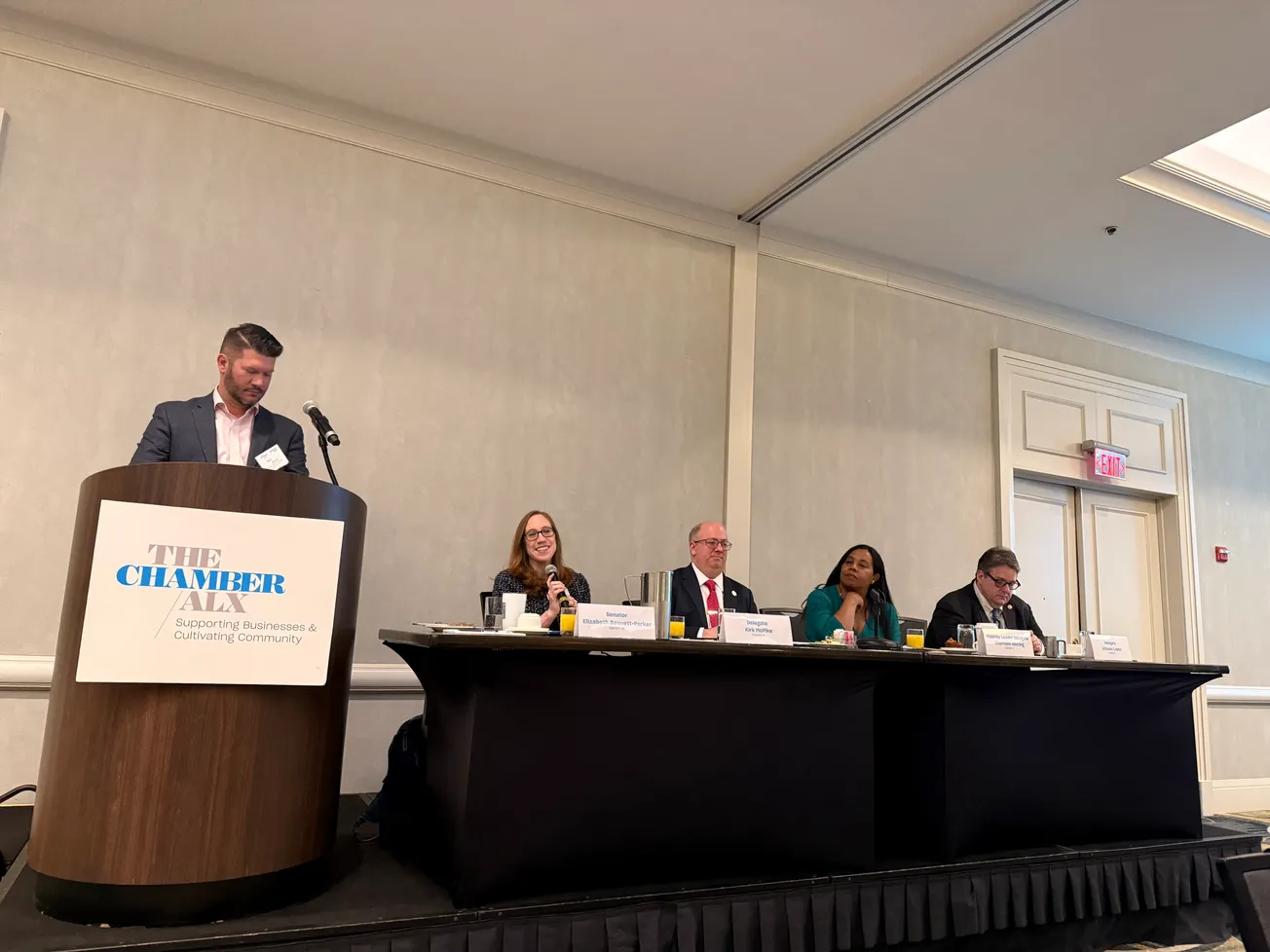
Alexandria's four-member General Assembly delegation gathered Thursday morning at the Hilton Alexandria Old Town to debrief on the 2026 legislative session before a room of business leaders, local officials, and community members — offering a candid look at what Richmond accomplished and the challenges still ahead.
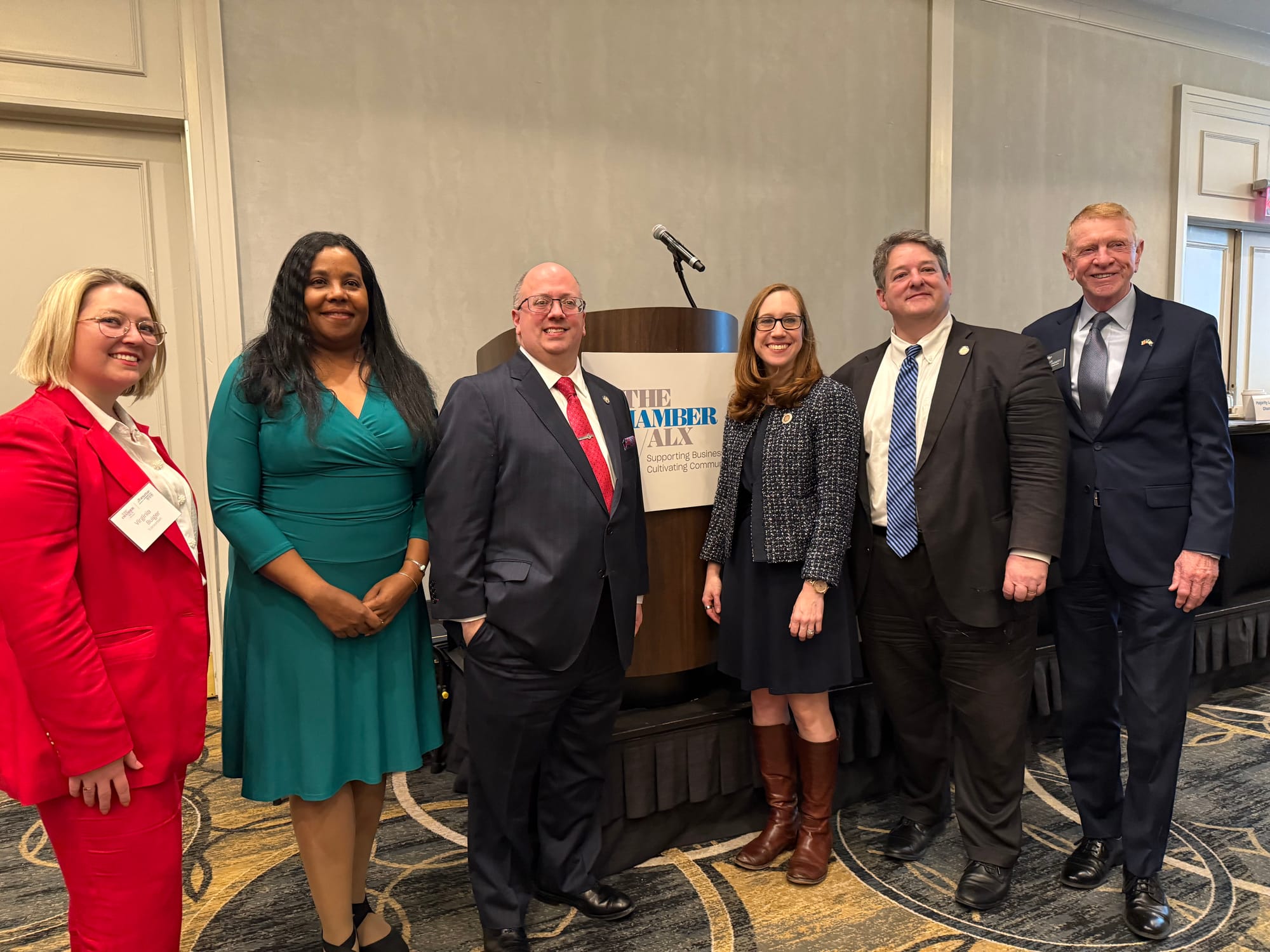
The annual General Assembly Breakfast, presented by Transurban and hosted by the Alexandria Chamber of Commerce, drew Sen. Elizabeth Bennett-Parker, Majority Leader Del. Charniele Herring, Del. Alfonso Lopez, and Del. Kirk McPike. Also in attendance were City Councilman John Taylor Chapman, City Manager James Parajon, and School Board Member Alexander Crider Scioscia.
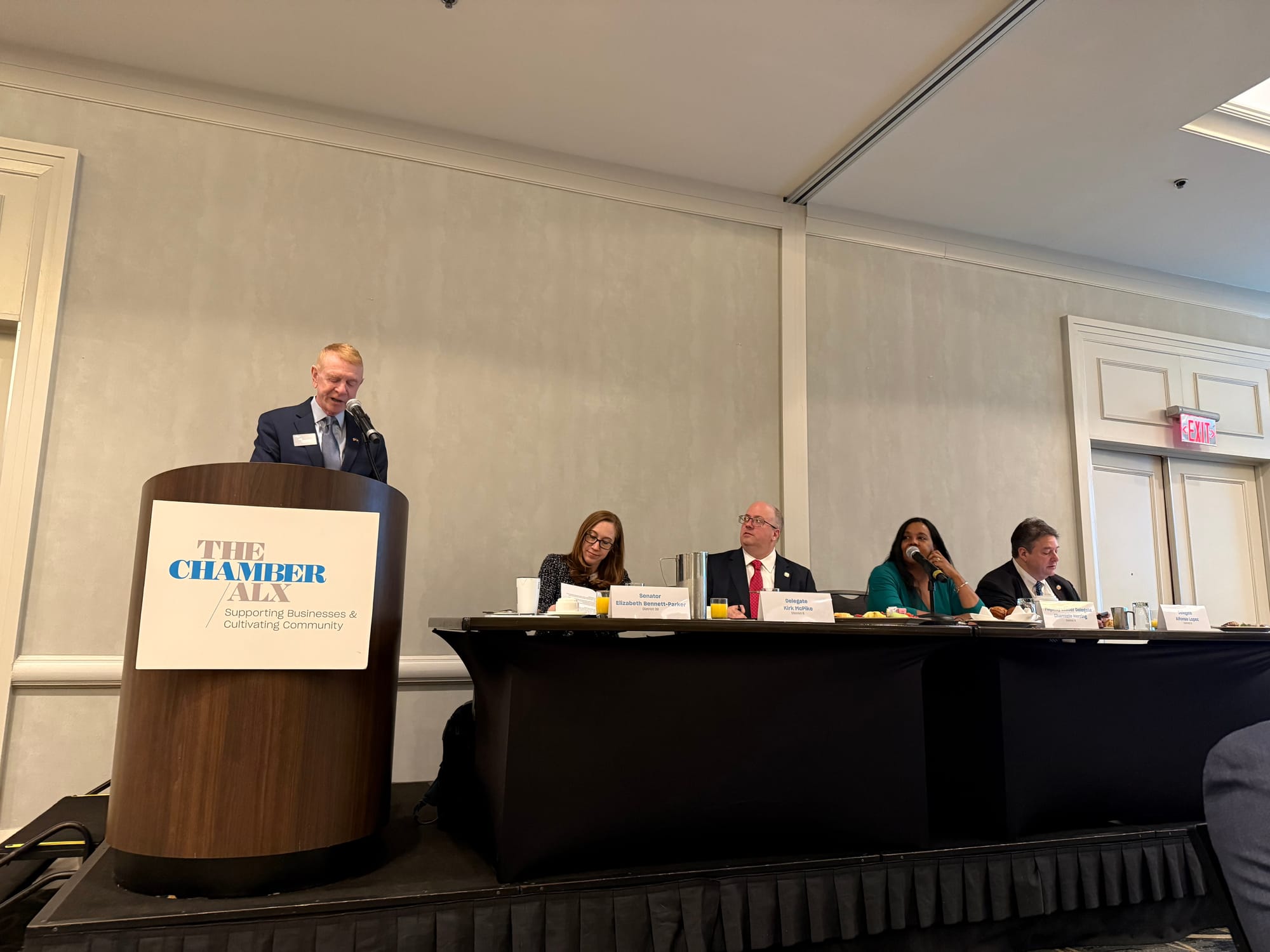
The event was moderated by Chamber Board Chair Bob Brant, who stepped in for Government Relations Committee Chair Lauren Augustine, currently on leave after welcoming a new baby. Chamber CEO Joe Haggerty opened the morning. Virginia Bulger, community and government affairs manager at Transurban, delivered the presenting sponsor's remarks.
A budget still in flux
The session adjourned last week without a finalized budget, and the delegation made clear the work is far from over. At the center of the standoff is a sales and use tax exemption for data centers — worth roughly $1.54 billion in uncollected revenue annually — that the Senate budget partially rolls back and the House is reluctant to touch.
"When we make a big business decision, you're going to affect our bond rating," Herring said, noting the governor's hesitancy to walk back a commitment made to the business community. "We have created a lot of good labor jobs related to these data centers."
McPike offered context for why the stakes have grown since the exemption was first put in place. Data centers, he explained, have shifted from cloud storage to AI-driven infrastructure requiring expensive Nvidia chips — making the tax gap far larger than originally projected.
Both chambers included significant WMATA funding — $153 million in the House budget and roughly $200 million in the Senate — though structured differently, with the House prioritizing operations and the Senate leaning toward capital investment. McPike called for a permanent, dedicated revenue stream for the transit agency so the region isn't renegotiating its funding every two years.
The delegation is set to return to Richmond on April 22 for the reconvened session, followed by a special budget session on April 23.
Housing, immigration,on and constitutional rights
Lopez, who created the Affordable Housing Trust Fund in 2013, pressed the case that Virginia needs $400 million annually to meaningfully address the housing crisis — far more than the $12.5 million increase in the House budget or $50 million in the Senate's.
"For every project we fund in Northern Virginia, there are seven that we don't." — Del. Alfonso Lopez
Bennett-Parker highlighted her bill granting localities the right of first refusal to purchase affordable housing units, targeting roughly 17,000 units statewide at risk of losing their affordability protections. A "Yes in God's Backyard" bill also passed, allowing nonprofits with underutilized land to build committed affordable housing on their properties.
On immigration, Lopez highlighted legislation addressing ICE detention practices, modeled on laws in Maryland, Massachusetts, Washington state and Illinois. McPike, who arrived in Richmond after the crossover window and was unable to file legislation this session, called those bills among the most impactful he voted on. The delegation also expressed pride in the General Assembly advancing constitutional amendments on voting rights, reproductive rights, marriage equality protections, and congressional redistricting.
Herring also flagged a redistricting ballot initiative set for April 21, urging attendees to pay attention. The measure would adjust congressional district lines and, she said, does not eliminate the state's bipartisan redistricting commission. "Whatever you think about it, the word is not getting out," she said. "For me it's just an imperative — it's leveling the playing field."
What it means for Alexandria
Several moments on Thursday pointed directly at Alexandria. Bennett-Parker noted her bill modernizing Virginia's 38-year-old mixed beverage ratio law was brought to her by a small business in Alexandria — one of several the city has been struggling to retain as competition with D.C. intensifies. She credited former delegate and owner of Captain Gregory's, Rob Krupicka, for championing the issue.
Under current Virginia law, restaurants must certify annually that at least 45% of their sales come from food, with alcohol capped at 55% — a threshold that hasn't been updated in nearly four decades and, critically, is calculated without wine and beer. The math works against Alexandria's restaurants in ways that are hard to see from the outside. Two $20 cocktails and a $25 burger, she offered as an example, does not meet the ratio. A $50 pour of bourbon requires a restaurant to sell five to ten times as much food as a lower-end spirit would. For establishments trying to compete with D.C. bars doing craft cocktails or high-end spirits — where no such requirement exists across the river — the regulation puts them at a structural disadvantage. "Our businesses are at a disadvantage," she said, adding that the bill passed with wide enough margins that she is optimistic the governor will sign it.
With Alexandria home to one of the highest concentrations of federal workers in the region, McPike pointed to the House budget's $200 million federal uncertainty contingency fund as a direct safeguard. The money is designed to step in if additional federal cuts affect residents' ability to afford child care or health care, or if contracts are pulled. "Right now we have a federal government in D.C. that is not providing a lot of stability," McPike said. It was a notable contrast to last year's breakfast, when the delegation warned of a potential 9.6% unemployment rate in the 8th Congressional District — the economic pressure, it seems, has not abated so much as been absorbed into the baseline.
One bill that didn't make it through this session caught McPike's attention for what it could mean locally. Legislation that would have encouraged housing development near job centers — exactly the kind of policy that maps onto Alexandria's transit corridors and employment hubs — fell short this year. "That bill needed a little bit more gestation," McPike said, signaling he expects it to return. Given Alexandria's ongoing tension between housing demand and available land, it's a bill worth watching.
Herring's non-compete bill for healthcare workers — protecting nurses, doctors and midwives from agreements that prevent them from seeking better conditions at competing health systems or starting their own practices — carries local weight in a city with major healthcare employers. The bill was prompted by a Virginia nurse who was fired after working a weekend shift at a nearby clinic and had to fight her former employer in court to have the agreement thrown out. "We have to treat our healthcare workers like the professionals that they are," Herring said.
Herring also invoked the West End by name when discussing new tenant protections for residents in uninhabitable units, noting that residents in those situations will no longer have to post back rent in order to pursue or defend a claim. And in response to an audience question about the shortage of guardians ad litem for children and incapacitated adults, she pointed to Alexandria specifically — noting that a retired federal judge in the city currently serves in that role. "It speaks to how important the work is," she said, while acknowledging the hourly rate remains too low to attract sufficient attorneys.
Gambling
All four lawmakers voiced opposition to the casino bill — which passed and would be subject to a Fairfax County referendum — as well as the skill games bill, which also passed. iGaming died in conference committee. McPike said he voted against the skill games bill four times on the final day of the session in an attempt to kill it.
"It's kind of like back in the 90s, lotteries are going to solve our school funding challenges," McPike said. "We've had lotteries for a long time across the country. I don't know if anybody's noticed, but it doesn't appear that our school funding challenges have been solved."
Looking ahead
All four flagged artificial intelligence as a defining challenge for the Commonwealth — both in terms of opportunity and regulatory complexity. Bennett-Parker raised autonomous vehicles, noting that a bill that passed the Senate before she arrived would have given localities more authority over scooters than over self-driving cars. Herring highlighted a new non-compete protection for healthcare workers. Bennett-Parker also pointed to a bill modernizing Virginia's 38-year-old mixed beverage ratio law — a change she said will give Alexandria restaurants, which compete directly with D.C., greater flexibility.
But it was McPike who offered perhaps the most pointed observation of the morning, flagging what he called a structural vulnerability in how Virginia funds itself.
"A person making $20,000 a year in Virginia is in the same tax bracket as somebody making $20 million a year in Virginia," he said. "And over time, that is not going to be a sustainable model."
Disclosure: The Alexandria Brief is a paying member of The Chamber ALX and a member of the chamber's Inner Circle. Like all members, The Alexandria Brief paid to attend this morning's event.