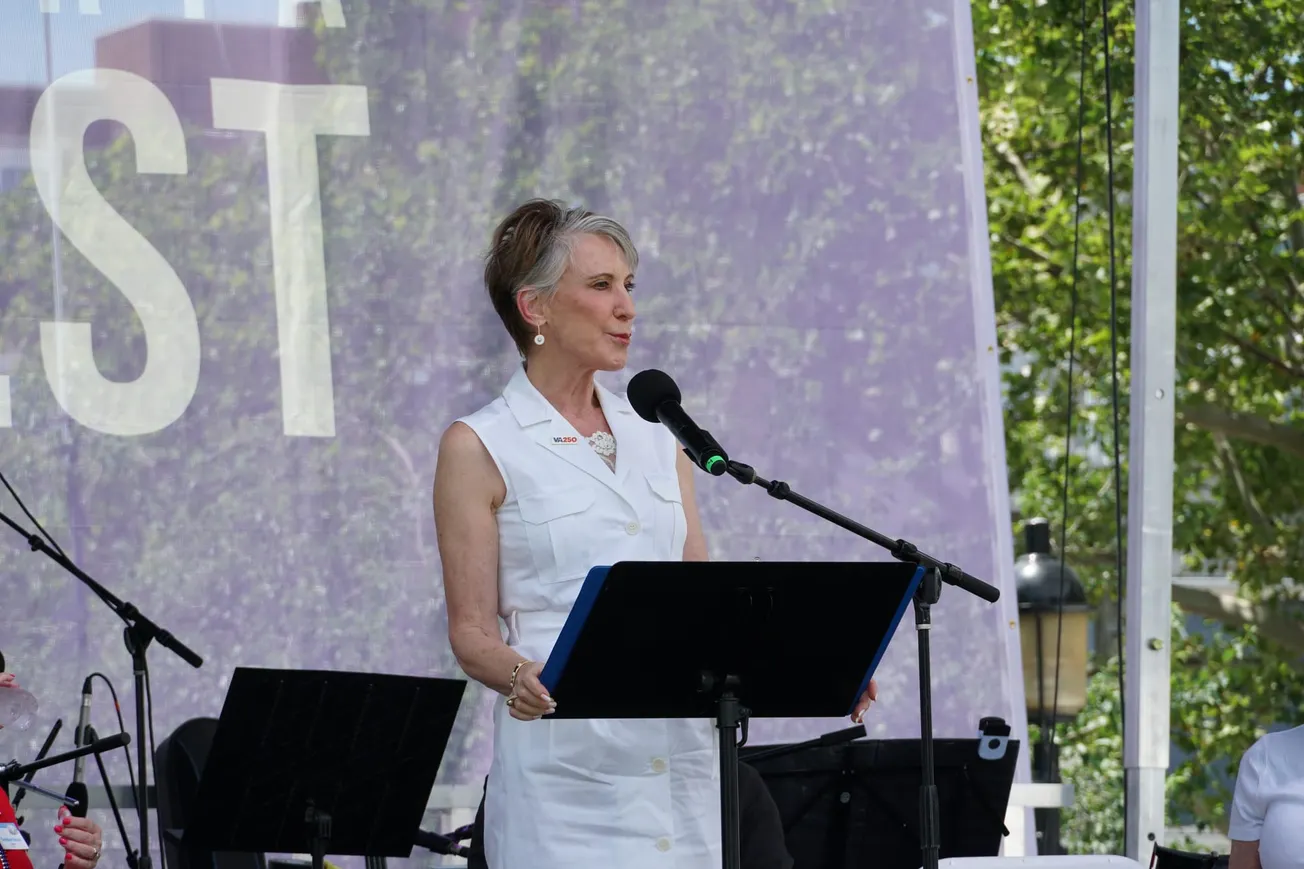
ALEXANDRIA, Va. — Speaking to a crowd gathered in midday June heat at Waterfront Park on Friday, Carly Fiorina opened her keynote for Sails on the Potomac with a claim she would spend the next several minutes defending: that the United States is unlike any other nation because it was founded not on ethnicity, territory or religion, but on ideas.
"When we as Americans do not know our history, we don't know why we are a nation," said Fiorina, who serves as honorary chair of the Virginia 250th Commission. She told the audience that ideas "can move the world" — and that a country built on them is fragile when its citizens forget what those ideas were, recalling her own college studies in history and philosophy.
Fiorina led Hewlett-Packard from 1999 to 2005, becoming the first woman to head a Fortune 20 company, and later ran for the U.S. Senate in California in 2010 and for the Republican presidential nomination in 2016. In April, she was named chief executive of the Colonial Williamsburg Foundation, where she had chaired the board since 2020. She and her husband live in Mason Neck, along the Potomac.
A date with meaning
Fiorina anchored the speech in the calendar. She noted that the gathering fell on June 12, the same date in 1775 that, by her account, George Mason penned the Virginia Declaration of Rights — a document she said became a model for Thomas Jefferson's Declaration of Independence and, later, for the Bill of Rights. Both Mason and Jefferson were Virginians, she reminded the crowd, as she built toward the line that would become the speech's refrain.
"America was made in Virginia," Fiorina said, adding, "with all due respect to Philadelphia and Boston and New York." She argued that without Virginia — which she called the oldest and most politically and economically powerful of the colonies — the revolutionary army "would never have gotten off the ground," and credited Patrick Henry's "give me liberty" speech in Richmond with persuading Virginia to commit men and arms to the fight.
The whole story, not the nostalgic one
If the speech celebrated Virginia, it also pressed the audience not to sand down the harder edges of the founding. Fiorina invoked figures often left out of commemorations: Gowan Pamphlet, an enslaved man who led the First Baptist Church, and James Lafayette, an enslaved man who spied for Gen. George Washington and helped relay British plans. She pointed to indigenous leaders Powhatan and Pocahontas, asking the crowd to imagine the nation without them.
She did not avoid the contradictions. Fiorina described the impossible choices the enslaved faced — including the 1775 Dunmore Proclamation, which offered freedom to those who fought for the British — and the divisions that ran through the founding generation, from class and status to the treatment of the enslaved and the indigenous. The radical idea that "all men are created equal," she acknowledged, applied at the time only to white male property owners. Yet that same idea, she argued, has since inspired "every movement of human dignity, liberty, sovereignty, everywhere ever since."
Fiorina leaned into the personal rivalries of the era to make the point that discord is not new. Mason and Washington, she said, were close friends who argued over the Bill of Rights and never spoke again, despite living as neighbors along the Potomac. Jefferson, she added, couldn't stand Patrick Henry.
A call to civic renewal
Fiorina closed by laying out what she described as the three goals of the Virginia 250 Commission: to educate by telling the entire story — "Nostalgia is not history. Propaganda is not history" — to engage every community so all Americans see themselves in the shared story, and to inspire "a season of civic renewal."
It is the responsibility of citizens, she said, to keep forming "a more perfect union." She ended with a welcome aimed beyond the city's borders: "America, welcome home."
Sails on the Potomac runs through Sunday at Waterfront Park. The free festival is part of Alexandria's contribution to the national 250th-anniversary commemoration.
 Ryan Belmore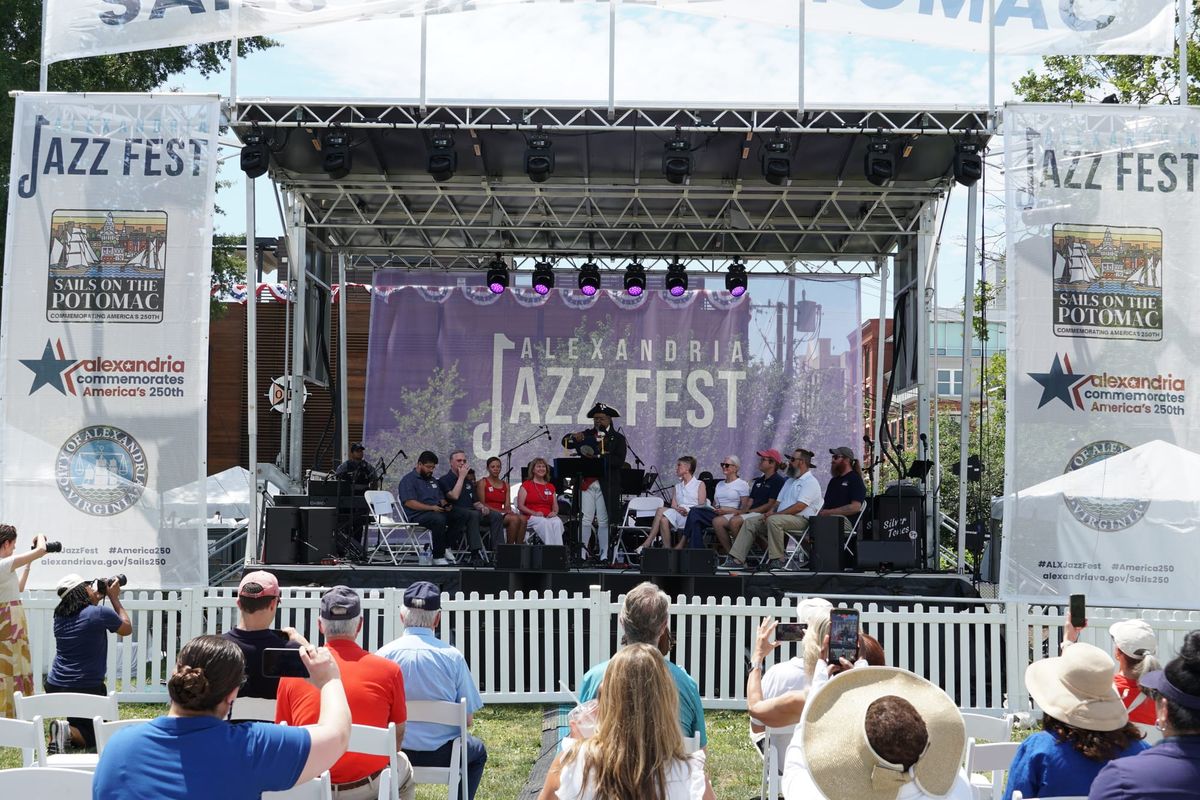
The Alexandria Brief
Alexandria, Va., news and information you won't find anywhere else.
The Alexandria Brief has no ads, no paywall, and no corporate owner. Support this work with a monthly or annual subscription, or a one-time contribution.
Publisher: Ryan Belmore, an Alexandria resident and journalist. Send feedback, story ideas, news, and tips to ryan@alexandriabrief.com.
Copyright 2026 Alexandria News LLC/The Alexandria Brief. All rights reserved. This material may not be published, broadcast, rewritten, or redistributed without express written permission.