Table of Contents
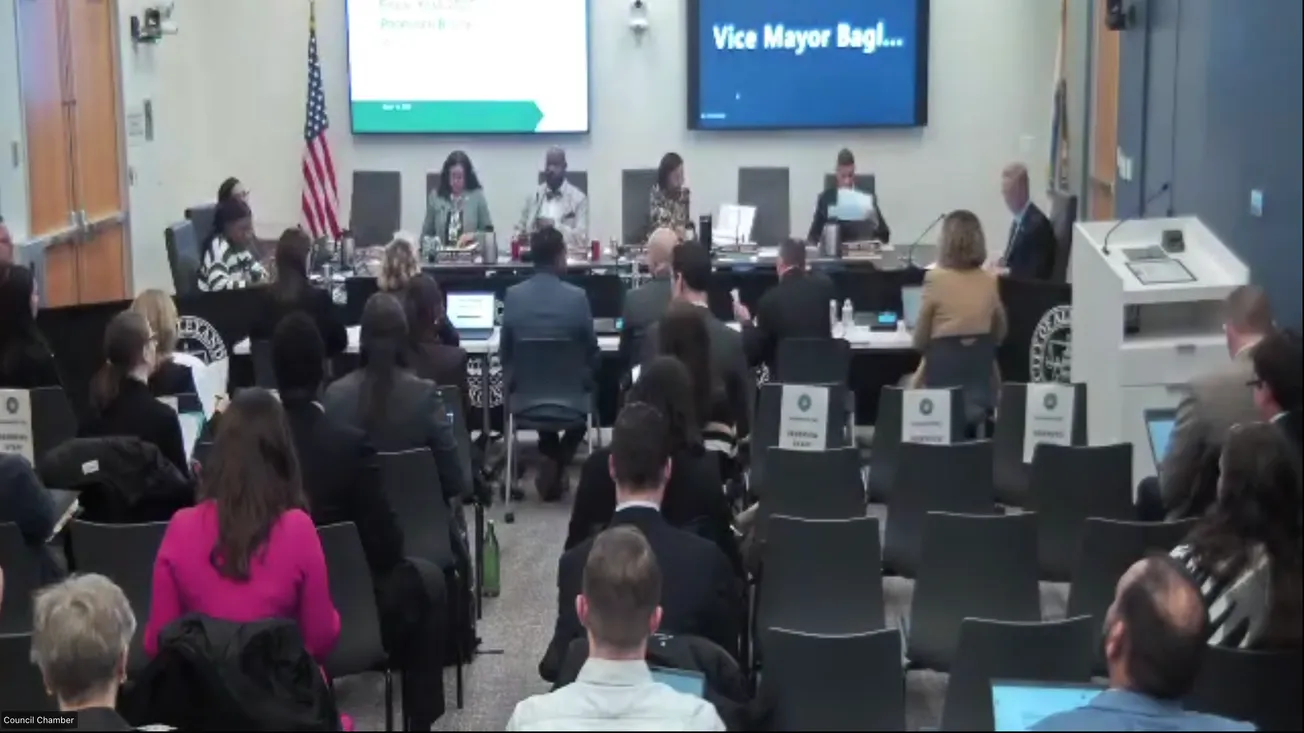
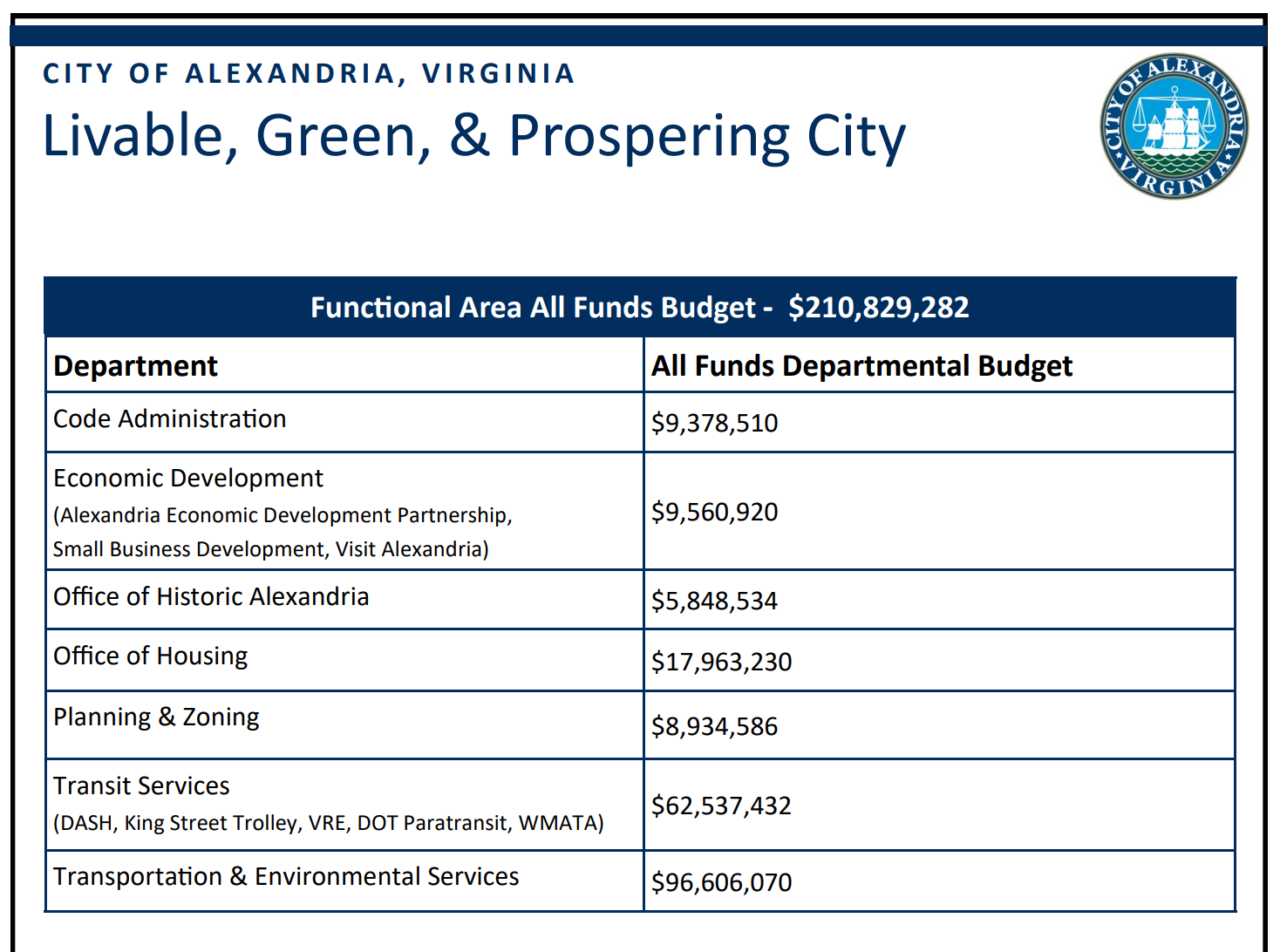
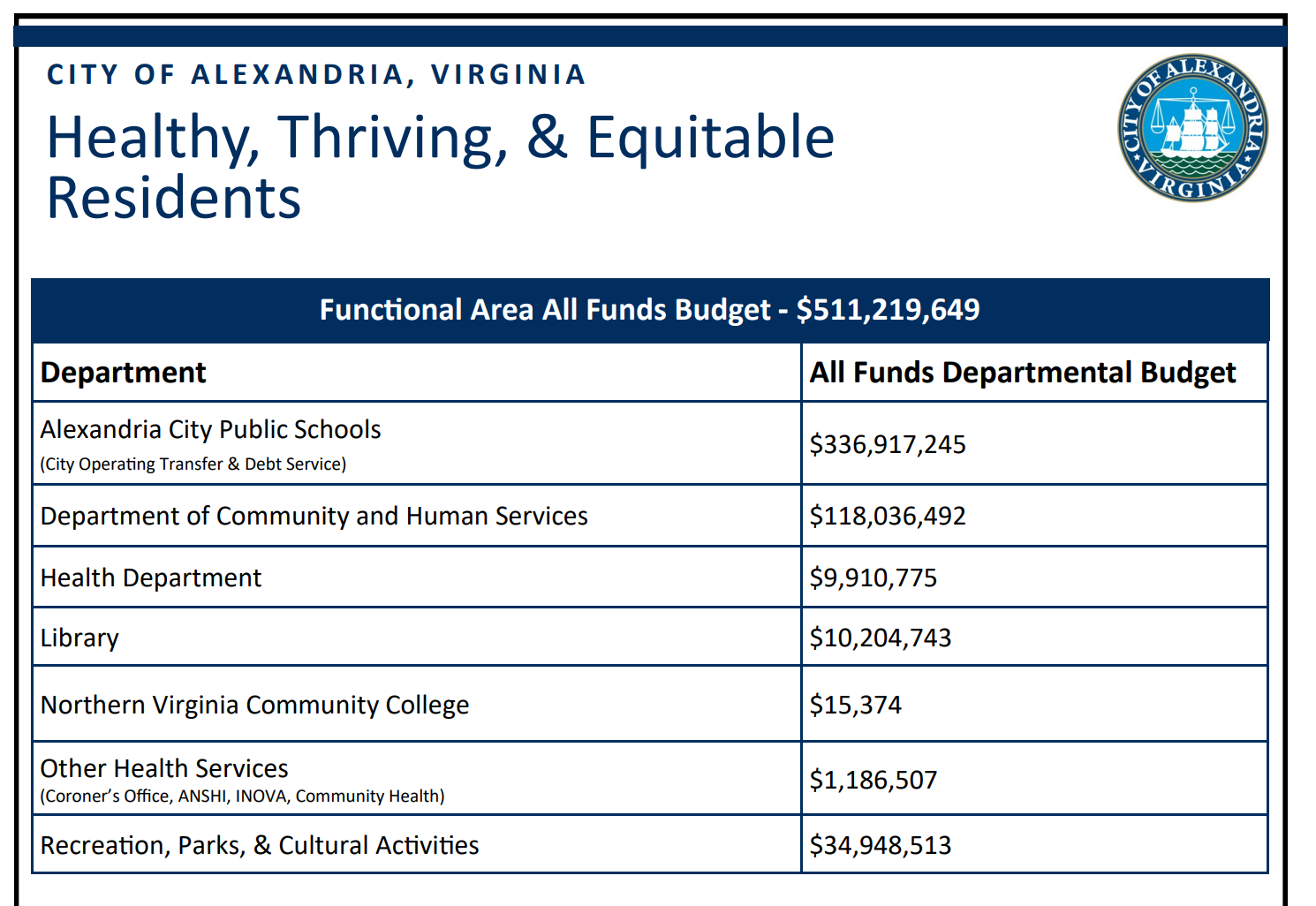
Alexandria City Council combined two budget work sessions into a single session Wednesday night at the Del Pepper Community Resource Center after Monday's session was canceled due to severe thunderstorms. The joint session covered the "Livable, Green & Prospering" and "Healthy, Thriving & Equitable" functional areas — together representing roughly $722 million of the proposed FY 2027 budget.
The session was the most wide-ranging of the budget cycle so far, touching on wastewater infrastructure, DASH bus expansion, a $100 million gap in the affordable housing pipeline, human services sustainability, and the future of the Torpedo Factory.
Parking fees going up; Sunday metering proposed
Transportation & Environmental Services led off with a series of proposed fee adjustments. Deputy Director Hillary Orr told Council the department is proposing to increase parking meter rates from 75 cents to $2.50 per hour and add Sunday metered parking hours — currently, metered spaces are free to users on Sundays. The city is also proposing to raise the parking citation fee from $40 to $50, which staff said is in line with peer jurisdictions and is expected to generate approximately $900,000 in additional revenue.
A separate increase tied to a VDOT road maintenance payment — reflecting 16.7 additional lane miles approved by Council in 2024 — is expected to bring in an estimated $534,000. Staff clarified this is not a new fee but an adjustment based on updated lane mileage.
The department is also deploying an upgraded automated vehicle location and GPS telematics system, live as of March 1, enabling real-time tracking of city fleet vehicles. Councilman Canek Aguirre asked whether GPS devices could be placed on contractor vehicles during snow operations; staff confirmed that was the explicit intent.
A $43 million wastewater capacity purchase
Sanitary Infrastructure Division Chief Erin Bevis-Carver presented a proposal to purchase 2.2 million gallons per day of wastewater treatment capacity from Fairfax County at a cost of $43 million — a purchase that would be in perpetuity with no return to Fairfax County. The city is currently at approximately 90% of its existing treatment capacity at AlexRenew. The purchase is funded entirely from sanitary sewer special revenues, with no general fund impact, using a mix of new FY 2027 funding and reprioritized prior-year balances.
Staff projected a 9 to 10% sanitary sewer rate increase in FY 2028, with another estimated 5% increase around FY 2035. Mayor Alyia Gaskins pressed staff on whether those increases could be phased more gradually rather than absorbed as larger one-time jumps — a model she said has worked well with the stormwater utility fee. Staff said they would explore phasing options.
Councilman John Taylor Chapman asked about potential compounding rate impacts, given that AlexRenew itself will add remaining capacity through future upgrades, which may also affect ratepayer bills. Staff said the option presented was the least impactful of those evaluated.
DASH seeks to make Route 32 enhancement permanent
DASH CFO Edward Ryder and General Manager and CEO Josh Baker, who participated remotely, presented the transit agency's budget, which reflects a $970,000 increase in the city's general fund contribution — about 2.8% — bringing the total DASH subsidy to $35,459,246.
A central question was the future of the Route 32 enhancement, which expanded service between Landmark and Van Dorn and is currently funded on a one-time basis. Making the enhancement permanent would cost approximately $240,000, Ryder said, though no action would be needed in this budget as the cost would not carry forward until FY 2028. Councilman Aguirre also asked staff to include the cost of extending service down Mount Vernon Avenue.
Mayor Gaskins raised the possibility of transitioning bus stop maintenance to DASH, noting uneven cleanup performance during the February snowstorm. WMATA assisted DASH in clearing bus stops during that storm; DASH tracked storm-related costs at approximately $10,000 for potential state reimbursement.
Councilman Aguirre flagged a broader financial risk: if the state fails to fund WMATA operating costs, Alexandria's share could be approximately $21 million. "I have confidence the state will make us whole," he said, "but it's something we need to be keenly aware of because an amount like that is pretty significant for our budget."
Across the fleet, Ryder confirmed that DASH recently received six clean-diesel buses and has 12 electric vehicles — five trolleys and seven buses — in production under its first LONO grant. An unexpected second LONO grant added 11 more buses.
Housing pipeline: 1,120 units waiting, $100M gap
Deputy Director Aspasia Xypolia of the Office of Housing told Council that more than 1,500 affordable rental units are currently under construction in Alexandria, with over 1,380 receiving some form of city support. But she stressed the scale of what remains: more than 1,120 units in the pipeline are waiting for city funding, representing a gap exceeding $100 million — roughly a 10-year commitment at $10 to $11 million per year.
On bonding authority, housing staff recommended $7 million in allocations: $2 million for the Ladre project, $3 million for Parkview rehabilitation — which houses existing tenants — and $2 million toward the CLI project, which staff described as close to closing on a significant development.
The Naja project — which had originally been designed to include 58 affordable homeownership units — has been reconfigured to 79 rental units. Staff said converting to homeownership would push the city funding gap from $4 million to approximately $20 million. Without philanthropic support in sight, staff said proceeding with rentals allowed the project to move forward. A final $4 million ask for Naja is expected before the Council in April.
City Manager Parajon highlighted a new collaboration between the Office of Housing and the Finance Department, sharing a position to support 311 calls and front-office needs — describing it as a commendable example of cross-departmental efficiency.
Historic Alexandria seeks state funds for Freedom House; takes modest cuts
Director Gretchen Bulova presented a $55,000 supplement to continue a part-time position and fund programming for the Alexandria Community Remembrance Project, alongside a 1% across-the-board reduction of $48,000. Cuts include reduced exhibit rotations, fewer outside consultants for archaeological services, one fewer interpretive sign, and reduced specialized landscaping at Fort Ward.
On Freedom House: $1 million is included in the Virginia Senate budget, but nothing is in the House. The General Assembly went sine die without a budget agreement and is scheduled to reconvene on April 23. If the Senate funding survives, it would flow through the Department of Historic Resources starting July 1.
Mayor Gaskins asked about coordination with Visit Alexandria on marketing reductions. Bova said the organization already serves as Historic Alexandria's primary marketing agent, and that reductions in rack cards and regional magazine advertising will be offset in part by national visibility surrounding the 250th anniversary of American independence.
Planning & Zoning loses one FTE; longtime assistant director retiring
Director Paul Stoddard announced the retirement of Assistant Director Nancy Williams after 17 years of service and introduced incoming Assistant Director Barbara Harris. The department is eliminating five long-vacant over-hire positions and one administrative vacancy, absorbing those roles into existing staff. A modest adjustment to the development review fee is projected to generate approximately $65,000 in additional revenue.
Councilman Chapman asked for a budget memo on what a comprehensive citywide master plan would require in staff and cost, noting the last full overhaul was in 1992. Stoddard said he would provide one. Council Member Abdel-Rahman Elnoubi asked about adding time-based performance metrics to the department's KPIs rather than just volume counts; Stoddard said specialized dashboards for the One Start program and zoning-for-housing are already tracking pipeline speed and will be expanded.
Chapman also asked whether the city could quantify the economic value of faster development review — the carrying costs saved for developers and the community benefit of sooner occupancy. Stoddard said he was happy to work up that analysis.
Climate action focuses on affordable housing electrification and utility rates
Climate Action Officer Ryan Freed told Council that FY 2027 priorities are multifamily building decarbonization and utility rate intervention. On ARHA electrification: at $25,000 to $30,000 per townhouse unit, the current $300,000 investment reaches roughly 10 units. The office is working with the Office of Housing, CDFIs, and C-PACE financing tools to leverage that investment into something larger in future years.
On utility rate cases, Freed said outside counsel costs have risen to a minimum of approximately $75,000 per intervention — partly because data centers have absorbed much of the specialized legal talent in this field. To manage costs, the office and City Attorney Brian Macavoy are handling a current demand-side management case without outside counsel.
Human services: survival services investment, rental assistance debate, federal uncertainty
DCHS Director Kate Garvey and Deputy Director Federico Gutierrez presented a 2.1% budget increase anchored by new investment in what the department calls "survival services." The Alexandria Fund for Human Services is increasing by $550,000, with new cooperative agreements directing funding to ALIVE food hubs, Carpenter Shelter, and senior meal services. The ALIVE food hubs served more than 86,000 Alexandrians on a duplicated count basis in FY 2025; senior meal services have grown from 1,400 meals to 20 seniors to nearly 5,000 meals to 90 seniors.
One-time funding is also proposed for three early childhood service providers — the Child and Family Network, the Family Support Project, and Northern Virginia Family Services' Healthy Families program — that had previously been cut from the Fund for Human Services.
Mayor Gaskins pressed city management on sustainability, noting these organizations cannot draw down other funding without a city commitment in place and that costs will only grow in future years. City Manager Parajon acknowledged the services should ultimately be sustained, but said the current budget could not absorb them as permanent ongoing expenditures without additional cuts. The Mayor said she wanted planning to begin now for FY 2028.
On rental assistance: the program currently operates at approximately $775,000 in combined General Fund and CSBG funding, serving roughly 245 households last year at an average payment of about $3,100, or about 31 households per $100,000. Advocates had sought a $5 million increase. Vice Mayor Sarah Bagley and Council Member Elnoubi pressed staff on whether additional funding could be structured to serve both pre-eviction prevention and post-eviction-notice cases. Garvey said the department is open to creative structuring if additional funds are available.
Garvey also reported significant progress on the mental health staffing challenge Council invested in two years ago: vacancies in mental health positions have dropped from 67 out of 114 to 25 out of 114. Department-wide turnover is now at 11%, well below the behavioral health sector average of 30 to 35%. A temporary HR position that supported that turnaround is being made permanent.
On federal uncertainty, Garvey said the department is monitoring the impacts of HR1 on SNAP and Medicaid compliance, but does not currently anticipate infrastructure costs being passed to localities. A staff position is being reclassified to support benefits compliance as SNAP and Medicaid caseloads run 700 to 1,000 families per worker at current staffing levels.
Recreation: spray park, Torpedo Factory, fees across the board
RPCA Director Hashim Taylor presented a range of fee adjustments, most of which had not been updated in years. The special events application fee will double from $50 to $100 — the first increase in at least eight years. Trail rental fees will increase for walks and 5Ks; marina fees will rise modestly; youth sports affiliate fees will increase $5 for the first time since 2016; and school-time program fees will increase $100 per year while maintaining discounts for families receiving free and reduced lunch, SNAP, and TANF support.
A new charge is proposed for "Powerful Fund Day" — the supplemental out-of-school program on ACPS days off. The program was previously free. ACPS days off beyond standard breaks have grown from 5 in 2019 to 13 in 2025, with approximately 30 non-city-holiday days projected for the coming school year.
Student parking on the Chinquapin loop at Alexandria City High School would increase from $120 to $150 per year.
Mayor Gaskins flagged a broader theme: the session had surfaced multiple fees that had not been updated in a decade or more. She suggested a regular review cadence to avoid large one-time jumps in the future.
The Colasanto spray park is expected to open this pool season, with $30,000 budgeted for required water quality inspections. A one-time $100,000 is proposed for interior and exterior maintenance at approximately five recreation centers to refresh and revitalize older facilities.
On the Torpedo Factory: Vice Mayor Bagley asked about the status of maintenance and any planned enhancements. Deputy Director Diane Ruggiero said the RFP for future management is due at the end of April, with a Council recommendation expected in September or October. No exterior improvements are budgeted pending those results, though she noted General Services has been actively maintaining critical infrastructure — water heaters, valve replacements — on equipment 60 to 80 years old. "There is a lot being done," Ruggiero said.
Mayor Gaskins and Councilman Elnoubi raised questions about inclusive access to recreation programs for children with disabilities and learning differences, noting gaps between therapeutic recreation options and what neighborhood out-of-school sites can currently accommodate. City Manager Parajon said a budget memo will examine what expanding that model would require in staffing and cost.
What's next
Work Session #6 — Accountable & Effective Government — is scheduled for Wednesday, March 25 at Del Pepper Community Resource Center. City Manager Parajon said it will also include an additional presentation. Budget adoption remains on track for April 29.
FY 2027 Budget Calendar
- March 25 — Work Session #6: Accountable & Effective Government
- April 6 — Deadline for council to notify staff of planned tax rate changes
- April 9 — Council add/delete deadline
- April 18 — FY 2027 Add/Delete and Tax Rate public hearings
- April 21 — Work Session #7: Preliminary Add/Delete
- April 27 — Work Session #8: Final Add/Delete (if needed)
- April 29 — FY 2027 Budget and Tax Rate Adoption, 6 p.m.
- July 1 — Fiscal Year 2027 begins