Table of Contents
Updated: This story has been updated on Sept. 9 with questions Councilwoman Jacinta Greene raised about the Flock contract, and with two asks from Councilman Abdel-Rahman Elnoubi — timelines for the third-party audit and for a Flock alternative, and whether the city can block localities with 287(g) immigration agreements from searching its cameras.
ALEXANDRIA, Va. — Mayor Alyia Gaskins said Tuesday night that she does not believe there is a role for Flock Safety in Alexandria, and Police Chief Tarrick McGuire told City Council he has been meeting with other vendors he believes offer stronger safeguards.
McGuire also said the city's Flock contract can be discontinued at any time, in response to questions from Councilwoman Jacinta Greene. He did not know its expiration date.
"While I do think there's a role for technology, and I do think we have seen the role that that has played and the benefit it has, I do not think there's a role for Flock in this community," Gaskins said.
Councilman Abdel-Rahman Elnoubi said he wanted to see serious steps toward getting rid of Flock, and asked for a timeline. Councilwoman Sandy Marks said she was interested in getting Flock out of Alexandria, but that removing the vendor alone would not satisfy her.
"Eliminating Flock isn't enough for me," Marks said. "Eliminating it and moving to a new and similar technology isn't enough for me without an extended conversation."
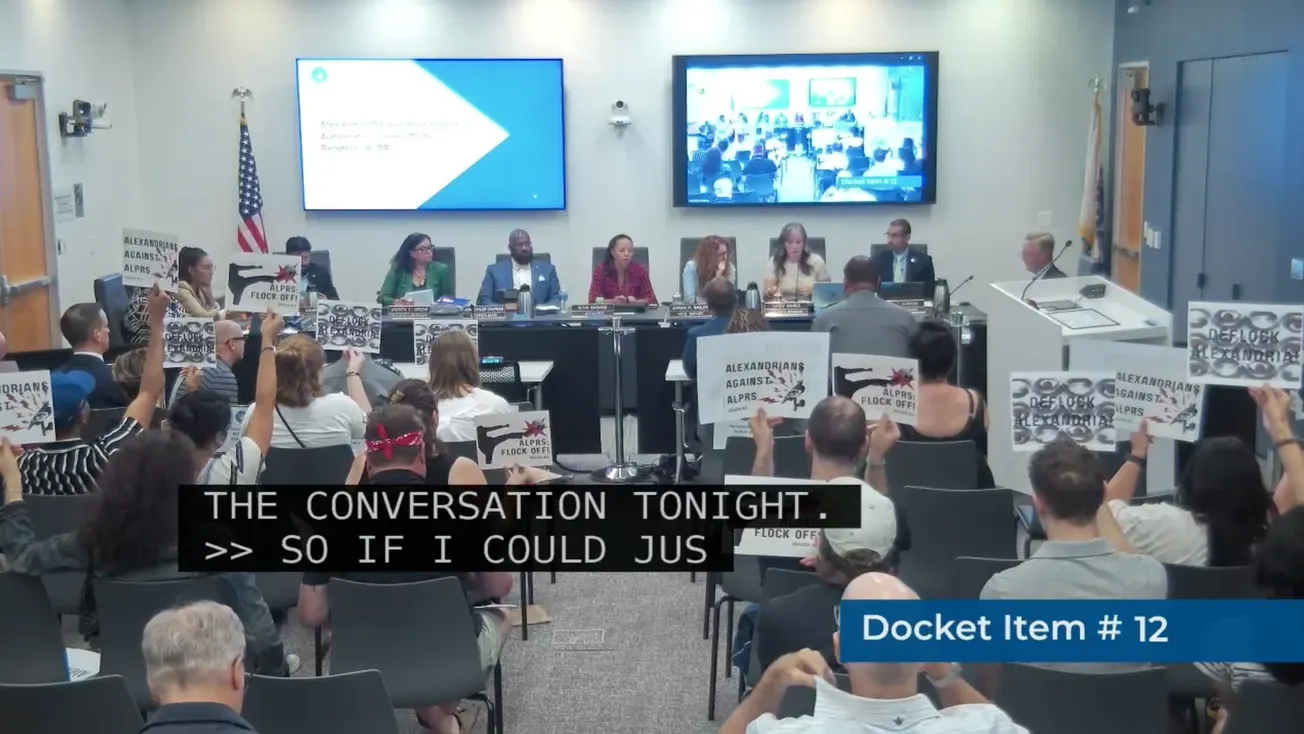
Residents filled the council chamber for the item, many holding signs reading "Deflock Alexandria" and "Alexandrians Against ALPRs."
The discussion came during an oral report on the city's automatic license plate reader program, the twelfth item on Tuesday's docket and one of four updates from City Manager James Parajon.
McGuire did not name Flock in his presentation. He told council the department has been meeting with additional vendors and is exploring options, and that any replacement would have to be consistent with community values and the department's needs. Asked for a timeline, he said he did not have a definitive one.
"I do recognize that there is a sense of urgency," he said. "But I also want to ensure that I'm doing my due diligence and that we get it right."
The contract
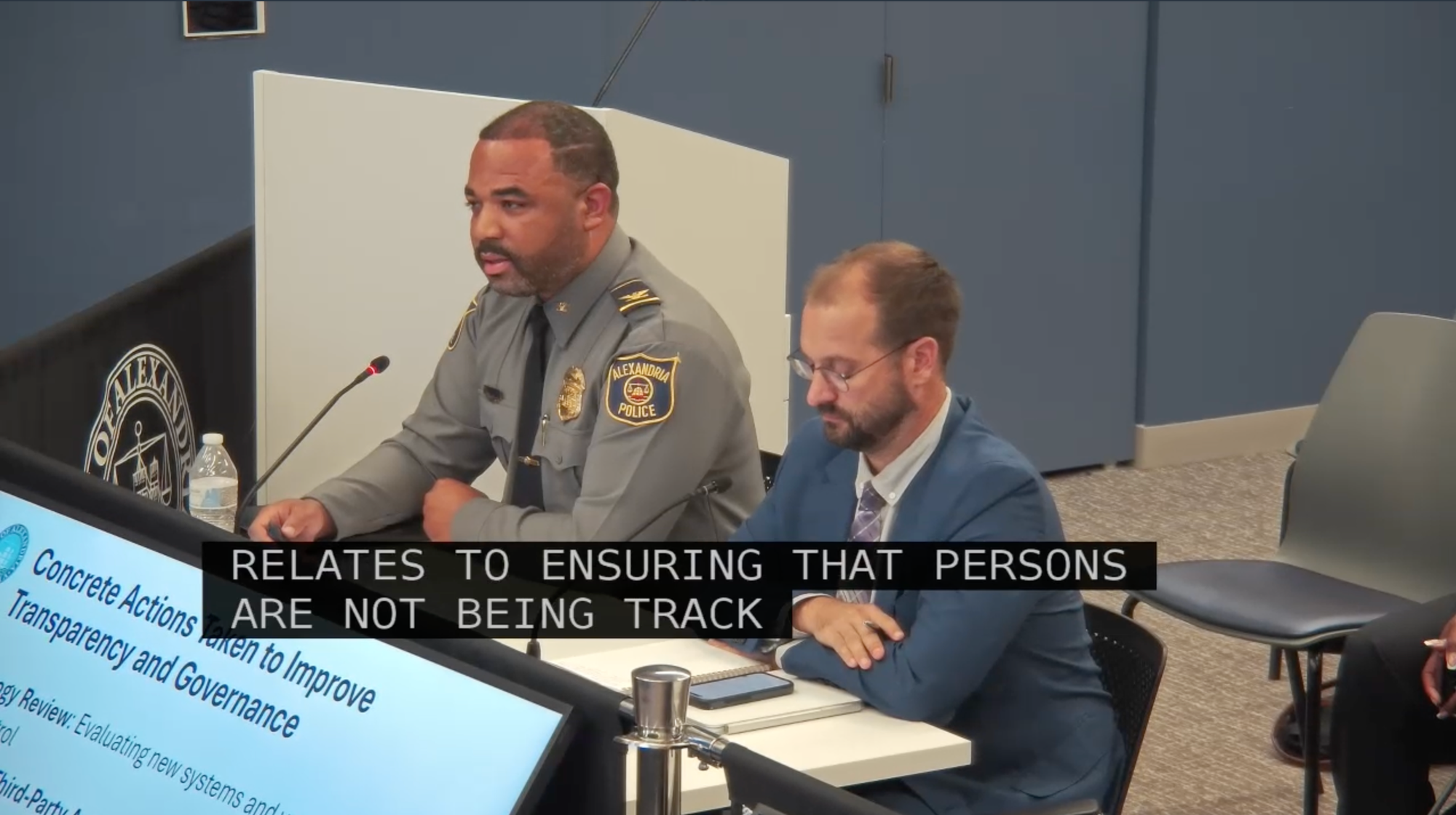
Councilwoman Jacinta Greene pressed McGuire on the terms of the city's Flock contract: when it started, how it was paid for, when it expires and whether Alexandria could get out of it.
McGuire said the contract began in 2023, when the city started its camera pilot. Grant funding through the Virginia Department of Criminal Justice Services covered more than $300,000 and the majority of the program's cost, he said. He believed it was a one-time award, and said he would follow up on the share paid from city funds.
He did not know the expiration date. Asked whether the contract could be ended, he said it can be discontinued at any time.
What the department said about oversight
McGuire said 233 officers are trained on the system, along with non-sworn crime analysts, and that untrained personnel cannot access the database. Every search, he said, requires an offense type, a case or computer-aided dispatch number and a stated reason, and all fields must be completed before a search runs.
A dedicated unit audits the system monthly. McGuire said those audits have found clerical errors — an officer entering a wrong case number, for example — but no malicious misuse. Officers who make errors are contacted and coached, he said, and a third error results in being locked out of the system pending full retraining.
The Alexandria Times reported last week that it found more than 50 instances of officers improperly labeling why they searched the database. Asked about those, McGuire said they occurred over a multi-year period and reflected human error rather than intent.
He said the department does not share license plate data with Immigration and Customs Enforcement, and that state law does not permit it to.
McGuire also said the department is working to bring in an outside auditor. Robin Engel, a criminologist who already has a data-sharing agreement with the department, is meeting with staff about auditing the department's ALPR data. Parajon said that the agreement is roughly a week away, absent a procurement issue.
The case for the cameras
McGuire defended the program's investigative value, citing the department's most recent homicide and cases involving a serial rapist and a man exposing himself to women.
"Without technology, we would not have solved those crimes," he said.
He also defended the 21-day retention period, the maximum Virginia law allows, saying detectives need time for field follow-up and that leads sometimes surface on the eighth or ninth day. Some departments nationally hold data for six months or a year, he said, which has never been Alexandria's practice.
Flock cut its recommended default retention period from 30 days to seven on Aug. 13. APD told The Alexandria Brief on Saturday it has made no decision to change its 21-day period.
Marks raised a related concern from the other direction, saying violent crimes against women and children are not always reported within seven days and that any retention decision should account for that.
What council asked for
Marks said she wants to understand whether Alexandria can control access query by query, rather than granting standing access to other jurisdictions, with someone at APD deciding whether a search is lawful before another agency runs it. She cited concerns about immigration enforcement and about people from other states seeking abortions. She also said Alexandria has roughly triple the ratio of cameras to residents and to square miles of its neighboring jurisdictions, and asked why coverage here is so dense.
Elnoubi asked for timelines on two things: the third-party audit, and the search for an alternative to Flock. He also asked whether the city can cut off access for localities that have 287(g) agreements deputizing their officers for federal immigration enforcement.
"I don't want ICE or any locality that deals with ICE accessing our data, because I don't want them targeting undocumented immigrants," Elnoubi said. "To the extent that we have the ability to do that, are we able to wall those localities off?"
McGuire said the department can. He said his staff is going through the agencies APD shares data with, that the sharing complies with state law and is limited to Virginia agencies, and that any action would be taken in consultation with the City Attorney's Office and the City Manager's Office.
The Alexandria Times has reported that 11 agencies on APD's sharing list have 287(g) agreements with Immigration and Customs Enforcement. The list has shrunk from 161 names on Aug. 18 to 152 on Wednesday, with no agencies added. APD told The Alexandria Brief last week that agencies drop off when they stop participating and that the list is maintained through a database rather than by the department.
Vice Mayor Sarah Bagley said she was leaving without full clarity on the number and location of cameras, and asked for follow-up reconciling the department's figure of 61 with other counts in circulation. She said she accepted the 61 figure but noted the community has seen others. She also asked what it would take to start from a position of not sharing data at all.
McGuire said the department can only speak to cameras it operates under contract, and that private businesses, neighboring jurisdictions and Northern Virginia Community College also operate readers in or near the city.
Councilman Canek Aguirre asked for a written breakdown distinguishing the city's camera types — fixed readers, cruiser-mounted units, body-worn cameras, traffic cameras and school bus cameras — and whether APD has agreements with private businesses or the community college for direct camera feeds.
Councilman John Chapman asked for the budgetary and staffing implications of the changes under discussion, including any vendor change.
Greene's questions on the contract left two commitments outstanding. McGuire said he would follow up with the contract's expiration date, which he did not know, and with the share of the program's cost paid from city funds rather than grant money. Both bear on Chapman's budget question.
Gaskins asked that community meetings on the technology be scheduled on their own rather than folded into other meetings, that answers to council's questions be published online, and that staff report back on what it would take to remove the Flock cameras. She also suggested a single dedicated page for the program, similar to the city's ICE operations page.
Parajon said staff would return with answers in days for some questions and a couple of weeks for others, published on the city website. On camera locations, he said the city would want a follow-up conversation.
The numbers
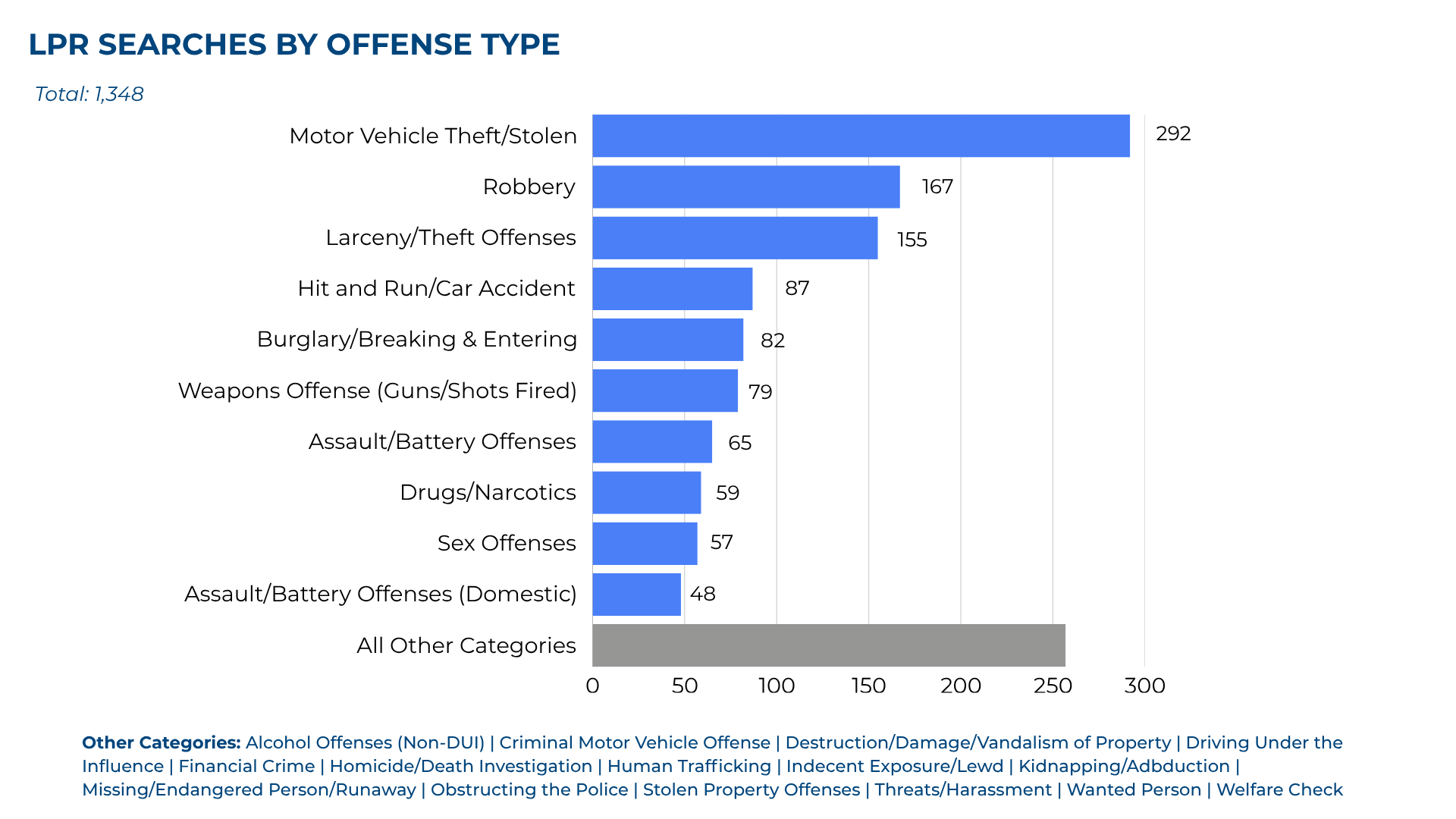
APD published an ALPR dashboard on the city website Tuesday, the day of the hearing. It reports 1,348 license plate reader searches by offense type, led by motor vehicle theft at 292, robbery at 167 and larceny at 155. The page says it will be updated roughly every 30 days but does not define the period the total covers.
Flock's separate transparency portal, updated the same day, reports 322 user search sessions over the past 30 days — down from 479 on Aug. 18. The portal does not define a search session, and the two figures have not been reconciled publicly.
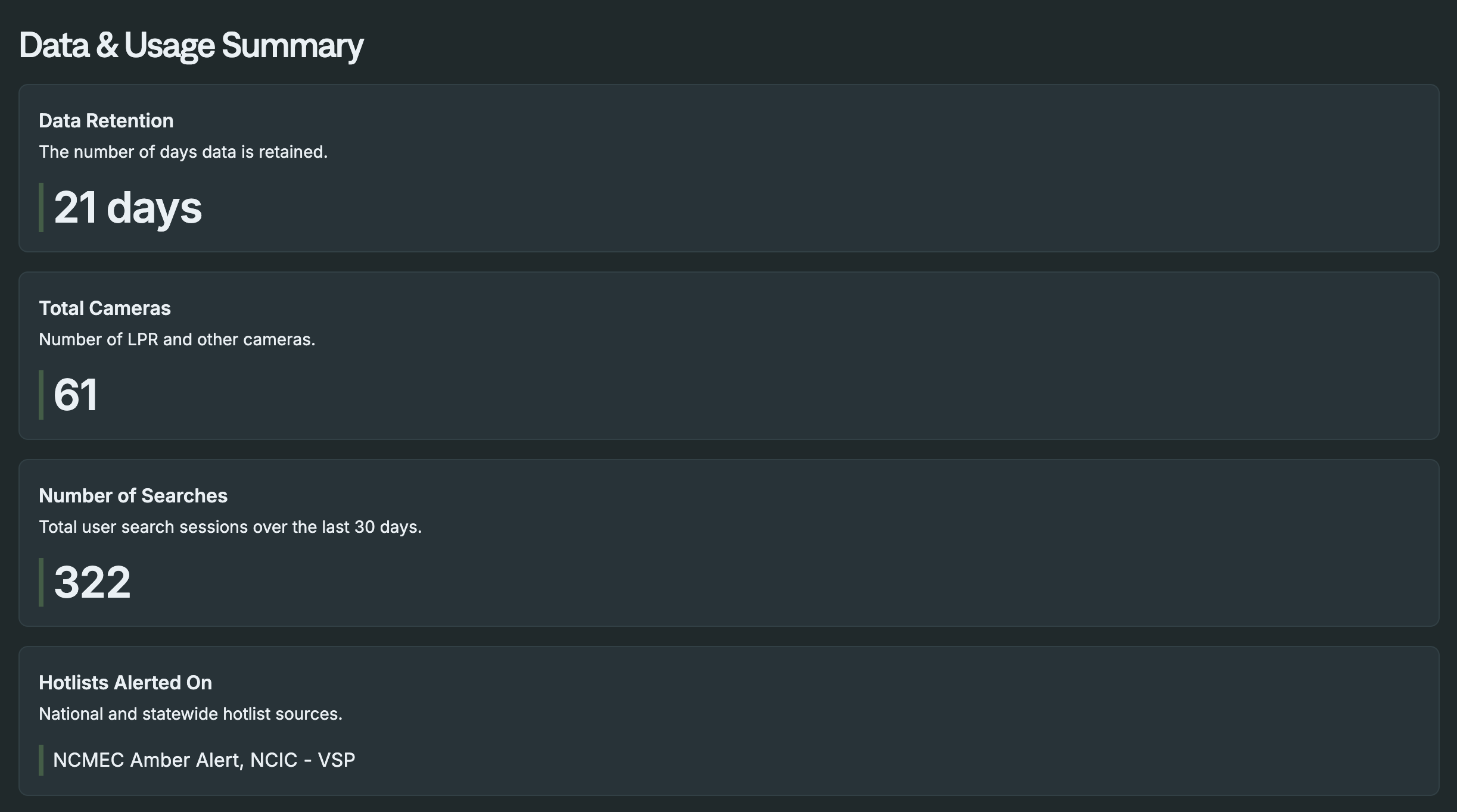
The portal's list of agencies that can search Alexandria's cameras has also shrunk, from 161 names on Aug. 18 to 153 on Tuesday, with no agencies added. All remain Virginia entities. APD said last week that agencies drop off when they stop participating and that the list is maintained through a database rather than by the department.
Camera locations remain unpublished. The department said Saturday it would not release them, citing operational and investigative considerations.
Watch the conversation
The presentation and conversation starts at approximately 2:47.
Ryan Belmore is an Alexandria resident and the founder and publisher of The Alexandria Brief. Send tips, feedback, and story ideas to ryan@alexandriabrief.com.