Table of Contents
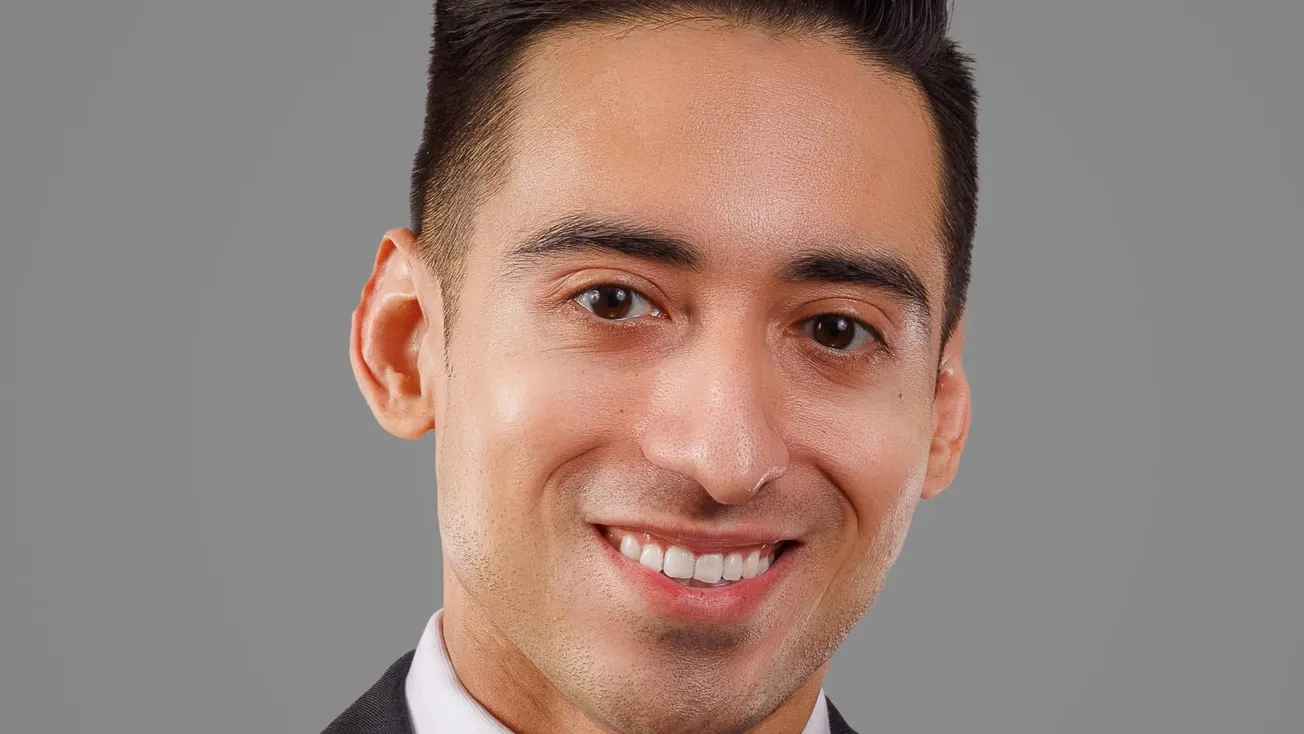
ALEXANDRIA, Va. — Tarrick McGuire has been Alexandria's police chief for nearly two years. His first full calendar year on the job has now been captured in the department's inaugural annual report — and the 29% drop in overall crime is, he says, only part of the story.
"I will never take the credit for outcomes," McGuire said in a one-on-one sit-down interview with The Alexandria Brief on Friday morning. "What I will take the credit for is the men and women who are producing the outcomes."
McGuire released the Alexandria Police Department's inaugural annual report Friday — a 74-page document covering everything from crime statistics to community cookouts, FBI Academy training to a newborn revived by CPR — a portrait of a department he says is evolving into something greater than the sum of its data.
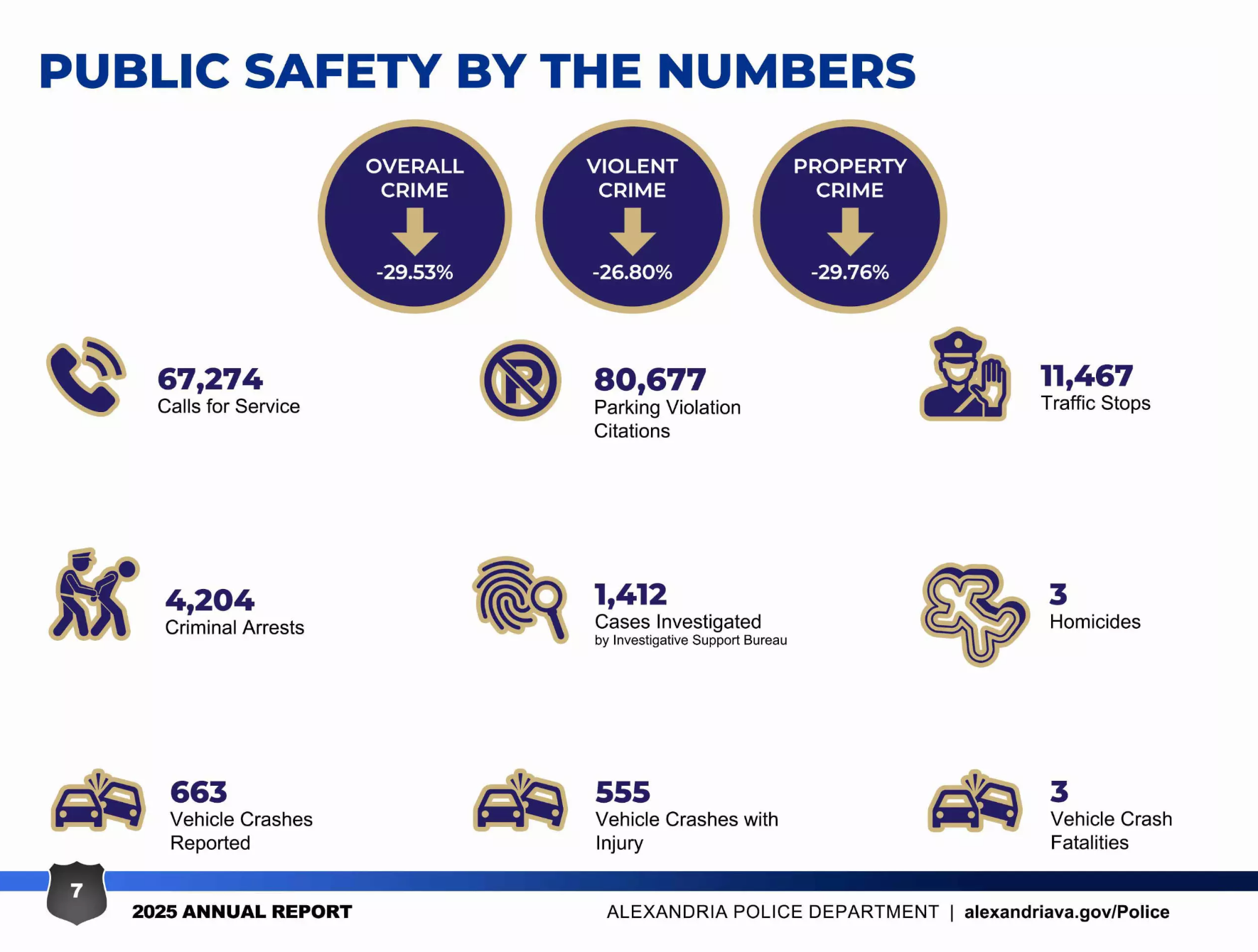
The headline figure is a 29.53% drop in overall crime from 2024, with violent crime down 26.80% and property crime down 29.76% — below regional and national trends. The department handled 67,274 calls for service, made 4,204 criminal arrests, investigated 1,412 cases through its Investigative Support Bureau, conducted 11,467 traffic stops, and recorded three homicides and three vehicle crash fatalities among 663 reported crashes. The top five call types — parking complaints, disorderly conduct, suspicious events, motor vehicle property damage, and commercial alarms — reflect the day-to-day reality of policing a densely populated city of more than 160,000 residents.
McGuire, who took office on November 25, 2024, and was sworn in on December 10, came to Alexandria from the Arlington, Texas Police Department, where he served as assistant chief. He is approaching two years leading a department he described as already doing good work — but one he has pushed toward what he calls a leading, learning, and self-correcting organization.
"Alexandria PD was doing good work," he said. "I will never take away from where our organization was. But we have to be held accountable to ourselves first before we can hold anybody else accountable."
A 29% drop — and what's behind it
On the crime decline, McGuire pointed to several factors beyond patrol deployment. An investigative team now responds immediately to crime scenes — a shift he said research shows leads to faster case resolution, greater witness cooperation, and quicker apprehension of suspects. "If we leave violent offenders on the street longer, there is a high propensity for them to re-offend," he said.
He also credited closer collaboration with the Commonwealth's Attorney's office, pointing to two high-profile regional cases — a sexual assault case involving a former D.C. police officer and a separate case involving someone from the federal government snatching women near Metro stations. "People really don't often see the collaborative nature behind not only our patrol response, but our investigative response," he said.
The Criminal Investigations Division, which investigated 1,412 cases in 2025, operates eight specialized units, including Special Victims, Homicide, Robbery and Gang, Fugitive Apprehension, Crime Analysis, Vice/Narcotics, and Electronic Investigations.
A third factor was a renewed focus on repeat offenders, working with probation officers and regional partners to ensure accountability. The Patrol Operations Bureau aligned deployment with real-time crime analysis through weekly crime review meetings, and built interagency partnerships with DASH, the Department of Community and Health Services, and Recreation, Parks and Cultural Activities.
The Brookings Institution's DMV Monitor analysis earlier this year placed Alexandria's per-capita crime reduction as the sharpest of any jurisdiction tracked in the Washington region. McGuire said the annual report data supports that picture, though he cautioned the figures are preliminary and may differ from what the department submits to the FBI's national crime database, making direct comparisons with other jurisdictions unreliable.
Prevention as a pillar
McGuire credited a refocused prevention approach built around Crime Prevention Through Environmental Design, or CPTED — a multi-disciplinary approach that uses urban and architectural design to reduce opportunities for crime. Officers Zachary Anderson, Johnny Larios, and Abby Mishler of the Crime Prevention Unit earned CPTED certification through the Virginia Department of Criminal Justice Services and began conducting assessments for businesses and neighborhoods on lighting, landscaping, and site design.
The Community Engagement Division participated in more than 180 events citywide in 2025, including community cookouts, Coffee with a Cop, and the annual Public Safety Trunk-or-Treat. The division also piloted a Safe Stays Program, partnering with West End hotels to train staff on recognizing signs of human trafficking, and hosted an Arlandria Movie Night that drew more than 200 residents to Four Mile Run Park.
Alexandria was also recognized as a Top 15 National Night Out community among cities with populations between 100,000 and 300,000, after increasing neighborhood participation by 44% and hosting 52 community celebrations across the city.
"We want to be preventative about crime," McGuire said. "And sometimes we have to interdict crime and then sometimes it's our response to crime."
The stories behind the numbers
When asked how residents can know whether they feel safer — something that doesn't appear on a data page — McGuire said the answer shows up in moments that statistics can't capture. He described community cookouts where officers are called by their first names, business owners who credit officer relationships with reducing theft, and a letter he received from 12-year-old Liam Hedges of Alexandria, who wrote in March to share a positive experience with Officer M. Brooks at Old Town Union Station.
Liam's father, Maj. Joshua Hedges of the U.S. Army, had been stationed in Alexandria for two years and was leaving on military orders. Before the family departed, Officer Brooks stopped to wave at the family, then came over to talk, spending time showing them he cared about the community.
McGuire also described a mother he met while delivering Thanksgiving meals who told him the AIM mentoring program had provided support for her children that they otherwise would not have had. And he recently learned about a female school resource officer who has been quietly running a mentoring program for young women in Alexandria City Public Schools — a story he said he only discovered by chance.
"We don't always get to share those stories," he said. "That's the data that you'll never see in the numbers."
Youth programs take root
The Alexandria Initiative on Mentoring, known as AIM, completed its inaugural year at George Washington Middle School, serving 21 participants across two cohorts. McGuire helped develop a similar program during his time in Arlington, Texas, where it earned national recognition from the Department of Justice's COPS Office as a model for 21st Century Policing. In Alexandria, pre- and post-program surveys showed participants made 20 to 25 percentage point gains in decision-making confidence and a strong shift toward viewing officers as trusted guides. Every respondent recommended the program, and 100% reported feeling comfortable communicating with officers afterward.
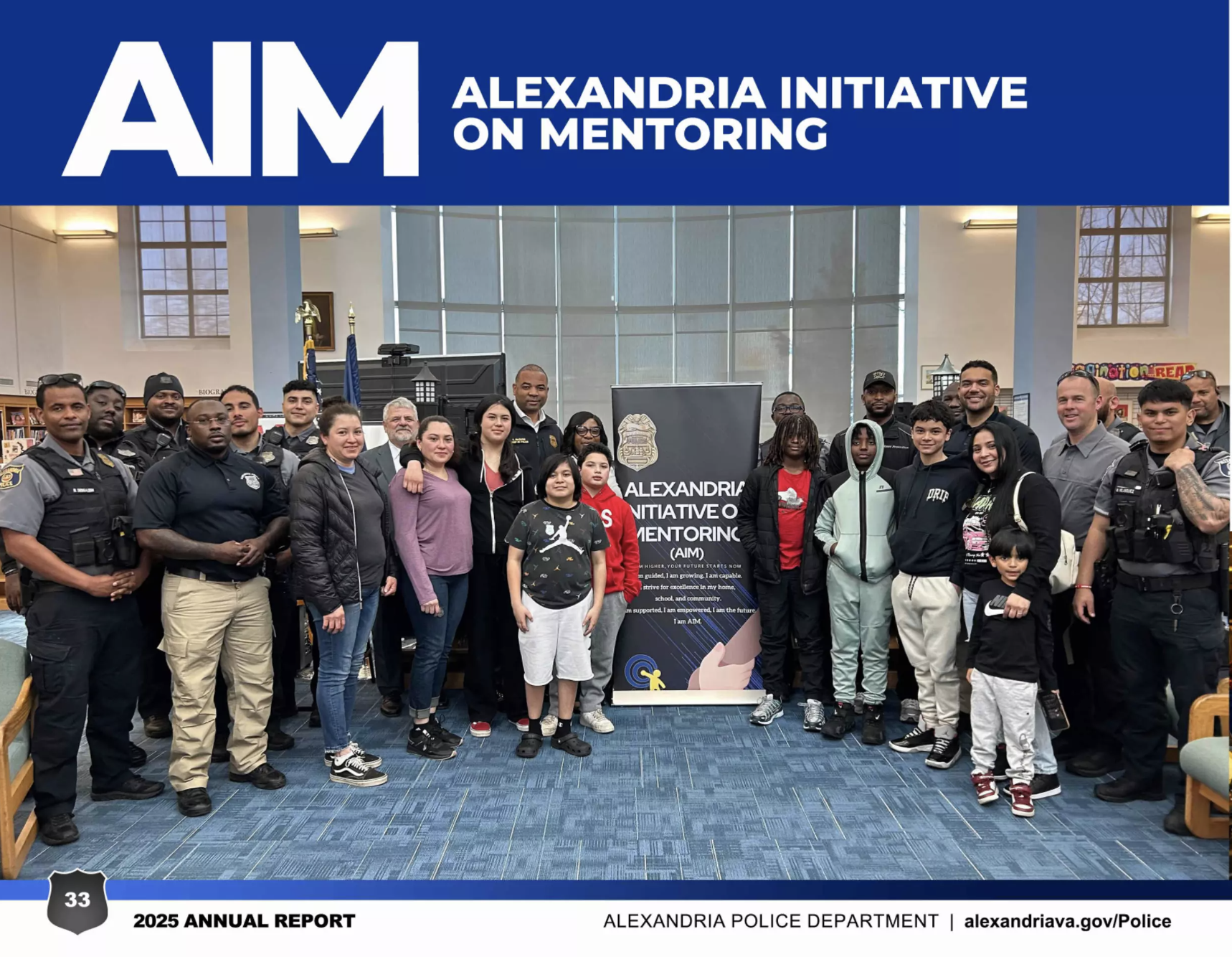
The Youth Resource Unit mentored 50 students during the year, helping many graduate from high school, earn GEDs, and pursue higher education. During summer school, 10 additional students graduated or earned GEDs, with nine enrolling in college. The Alexandria Police Foundation provided laptops to students continuing their education.
Staffing: work to do
On staffing, McGuire was direct. "We have work to do," he said. The department has an authorized strength of 322 sworn personnel and 114 non-sworn staff, but availability has been strained by officers called to active military duty, National Guard deployments, and departures to federal agencies offering higher pay. "I want to be very clear about this — I'm not talking about to go do immigration enforcement," he said. "But we've had officers that have left to pursue those opportunities."
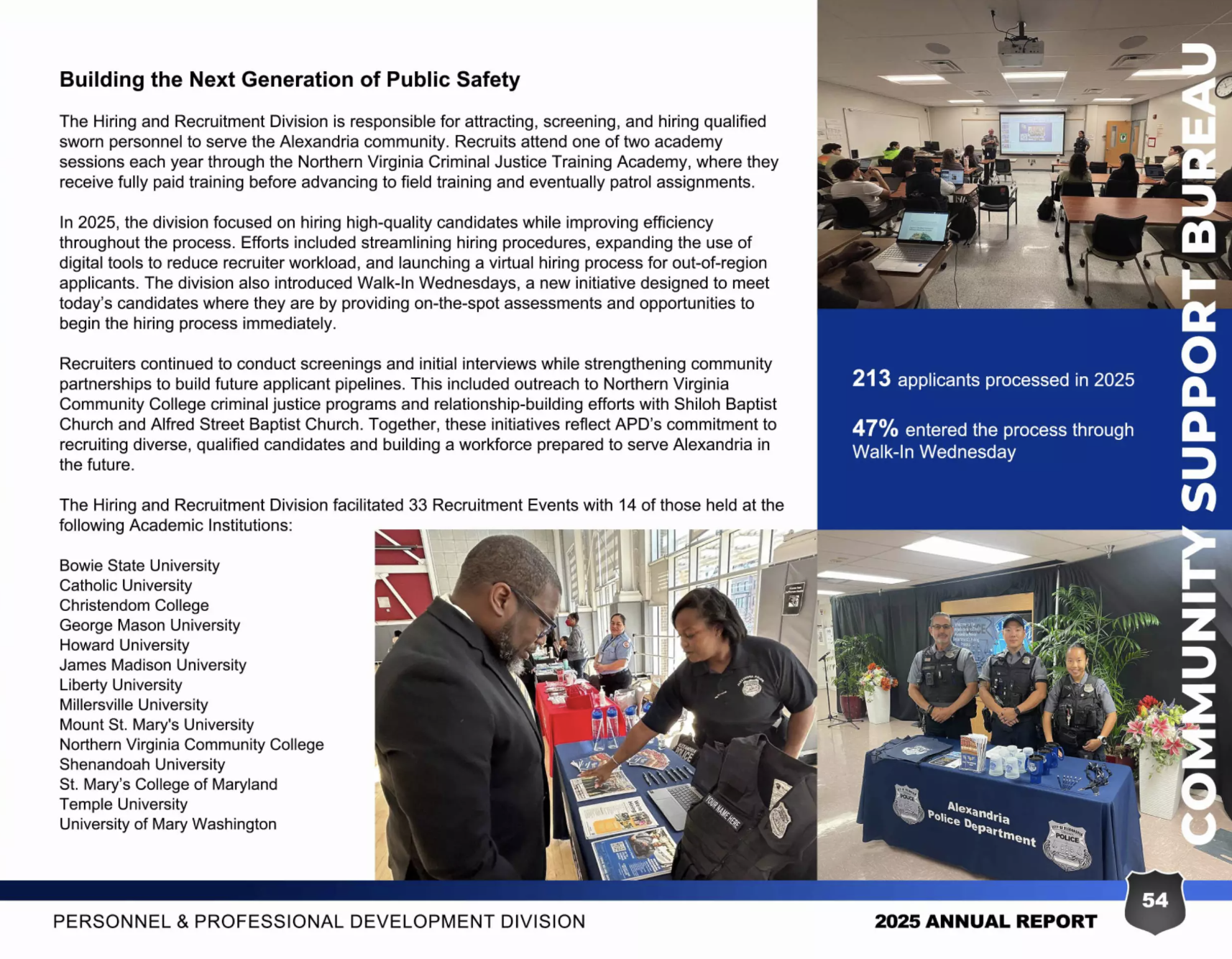
The recently completed collective bargaining process raised starting officer pay to $75,000, a 17.21% increase, which McGuire said should help stabilize retention. The department processed 213 applicants in 2025 through 33 recruitment events at institutions including Howard University, George Mason University, and Bowie State University. In a standout figure, 47% of applicants entered through Walk-In Wednesdays, a new initiative allowing candidates to begin the hiring process on the spot. "The days of posting a job online and thinking that we're going to have multiple people sign up is absurd today," McGuire said.
Training and officer safety
APD launched a comprehensive full-week in-service training program in 2025, with nearly every officer participating. The training incorporated virtual reality for TASER scenarios, firearms instruction by certified range instructors, and an eight-hour day of reality-based scenarios drawn from real incidents. APD also led a joint training day at the FBI Academy in Quantico for its Special Operations and Hostage Negotiations teams and hosted the FBI Basic Crisis Negotiation Training Course — a 40-hour program that has provided regional access to nationally recognized training since COVID.
One measurable result: assaults on police officers dropped from 64 in 2024 to 37 in 2025 following implementation of the training week.
Investing in officer wellness
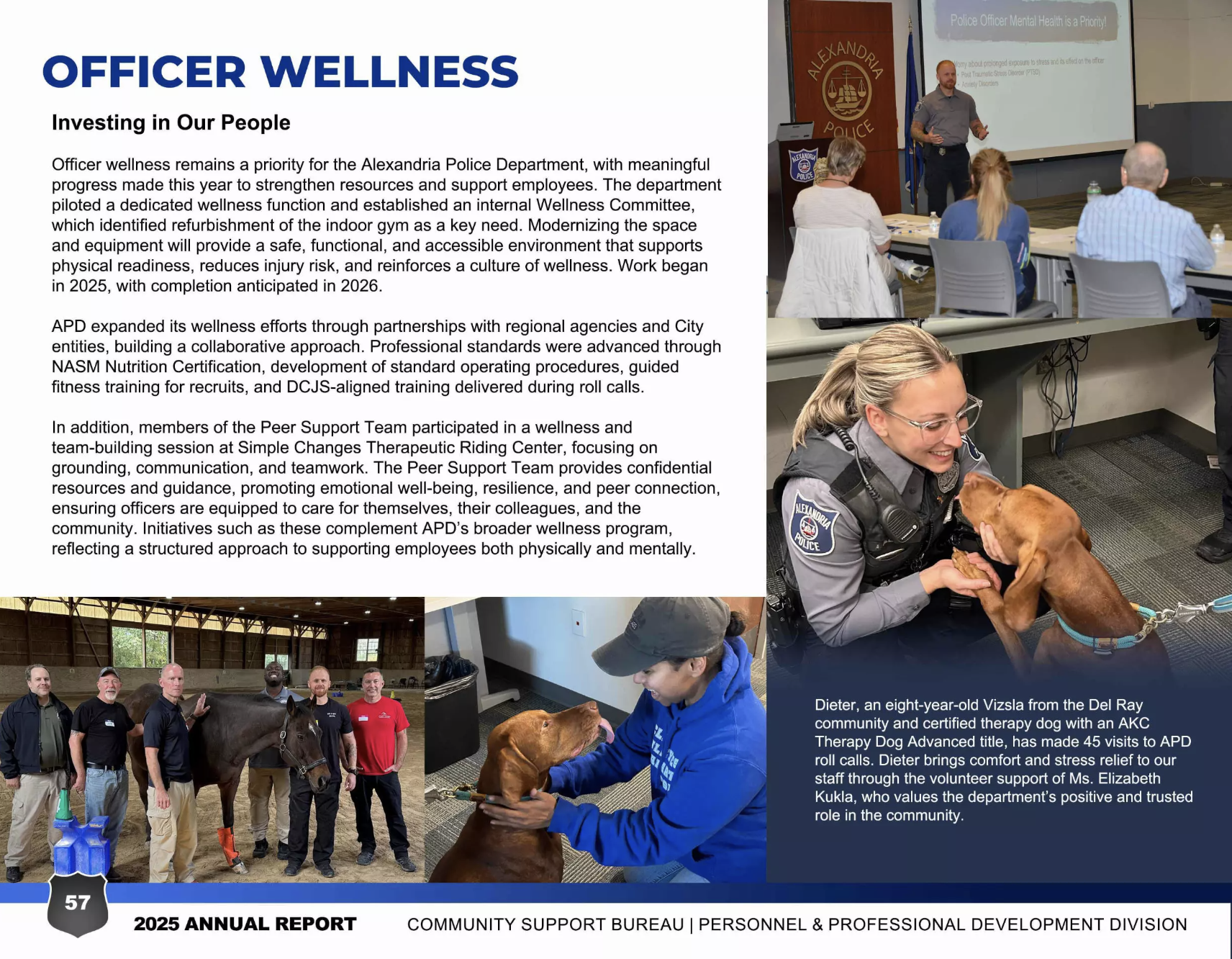
APD piloted a dedicated wellness function in 2025 and established an internal Wellness Committee, which identified refurbishment of the department's indoor gym as a key need, with completion anticipated in 2026. The Peer Support Team participated in a team-building session at Simple Changes Therapeutic Riding Center, focusing on grounding, communication, and teamwork. And Dieter — an eight-year-old Vizsla therapy dog from Del Ray, certified with an AKC Therapy Dog Advanced title — made 45 visits to APD roll calls, providing comfort and stress relief through the volunteer support of his owner, Elizabeth Kukla.
A year of moments
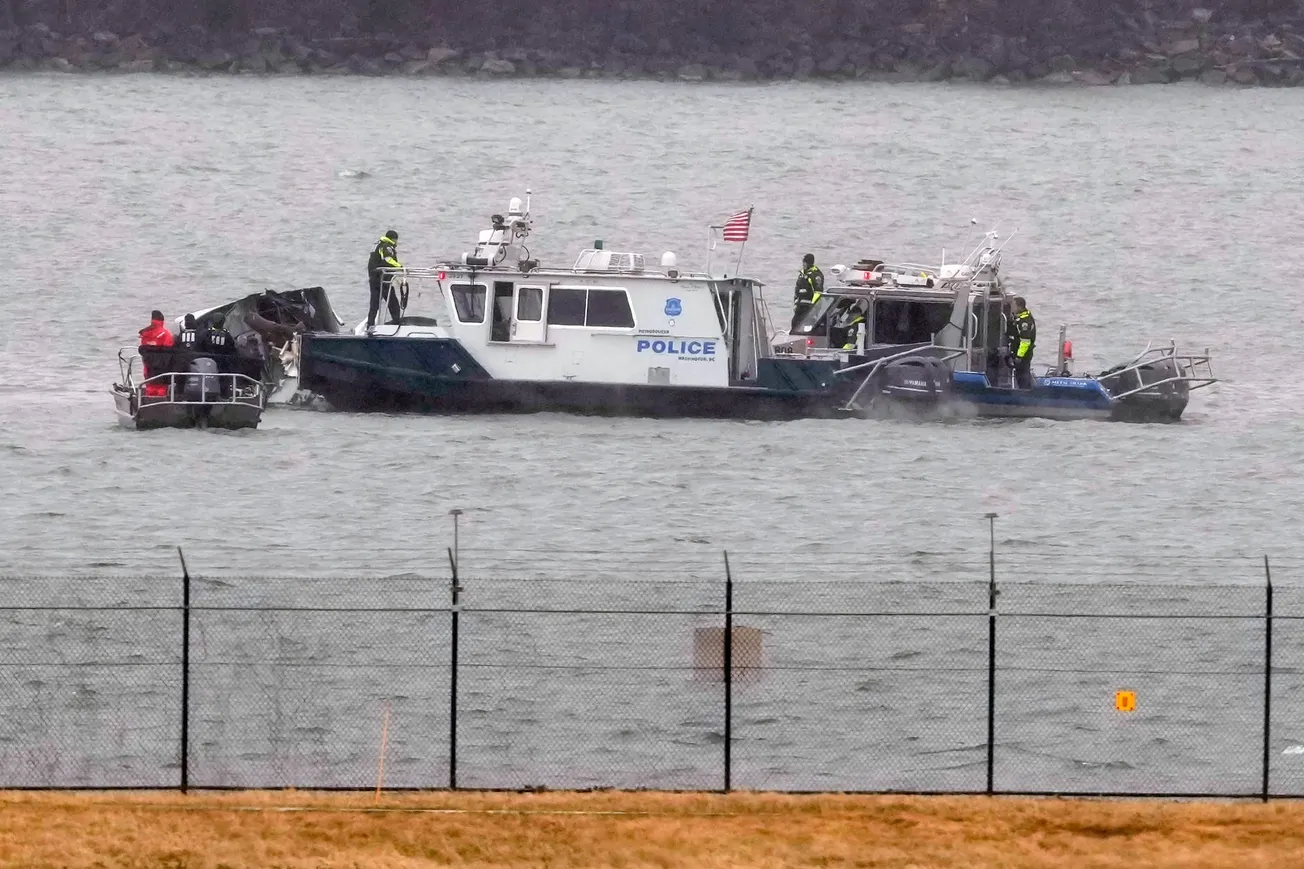
The report's year-in-review captures the breadth of 2025: in January, 20 APD personnel deployed to the site of the midair collision near Reagan National Airport, assisting regional partners with recovery operations in one of the year's most significant mutual aid responses. When a winter snowstorm struck, officers maintained around-the-clock operations, assisted stranded motorists, checked on vulnerable residents, and ensured continued access to essential services. In February, officers secured two escaped horses — Snickers and Pickles — from Burgundy Stables along the Telegraph Road corridor. In March, officers and community members beautified Charlie Hill Park in honor of fallen Corporal Charlie Hill, killed in the line of duty, whose legacy the department honors annually. Throughout the year, APD safely managed approximately 80 special events. In August, the department convened meetings with interfaith leaders and human rights organizations to inform policy on hate crimes and bias incidents. In December, officers volunteered their time to run the APD Youth Camp Christmas Tree Lot, with proceeds funding scholarships for Alexandria youth.
Noteworthy achievements
Officers David Hiltz and Liam Reilly were named Alexandria Chamber of Commerce Community Champions after reviving an unresponsive newborn through CPR. Lieutenant Marcus Downey graduated from Session 295 of the FBI Academy and received the 2025 City of Alexandria Spirit of MLK Award. Sergeant Matthew O'Malley was recognized by the Del Ray Business Association for coordinating public safety at community events, and the department received the DBA's 2025 Public Service Star Award. Officer Jeff Sun was honored with the Washington Regional Alcohol Program 28th Anniversary Law Enforcement Award. APD officers also took top honors at the 46th Annual Mid-Atlantic Police Motorcycle Rodeo.

Looking ahead
The report coincides with the rollout of McGuire's G.R.E.A.T. public safety framework — five pillars covering Geographical Policing and Accountability, Relationships, Evidence-Based Strategies and Enforcement, Assessment, and Technology — which he presented to City Council on June 9 and took to a Public Safety Summit on June 18. McGuire said the framework will become the lens through which future annual reports measure the department, with an annual summit component and direct community briefings on crime and public safety planned going forward.
Asked what he would want every resident to take away from the report, McGuire kept it simple: "That your police department cares, and recognize our continual growth. We're not perfect. But this city has a good police department. And this police department will achieve greatness through the collaboration with the residents in our city."
He also credited City Manager James Parajon for providing the resources to execute the department's vision. "You cannot be successful as a police chief without the support of your city manager," he said. "You can have a plan, but if you don't have the resources to execute that plan, that plan is null and void."
But collaboration, McGuire said, only works if the community shows up before a crisis — not after. Too often, he said, people engage with police only when they have been personally affected by crime. What he is asking for is something different.
"We cannot be everywhere at the same time, but the people that live in neighborhoods and communities are there 24/7," he said. "What I'm asking for the community is to stay engaged, to show up when there is not a crime issue. Because when you make plans of how you will address an issue before it comes up, it will absolutely negate how you would deal with an issue when it happens."
The inaugural annual report will be followed by one every year. The work, McGuire said, is infinite. "I have always experienced policing and public safety as an infinite game," he said. "There's no winners or losers at the end of the year. It's a continuous process."
The full report is available at alexandriava.gov.