Table of Contents
ALEXANDRIA, Va. - The story of The Lyceum begins not with a building but with a date: July 24, 1794, when the Alexandria Library Company was founded at the home of John Wise. A week later, members gathered upstairs at Gadsby's Tavern to elect officers. That organization — one of the earliest lending libraries in Virginia — would go on to play a central role in building the structure that nearly disappeared 152 years later.
In 1838, a Quaker schoolteacher named Benjamin Hallowell joined six other prominent Alexandrians to form the Alexandria Lyceum — a place for lectures and debates at a time when public education was still a novel concept in the South. By 1839, the program had grown popular enough that Hallowell partnered with the Alexandria Library Company to build a permanent hall on Washington Street. The building opened December 12, 1839, with a lecture by U.S. Postmaster Daniel Bryan. The local paper called it "the new and beautiful Hall."
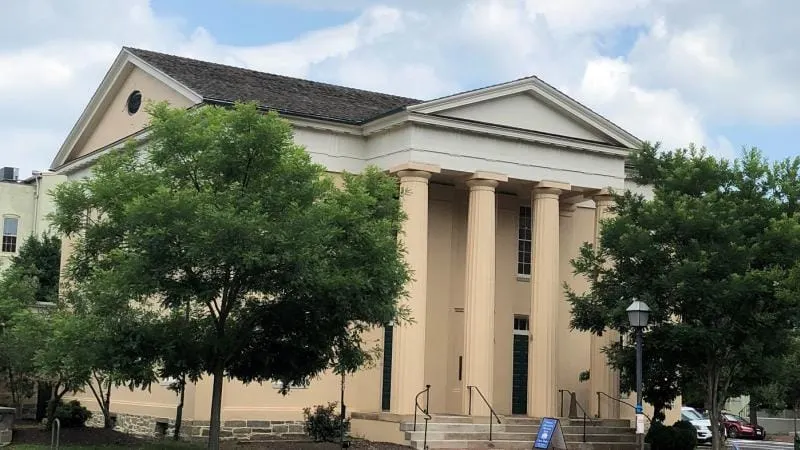
For two decades before the Civil War, The Lyceum was the intellectual and cultural center of Alexandria — a library and reading room on the first floor, a large lecture hall on the second where musicians, debaters and traveling scholars from across the country performed. Union forces seized it in the spring of 1861 and converted it into a hospital. After the war it was sold, remodeled into a private residence, and eventually became an office building. The institution that Hallowell and the Library Company built had, by the mid-20th century, become unrecognizable.
On July 24, 1946, the owners of 201 S. Washington Street sought court approval to demolish the building entirely and replace it with contemporary office development. The request set off a citizen preservation effort that would take more than two decades to resolve. By the late 1960s, the once-elegant structure had become what the city's own records describe as "a run-down eyesore," and plans were again underway to tear it down. A major preservation effort, led by Jean Keith and other local advocates, culminated in a dramatic 4-3 vote by Alexandria City Council in 1969 to purchase the building. Renovated and refurnished, The Lyceum reopened in 1974 as Virginia's first Bicentennial Center and became the city's history museum in 1985.
One more July 24 footnote worth noting: on this date in 1774 — six days after George Washington signed the Fairfax Resolves at Market Square — he recorded a simple diary entry: "Went up to Church at Alexandria. Returnd to Dinner." The city he worshipped in that Sunday is the city that would build The Lyceum 65 years later, nearly lose it two centuries after that, and ultimately save it by four votes.
The building at 201 S. Washington Street is now the Alexandria History Museum at The Lyceum — one of the finest examples of Greek Revival architecture in the city. It nearly didn't make it.