Table of Contents
For the better part of this month, I've spent my afternoons in a press room at Episcopal High School, listening to a World Cup team talk about my city.
I asked Croatia's coach this week what he'd take from his time here. Zlatko Dalić called Alexandria beautiful and peaceful. No objections, he said. One of his players, Marco Pašalić, told us he felt "right at home."
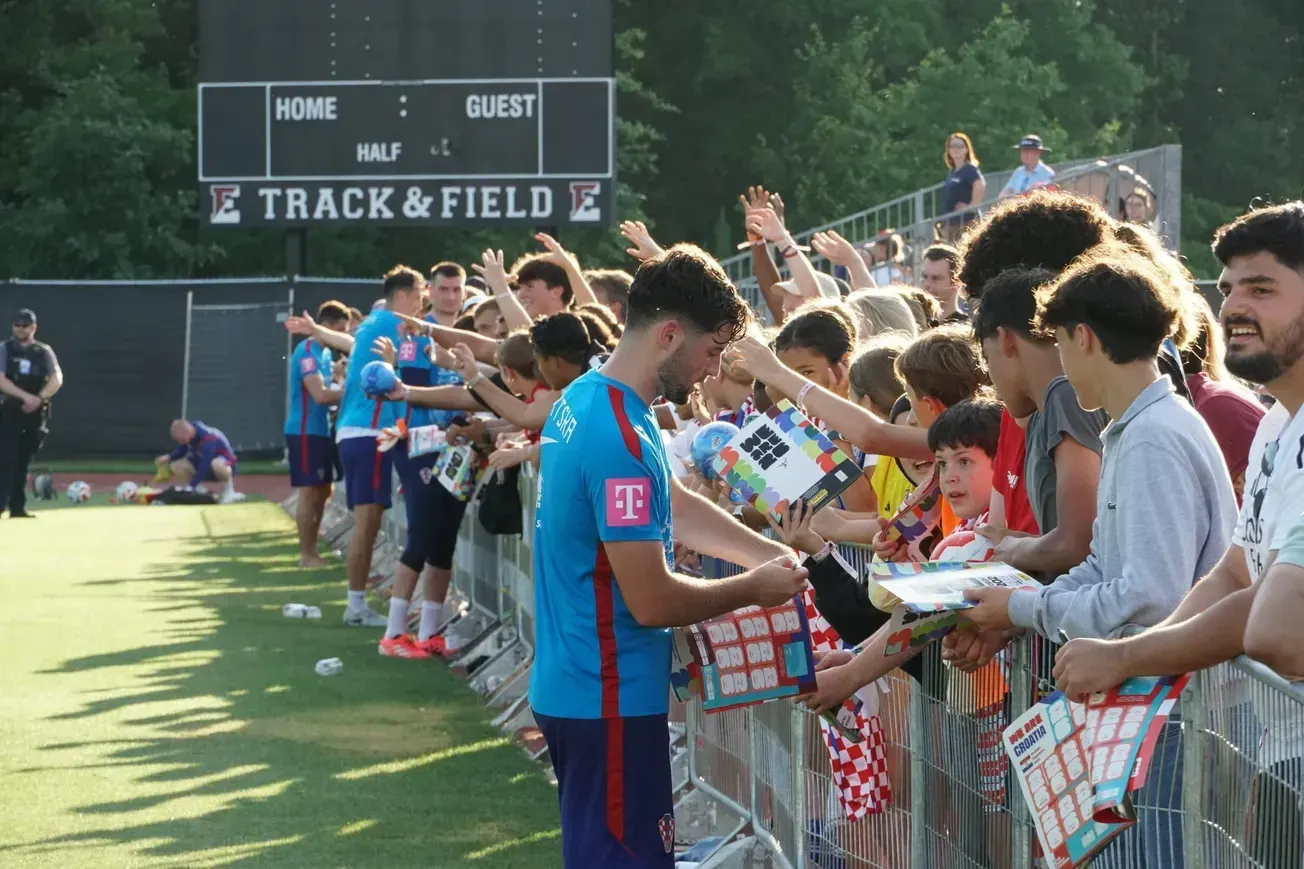
That's not nothing. A team that could have based itself anywhere in North America chose Alexandria, made it home for a month, and is leaving fond of the place. Hundreds of local kids got autographs and mini soccer balls at a community event. The mayor read a proclamation. Restaurants put Croatian dishes on their menus. Boutiques flew the red-and-white checkers. Bars filled up for watch parties.
I started The Alexandria Brief to chronicle this city — its council meetings, its schools, its small businesses, its people. I did not expect that to include a World Cup. Back in January, I noticed Alexandria's name turning up in Croatian soccer coverage and turned around a story for our readers: one of the best teams on the planet was coming here. It felt almost implausible at the time. For a month this summer, a reader-funded local outlet got to cover a global event happening in its own backyard, often as the only English-language reporter in the room. I won't forget it. And I don't think the city should either.
But here's the thing I keep coming back to. This didn't start with the team.
It started with a stamp.
Back in May, before a single player arrived, the Croatian ambassador and Mayor Alyia Gaskins stood in the Torpedo Factory and opened an exhibit of Croatian postage stamps. "This is bigger than football," the mayor said that night. Real success, she added, would be if the team came to feel like family rather than guests.
The ambassador, Pjer Šimunović, picked up the thread. He said Alexandria reminded him of home — maybe, he suggested, that's part of why the team chose it. And then he borrowed a phrase Alexandrians love to use about themselves. The partnership, he said, would let Croatia "punch above our weight."
I've heard our own officials use those exact words about Alexandria for years. A small city that competes with much bigger ones. And here was a representative of a nation of fewer than four million people — a country that reaches World Cup finals — using them right back at us.
That was the moment, for me. Two small places, proud of being small but mighty, each recognizing the thing they admire most about themselves in the other.
The mayor told a story that night about her childhood best friend, Sarah — someone different from her in nearly every way, but a friend for more than 20 years because, she said, "we were genuinely curious about each other." She offered it as a model for Alexandria and Croatia.
I think we should take her up on it.
Alexandria already has four sister cities — Dundee, Scotland; Helsingborg, Sweden; Caen, France; and Gyumri, Armenia. We have a committee, a process, and a city code chapter that lays out exactly how to add a fifth. We know how to do this. We've done it four times.
So why not a Croatian one?
There's an obvious candidate. The torpedo that gave our Torpedo Factory its name was invented in Rijeka, Croatia's principal seaport — a fact the ambassador pointed out, standing inside the building, in May. Rijeka is a walkable, historic port city that reinvented itself through culture; it was a European Capital of Culture in 2020 under the slogan "Port of Diversity." It is, in other words, a city that punches above its weight. Sound familiar? One of the players we got to know this month, Pašalić, played there before Orlando.
It doesn't have to be Rijeka. But it should be somewhere. And the appetite is already there.
I asked Mayor Gaskins this week where she sees this going. "The momentum and energy that has been generated by hosting the Croatian National Football Team has been amazing," she told me. The city, she said, is now being recognized among international travelers as a top destination — for its historic charm, walkable streets, restaurants and welcoming residents. "I think we should find ways to build on our growing relationship with the Croatian community to spur more opportunities for cultural exchange, sports tourism, and friendship."
The ambassador said much the same in May — that he's looking forward to more. The groundwork is already poured.
I know how this sounds to some people. A sister city can read like a ceremonial gesture — a plaque, a signing, a photo, and not much after. But I've watched what these relationships actually do.
This August, an Alexandria rugby team flies to Dundee, Scotland — one of our four sister cities — to play for the Mayor's Cup, a competition being revived after years away. That's not a plaque. That's dozens of Alexandrians crossing an ocean to compete against, and break bread with, people in a city they're now bound to. Our sister-city ties have brought Swedish students to Alexandria classrooms and the Helsingborg Symphony to our stages.
In Newport, Rhode Island, where I lived and published before Alexandria, the relationship with Kinsale, Ireland — now 25 years old — has produced chef exchanges, student exchanges across three schools, and a summer pipeline of young Irish workers who staff the restaurants, hotels and yacht clubs during the busy season. The local chamber there calls it an economic engine. They mean it literally.
That's what's on the table. Student exchanges. Chefs trading kitchens. A high schooler from Alexandria spending a summer in a Croatian port city, and one from there spending a summer here. Businesses finding partners. Coaches and clubs trading methods — in a soccer-loving city that just spent a month around one of the best teams on earth. Lifelong friendships, the kind the mayor has with Sarah.
None of this happens without a lot of people. Visit Alexandria, which won the bid and spent a year making the city ready. The Alexandria Soccer Association, which put hundreds of kids within arms reach of a World Cup team. The City of Alexandria, which treated a month-long hosting gig as the start of a friendship. And the dozens of restaurants, shops, and bars — and the volunteers, the band, the diaspora — who showed up and made a global event feel like a neighborhood one.
That's the part that stays with me. Not that we hosted a team. That a whole city showed up.
There's a mechanism for this. Alexandria's Sister Cities Committee meets monthly, residents can weigh in, and the City Council has the authority to add a fifth sister city the same way it added the first four. The idea just needs someone to carry it — and a city willing to be curious.
The Vatreni leave us after Saturday, win or lose. Today is their last full day on the schedule here in Alexandria before they head to Philadelphia for the finale. They might advance and play on. They might lose to Ghana — another team that called Alexandria home this month, however briefly — and go home. Either way, the case is the same. A relationship worth building doesn't depend on a scoreline.
A friendship doesn't have to end when the tournament does.
Let's punch above our weight.
— Ryan
Publisher's Note reflects the views of Ryan Belmore, founder and publisher of The Alexandria Brief.