

Table of Contents
ALEXANDRIA, Va. — Alexandria is among the localities placed under a regional drought watch issued Tuesday by the Metropolitan Washington Council of Governments, which is urging residents and businesses to conserve water voluntarily after a third straight year of dry conditions.
The watch, declared by COG's Drought Coordination Committee, covers nearly six million residents across the District of Columbia, suburban Maryland and Northern Virginia. Officials said the Potomac River and backup reservoirs hold an adequate supply for now, but they want the public to take simple steps to protect the region's water if dry weather persists.
The advisory comes as a hot, mostly rainless stretch settles over the city. The National Weather Service forecast calls for sunny skies and a high near 89 on Thursday, climbing to about 93 on Friday and 95 on Saturday, with the first real chance of showers not arriving until Sunday afternoon — the kind of warm, dry weather that can deepen a drought.
It also adds a regional layer to drought conditions Alexandria has faced for months. Nearly all of Virginia, including the city, has been under a state drought warning — a more serious status meant to signal that a significant drought event is imminent — that the Virginia Department of Environmental Quality kept in place in late May despite recent rains. State officials said groundwater levels remain well below normal across most of the commonwealth.
Under COG's Regional Drought Response Plan, a watch is the second of four stages. It sits above the normal stage, which calls only for wise water use, and below the warning stage, when voluntary water restrictions are encouraged, and the emergency stage, when jurisdictions and utilities may impose mandatory restrictions in a coordinated way. Since the regional plan was adopted in 2000, the area has never reached the warning stage under it.
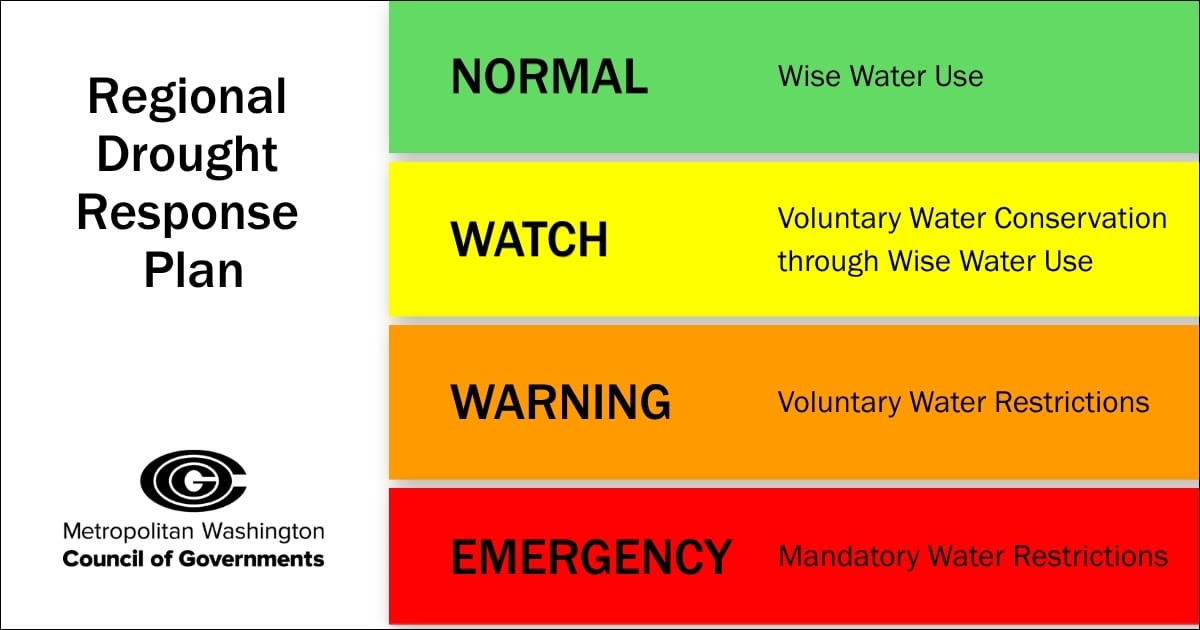
The region's most recent drought watch ran from July 2024 to June 2025. Conditions this year have been severe: record-breaking high temperatures in March and April coincided with historically low streamflows, and the Potomac River fell to its lowest level in 130 years of records. The two-year precipitation deficit is nearly 8 inches.
"Our region hasn't seen extremely dry conditions like this in about two decades when local leaders and COG first established a drought response plan to support coordination and communication regionwide," COG Executive Director Clark Mercer said. He asked the public to fold water-saving habits into daily routines.
The Potomac supplies 78% of the region's drinking water. Michael Nardolilli, executive director of the Interstate Commission on the Potomac River Basin, said the commission is monitoring the river's flow daily with federal agencies, regional partners and water suppliers, and that the area's infrastructure is well-equipped to handle drought.
Water utility leaders echoed the call for voluntary conservation. WSSC Water General Manager and CEO Kishia L. Powell said simple changes could help customers save water and money, and Washington Aqueduct General Manager Rudy Chow described managing the shared supply as a collective responsibility. Fairfax Water General Manager Jamie Bain Hedges said residents can make a difference during dry spells by using water wisely.
COG suggested several conservation steps indoors and out: keeping showers under five minutes, turning off the tap while brushing teeth or shaving, running only full loads of dishes and laundry, and fixing plumbing leaks. Outdoors, officials recommended monitoring lawn and plant watering, sweeping sidewalks and driveways rather than hosing them, and avoiding car washing or using a commercial wash that recycles water.
More information is available on COG's current drought conditions and Wise Water Use campaign web pages.