Table of Contents
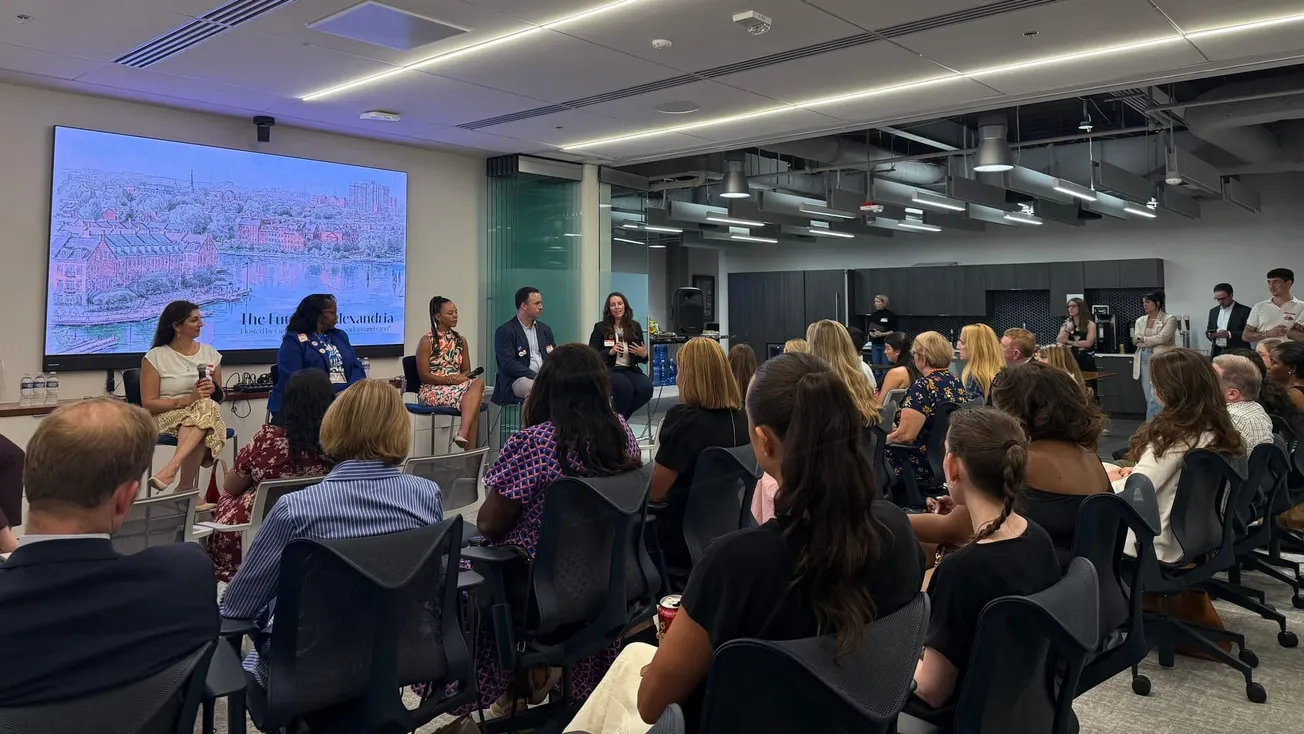
ALEXANDRIA, Va. — Affordable housing, rising unemployment and the untapped potential of the West End took center stage Thursday evening as Alexandria's mayor, a prominent developer, and community leaders gathered for a candid public conversation at a roundtable hosted by global design firm Gensler and Old Town-based general contractor rand* construction.
The event, part of Gensler's District Ambassadors series, drew a crowd to rand*'s headquarters at 1029 N. Royal St. for a panel discussion moderated by Gensler interior designer Abby Gwynn. Panelists included Mayor Alyia Gaskins, Jay Kelly, senior vice president of development at Foulger-Pratt; Lynn Thomas, executive director of Community Lodgings; Calaneet Balas, president and CEO of the ALS Association; and Liz Bolton, director of strategic communications at the Alexandria Economic Development Partnership.
rand* founder and executive chairman Linda Rabbitt, who established the firm in Old Town in 1989, opened the evening by crediting Gensler as a founding partner in the company's growth. Rabbitt noted that rand* has grown into the largest woman-founded, woman-owned general contractor in the country — and expressed personal pride in Alexandria's trajectory. "Alexandria's changed a lot in the years that we've been here," she said, "but always to the better."
What makes Alexandria unique?
Panelists were quick to name the city's small businesses and collaborative culture as its defining strengths. Gaskins, who had come straight from the 50th anniversary celebration of the Fish Market, described the deep-rooted loyalty she encounters at Alexandria's independent businesses — customers recounting meeting their spouses there, or following parents back to shops they grew up visiting. "If we can keep unlocking their stories," Gaskins said, "that's the thing that you're going to say, I don't want to go to D.C. tonight — I want to go to Alexandria."
Bolton, a former Gensler staffer who now works to attract businesses to the city, said she walked to the event from her home near Braddock Road Metro — and that ease of access, she suggested, is part of what distinguishes Alexandria. She also gave a nod to the city's standing as a hub for women-led business, noting that the Washington Business Journal recently ranked rand* the most valuable women-owned company in the region, with several other Alexandria-based firms also making the top five. "I think it's an amazing place for women to succeed," she said.
Kelly added that from a developer's standpoint, Alexandria is simply the most accessible jurisdiction in the region. He cited a recent permit extension at Landmark that cost $100 and a phone call, contrasting it with a six-month bureaucratic ordeal for a comparable project across the river.
Housing, workforce and the hardest tradeoffs
The sharpest exchange of the evening came when the conversation turned to housing production and affordability. Kelly argued that the basic public benefit of development is the housing itself — and that piling on regulatory costs and green building requirements makes it increasingly difficult to build anything at all. He cited D.C. as a cautionary tale, where ballot initiatives have frozen investor confidence even after the mayor took steps to signal the city was open for development.
Gaskins acknowledged the tension directly, noting that while she needs Kelly and developers like him to get projects out of the ground, she also hears from residents living in buildings with mold and rodent problems, and from the city's homeless shelters, which are over capacity. "I can't have a city where so many people who have lived here, worked here will never have an opportunity to stay here," she said. She floated the idea that not every standard needs to carry equal weight — that if affordable housing at the lowest price points is the goal, flexibility on other requirements may be necessary.
Gaskins also flagged a less-discussed challenge: Alexandria's unemployment rate has risen more than a percentage point, and faster than neighboring jurisdictions. She said roughly 3,000 Alexandrians were unable to find work as of May — many of them drawn to the area for federal government jobs that have since disappeared. "If we can't get our talent back to work and help them be able to stay here," she warned, "they are going to be looking for the places where they can go."
That workforce concern is driving new ideas. Gaskins described early conversations around the Del Pepper Center — the city building where roughly 3,000 people pass through daily for health and human services — where an unused kitchen has been sitting idle. The city is now exploring turning it into a culinary arts incubator, with tracks for summer youth employment, small business development and reentry job training for people leaving the city's detention facilities. "It's an asset that is just like waiting to be reactivated," she said.
Thomas added that the housing crunch hits hardest for the most vulnerable. Community Lodgings is currently relocating residents to make way for a project that will replace 28 units of affordable housing with 91 units at 30 to 60 percent of area median income. "We don't just look at ourselves as a housing provider," she said. "We are providing the entire continuum."
Growth hotspots and surprises
On geography, panelists pointed to the West End, the Eisenhower corridor and Potomac Yard as the city's most active growth zones. Gaskins said she was unexpectedly energized after a recent tour of Building Momentum, a flexible warehouse hub on the West End where she found small companies building drones and testing new technologies. "I would have never thought of us as a space for that," she said — and added that the city needs to think carefully before converting those warehouse spaces to housing, given the unique role they play as incubators for innovation.
Bolton noted that co-warehousing spaces like Saltbox have become one of Alexandria's strongest market sectors — a development she admitted she hadn't initially anticipated. "Having those flexible spaces lets people experiment," she said.
Kelly, meanwhile, said he remains most excited about the Power Plant redevelopment on the waterfront — a project he described as an opportunity to connect Old Town all the way through to Arlington and transform what he called an absolute blight into something spectacular.
Flops, risks and lessons
The panel closed with a round of reflection on projects that didn't pan out. Gaskins drew laughs and applause when she said she's learning to get comfortable with failure in government — and that her approach is increasingly to tell her staff to just try things. "I'll have your back," she said. "If we get killed for this, I'll take the hit."
Balas drew a parallel from her experience merging 40 separate ALS Association corporations into one during the pandemic — a wrenching process that produced lawsuits and public controversy before ultimately leaving the organization healthier. "Don't let the perfect get in the way of the good," she said, "and keep moving forward."
Bolton cited the collapse of the proposed Potomac Yard Entertainment District — the $2 billion arena deal that would have brought the Washington Wizards and Capitals to Alexandria before falling apart in Richmond in 2024 — as her example. Rather than dwelling on the loss, she described how it forced 18 months of deep community engagement: 890 touch points, a citywide summit, and ultimately the Alex4 economic development blueprint that now guides the city's growth strategy. "It is my job to come out and talk to the community and make sure that they understand what is happening and why it's important," she said.
The evening continued with a happy hour at TJ Stone's down the street.