Table of Contents
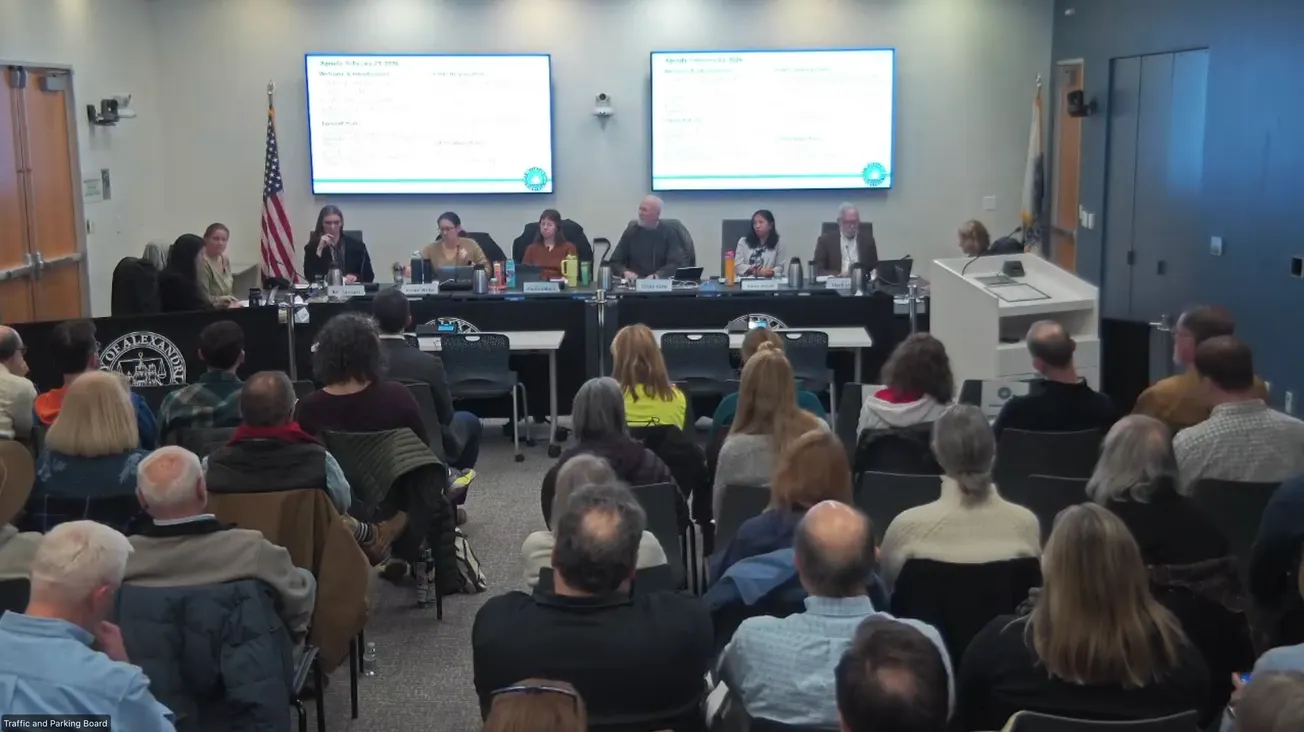
The Alexandria Traffic and Parking Board unanimously approved the Braddock Road Corridor Improvements Project early Tuesday morning after a marathon public hearing that stretched past 1 a.m. and drew 66 speakers—more than half of whom supported the project.
The 6-0 vote came at 1:18 a.m., more than six hours after the meeting began, with Chair Ann Tucker absent. The board approved the city’s full recommendation without modifications, after defeating an amendment that would have retained parking between Commonwealth Avenue and Russell Road.
Board member Annie Ebbers moved to approve the full staff recommendation. Board member Mark Stout then moved to amend the proposal to retain parking on segment three (Commonwealth to Russell), which Vice Chair Casey Kane seconded with a modification to remove parking on only one side. After discussion, the amendment was defeated and the full recommendation passed unanimously.
What was approved
The Traffic and Parking Board approved the city’s full recommendation for the Braddock Road Corridor Improvements Project, which includes:
Bike lanes:
- Protected bike lanes along the entire corridor from Russell Road to West Street.
- Two-way protected bike lane on the north side between the Metro station and trails.
- One-way separated bike lane on the south side.
Parking removal:
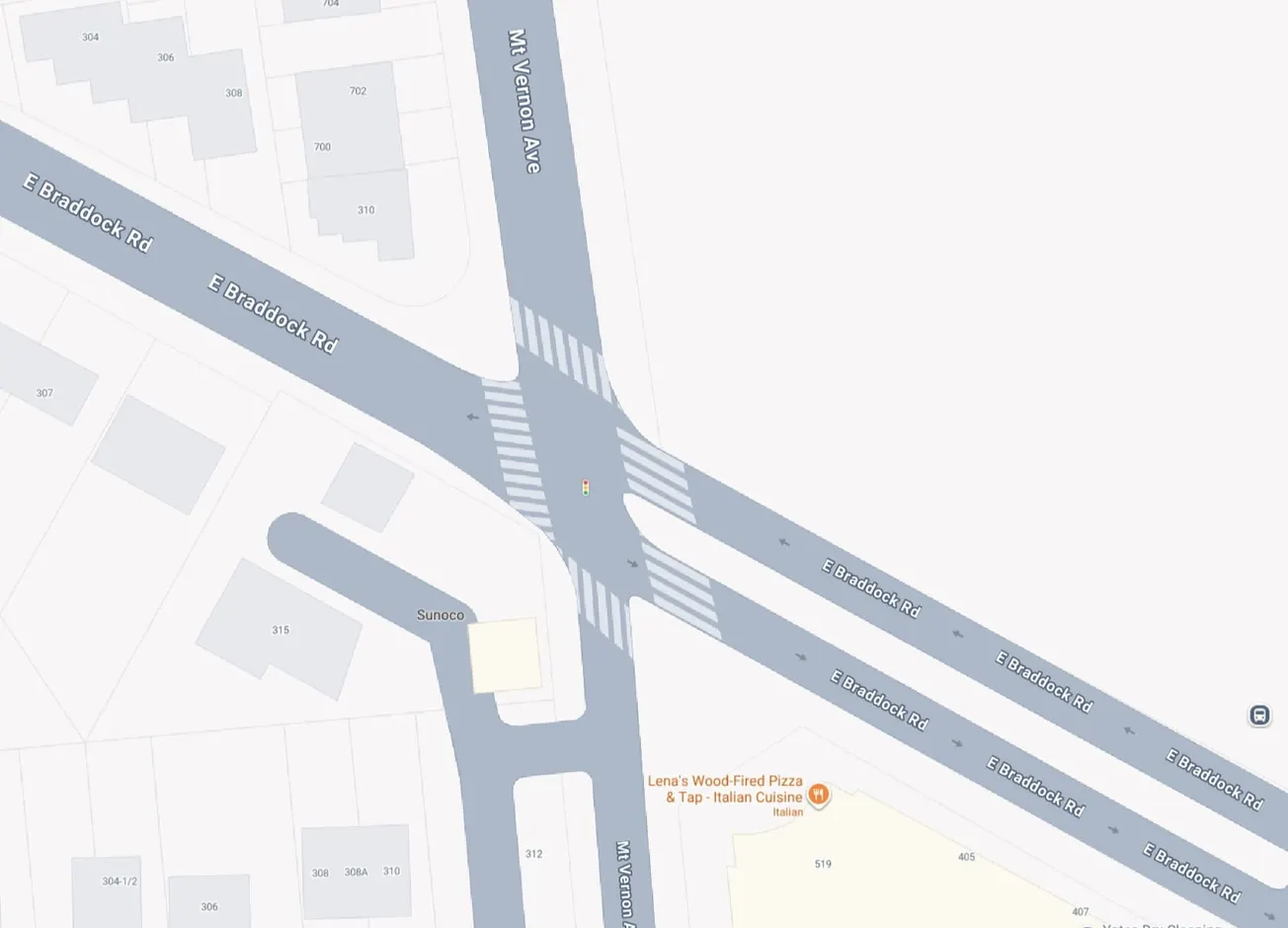
- Remove most on-street parking between Mount Vernon Avenue and Russell Road.
- Retain approximately 100 feet of parking on the unit block of East Braddock Road and 60 feet on the 200 block.
- Remove parking on Commonwealth Avenue between Braddock Road and Spring Street.
Traffic changes:
- Remove one travel lane in each direction between Yates Corner and West Street (near Metro).
- Consolidate turn lanes at Russell, Commonwealth, and Mount Vernon intersections (”compact intersection” design at Mount Vernon).
- Add commercial loading zone near Yates Corner.
Other improvements:
- Relocate one disability parking space; add two new disability spaces on Hancock Avenue and Luray Avenue at Braddock Road.
- Shorter crossing distances at major intersections (currently as long as 100 feet).
- Safer pedestrian crossings between trails and the Metro station.
Parking analysis
According to the city’s staff report, only one home on the affected corridor does not have off-street parking. City staff worked with that resident to address their specific parking needs.
The city also worked with Good Shepherd Lutheran Church to relocate disability parking spaces to nearby streets—Hancock Avenue and Luray Avenue—to maintain accessible parking for congregants with mobility limitations.
The staff report documents that parking utilization on the corridor is relatively low, with peak usage reaching approximately 28 spaces on weekdays and 47 spaces on Sundays. The city identified approximately 105 on-street parking spaces within the project area, with more than 300 additional spaces available on surrounding streets within a two-block radius.
The city’s case
Complete Streets Program Manager Alexandria Carroll presented the city’s recommendation for 71 minutes, citing multiple safety concerns and adopted city policies requiring the improvements.
Carroll noted that the corridor has been identified by the Virginia Department of Transportation as a “high” and “very high” priority for pedestrian and bicycle safety improvements. The eastern section near the Metro is rated as “very high priority” for bicycle access and “high priority” for pedestrian access.
The project stems from multiple adopted city plans, including the 2016 Pedestrian and Bicycle Master Plan, the 2017 Vision Zero Action Plan, the Alexandria Mobility Plan, and a 2023 Safe Routes to School audit at George Washington Middle School.
Between 2019 and 2023, there were 17 crashes in the project area, resulting in 8 injuries. A pedestrian was killed at the intersection of Braddock Road and Commonwealth Avenue in 2015.
Carroll highlighted multiple safety concerns in the existing conditions:
Pedestrian safety risks: Two uncontrolled crosswalks near the Metro station create “multiple threat crash risk” where drivers in one lane stop for pedestrians but drivers in the adjacent lane do not, creating near-miss situations. “This is a really high risk scenario,” Carroll said, noting many children use these crossings to get to George Washington Middle School.
Speeding: The posted speed limit is 25 mph, but the 85th percentile speed ranges from 29-32 mph depending on the segment.
Long crossing distances: Crosswalks at major intersections are as long as 100 feet—twice the length of typical Old Town crosswalks and 2.5 times longer than conventional intersections.
Bicycle infrastructure gap: Protected bike lanes exist west of Russell and east of Mount Vernon, but there’s a gap in between. “It’s important that these facilities are actually connected so that they can take people where they want to go,” Carroll said.
Narrow sidewalks: Most sidewalks are only 4-5 feet wide with no buffer from traffic, below the city’s standard minimum of 5-6 feet.
Carroll emphasized the project is part of a larger citywide bicycle network. “When we talk about bicycle infrastructure on Braddock, I want to make sure that we’re not thinking about it in isolation and in a vacuum. It is a puzzle piece to a much larger network.”
Divided testimony
Approximately 37 speakers supported the project while 29 opposed it during nearly three hours of public comment that began at 9:52 p.m. and continued until 12:47 a.m.
Opposition voices
Del Ray Cafe owner Margaret Janowsky, who had submitted letters calling Complete Streets Program Manager Alexandria Carroll “an embarrassment to the City of Alexandria,” spoke in opposition but struck a more measured tone than her inflammatory written comments.
“I would like to state up front that we support any and all safety improvements to the section of East Braddock Road between Mount Vernon Avenue and Northwest Street identified by VDOT as the area needing improvement,” Janowsky said. “We have been accused of being against safety, which is absurd. We live here, we walked our children to Maury [Elementary], now Brooks [Elementary], and then they walked to GW Middle School.”
Janowsky questioned the city’s traffic analysis, particularly its “no build” assumption for future conditions. “It is really quite unbelievable that this analysis could possibly propose that our future traffic could be based on a no build scenario,” she said, citing new development at North Old Town, the power plant site, and Landmark Mall.
She warned that removing turn lanes would cause traffic backups. “Any one car turning left will bring this traffic to a complete halt,” Janowsky said.
Her husband, Laurent Janowsky, also spoke, arguing that on-street parking adds value to properties. “When I bought my house, it came with street parking and I paid taxes every year. I never thought that I could lose or would lose my parking,” he said. He questioned whether the city’s data shows safety problems in segments two and three. “Don’t fix what’s not broken.”
Elizabeth Trigg, who has lived on the 200 block of East Braddock Road for 18 years and describes her family as multimodal residents who walk, bike, and use transit, delivered one of the strongest opposition statements.
“While I support the improvements proposed in segment one, those between West and Mount Vernon Avenue, I’m here to voice my firm opposition to the current proposals for segments two and three,” Trigg said. “This stretch of Braddock Road is not just a residential neighborhood but functions as a major east-west artery and is already plagued by extreme traffic backups during weekday morning and afternoon rush hours.”
Trigg argued there is no safety justification for segments two and three. “The city’s own data shows this is the safest stretch of the entire 3.75 mile Braddock Road corridor and since 2017 there have been zero pedestrian or bicycle incidents,” she said. “We are essentially being asked to undergo major surgery on a healthy stretch of road.”
She questioned who benefits from the project. “If there is no safety crisis to solve, I have to ask who is being served by this? It is certainly not the residents who live here and is not the commuters who rely on it daily.”
Trigg noted that more than 200 property addresses signed a petition opposing the changes. “Your primary duty is to the citizens who lives in these neighborhoods, not to a hypothetical engineering model that ignores the reality on the ground.”
Good Shepherd Lutheran Church Pastor Kate Costa spoke against removing the handicap space on Braddock Road, saying it would force disabled congregants to walk 150-175 feet from relocated spaces around the corner instead of 25 feet from the current location.
“Access to our building matters for worship. It matters for community spaces and it matters for those with disabilities,” Costa said. She noted the church hosts INOVA blood drives that collected 75 pints last year—enough to save more than 200 lives—and that INOVA requires accessible host sites with vehicle access for their equipment.
Riley DePiano, who lives at 115 West Braddock Road in a house without a driveway, said the project “raises real equity concerns” for residents without off-street parking. “Please imagine having to walk several blocks while carrying groceries, managing your children, or supporting elderly family members. The impact isn’t minor, it directly affects our daily lives.”
Donald Niss, who lives at 22 West Braddock Road, said he supports segment one improvements but opposes parking removal on segments two and three. He noted he recently saw an ambulance stuck in backed-up traffic for four or five light cycles. “I would’ve liked to have seen more data on emergency vehicle use in the proposal,” Niss said.
James, a resident who has lived on West Glendale Avenue for 45 years, warned that removing parking from Braddock would push it onto side streets. “West Glendale between Russell and Commonwealth is a cutoff street” where drivers already cut through to avoid backed-up traffic, he said, noting 22 children on his street walk to George Washington Middle School.
Support voices
Supporters included parents, cyclists, disability advocates, and transportation professionals who emphasized safety concerns and the need for protected infrastructure.
Brian Egan, who bikes with three children under five in a cargo bike, said he goes through the Braddock/Russell intersection multiple times daily. “I go down that with three kids on my bike going 20 miles an hour and cars start to zoom past me. They don’t care. They want to get where they’re going real fast. It’s very dangerous.”
Egan noted that the fatality rate for cyclists hit at 30 mph is 55% compared to 12% at 25 mph. “I’ve heard a lot about there’s not a lot of bikes here, not a lot of people bike. No one uses it. I don’t see people on bikes. Again, I go down there every day. I see bikes all the time and once we add bike lanes there’ll be this concept called induced demand. It makes it easy, it makes people feel safe, it makes people feel comfortable and they will use it.”
He challenged claims that opposition represents the neighborhood. “The median age in Rosemont for an adult is 40 years old. Does that seem representative of the people we’ve been hearing tonight? I want you to ask who’s not here? People who are not here are home with their kids. My wife couldn’t make it here because [she’s] watching our kids.”
Egan warned that opponents are “waiting for a fatality. That’s if you read between the lines, they’re waiting for someone to die. That’s the data they’re waiting for. It could be me or it could be my kids. I really hope it’s not.”
Tim Shaw, whose 13-year-old daughter was left with limited mobility after an accident 11 years ago, said the current Braddock Road design is “disappointingly inaccessible.”
“Simply put, we must travel in traffic” because sidewalks are too narrow for wheelchairs, Shaw said. “The sidewalks as noted are too narrow for us, especially around the utility poles. For those of you who do want to advocate for accessibility, each of the driveway curb cuts is an obstacle for us to navigate.”
Shaw said traveling in the road avoids these obstacles “but there is no refuge from a line of traffic. To make it truly accessible, we need dedicated lanes for wheelchairs, strollers, bikes, runners, scooters, what have you. The status quo is not a viable solution.”
He noted the city has a process to address parking needs as they arise. “We should not halt broader accessibility and safety improvements to address narrow needs where other solutions may exist.”
Mike Griffith, who led the Federal Highway Administration’s Office of Safety Technology for 14 years, said his 37 years in highway safety inform his support for the project.
“I have safety in my soul, so you might be surprised that I support this project,” Griffith said. “The question that I asked myself before I put my comments together is what makes a city livable, healthy and safe? And I believe designing cities that encourage walking, cycling, scooting and public interaction enhance the quality of urban life.”
Griffith said protected bike lanes are backed by rigorous research. “I didn’t wait to get in a crash before I started wearing a helmet. Likewise, we shouldn’t wait for a tragic pedestrian or bike crash to happen on Braddock Road and then react after the fact by making improvements.”
He noted the proposed improvements are “all grounded in science. That’s very important. We want to make sure that what’s being proposed is backed by rigorous research studies. I am familiar with this research. What is being proposed is backed by science.”
Joe Fray, who lives on segment three and will lose parking in front of his house, spoke in support. “While I realize that this change will not be without inconvenience to me, my family and my neighbors, the benefits of the broader community are immense.”
Fray said his young daughter “loves riding her bike and she’s getting to the age where she can be trusted to ride around the neighborhood on her own, but the street in front of our house is terrifying for her.”
He rejected the framing that this is about cars versus bikes. “Opponents of this project and bike lanes generally often depict the trade-offs inherent in this discussion as a choice between car users’ way of life and bikers’ little hobby, but people should be able to choose how they get around in [this] wonderful, accessible, dense city and there’s room enough for all of us.”
Several other residents who will lose parking in front of their homes also spoke in support of the project, emphasizing that broader safety benefits outweigh individual parking convenience.
Mike Rodriguez, who was struck by a car on Braddock Road in a hit-and-run last June, said the current intersections “have always felt harrowing.” He noted his neighborhood successfully advocated for traffic calming on Taney Avenue last year that required removing about 20 parking spaces. “A little bit over six months into the implementation of that project and the vast majority of stakeholders both within and without the neighborhood regard the project as a success.”
Jacqueline Kittredge, co-leader of the Naomi Brooks bike bus that rides to school every Friday morning, said protected bike lanes would make the route safer for students and families. “Protected bike lanes are a welcome change for someone like me who has a healthy fear of riding my bike in the street alongside cars. It only takes one distracted driver for a cyclist to be seriously injured or worse.”
James Miceli, a semi-professional road cyclist who bikes to work daily, said even experienced cyclists face danger on roads like Braddock. “A street like Braddock Road is some of the most dangerous kind of street you can be on because with shadows you can be rear-ended and not have a single second of warning. All it takes is somebody texting, somebody speeding, which we saw from the data is happening all the time on that road and your life can be over.”
Tim Laderach, a former City Council candidate, who maintained his support for the project throughout his campaign despite opposition pressure, spoke online after midnight.
“I don’t view this as a debate about bikes versus cars, and I view this as a question of systemic alignment,” Laderach said. “The EPC is clear that we can’t meet our Vision Zero goals or our environmental action plan goals while leaving a high-risk gap in our infrastructure. We have to prioritize the safety of our students and our commuters over the convenience of vehicle storage.”
Laderach emphasized that “safety is not a luxury. We are fortunate that we haven’t seen a recent tragedy on this stretch, but safety isn’t just the absence of accidents, it’s the presence of protection that allows a child to bike to school with confidence.”
The hearing
The meeting began at 7 p.m. on Monday. The board first approved consent items, including parking modifications for Old Town circulator bus stops and creation of a restricted overnight parking district in the Beverly Hills neighborhood, before taking up the Braddock Road project at 8:10 p.m.
Complete Streets Program Manager Alexandria Carroll presented the city’s recommendation for 71 minutes, finishing at 9:21 p.m. The board then took a 10-minute break before public comment began at 9:52 p.m.
After nearly three hours of testimony from 66 speakers, the board discussed the project for approximately 31 minutes before voting.
Vice Chair Casey Kane questioned details about intersection designs and bike lane configurations before the vote, asking staff to clarify which specific design options were included in the recommendation. Kane confirmed the recommendation included the “compact intersection” at Mount Vernon Avenue, “Commonwealth bike lanes” on Commonwealth Avenue, and the “bike lane option” at Russell Road.
Board member Dane Lauritzen expressed concern about the amendment to retain parking. “I think particularly since we want these to be relatively broad, comfortable, and safe for bicyclists, that it requires the space that we are potentially using for the parking at this point to provide that comfort and that safety. And I would consider it inconsistent with things like the Alexandria mobility plan or the specific city priorities to fill this gap in the bike lanes. So I would oppose this amendment.”
Board members did not directly address the personal attacks on Carroll contained in public comment letters submitted to the board.
Voting members present: Vice Chair Casey Kane, Annie Ebbers, Dane Lauritzen, Ashley Mihalik, Kursten Phelps, and Mark Stout.
Speaker attrition
By the time online speakers were called after midnight, some who had pre-registered were no longer present. The meeting began with in-person speakers at 9:52 p.m., and online speakers weren’t called until after 12:47 a.m.—nearly three hours later.
Several online speakers, including some who had pre-registered, did not respond when called, suggesting they had left the meeting or lost connection during the lengthy hearing.
What happens next
Opponents now have 15 days to file an appeal to City Council. Under Alexandria city code, a petition signed by at least 25 property owners or residents can appeal the board’s decision to City Council, which would then hold its own public hearing.
Mayor Alyia Gaskins told residents at a January Rosemont Citizens Association meeting that the project would not come to City Council unless appealed.
“For this particular project, it actually doesn’t necessarily come to the Council unless it’s on an appeal,” Gaskins said.
The Rosemont Citizens Association, which says it represents all residents of Rosemont, voted 61-12 in January to oppose parking removal between Mount Vernon Avenue and Russell Road. Both that vote and a November vote represented fewer than 2% of the neighborhood’s 4,136 residents.
RCA Second Vice President Rosemary Spano testified Monday night that the RCA “opposes the removal of parking spaces on segment three of the Braddock Road corridor, which is the portion between Russell Road and Commonwealth Avenue” and “also opposed the removal of parking spaces on segment two of the Braddock Road corridor, which is the portion between Commonwealth Avenue and Mount Vernon Avenue.”
Spano noted the RCA “has not taken a position on improvements to segment one of the Braddock Road corridor, which is the portion from Mount Vernon Avenue to West Street.”
It remains unclear whether the RCA or other opponents will appeal the decision. The Alexandria Brief has reached out to RCA President Jol Silversmith for comment on whether the organization plans to file an appeal.
Reactions
Ken Notis, chair of the Alexandria Bicycle and Pedestrian Advisory Committee, praised the board’s decision in an email to The Alexandria Brief overnight.
“We are delighted by the Board’s decision to support this project without compromise,” Notis said in a statement. “The hearing demonstrated the project has significant public support as reflected by the majority of speakers.”
Notis said city staff’s materials and analysis “showed that they have done their homework and demonstrated that this project is ready for construction.”
Update, Tuesday, February 24, 2026: This story has been updated from a breaking news story published early Tuesday morning to include extensive testimony from both supporters and opponents, details from the city's presentation, and board discussion from the six-hour hearing.