Table of Contents
Updated Tuesday, June 16, 2026: ACPS communications said acting Minnie Howard Campus administrator PreeAnn Johnson, whose letter the newsletter published, was speaking as an Alexandria resident. Johnson signed the letter in her ACPS title, and the district has not taken a formal position on the W. Braddock Road study.
Updated Tuesday, June 9, 2026, at 5 p.m. with a statement from the City of Alexandria and additional reporting on the 2023 Safe Routes to School audit. This story was originally published on June 8 at 4:49 p.m.
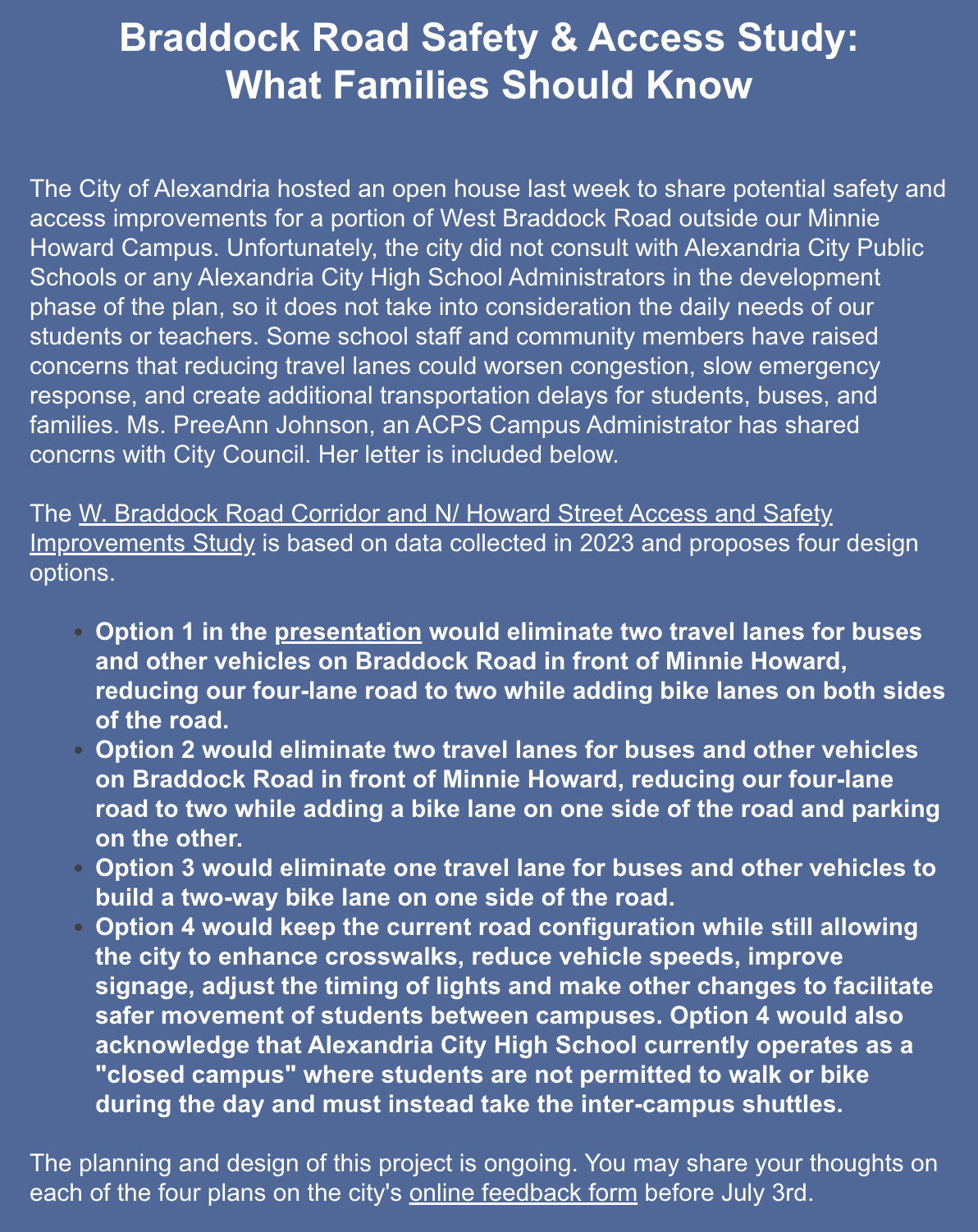
ALEXANDRIA, Va. — A year-end newsletter to Alexandria City High School families has put a spotlight on the city's W. Braddock Road and N. Howard Street safety study, relaying concerns from what it calls some school staff and community members that lane changes could worsen congestion and slow emergency response, and stating that the city did not consult Alexandria City Public Schools during the project's development. The city says it invited ACPS to take part in the current phase and the school did not — an account that confirms the schools were not involved in the present design work while disputing the newsletter's framing of why.
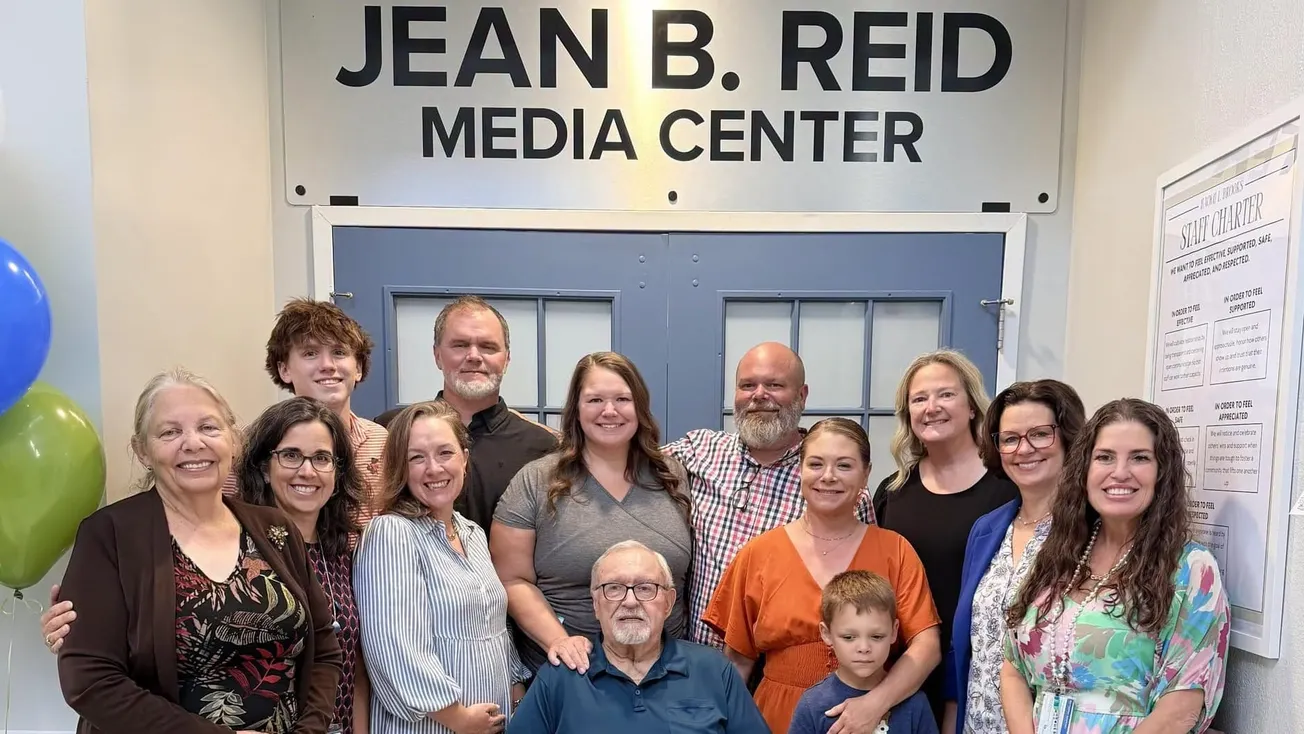
The ACHS PTSA's June 8 "Celebrating Our Titans" edition urges families to comment through the city's online feedback form, open through July 3, and publishes a letter from PreeAnn Johnson, the acting administrator of the Minnie Howard Campus, opposing the project. Outgoing PTSA President Missy Estabrook said Johnson's letter was first written about a different segment of Braddock Road — the eastern stretch near the Metro, where the city has approved removing turn lanes and parking — but that Johnson asked it run to register her opposition to all phases of the city's Braddock Road work, including in front of the Minnie Howard Campus.
Two projects, one corridor
Two separate city efforts share the Braddock Road name.
The eastern Braddock Road Corridor Improvements Project, near the Braddock Road Metro station between Russell Road and West Street, was approved 6-0 by the Traffic and Parking Board in February. Opponents, including two churches, appealed to City Council, which rejected the appeal 4-3 last month and allowed the project to proceed with modifications, including preserving 11 parking spaces in front of Good Shepherd Lutheran Church.
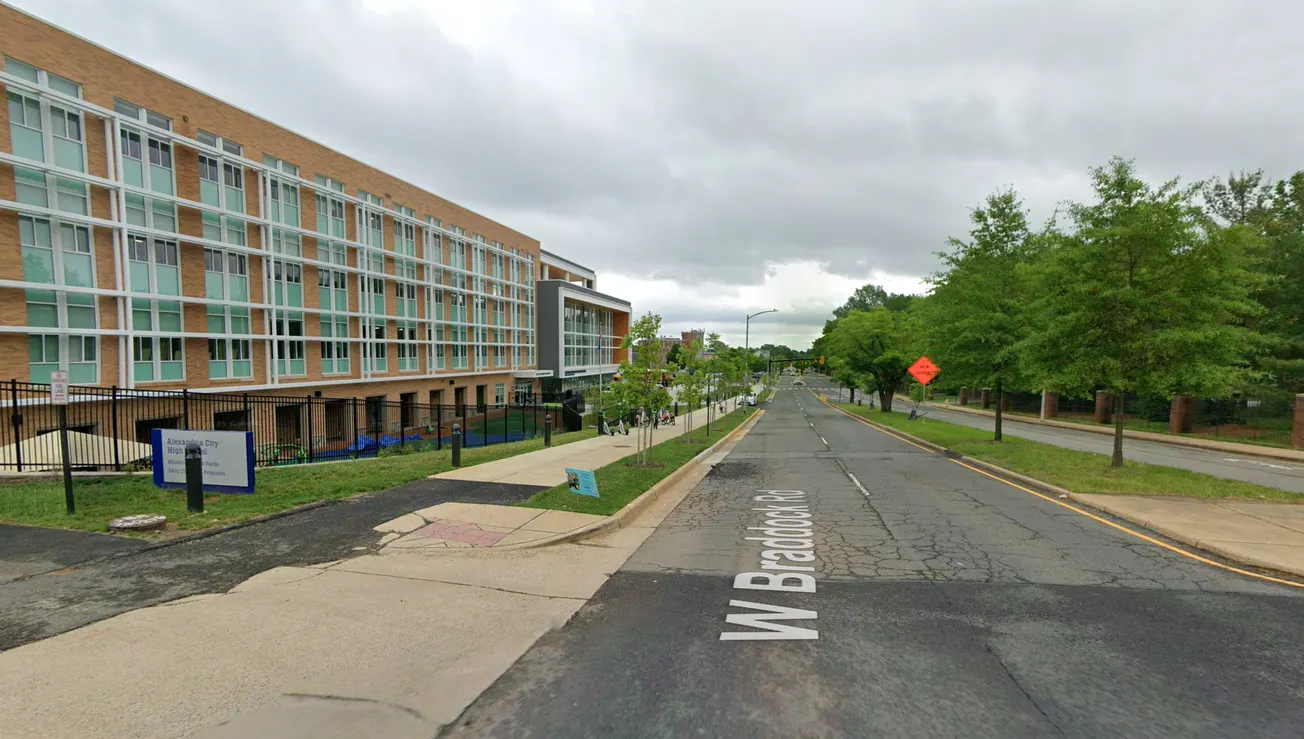
The project the newsletter addresses is the separate W. Braddock Road Corridor and N. Howard Street Access and Safety Improvements Study, covering W. Braddock Road from N. Van Dorn Street to Crest Street and N. Howard Street from Seminary Road to W. Braddock Road. It remains in the concept phase. The city's timeline calls for community engagement this summer, a recommendation to the Traffic and Parking Board, and only then detailed design and funding.
What the city is studying
According to the city's June 4 open house materials, the study presents four options for W. Braddock Road: protected bike lanes (Option 1), a protected two-way cycle track (Option 2), a hybrid of the two (Option 3), and no change (Option 4). For N. Howard Street, three options are offered: protected bike lanes, a two-way cycle track, and no change. The city has published cross-section renderings of each West Braddock option on its project website. The city describes its "no change" options as offering no additional design features and no identified safety benefits.
Separately, the city lists corridor treatments it says could accompany any option, including high-visibility crosswalks, leading pedestrian intervals, signal-timing adjustments, consolidated bus stops, no-turn-on-red restrictions, curb-radius tightening and slip-lane removal.
The city frames the lane question through what it calls "right-sizing" — adjusting road design to match actual traffic volumes. Its capacity analysis found peak-hour traffic at measured cross streets along W. Braddock Road running well below even two-lane capacity, the city's basis for arguing that fewer lanes need not worsen congestion. On the project corridor, the city counted 56 crashes between 2021 and 2025, 22 of them involving injuries, including two pedestrian crashes.
Detailed Options: The design team created conceptual design options for West Braddock Road and North Howard Street to convey some of the possibilities to right-size the roads and introduce measures to improve roadway safety. Please use the links below to review the individual options for each roadway.
West Braddock Road:
Existing Conditions & Option 4: No Change
Option 1: Protected Bike Lanes
Option 2: Protected Two-Way Cycle Track
Option 3: Hybrid
North Howard Street: The link below will take you to a second website, similar to google maps, where you can click through three design options, scroll, and turn on different base layers to look at the design options.
Link to North Howard Street Design Options: Options include Existing Conditions & No Change, Option 1: Protected Bike Lanes and Option 2: Two-Way Cycle Track
The newsletter's summary of the options differs from the city's materials in places. It describes Option 4 as keeping the current configuration while still allowing enhanced crosswalks, reduced speeds and signal-timing changes, and as acknowledging that the high school operates as a "closed campus" where students are not permitted to walk or bike during the day and must use inter-campus shuttles. The city's Option 4, by contrast, is a no-change baseline with no features attached. The "closed campus" characterization is also at odds with the documentary record: the city's 2023 Safe Routes to School assessment notes students walk between the Minnie Howard and King Street campuses, the city reports up to 350 to 450 students choose to walk between them across three daily class-transition periods, and shuttle buses run between the two as an option rather than a requirement.
The consultation dispute
At the center of the newsletter's concern is its statement that the city "did not consult with Alexandria City Public Schools or any Alexandria City High School Administrators in the development phase of the plan."
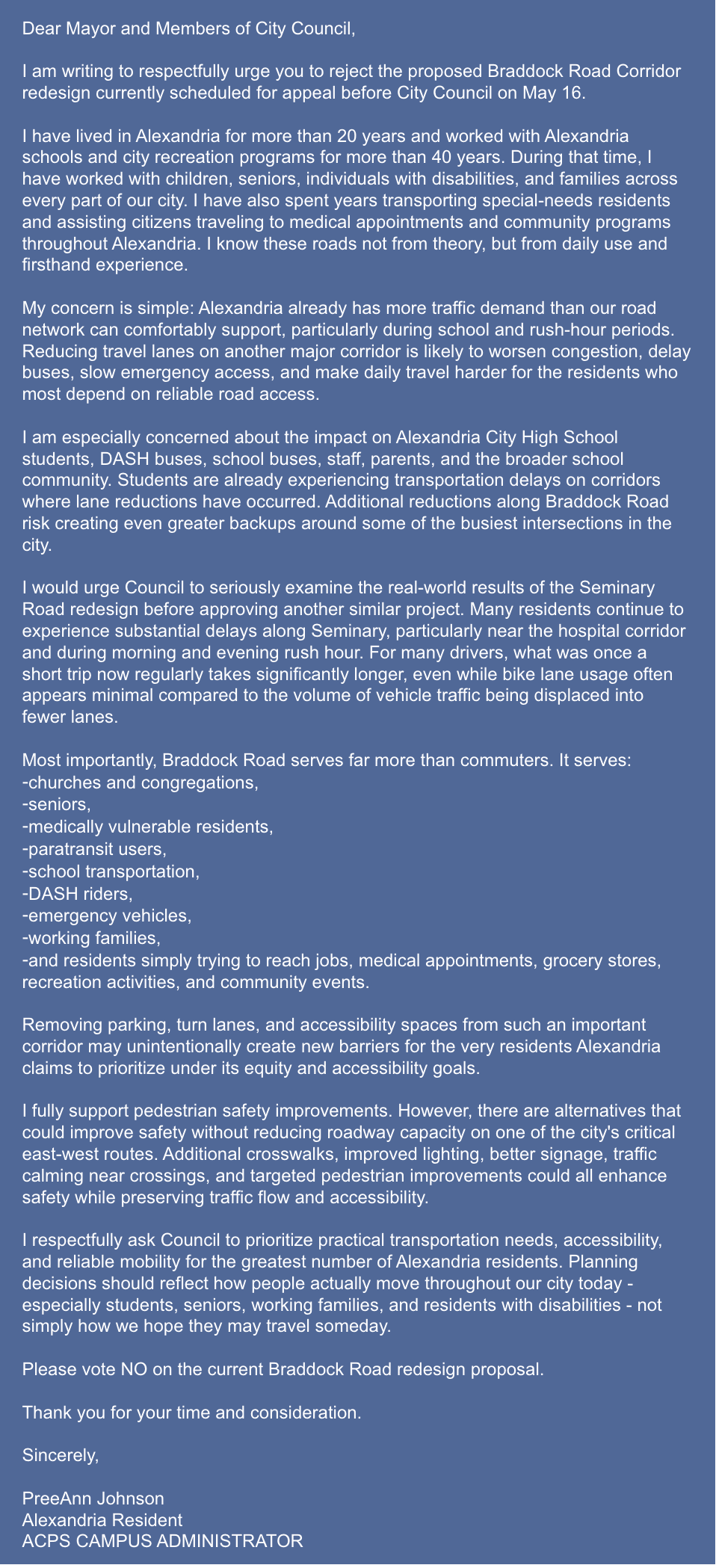
The city's account differs in emphasis but confirms the central point: ACPS did not take part in the current phase. In a statement provided by Ebony Fleming, the city's Director of Communications and Public Information, the city said its outreach built on engagement from the 2023 Safe Routes to School audit and that staff invited ACPS representatives, "both at the campus and administration levels," to review project materials, join a site walk and design charrette, and provide feedback on the study's concepts. "Although ACPS was unable to participate during this phase of the study, the City remains committed to collaboration and welcomes ACPS involvement as the project advances," the statement said. The city called the study "an early step in the planning process" and said it looked forward to working with ACPS in the coming months.
“The City’s outreach for the West Braddock Road Corridor Study built on engagement and input received from ACPS during the 2023 Safe Routes to School Safety Audit. City staff has made efforts to engage ACPS representatives, both at the campus and administration levels, inviting them to review project materials, participate in a site walk and design charrette, and provide feedback on study concepts and recommendations. Although ACPS was unable to participate during this phase of the study, the City remains committed to collaboration and welcomes ACPS involvement as the project advances. As noted at the June 4 open house, this study represents an early step in the planning process, and staff will continue engaging stakeholders and community members to refine potential improvements. We look forward to working with ACPS in the coming months to build on both the Safe Routes to School recommendations and the corridor study concepts.” ~ Ebony Fleming, the city's Director of Communications and Public Information, on behalf of the city.
That account squares with the documented record in one respect — ACPS staff, including now-interim principal Lance Harrell, participated in the 2023 audit that underpins the study — while leaving a factual gap with the newsletter over the current phase. The city says it sought ACPS's participation and the schools did not take part; the newsletter says the city did not consult ACPS. Neither the city's statement nor The Alexandria Brief has resolved a more specific dispute Estabrook described from the June 4 open house: she said project planner Sara Brandt-Vorel told attendees administrators had been consulted, that Johnson stood up to dispute it, and that an assistant director in the city's Capital Programs, Planning and Design Office, Arthur Carpenter Holmes, said his office was not involved in the design phase and first saw the project on June 4. The city's statement did not address that exchange.
ACPS communications did not respond before publication. In a June 16 statement, the office said Johnson — who signed the letter in her ACPS title as acting Minnie Howard administrator — was speaking as an Alexandria resident. The statement did not address whether the city consulted ACPS during the study's development or the June 4 open-house exchange Estabrook described.
The Seminary Road comparison
Johnson's letter cites the 2019 Seminary Road reconfiguration as a cautionary example, writing that drivers face substantial delays and that bike use "often appears minimal."
That characterization is at odds with the city's 2022 evaluation of that project, which found crashes on Seminary Road fell 41 percent, that severe-injury and fatal crashes dropped to zero, and that travel times decreased 17 to 24 percent despite the lane reduction. The same report found bike ridership rose about 75 percent at peak times, though from a small base.
Residents can review the options and comment through the city's feedback form through July 3.