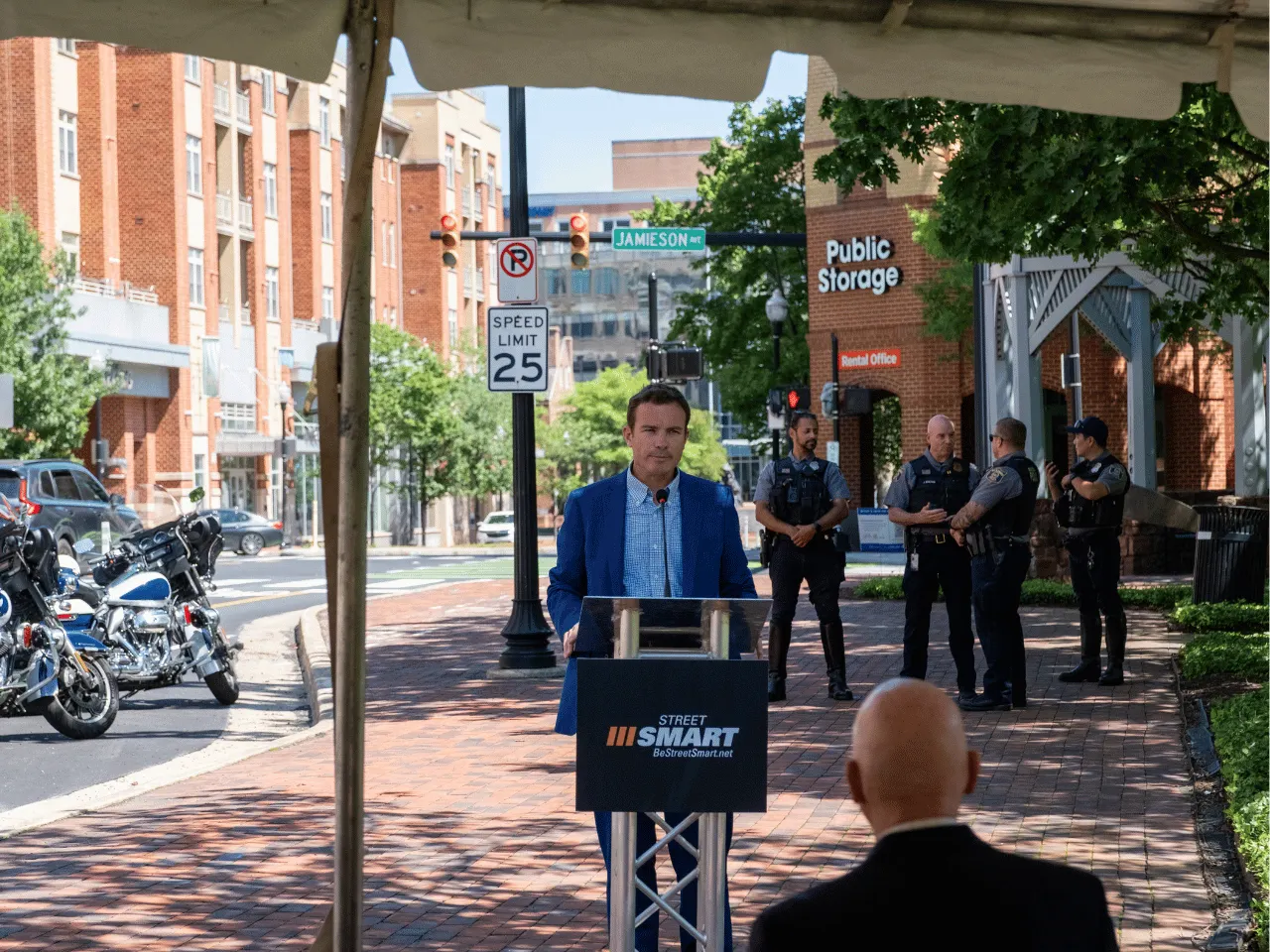
ALEXANDRIA, Va. — Pedestrian crashes in Alexandria are down 14% so far this year and bicycle crashes are down 28%, the city's police department said Thursday, as regional officials gathered in the Carlyle neighborhood to unveil a redesigned Holland Lane streetscape aimed at making the corridor safer.
The numbers came from Assistant Chief Mike May, who commands the Alexandria Police Department's Community Support Bureau, at an event organized by the Metropolitan Washington Council of Governments to launch the spring round of its Street Smart safety campaign. May said traffic fatalities in the city have also declined, from two at this point last year to one in 2026.
"One fatality is still one too many," May said. "Many crashes are preventable and stem from factors such as distracted driving, failure to yield and poor visibility."
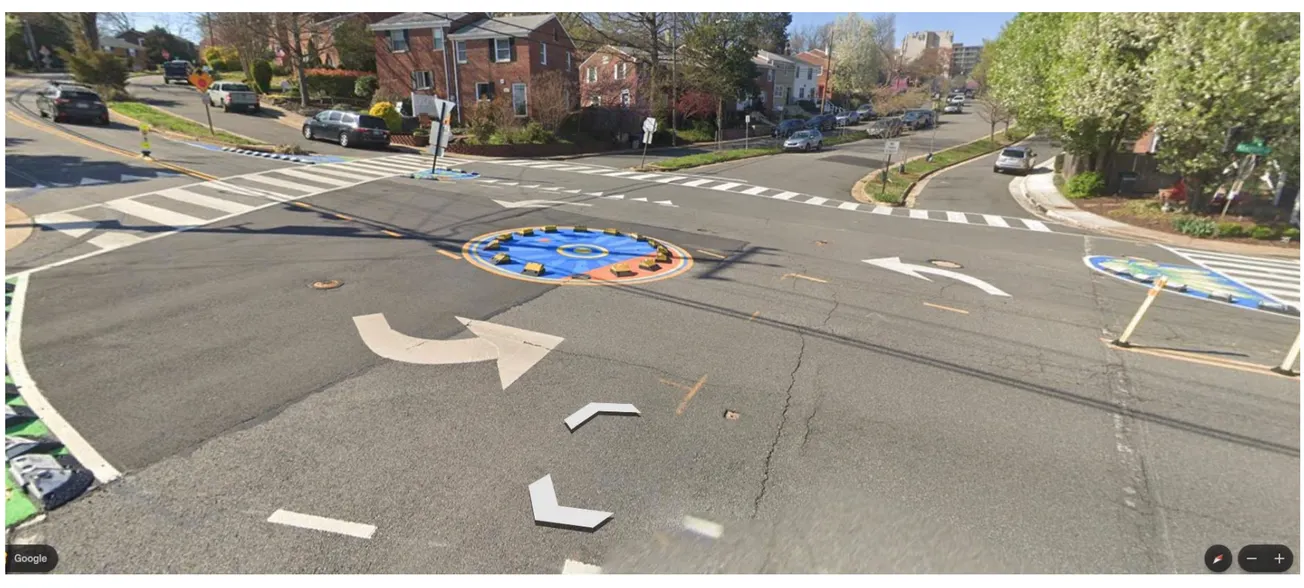
The Holland Lane Corridor Improvement Project, one of several active initiatives on Alexandria's Vision Zero work list, was the event's tangible centerpiece. Councilman Canek Aguirre, who chairs COG's Transportation Planning Board, said the redesign narrowed the road, added bollards and was designed in particular to slow drivers making right turns from Eisenhower Avenue. He said he had stood at the corner for an hour with a senior from Alexandria City High School watching traffic before backing the project, and that a pedestrian walking a dog was struck at Ballenger Avenue not long before the council approved it.
"By putting up this infrastructure, by putting in these bollards, we're actually helping to slow those right turns," Aguirre said.
The event came as the region continues to grapple with traffic violence. In 2025, 292 people were killed on Washington-area roads, according to COG, including 94 pedestrians and cyclists. In Virginia, 138 pedestrians and 15 bicyclists were killed last year, said Kimberly Burt, the Virginia DMV Highway Safety Office's deputy director of grant programs. Pedestrians and cyclists account for more than 30% of all traffic fatalities in the D.C. region, COG executive director Clark Mercer said.
Mike Doyle, the founder and executive director of Northern Virginia Families for Safe Streets — the volunteer group that helped lobby the city to adopt its Vision Zero plan in 2017 — spoke as both an advocate and a crash survivor. Doyle, who was struck by a driver turning left in an SUV while walking home in Old Town, said his organization has crowdsourced near-miss data and pushed legislation in Richmond, including this year's expansion of speed safety cameras beyond school zones to high-crash networks and a coming program of stop-sign cameras. He pointed to Holland Lane specifically. "Crossing this road before these changes was very dicey," he said. "Thank you for this. This is a part of the solution."
Bob Cox, a NoVA FSS volunteer who became a double above-the-knee amputee after a drunk driver hit him in a parking lot more than five years ago, gave the morning's most personal testimony. "This is what 18 miles per hour, getting hit at 18 miles per hour looks like," Cox said. "It doesn't have to be that fast to have big consequences." Cox said he had decided not to be "defined by my trauma" and instead to advocate for bike lanes, cameras and safer streets. "I want to make Alexandria the best it can be."
May said the police department's approach rests on five pillars: high-visibility enforcement focused on distracted driving, speeding and failure to yield; automated enforcement, including red-light cameras and an expanding school-zone speed-camera program; engineering work with the Department of Transportation and Environmental Services on traffic calming such as speed cushions and curb extensions; data-driven policing using a traffic-citation model developed by George Mason University, with annual reporting for transparency; and educational campaigns including Street Smart, bike rodeos and sober-ride initiatives.
"If we see you violating the rules of the roadway, we will issue citations," May said. "This applies to motorists, cyclists, scooter operators alike."
Adam Snider, communications director for the nonprofit Governor's Highway Safety Association, said national pedestrian fatalities have begun trending downward after reaching a 40-year high a few years ago, with three consecutive years of decline now likely. He singled out Virginia, the District of Columbia and Maryland as among the first jurisdictions in the country to pass intelligent speed assistance legislation, which targets the most extreme speeders. "We know what works," Snider said. "We need to go all in on a comprehensive approach."
Mercer, who said he grew up in Alexandria and attended Alexandria City High School, closed the event by tying the corridor improvements to a personal anecdote about Seminary Road's protected bike lane. He said he had asked his mother, who still lives in the family's longtime home, what she thought of the lane. "She said, with that bike lane in, I felt safe for the first time in decades that I wasn't going to be hit by a car walking on Seminary Road," Mercer said. "It's that sense of community that I grew up with here."
After the speaking program, the Alexandria Police Department conducted a crosswalk enforcement demonstration at the intersection of Holland Lane and Duke Street.