Table of Contents
Alexandria's unemployment rate rose by more than a percentage point last year, private sector jobs contracted at one of the steeper rates in the Washington region, and personal bankruptcy filings surged nearly 30%, according to new data from the Brookings Institution's DMV Monitor published this week.
The data arrives as Alexandria City Council prepares to receive a workforce development presentation from Brookings on Tuesday, March 10 — the same week work sessions on City Manager James Parajon's proposed $977.3 million fiscal year 2027 budget continue.
Unemployment and jobs
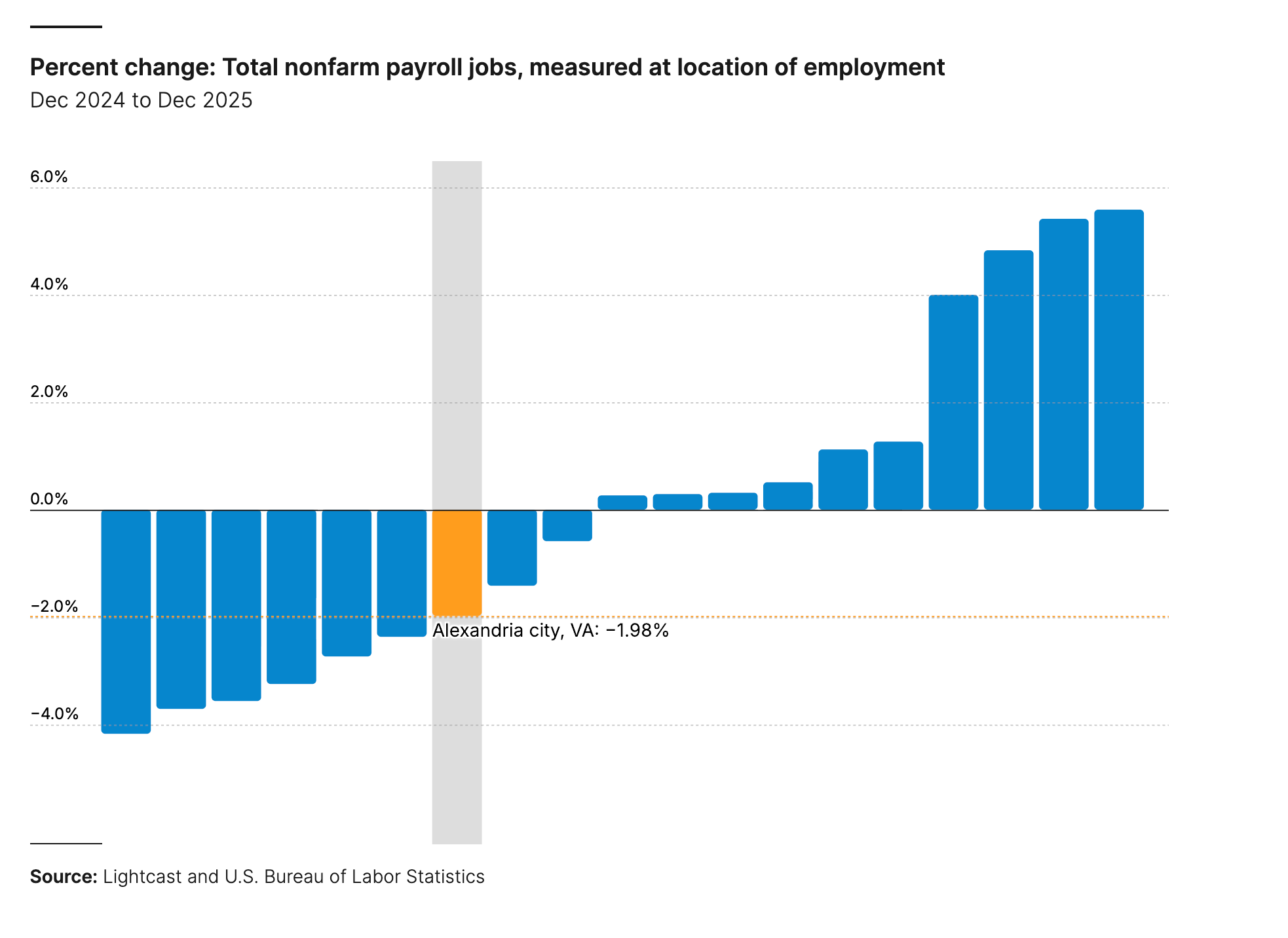
Alexandria's unemployment rate stood at 3.62% in November 2025, up 1.10 percentage points from November 2024, according to Brookings' analysis of Bureau of Labor Statistics data. A report presented to council in February cited a slightly different figure of 3.8%, reflecting a different data snapshot — but both point to the same trend: unemployment in Alexandria is rising.
Across the greater Washington, D.C., region, unemployment rose 1.3 percentage points over the same period — a jump 3.5 times higher than the national average, according to Brookings. The DMV region as a whole shed jobs at a rate of 1.7% in 2025, the worst performance among all major metropolitan areas in the United States.
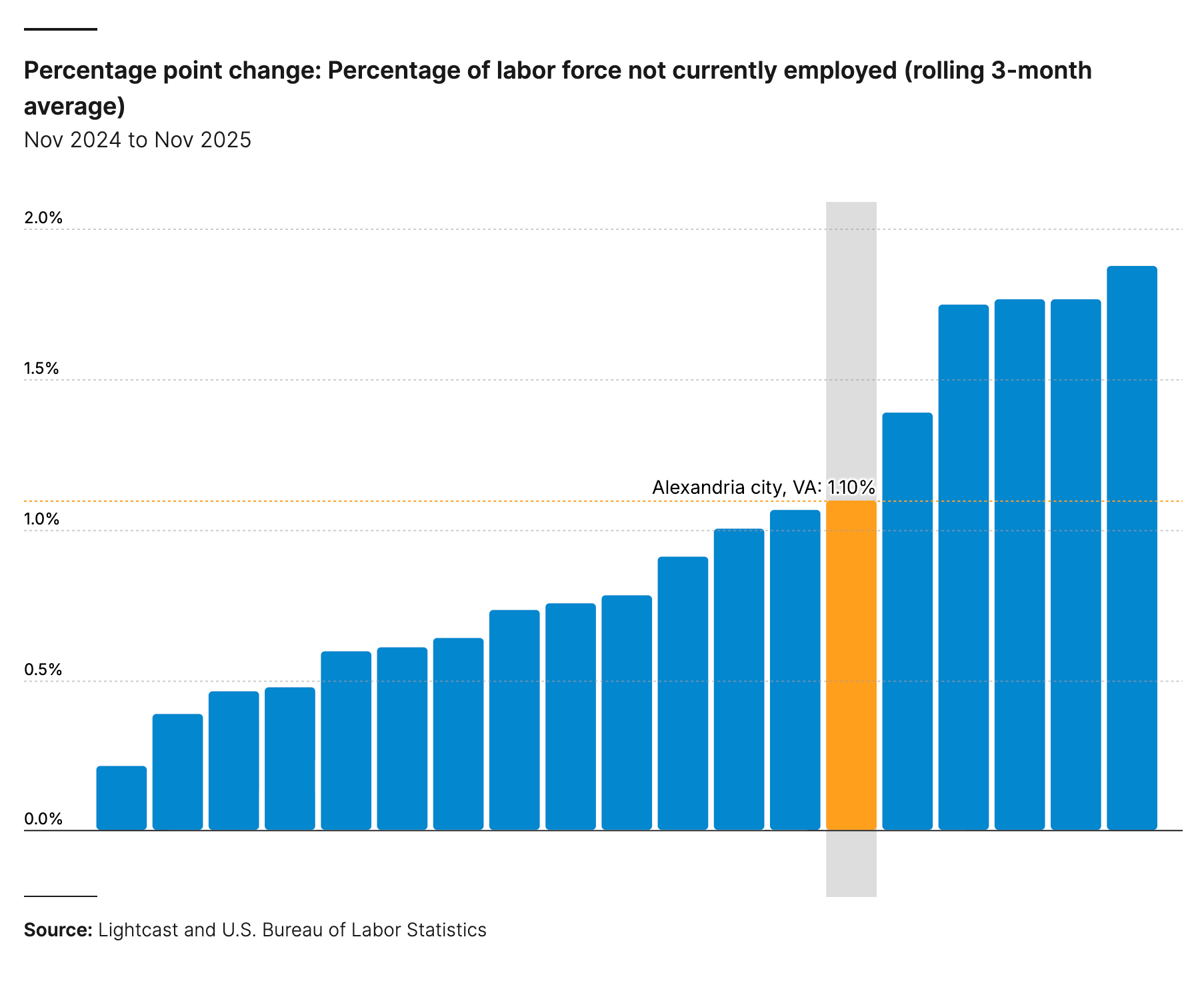
Total nonfarm payroll jobs in Alexandria — measured at the location of employment — reached 88,099 in December 2025, a decline of 1.98% from December 2024.
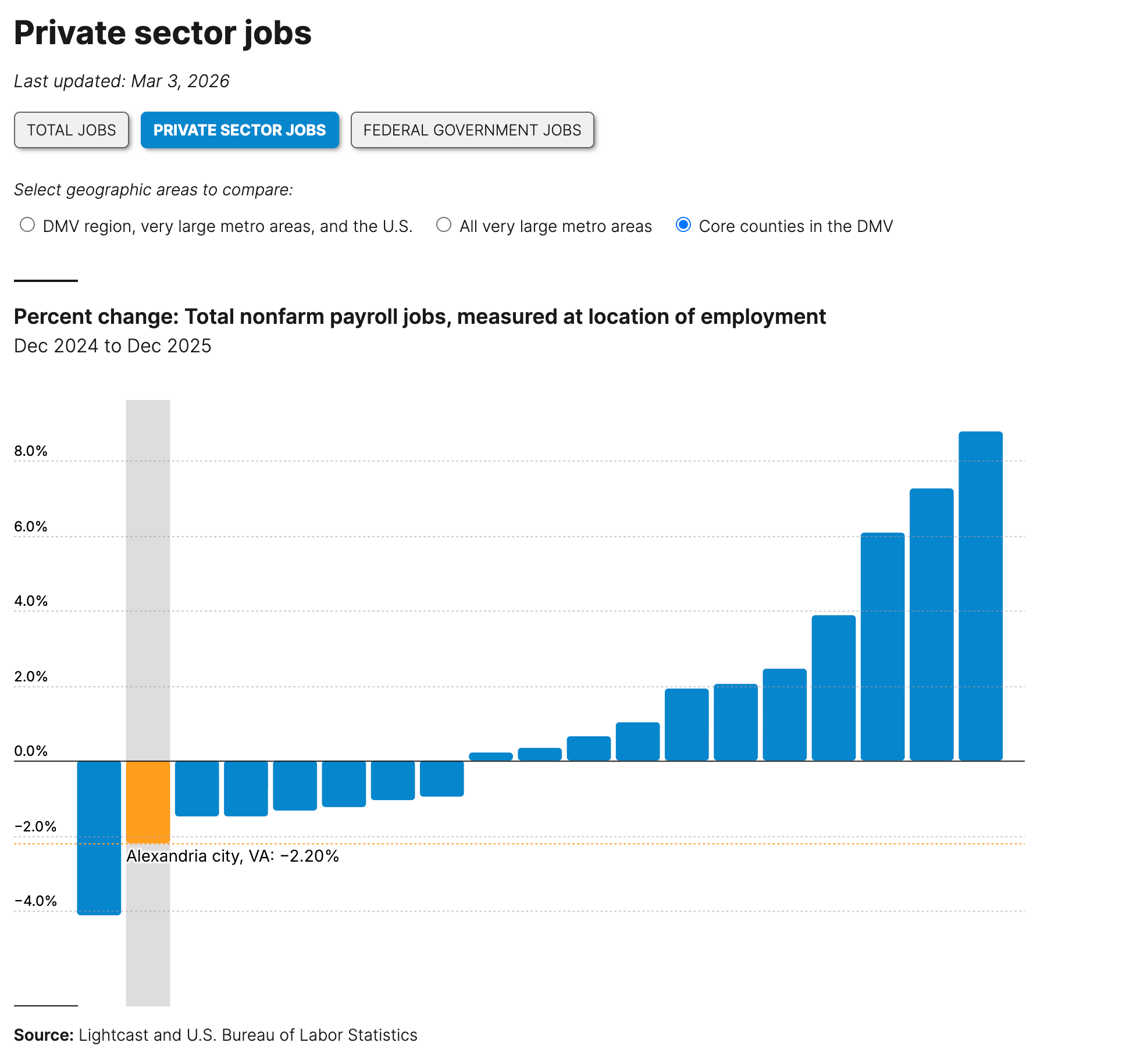
Notably, Alexandria's federal government job loss of 4.61% over that period was actually among the smallest in the DMV region, where most counties lost federal jobs at rates of 10% to more than 20%. The bigger driver of Alexandria's job contraction appears to be the private sector, which shed 2.20% of its jobs year over year — one of the steeper private sector declines among core DMV counties. That figure reflects the broader regional pattern Brookings researchers identified: as federal contracting cratered, it dragged down adjacent private sector employment.
Online job postings in Alexandria edged up 6.35% to 1,629 listings in December 2025 — a modest counterpoint to the overall job market contraction, suggesting some employer demand remains.
Commercial space and spending
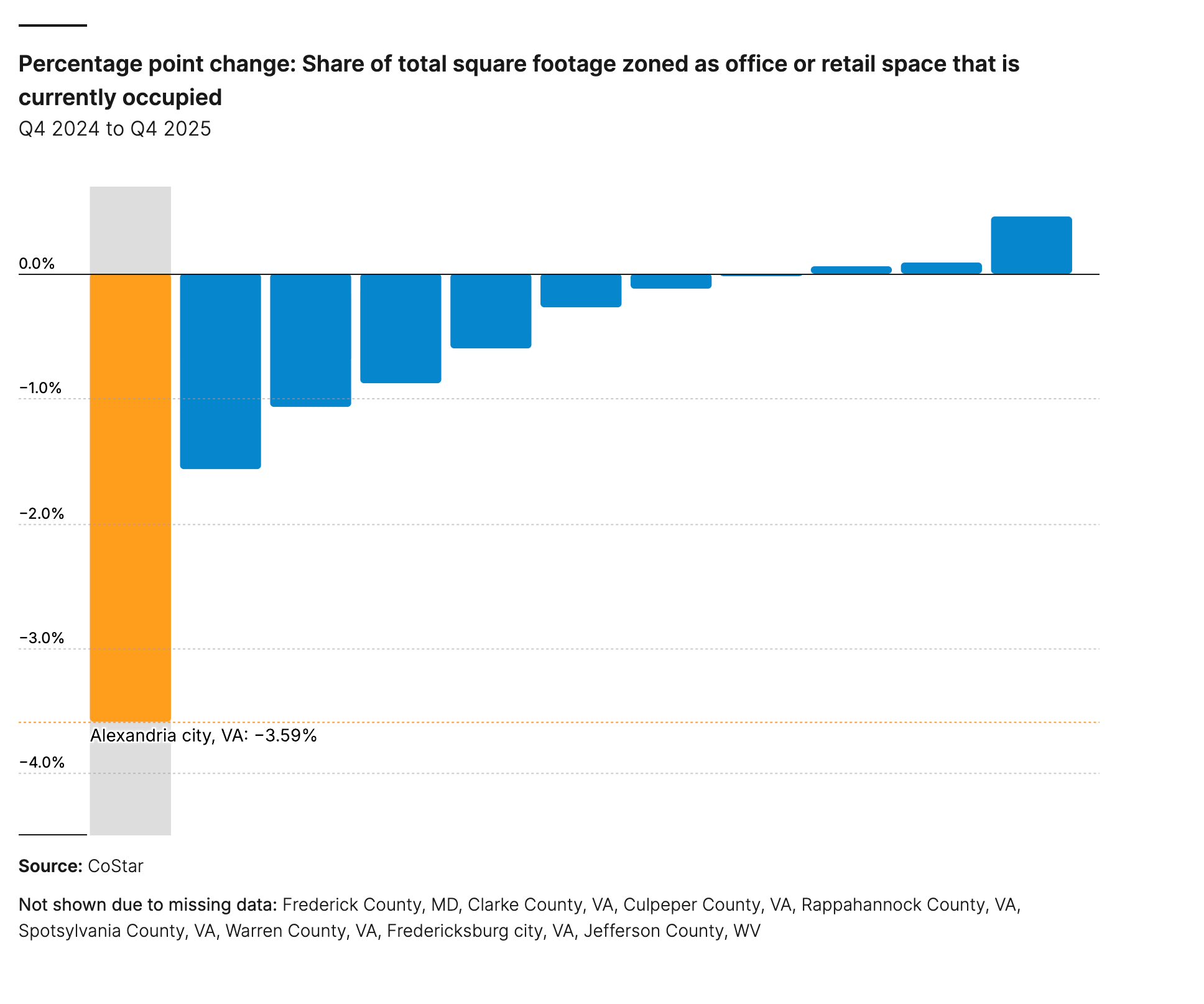
The picture in Alexandria's commercial real estate market is mixed. The city reported in February that office vacancy had fallen to 18.9% — a trend it described as bucking regional norms. However, Brookings' analysis of CoStar data, which measures occupied commercial square footage across both office and retail space, shows that Alexandria's commercial occupancy rate fell by 3.59 percentage points between the fourth quarter of 2024 and the fourth quarter of 2025 — the steepest decline among all core DMV counties tracked. The two figures are not directly comparable and may reflect different segments of the commercial market or different measurement methodologies, but together they suggest the city's commercial sector is under meaningful pressure.
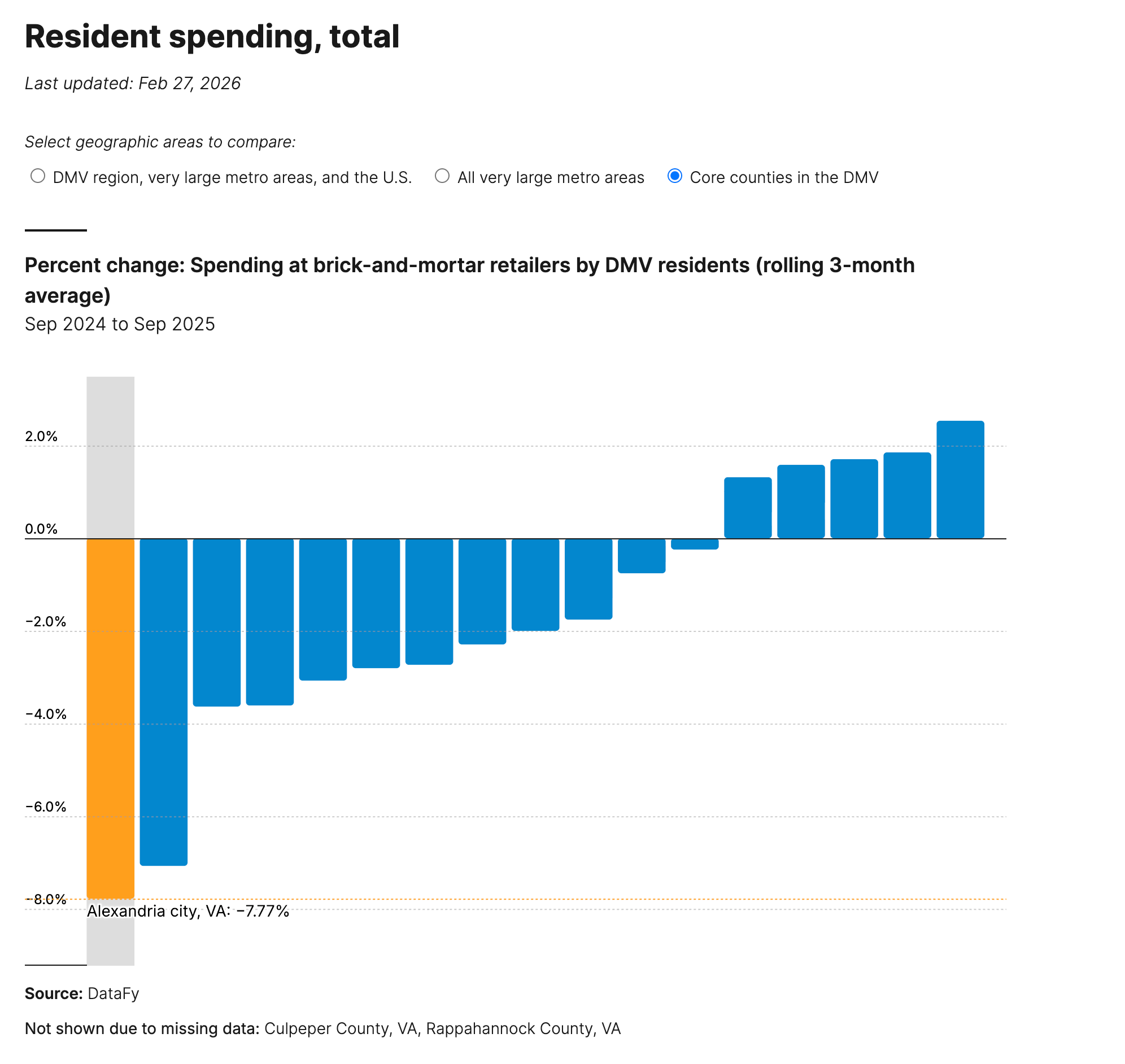
Resident spending at brick-and-mortar retailers dropped 7.77% between September 2024 and September 2025, with Alexandria residents spending approximately $94.2 million per month on a rolling three-month average — the sharpest decline among core DMV counties, according to Brookings' analysis of DataFy data.
Financial stress indicators
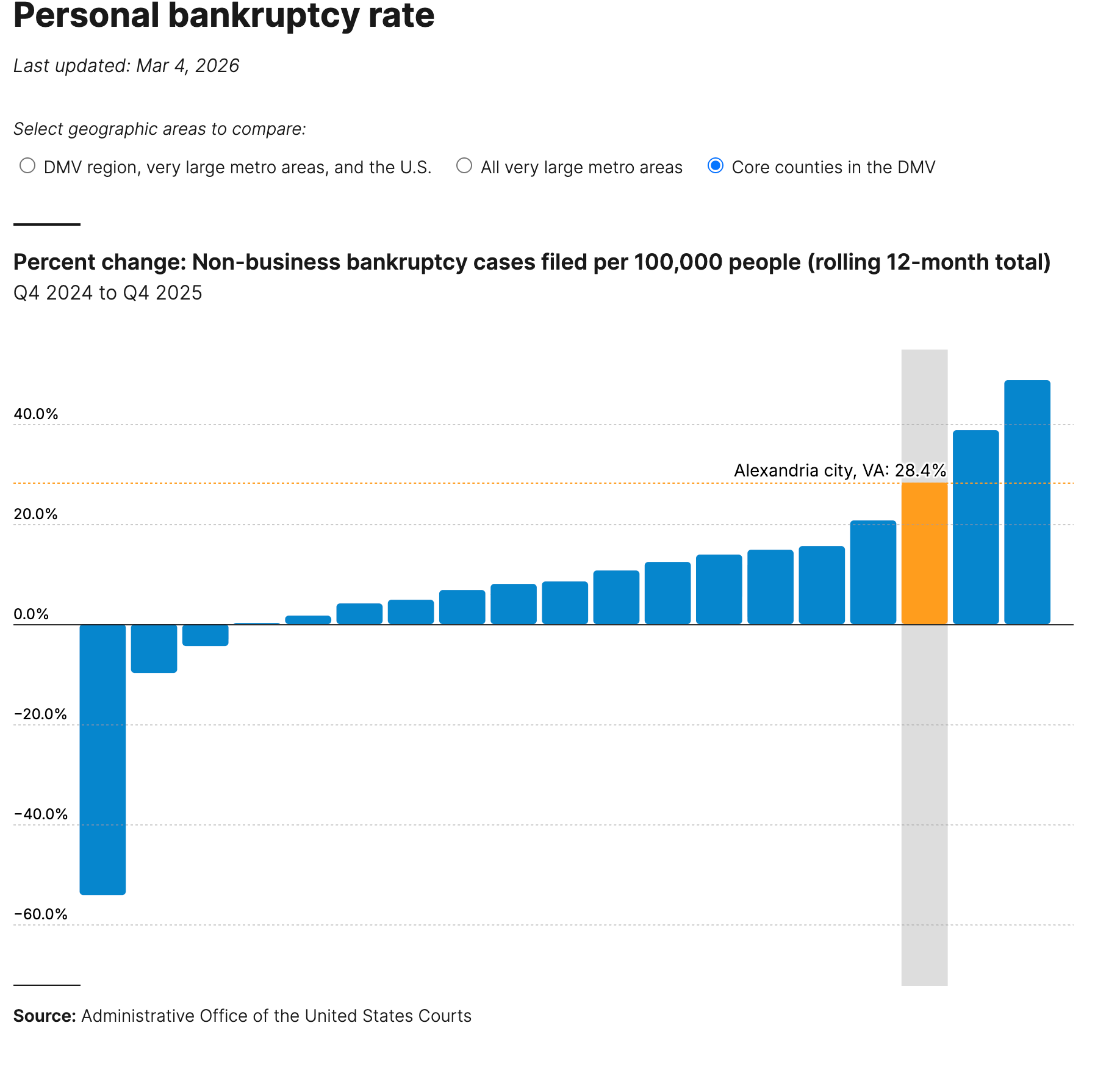
Personal bankruptcy filings in Alexandria rose 28.4% between the fourth quarter of 2024 and the fourth quarter of 2025, reaching 98 non-business filings per 100,000 residents — among the higher increases in the region.
The number of Alexandria residents enrolled in Medicaid and the Children's Health Insurance Program totaled 27,039 in October 2025, down 8.68% year over year. SNAP participation declined to 11,589 residents, a drop of 5.78%. Brookings notes that Medicaid and SNAP declines across the region reflect multiple factors, including the ongoing unwinding of pandemic-era enrollment expansions, and are not solely attributable to federal job losses.
Regional context
Brookings researchers Glencora Haskins and Tracy Hadden Loh attributed the region's deteriorating labor market primarily to the Trump administration's federal workforce reduction initiative, carried out in part through a deferred resignation program — known as the "fork in the road" — that kept affected workers on the federal payroll through Sept. 30, 2025, before their departures registered in official employment counts.
Across the DMV region, roughly 54,000 of the 56,000 jobs lost in 2025 stemmed directly from federal employment cuts — a 14.3% reduction in the region's federal workforce. Brookings identified suburban Virginia jurisdictions closest to the District, including Alexandria, as bearing a disproportionate share of the unemployment impact, given historically higher concentrations of federal workers commuting into D.C. and surrounding counties.
"The federal government is not a passive bystander to the DMV region's economy — it is an anchor," Haskins and Loh wrote in the analysis published Wednesday. "The loss of approximately 54,000 federal jobs in the span of 12 months is not an exercise in efficiency, but an industry shock bearing consequences for the entire region."
City Manager James Parajon flagged the issue to City Council as early as January, warning of "continued uncertainty, primarily related to some of the federal" workforce changes.
Budget backdrop
Tuesday's Brookings presentation comes as Alexandria works through one of its more constrained budget cycles in recent years. Parajon's proposed FY 2027 budget totals $977.3 million and closes a $22.9 million gap without raising the real estate tax rate — in part by eliminating 45 vacant positions. The budget includes $750,000 for ALX Forward, the city's new economic development strategy, and $1 million in fund balance designated for economic incentives.
City Council's Tuesday legislative meeting begins at 7 p.m. at City Council Chambers at Del Pepper Community Resource Center, 4850 Mark Center Drive. The Brookings presentation is the ninth item on the agenda, listed under the city manager's oral report. Also on Tuesday's docket: the first reading of an ordinance setting real and personal property tax rates for calendar year 2026, and receipt of the city's monthly financial report through January 2026 — meaning council members will be absorbing the workforce data on the same night they advance the tax rate that will fund the city's response to it.
The meeting will be livestreamed on government channel 70 and the city's website.
The full Brookings DMV Monitor dashboard, including Alexandria-specific indicators, is available at brookings.edu/articles/dmv-monitor.
Sources: Brookings Institution DMV Monitor, updated March 5, 2026; Brookings Metro analysis by Glencora Haskins and Tracy Hadden Loh, published March 5, 2026; City of Alexandria FY 2027 proposed budget presentation, Feb. 24, 2026; The Alexandria Brief reporting. Jobs and unemployment data from Lightcast and the U.S. Bureau of Labor Statistics. Commercial occupancy data from CoStar. Resident spending data from DataFy. Bankruptcy data from the Administrative Office of the U.S. Courts. SNAP and Medicaid data from the Virginia state agency reporting.