Table of Contents
Nearly two months after Winter Storm Fern brought Alexandria to a standstill, city officials presented a formal after-action report to City Council on Tuesday night, detailing a response that cost $9.6 million, involved nearly 500 city and contract workers, and stretched across 19 consecutive days of around-the-clock operations — and laying out a series of changes the city says it will make before the next major storm.
Emily Baker, deputy city manager and interim director of Transportation and Environmental Services, and Marc Barbiere, the city's emergency manager, led the presentation. Baker opened with a frank summary of the event's scale and complexity: "This event was of historic nature," she told council. "You couldn't get a shovel and clear your sidewalk. We couldn't use a regular plow and clear the street."
What made Fern different
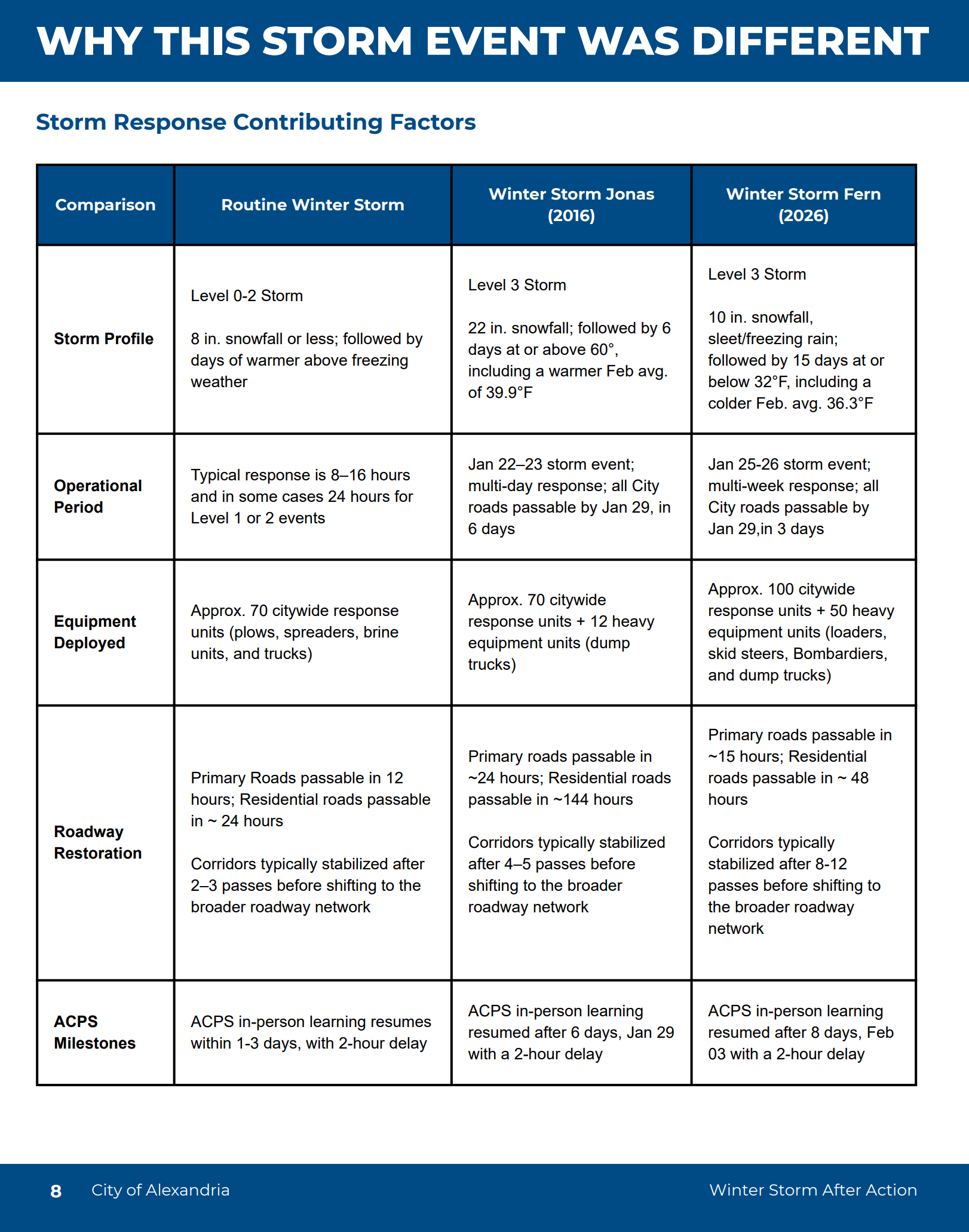
Winter Storm Fern began Jan. 24, bringing up to 8 inches of snow before transitioning to sleet and freezing rain — a combination that, under 15 consecutive days of below-freezing temperatures, created what the after-action report describes as "snowcrete": concrete-like hardened accumulations that standard plowing equipment could not remove. Temperatures did not rise above freezing until Feb. 2.
The result was the most significant weather event in the Washington region since Winter Storm Jonas in 2016, which brought 23 inches of snow and blizzard conditions. While Jonas brought far more snow by volume, Fern's ice accumulation proved in some ways more operationally demanding. Some primary corridors required more than a dozen plow passes before they could be stabilized — compared to two to three passes in a typical storm and four to five during Jonas. The city was forced to bring in specialized construction equipment including skid steers, rubber-tire loaders, and bombardiers, with contractors arriving from as far away as Minnesota.
The storm triggered local, state and federal emergency declarations. Mayor Alyia Gaskins addressed frustrated residents publicly on Jan. 27, acknowledging the challenges and explaining why some neighborhoods remained impassable days after the storm. Alexandria City Public Schools were closed for eight consecutive days, reopening Feb. 3 with a two-hour delay.
The scale of the response
The numbers Baker presented to council Tuesday illustrate the scope of what the city undertook.
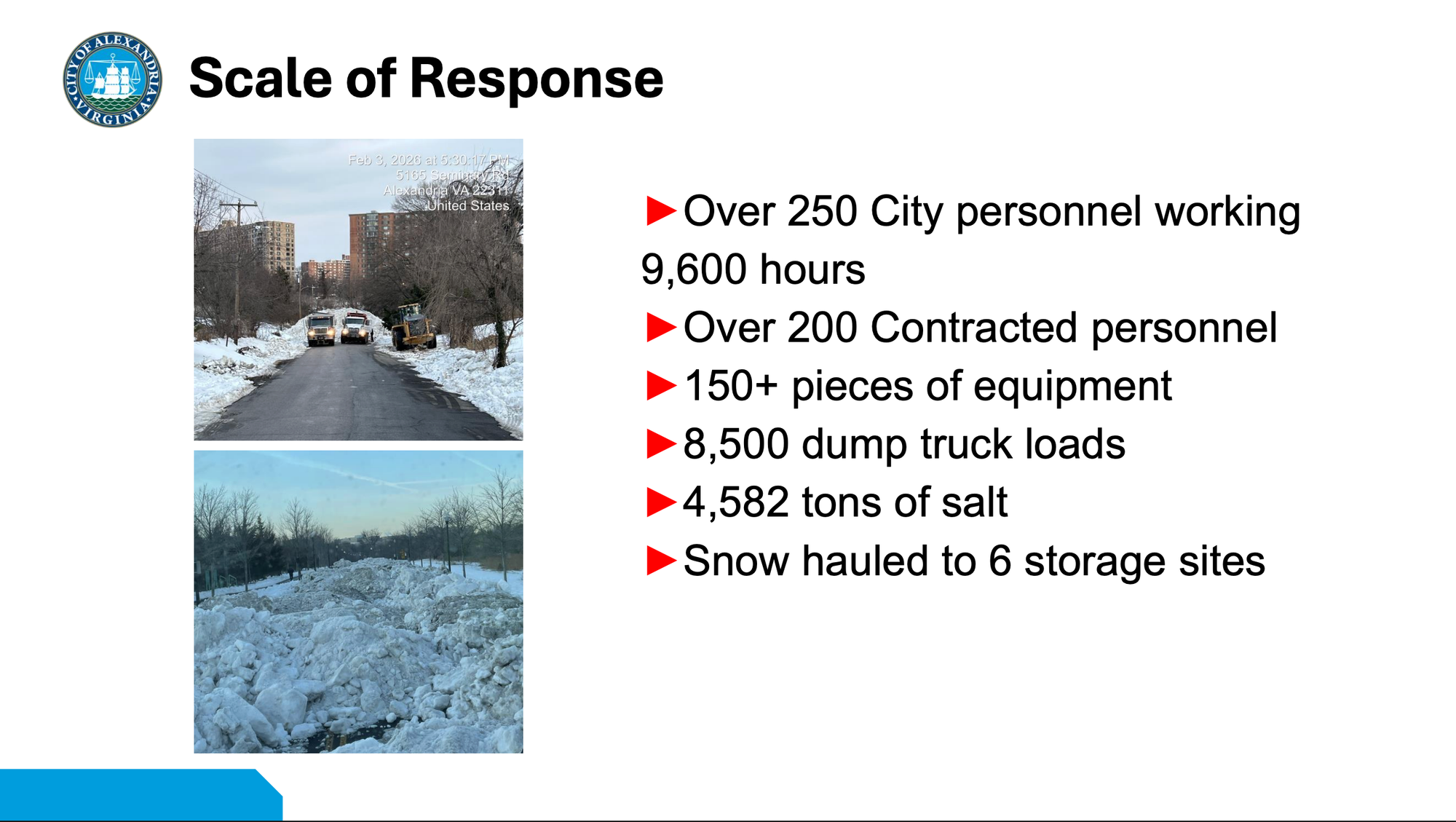
Approximately 266 city personnel logged 9,600 total hours. More than 200 contractor staff supported continuous 24-hour operations across multiple shifts from Jan. 24 through Feb. 13 — 19 straight days, 38 total shifts. Daily shifts continued through March 2. More than 150 pieces of roadway equipment were deployed per shift. Crews removed approximately 8,500 dump truck loads of snow and hardened accumulation, used 4,582 tons of salt, and hauled snow to six off-site stockpile sites across the city.
Primary roadways were safely passable within approximately 15 hours. Secondary roads were clear within 35 hours. By Jan. 29, 97% of all roadways were passable. School sites were cleared by Feb. 1. Parks were cleared by Feb. 16. The city's 311 system received 1,606 tickets related to the storm.
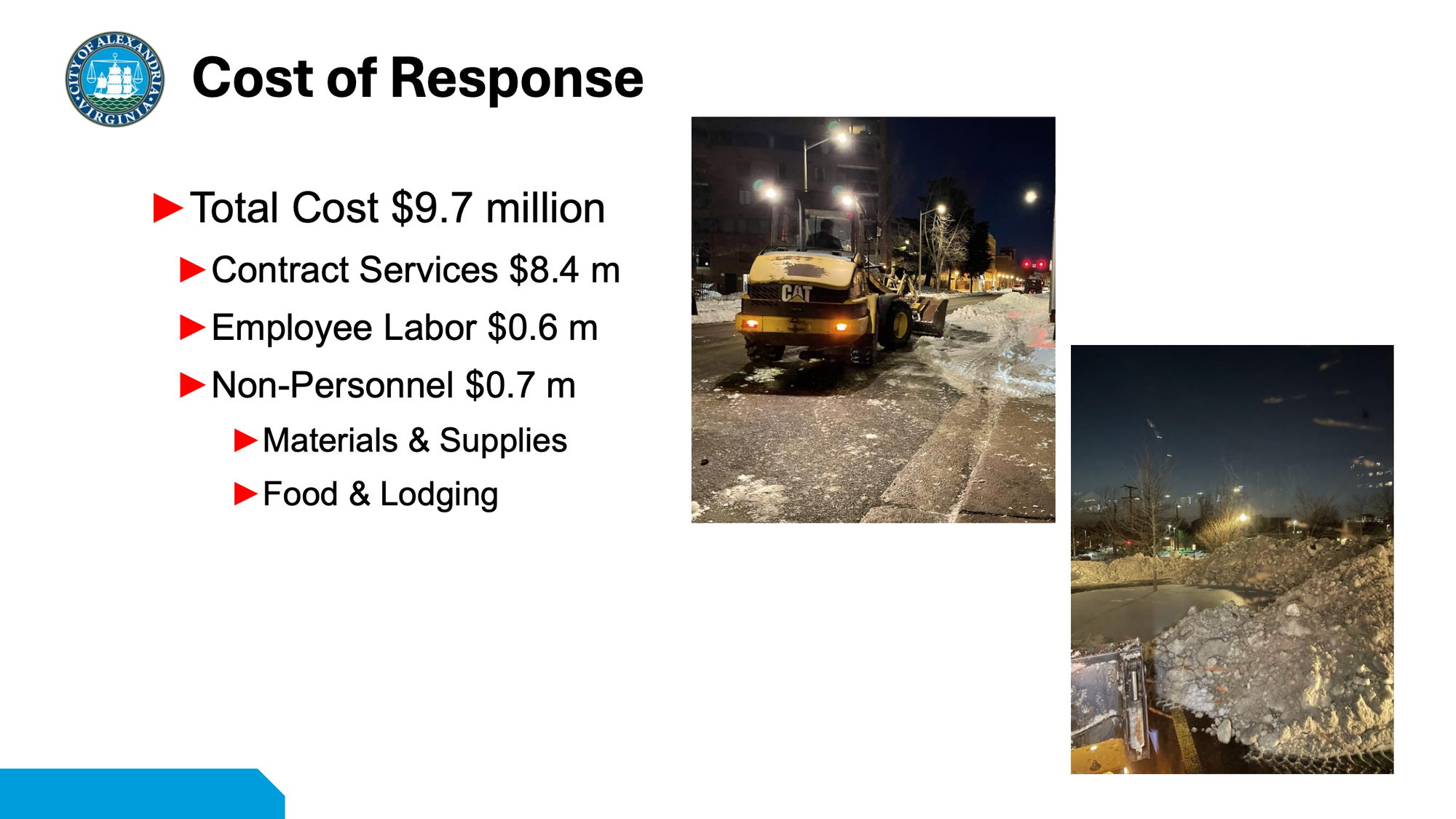
The total cost to date is $9,664,365. Contractor services account for the vast majority — $8.35 million — reflecting the specialized heavy construction equipment and round-the-clock staffing required. Employee labor came to $647,154, with an additional $666,228 in non-personnel costs including lodging, materials and supplies. The city noted that the cost tally was still preliminary as of March 19.
Baker said the response was consistent with or better than neighboring jurisdictions and that no responding staff suffered significant injuries. The city suffered no major infrastructure damage or power outages during or after the storm. Emergency response times for police and fire were not impacted.
What went wrong — and what the city is changing
Baker organized the report's findings into three categories: planning, communications, and technology — along with a set of policy considerations that will come back to council this fall.
On planning, Baker acknowledged the city needs a deeper bench of trained responders for prolonged events, more formalized priorities for pedestrian networks, transit corridors and school access routes, and stronger contractor agreements. During Fern, the extended duration meant the city needed to shift priorities repeatedly across three weeks — a complexity the current Snow Operations Plan wasn't fully designed to handle.
On communications, Baker said the city needs to be clearer in real time about what its priorities are and why — and more transparent when it falls behind. "We want to be messaging: here is our priority today. This is not our priority. Here's when we're going to get to what your priorities are," she said. Mayor Gaskins pressed Baker on the snow map specifically, noting that residents had received "passable" status notifications for streets that remained impassable in their experience. Baker acknowledged the gap — in part a result of contractors unfamiliar with city street layouts who couldn't accurately report which roads they had cleared. "We lost control of the snow map during this event," Baker said, adding that the city has already begun acquiring GPS tracking technology to address it.
On technology, Baker said the city is now acquiring vehicle-tracking "pucks" that can be placed in both city and contractor vehicles to transmit real-time location and plow pass data to the public-facing snow tracker map. The city is also working with the 311 system to add more specific snow reporting categories to give residents better options for submitting requests and to allow staff to track and prioritize them more precisely.
Policy changes coming this fall
The after-action report identified three policy areas Baker said staff will study and bring back to council with recommendations in the fall.
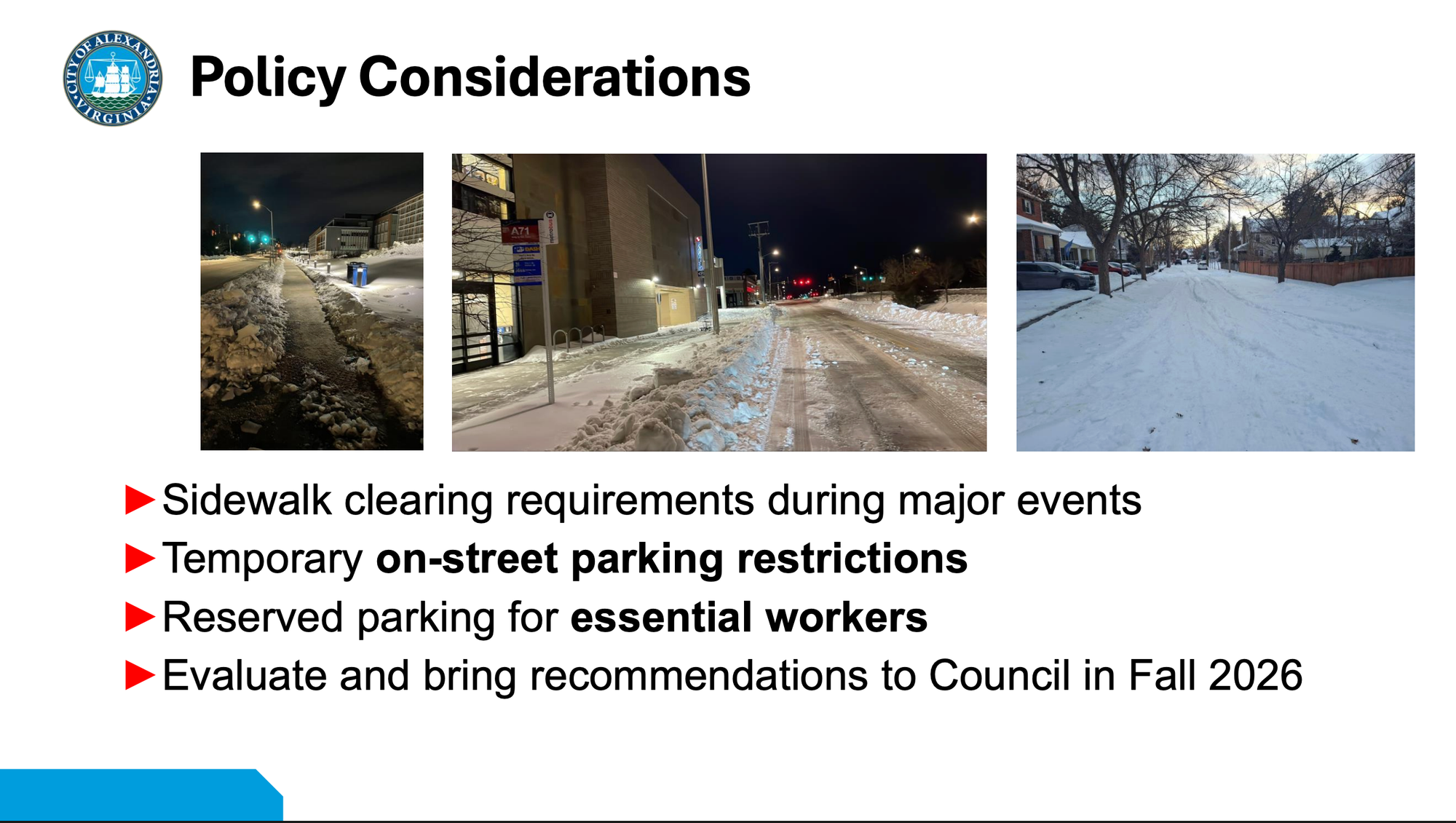
The first involves sidewalk clearing requirements. Under current city code, property owners are required to clear sidewalks within a set timeframe after a storm. Baker said that requirement doesn't account for events where ice accumulations make shoveling physically impossible — even for able-bodied residents — and where an active emergency declaration is in effect. Staff wants to evaluate flexibility in the ordinance for events of this magnitude.
The second involves on-street parking restrictions. Baker said cars parked along residential streets significantly complicated plowing operations, and the city wants to evaluate whether it can require residents to park on one side of the street — or clear streets entirely — in advance of major storms. "It's much easier for us to clear the street if there aren't cars parked there," she said.
The third involves reserved parking for essential workers and teachers. Some schools lack sufficient parking for teachers and support staff who must report during emergencies, and Baker said the city wants to look at whether on-street spaces can be designated for essential workers during storm events when parking becomes scarce.
Council reaction
Mayor Gaskins opened the council's response by thanking Baker and acknowledging Deputy City Managers Alethea Predeoux and Yon Lambertt, who she said were central to the city's coordination throughout the event. "This was an all hands on deck effort and really pulled from almost every department across the city," Gaskins said.
Council discussion focused heavily on transit and the bus stop recovery experience. DASH CEO Josh Baker — who had presented separately earlier in the evening at the Alexandria Transit Company stockholders meeting — had raised the issue himself during that session, noting that WMATA had voluntarily cleared 46 Alexandria transit stops during the storm in an act of regional goodwill. Mayor Gaskins said she wanted to understand both the day-to-day bus stop maintenance question and the emergency deployment question as two separate but related conversations — and indicated she would welcome DASH taking a leadership role in bus stop maintenance going forward.
The after-action report has been posted publicly on the city's website. Work on improvements is already underway; staff expects to have GPS vehicle tracking in place before next winter season and updated 311 snow categories active by spring or summer.