
Table of Contents
ALEXANDRIA, Va. - When Croatia's national soccer team went looking for a place to base itself for the 2026 World Cup, it weighed professional training grounds and university facilities up and down the region. Then it picked a boarding high school in Alexandria.
As the team prepares to leave Alexandria this week, Dan O'Neil, Episcopal High School's director of auxiliary programs, will admit he did not see it coming.
"We were pleasantly surprised when Croatia chose us," O'Neil said in an interview, acknowledging that, for all his pride in the school's fields, he was not highly confident Episcopal would beat out the professional and collegiate options. "It's been a really wonderful experience."
His surprise was not unfounded. When the Croatian Football Federation announced the choice in January, team manager Iva Olivari said the federation had analyzed more than 60 potential base camps, with a delegation visiting eight sites in the northeastern U.S. and Canada before Dalić's staff unanimously settled on Alexandria. Technical director Stipe Pletikosa cited the quality of Episcopal's pitches, fitness facilities and recovery areas, along with the city's proximity to Reagan National Airport.
It is the second straight summer Episcopal has hosted an international team. In 2025, the school served as a base camp for Al Ain FC of the United Arab Emirates during the inaugural FIFA Club World Cup. This year, it was the Vatreni — and after reaching the World Cup's Round of 32, the team's last days at Episcopal gave O'Neil a moment to reflect on what it takes to host a national team, and what the month has meant for the school.
A handful of grass fields
Episcopal's path to hosting traces partly to geography. There are only a handful of natural grass fields in the D.C. area, O'Neil said, and teams playing matches at venues like Audi Field or Northwest Stadium need somewhere to train. Over roughly the past five years, the school has hosted a variety of teams passing through for friendlies and tournaments.
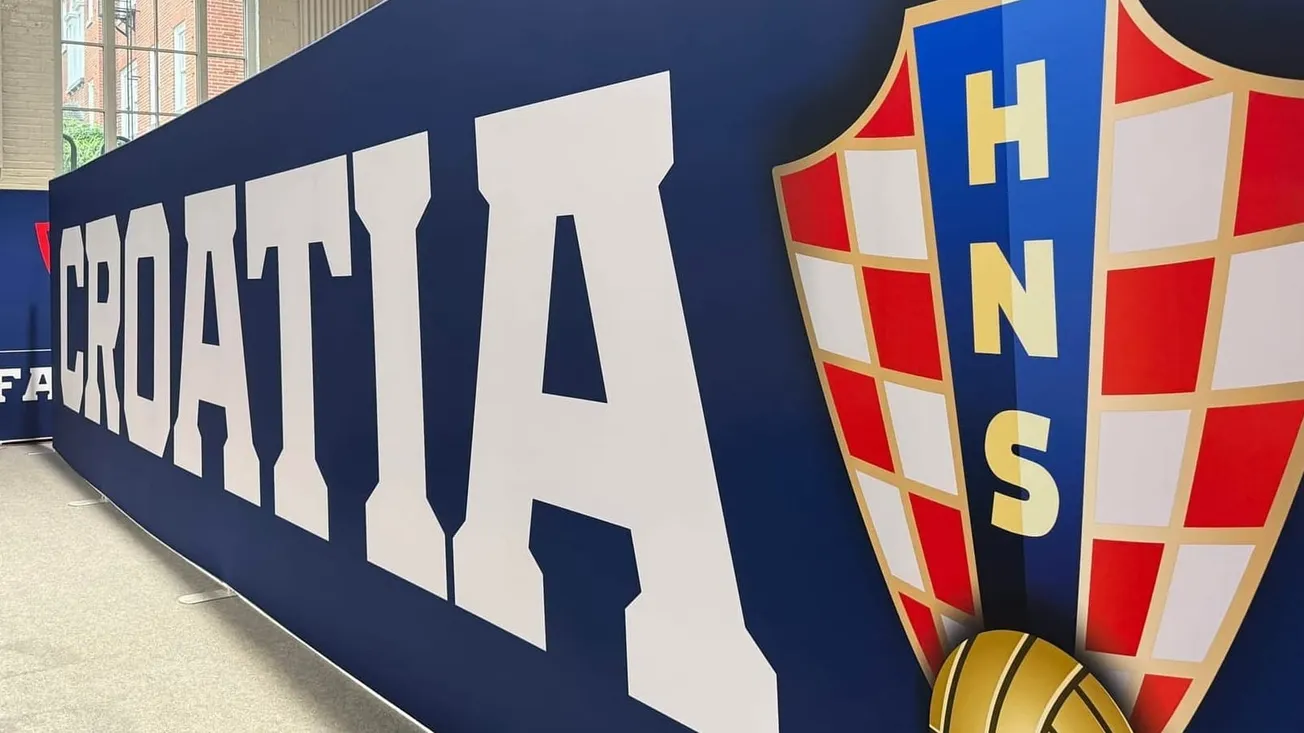
The school did not have to build anything for Croatia, O'Neil said. Keeping the fields ready is a daily commitment regardless — mowing and upkeep the grounds crew handles whether a World Cup team is in residence or not. The most visible adaptation was the media center, the room where Croatia held its near-daily press conferences. Once full of maroon Episcopal branding, it was transformed with fabric backdrops and window images into something that felt, as O'Neil put it, like the team's media home.
Golf carts, ice and a locked-in routine
Hosting a national team for a month, it turns out, comes with a learning curve — and a few surprises.
There is never enough ice, O'Neil said, between the ice baths, the cold water and the heat. And then there were the golf carts. Players who can run seven or eight miles in a match, he noted with amusement, came to love a golf-cart ride back and forth across the sizable campus.
The bigger revelation was how regimented the operation is. People sometimes imagine the players show up, train for two hours and leave, O'Neil said. Instead, he saw a tightly scheduled world of meetings, tactics, recovery, chef-prepared meals and training — a team "really locked in." Given Croatia's results, he added, it was hard to argue with the approach.
O'Neil credited the school's 2025 experience with Al Ain as a kind of dry run. The Club World Cup, newer and smaller in scale, let his team "stress test" the operation before putting its best foot forward for the World Cup.
Pride, and a school's history
For O'Neil — who grew up in the area playing and coaching soccer, and calls the World Cup hosting "a passion project" — the month carried a deeper meaning for a school that has enrolled international students since the 1800s and today draws roughly 20% of its student body from outside the U.S.
That a team of Croatia's stature chose to make Episcopal its home, he said, brought a real sense of pride to a community where students live on campus nine months a year. Students and staff who helped support the stay, he added, came away with a singular experience — "a really unique story they can take with them."
What comes next
O'Neil sees no reason the arrangement should be a one-off. Episcopal regularly hosts teams in town to play the Washington Spirit, D.C. United or friendlies, he said, and he is hopeful the school made a strong enough impression to stay in the mix for future events — including the 2031 Women's World Cup. The United States is set to co-host that tournament with Mexico, Costa Rica and Jamaica, and Washington is among the venues proposed in the bid — contingent, in D.C.'s case, on the new Washington Commanders stadium, which O'Neil suggested could make the region more attractive as a host.
He was careful about one thing, though: privacy. After field quality, O'Neil said, a team's biggest priority is a private training environment — which is why public access during the stay was limited largely to the June community event that brought hundreds of local children to campus. The school would welcome more community events when possible, he said, but teams come first and foremost for a place to work undisturbed.
Asked how Episcopal will judge whether the month was a success, O'Neil pointed to the team itself. The results matter, he said — though he was modest about how much the school could claim credit — but everything he had heard suggested Croatia genuinely enjoyed its time there. "They are advancing out of here and leaving here on a high," he said. "We're just wishing them the best of luck."
He closed with a word about the wider effort, thanking the city, emergency responders, the team's hotel and others who made the stay possible. "I don't think any of us could have done this on our own," he said.
Croatia trains at Episcopal through Tuesday before departing for Toronto and its Round of 32 match against Portugal on Thursday.