Table of Contents
A Brookings Institution economist presented stark economic data to the Alexandria City Council on Tuesday night, painting a picture of a city navigating the regional fallout from federal workforce reductions in ways that distinguish it from its neighbors — and not always in the ways residents might expect.
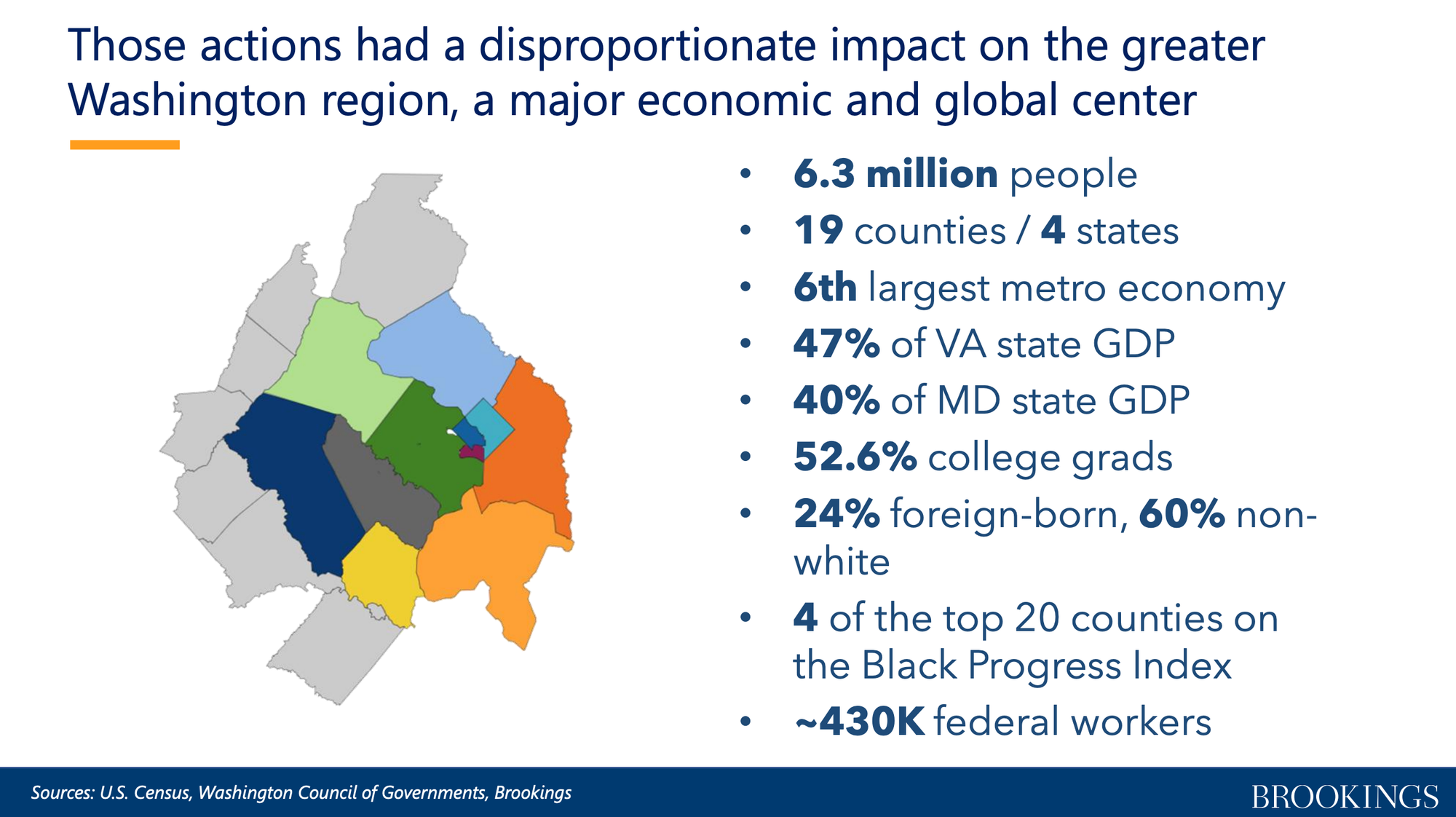
Tracy Hadden Loh, a fellow at Brookings who leads the institution's DMV Monitor project, told the council that while Alexandria has largely been spared the direct federal job losses battering other parts of the region, its private sector has absorbed damage that rivals or exceeds nearly every other DMV jurisdiction.
"For the city of Alexandria, the concern is the private sector," Loh said. "The city of Alexandria lost more private sector jobs than almost any other jurisdiction in the whole DMV last year."
The presentation was part of the city's ongoing monthly economic briefings — a practice City Manager Jim Parajon began last fall at Mayor Alyia Gaskins' request. The Alexandria Brief covered the underlying Brookings data when it was published last week; Tuesday's session gave the council its first chance to question Loh directly and connect the data to the city's $977.3 million FY 2027 budget process.
The warning signs were visible months ago. At a September briefing, Parajon presented city data showing Alexandria's unemployment had climbed from 2.5% to 3.6%, and that active home listings had surged 44% — prompting Vice Mayor Sarah Bagley to ask whether federal workforce anxiety was driving residents to sell. The new Brookings data, drawn from a dashboard of 25 indicators tracking the DMV in near-real time, suggests those concerns were well-founded, and conditions have continued to deteriorate.
On direct federal jobs: Alexandria fared better than most
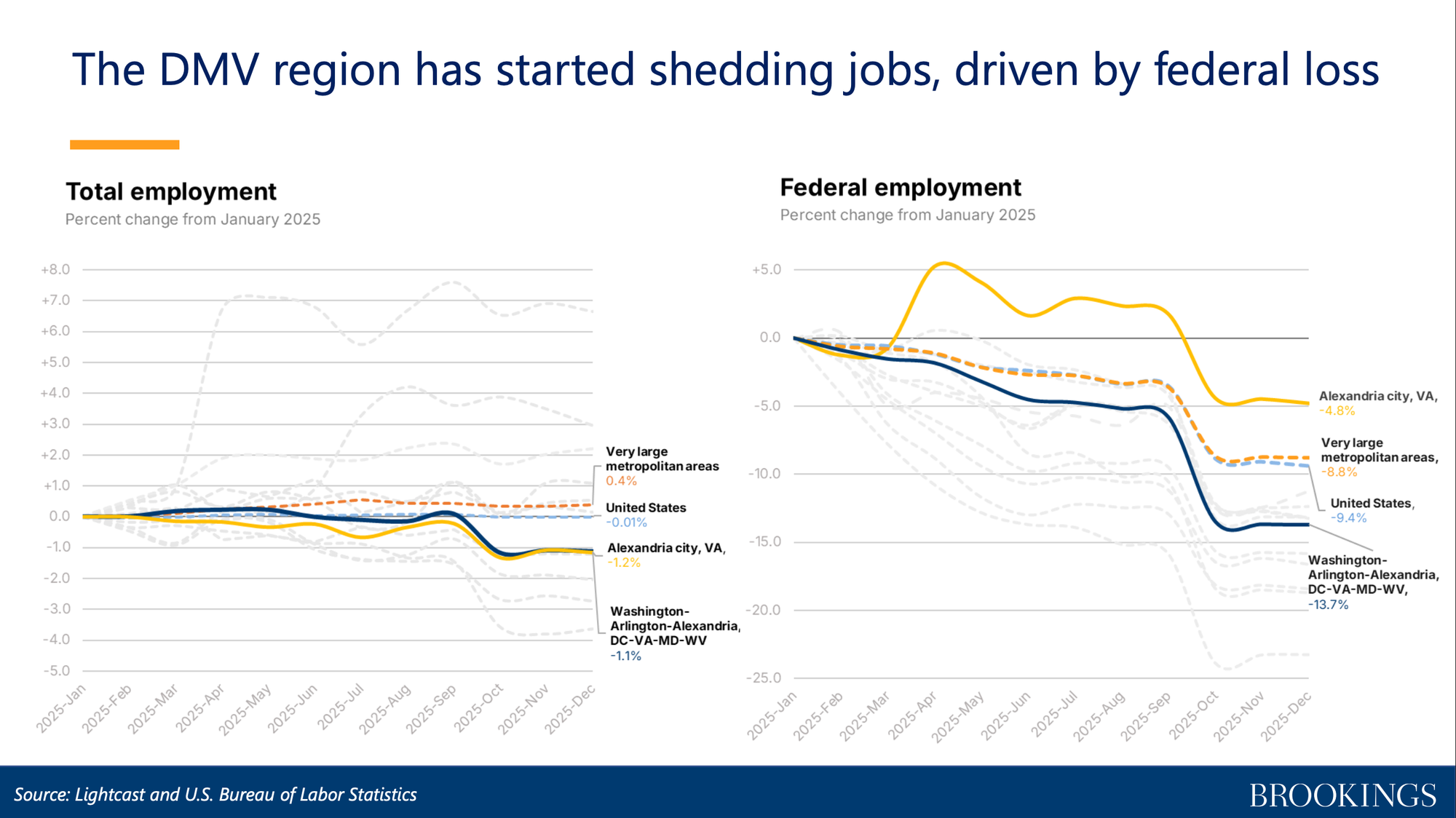
Loh opened with what amounted to a counterintuitive reassurance. While the broader Washington-Arlington-Alexandria metro lost federal employment at a rate of 13.7% from January 2025 — far outpacing the national 9.4% decline — Alexandria's federal employment fell just 4.8%.
"Alexandria got off super light compared to pretty much literally everybody else," she said. "There were quarters where the city of Alexandria actually gained federal jobs."
The reason, she explained, is that while the DMV hosts the greatest concentration of federal workers in the nation, those workers predominantly live in Virginia and Maryland suburbs. The cuts have been targeted rather than across-the-board, hitting agencies and functions concentrated elsewhere in the region.
Across the DMV, roughly 54,000 of the 56,000 jobs lost in 2025 stemmed directly from federal employment cuts — a 14.3% reduction in the region's federal workforce, which Brookings researchers attributed in part to the Trump administration's deferred resignation program, which kept affected workers on the federal payroll through Sept. 30 before their departures registered in official employment counts.
The private sector story is different
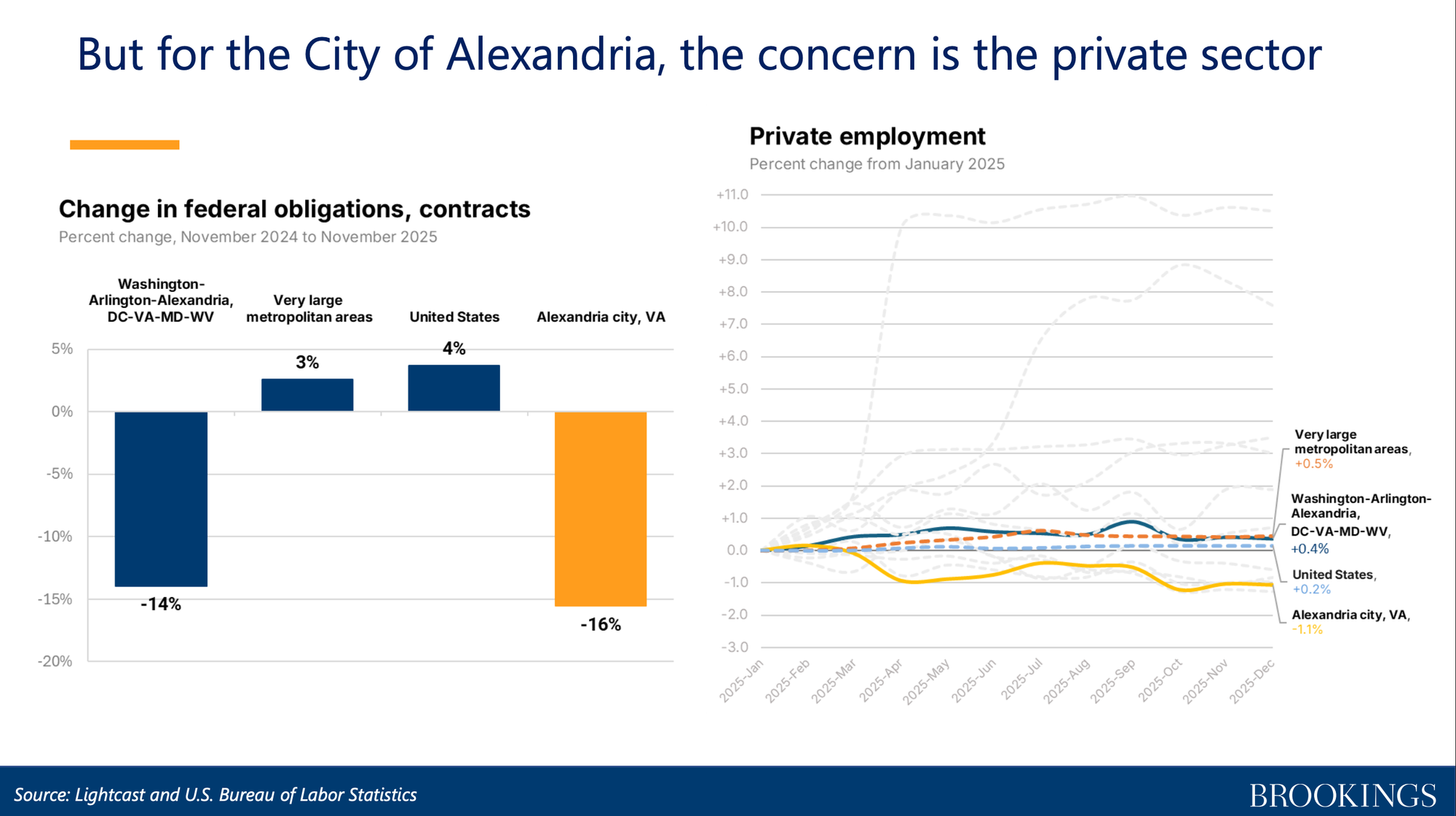
Alexandria's insulation from direct federal job losses has not protected its private economy. Private employment in the city fell 1.1% over the course of 2025 — a period when the broader Washington-Arlington-Alexandria metro still posted a 0.4% private sector gain and the national figure was essentially flat.
Total nonfarm payroll jobs in Alexandria reached 88,099 in December 2025, a decline of 1.98% from December 2024, according to Brookings' analysis of Bureau of Labor Statistics data.
Compounding that: Alexandria's federal contract obligations fell 16% from November 2024 to November 2025 — worse than the region's 14% decline, and dramatically worse than the national figure of +4%. Much of Alexandria's private employment is tied, directly or indirectly, to federal contracting.
The stress has spread to consumer behavior. Resident spending at brick-and-mortar retailers dropped 7.77% between September 2024 and September 2025 — the sharpest decline among core DMV counties, according to Brookings' analysis of DataFy data. Commercial occupancy fell 3.59 percentage points in the fourth quarter of 2025 compared to a year earlier, also the steepest drop among tracked DMV counties.
Online job postings in Alexandria edged up 6.35% to 1,629 listings in December 2025 — a modest counterpoint, suggesting some employer demand persists even as overall employment contracts.
Unemployment and who it's hitting
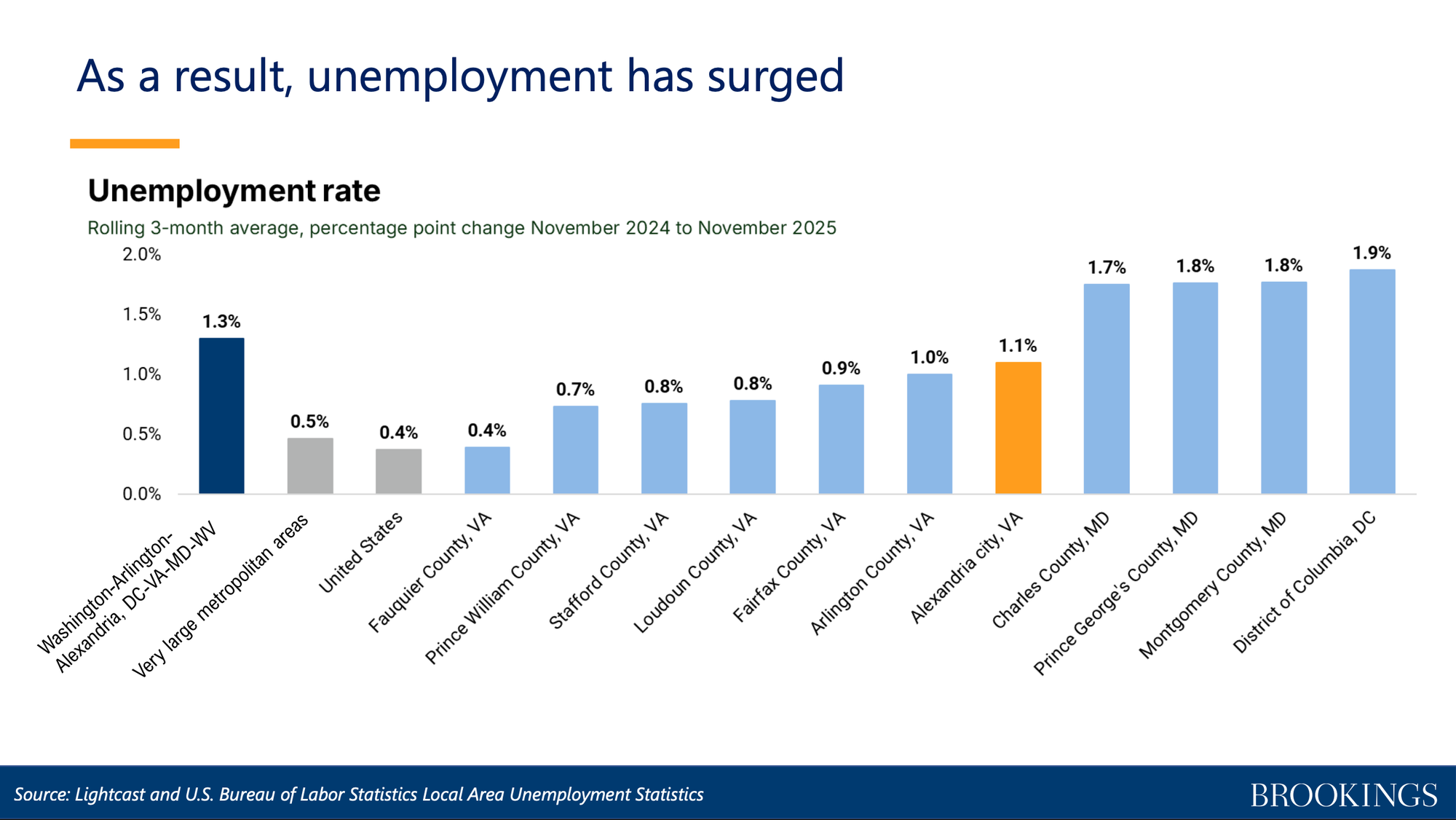
Alexandria's unemployment rate stood at 3.62% in November 2025, up 1.1 percentage points from November 2024 — the largest increase of any Virginia jurisdiction measured. A report presented to the council in February cited a figure of 3.8%, reflecting a different data snapshot, but both point to the same trend.
Loh was careful to contextualize the numbers: Maryland jurisdictions and D.C. have absorbed larger absolute hits, and the DMV's regional unemployment surge of 1.3 points is more than triple the national increase of 0.4 points. "Everything is relative," she said. "This is why context is so important."
Personal bankruptcy filings offer another measure of household stress. Non-business filings in Alexandria rose 28.4% between the fourth quarter of 2024 and the fourth quarter of 2025, reaching 98 filings per 100,000 residents — among the higher increases in the region.
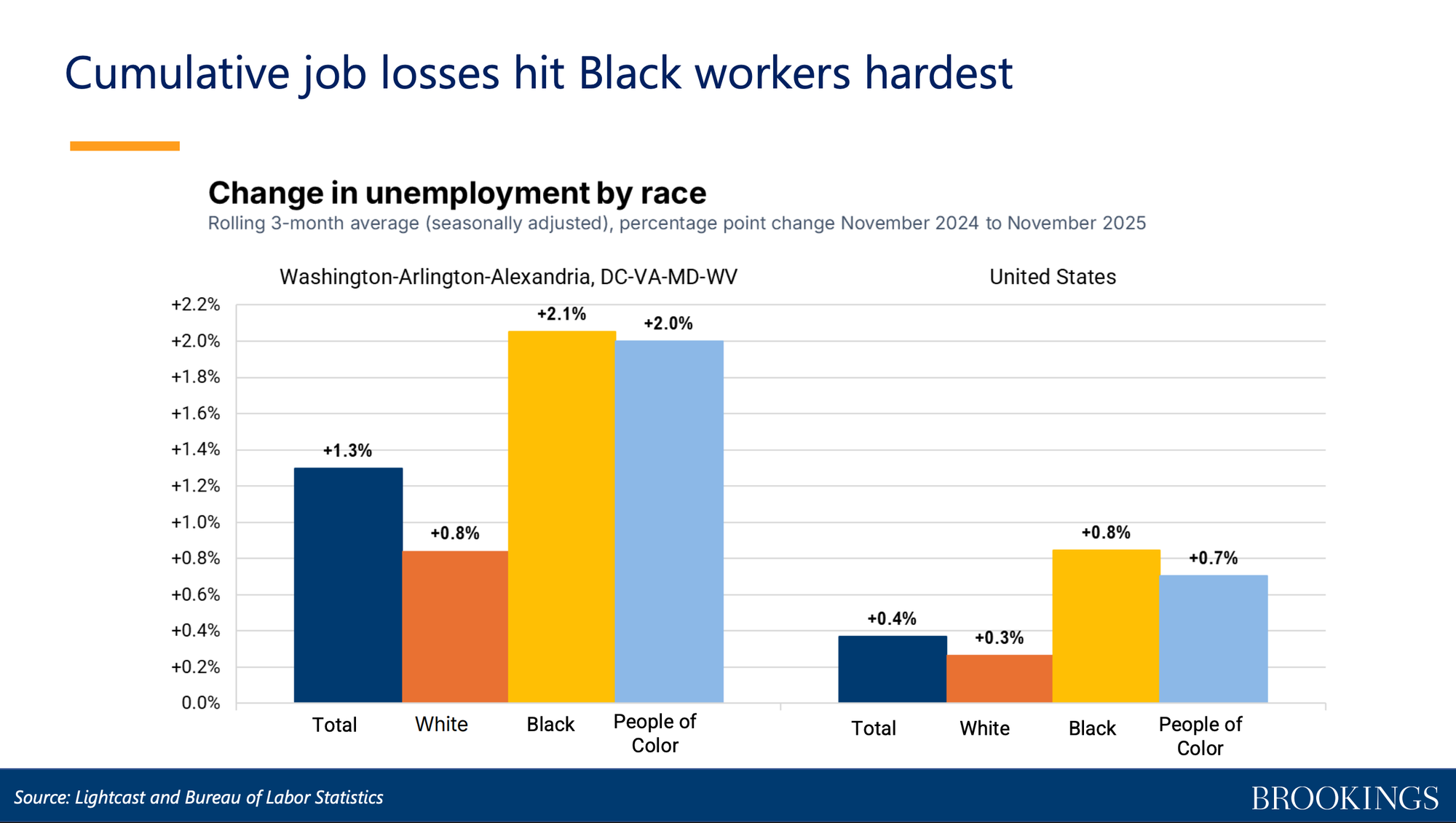
The racial breakdown drew particular attention during the presentation. Across the Washington-Arlington-Alexandria metro, unemployment among Black workers rose 2.1 percentage points — more than double the 0.8-point increase for white workers. The comparable national figures were 0.8 and 0.3 points respectively.
"The unemployment rate for Black workers has gone up over 2 percentage points in just one year, while the unemployment rate for white workers has gone up less than 1 percentage point," Loh said. "When inequality gets worse, it's bad for people, but it's also bad for the economy."
Housing: listings surge, prices drop
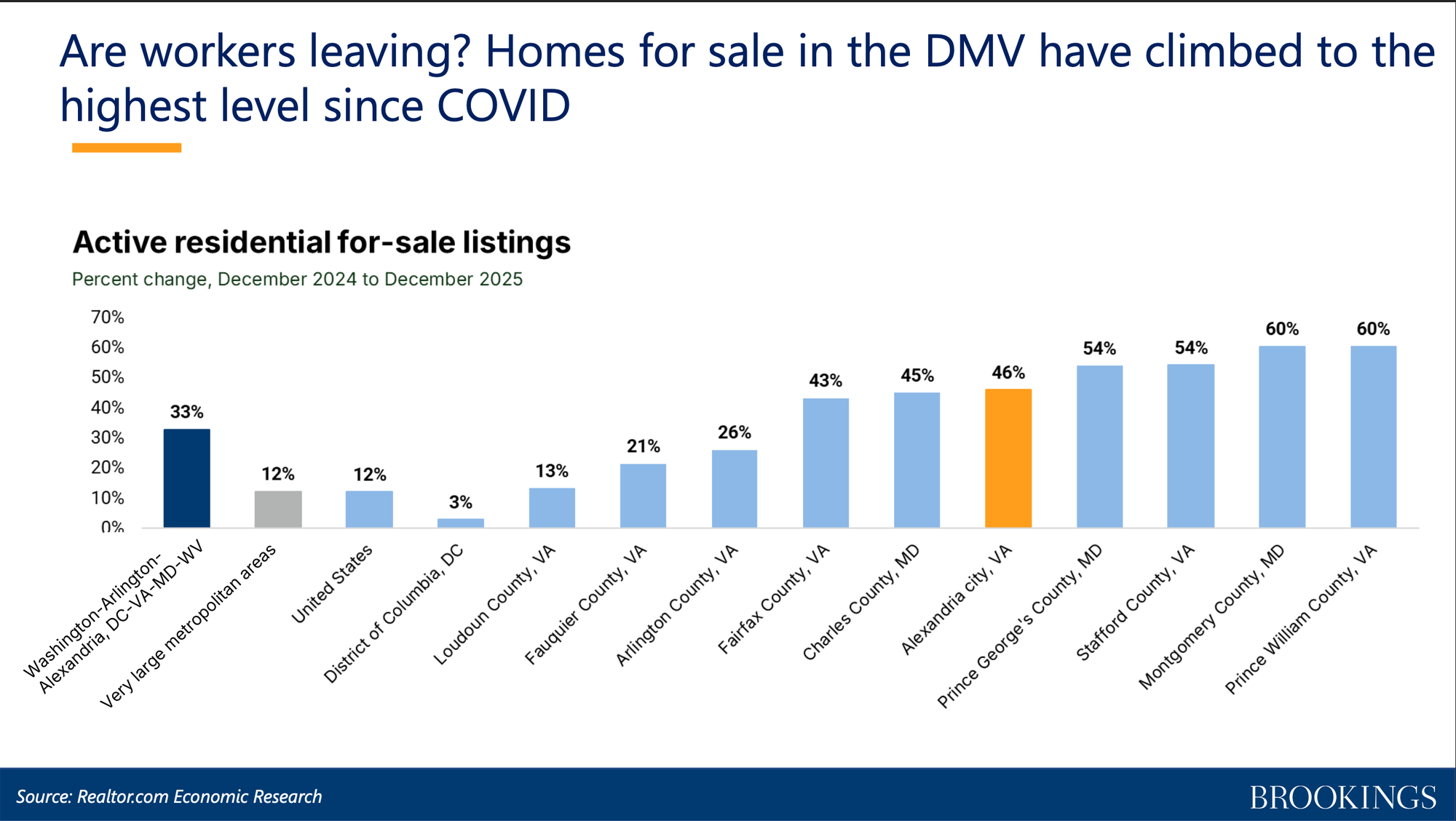
The residential market data may be the most visible sign of economic stress. Active for-sale listings in the Washington-Arlington-Alexandria metro rose 33% from December 2024 to December 2025 — nearly triple the national and large-metro averages of 12%. Within the region, Alexandria's increase was 46%, among the sharpest in the area.
Loh framed the data around the central question it raises: "Are workers leaving?" She was careful not to overinterpret it. "Where there's a seller, there's a buyer," she said. But the price data is harder to dismiss.
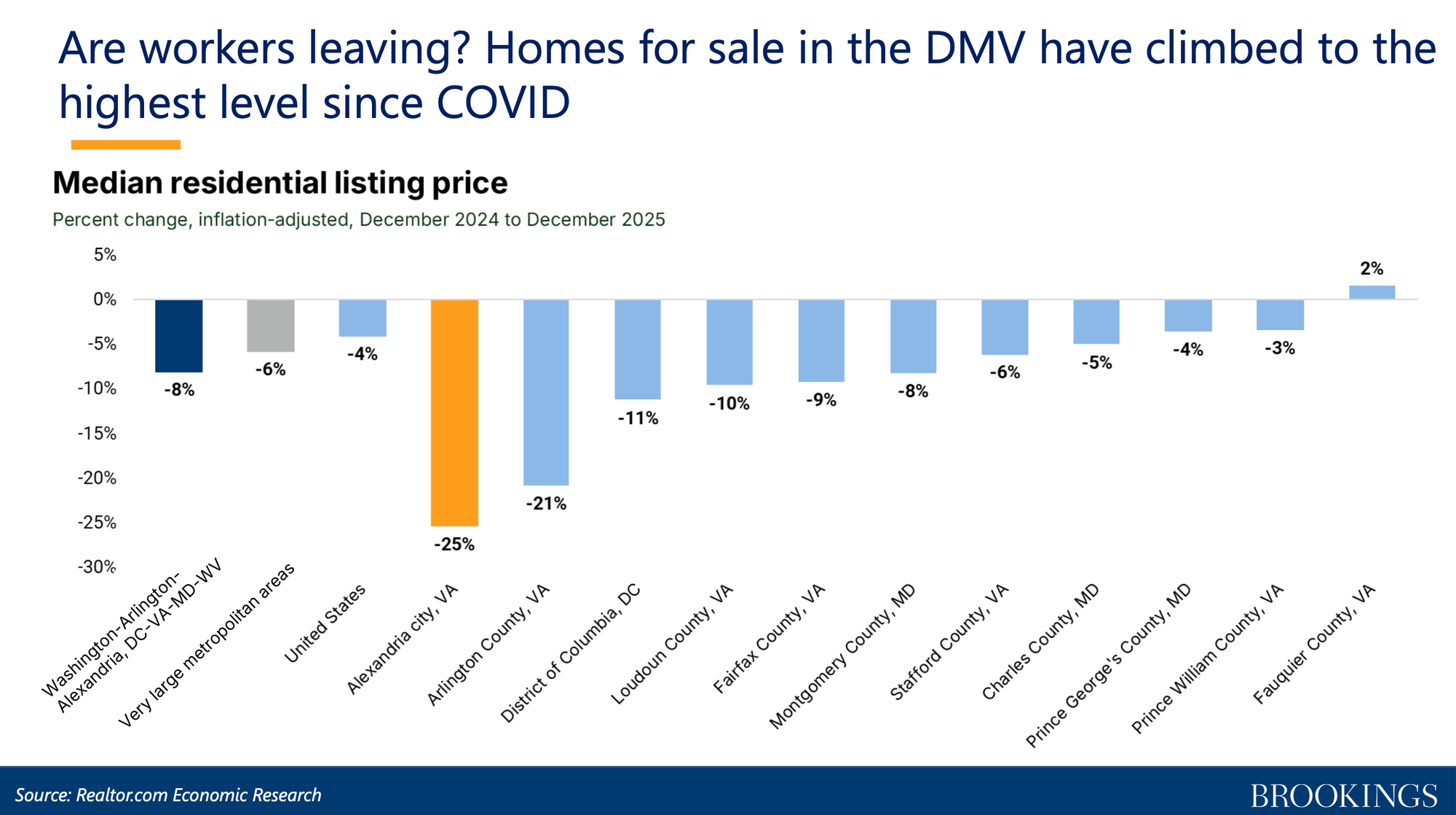
Alexandria's inflation-adjusted median residential listing price fell 25% from December 2024 to December 2025 — the steepest decline of any jurisdiction in the region, and more than triple the regional average of 8%. More listings, sharply lower prices: the two figures together suggest meaningful pressure on homeowners and the city's property tax base.
Hiring slowdown, venture capital collapse
Loh described a broader chilling effect on economic activity across the region. Internship postings in the Washington DC-MD-VA area fell 29% from December 2024 to December 2025 — compared to a 5% decline for other large metros and 4% nationally. Full-time job postings in the region rose just 6%, roughly half the national 12% increase.
Venture capital volume in the Washington-Arlington-Alexandria metro fell 25.1% from January to November 2025, even as the national figure rose 17.3% and other large metros climbed 20.2%.
"This is a five-alarm fire from an innovation economy perspective," Loh said. She described the region as one of five "AI star hubs" in the country with the raw ingredients for major innovation growth — but said the investment dollars aren't arriving to capitalize on them. "No one jurisdiction within the DMV can solve this alone."
Council reaction
The presentation drew substantive responses from across the dais. Mayor Gaskins connected the data directly to the budget deliberations underway and to the 24 speakers who raised cost-of-living and affordability concerns at Monday's public hearing. "When I saw your data, I was like, this is exactly what we need to understand so we can figure out where the places we can be most strategic in intervening," she said.
Councilman Canek Aguirre highlighted Alexandria's active incubator RFP and a regional job fair organized in part by Rep. Don Beyer to help displaced federal workers translate their government experience to private sector roles. Vice Mayor Bagley pressed Loh on the hotel revenue data — asking whether the regional decline reflects a shift in visitor patterns, conference cancellations, or something deeper. Loh said the data is consistent with federal agencies pulling back on travel and events, but that the full picture requires more analysis.
On housing, Loh offered one of her more pointed assessments of the night. She said that when she convened economic development directors from five DMV jurisdictions in December — institutions that directly compete with each other for investment — every one of them named the cost of housing as the single biggest barrier to regional growth. "Not Trump," she said. "Housing." She added that Alexandria is "way out front relative to most other jurisdictions in addressing that" — but that the regional housing deficit is too large for any single city to solve.
One bright spot
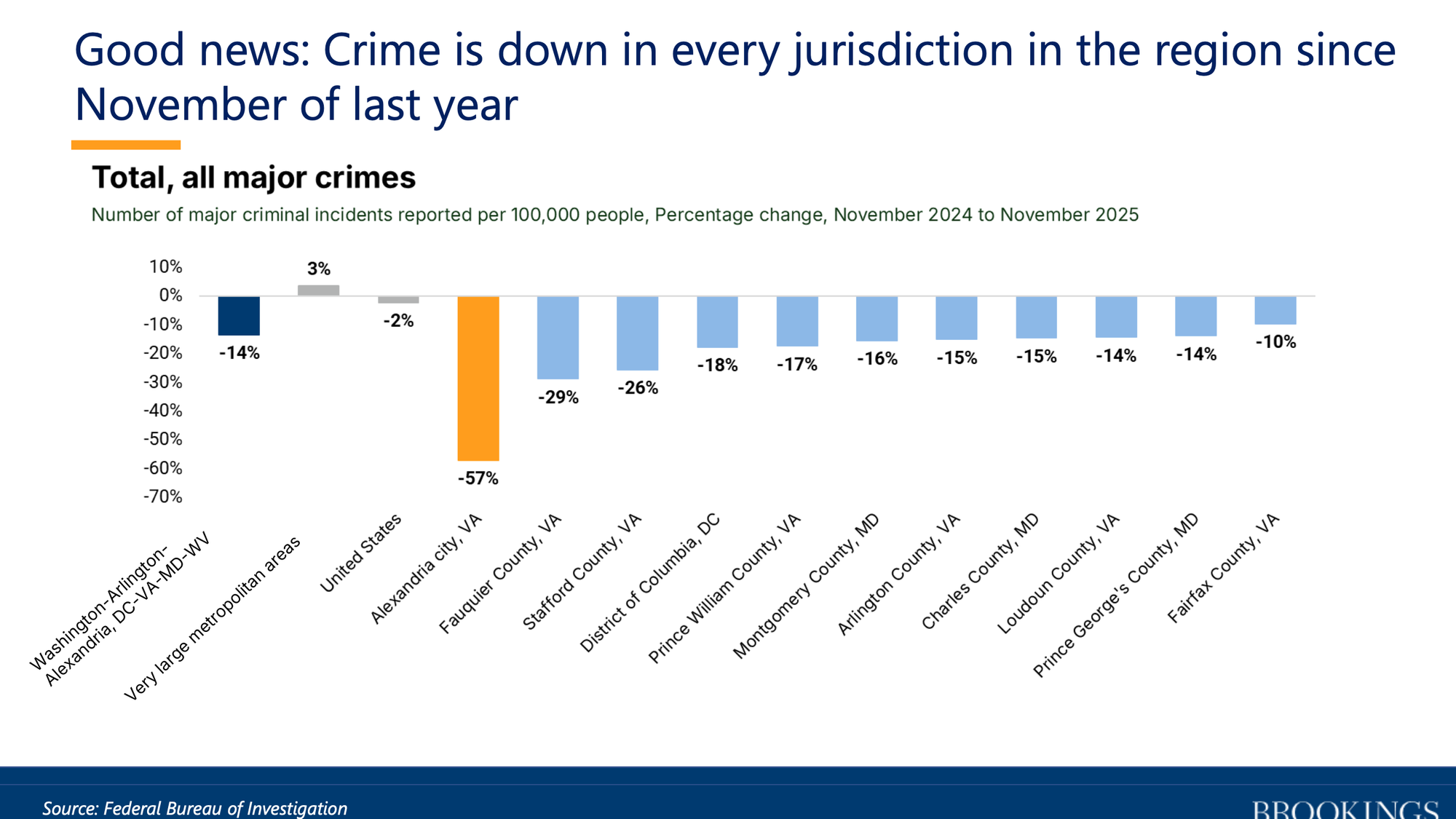
Crime across the region fell in every jurisdiction from November 2024 to November 2025. Alexandria's decline was the most dramatic: major criminal incidents fell 57%, the sharpest drop of any jurisdiction measured. The regional average was 14%; nationally, crime ticked up 2%.
The Brookings DMV Monitor is available at brookings.edu/dmv-monitor. The Brief's previous coverage of the DMV Monitor data is available here.
More from the meeting
 Ryan Belmore