Table of Contents
With the Trump administration's National Park Service standing firm against the city's decade-in-the-making pump station plan, Alexandria City Council signaled Tuesday night that it is ready to move forward with a less expensive — and less comprehensive — approach to waterfront flood mitigation, directing staff to advance a redesigned gravity-based system for a formal scope decision in June.
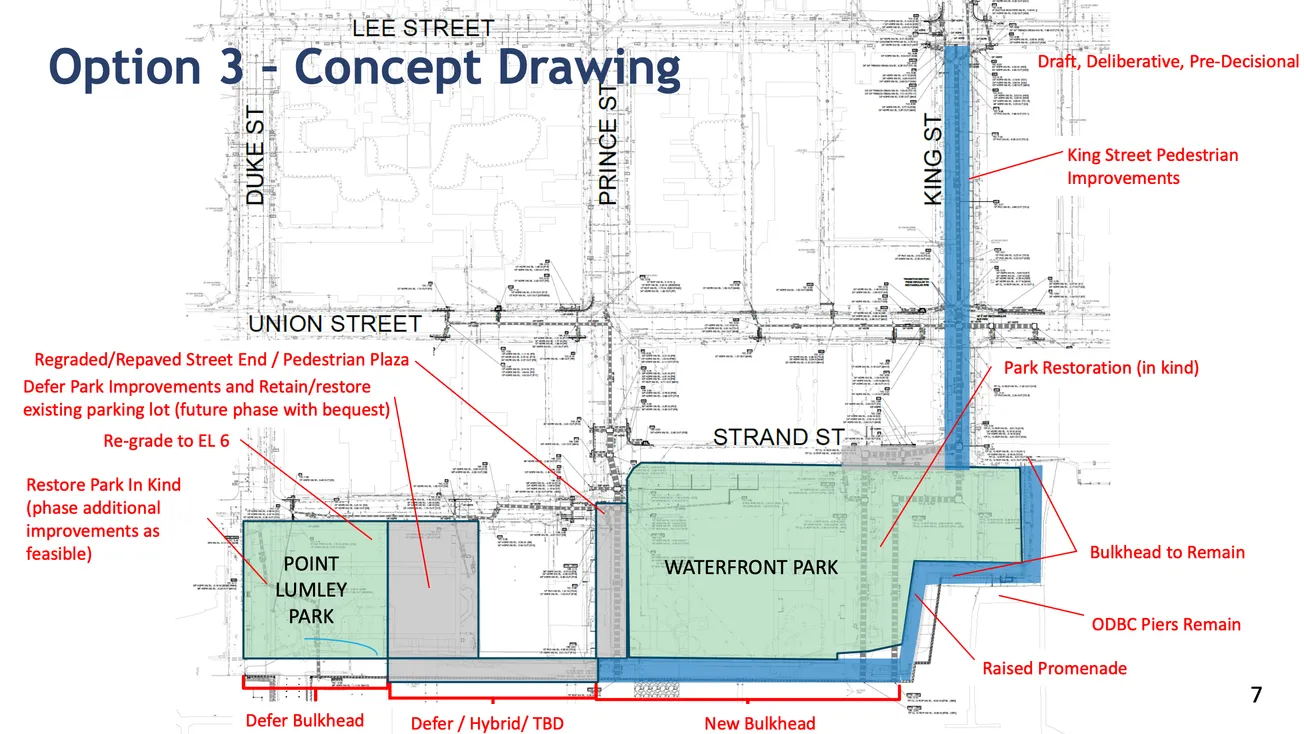
The guidance came after a detailed presentation from Matthew Landes, the city's waterfront flood mitigation project manager and a portfolio manager in the Department of Project Implementation. Landes laid out four options for the project's future and recommended that the council direct staff to further develop Option 3, an enhanced gravity storm sewer system that would eliminate sunny-day flooding and provide river flood protection up to a defined elevation — but would not fully protect against projected sea level rise and would leave the door open for a pump station at a later date.
Mayor Alyia Gaskins made the council's direction explicit at the close of the discussion and asked staff to return in June with tighter cost figures, information on backup portable pump options, and a stakeholder engagement plan. No vote was taken; Tuesday's session was guidance only.
Background: A project derailed by a federal reversal
The waterfront flood mitigation project has been in development for nearly a decade. As The Alexandria Brief first reported last month, the Interior Department's National Park Service reversed course on Feb. 20, with NPS Comptroller Jessica Bowron informing City Manager James Parajon that the federal government would not modify the 1981 Settlement Agreement that governs Waterfront Park — a direct reversal of the agency's position from just 13 months earlier. The reversal declared the proposed pump station an "impermissible use" under the settlement's deed restrictions and killed the deed modification process that had been underway.
Mayor Gaskins addressed the reversal publicly in late February, saying the city would return to council in March with alternatives and that the work on flood resilience must continue regardless.
That presentation came Tuesday night — and it arrived with significant new complications beyond the NPS reversal.
Costs have surged
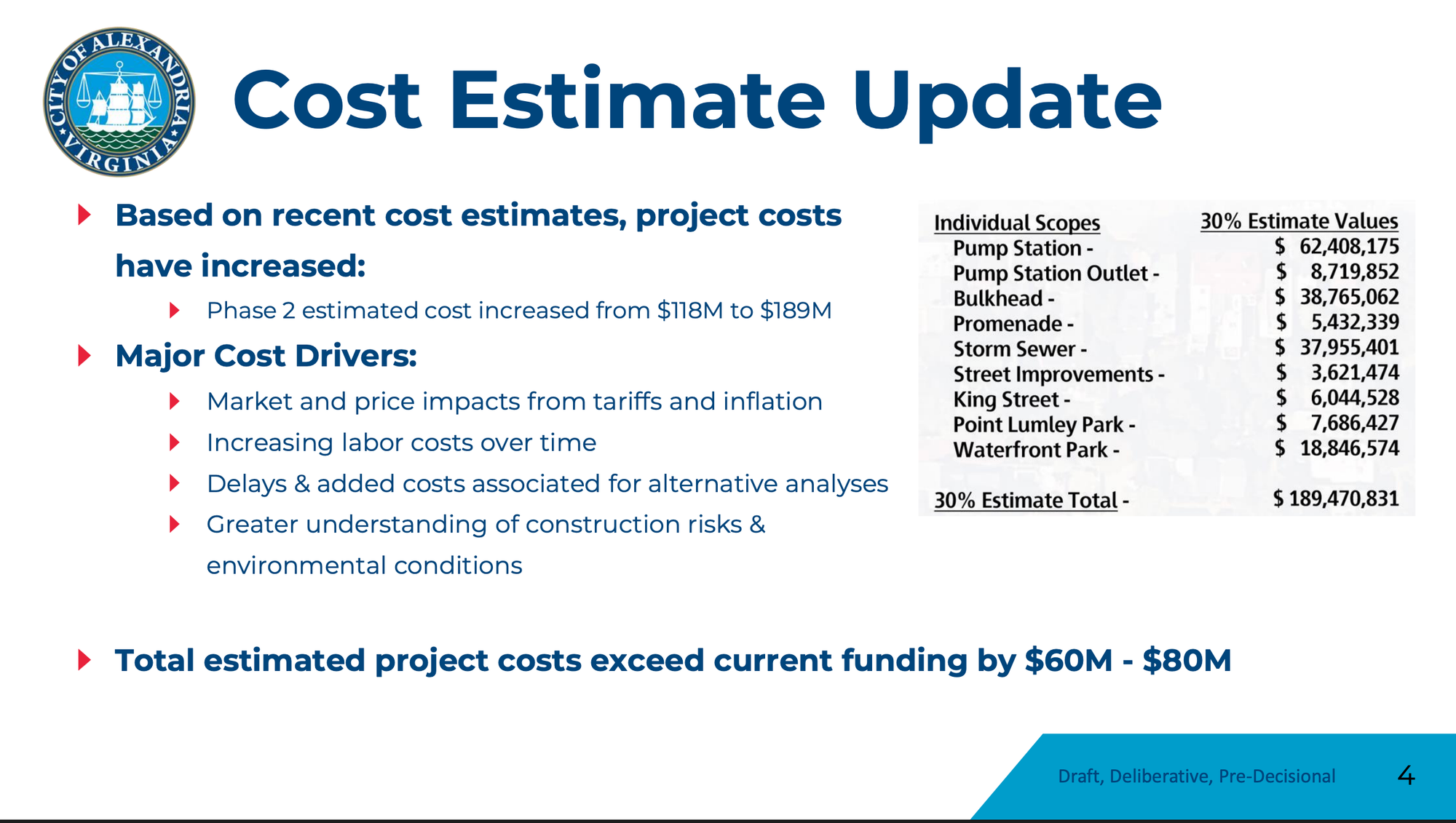
The Phase 2 cost estimate for the project has jumped from $118 million to $189 million, according to city staff. The increase is driven by tariff and inflation impacts on materials, rising labor costs, delays tied to alternative site analyses, and a greater understanding of construction risks and environmental conditions on the site. All told, total project costs now exceed current funding by $60 million to $80 million.
The original project — a roughly $145 million effort funded primarily through $142 million in city capital funds approved in May 2025 and a $3.24 million state grant — was designed to address three sources of recurring waterfront flooding: tidal backflow into the storm sewer system, river water overtopping aging bulkheads, and heavy rain runoff. The NPS reversal eliminated the two options built around the original pump station concept, leaving council to choose among the remaining alternatives.
The options on the table
Landes presented four paths forward Tuesday. The two anchored to the original pump station concept — Option 1A, the current project as designed, and Option 2, a version that deferred bulkhead and park improvements — were both effectively eliminated by the NPS reversal. Option 1B, which would relocate the pump station to 1 Prince St. along with other improvements, remains technically available but carries an additional cost of $100 million to $130 million beyond current funding — a price tag council members described as unrealistic at present.
That left Option 3, the enhanced gravity system, as the viable path. Under Option 3, the city would install an upgraded storm sewer system with flood control gates and valves to eliminate sunny-day flooding and provide river flood protection, while deferring bulkhead and park improvements at Point Lumley. The approach is anticipated to fall within the existing project budget, pending independent cost verification.
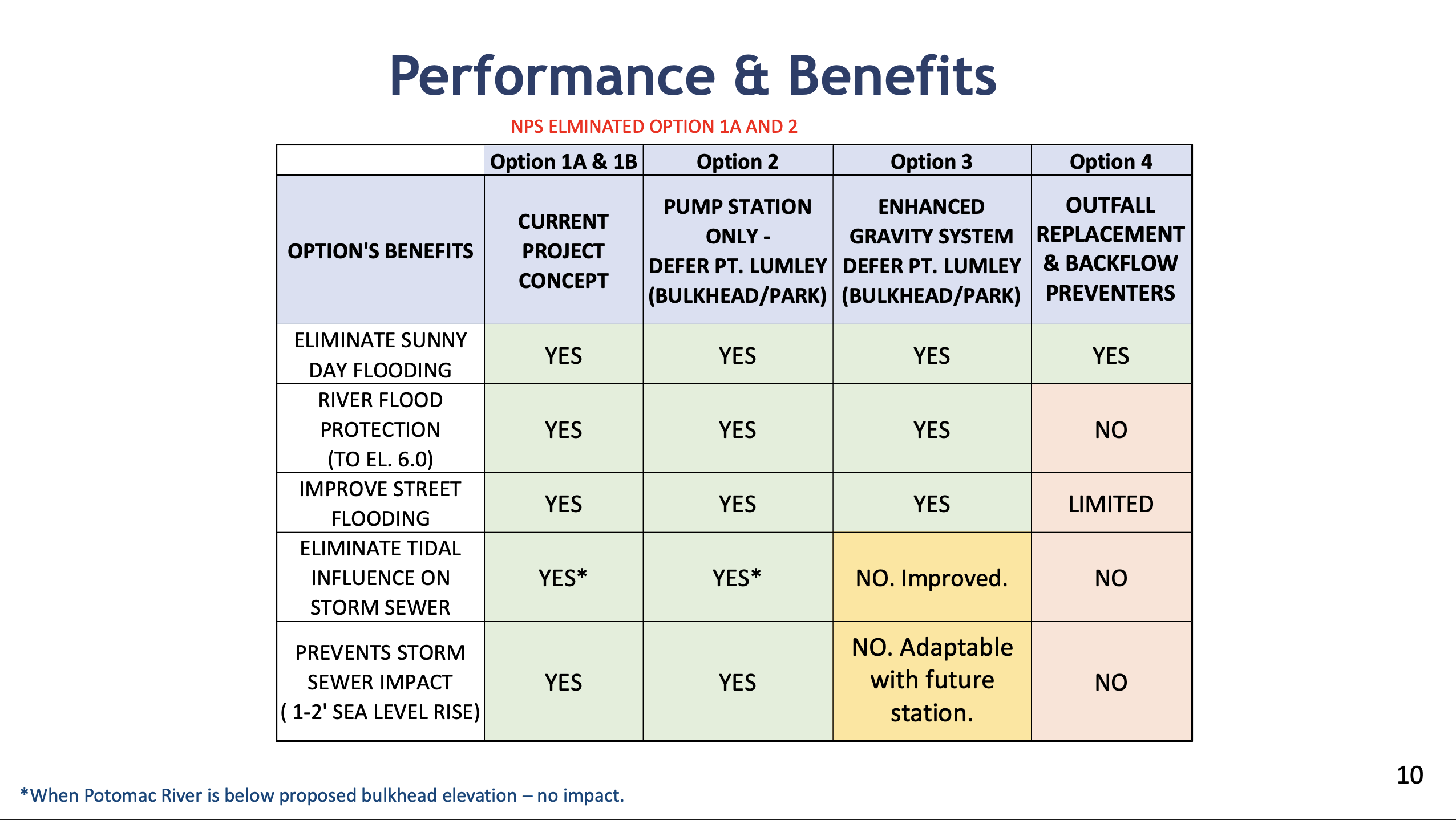
The trade-off is significant. Option 3 would not eliminate tidal influence on the storm sewer system under higher river conditions and would not protect against the 1-2 feet of sea level rise projected in coming decades. Landes acknowledged that a pump station would ultimately be needed to address sea level rise — but said Option 3 does not foreclose that possibility.
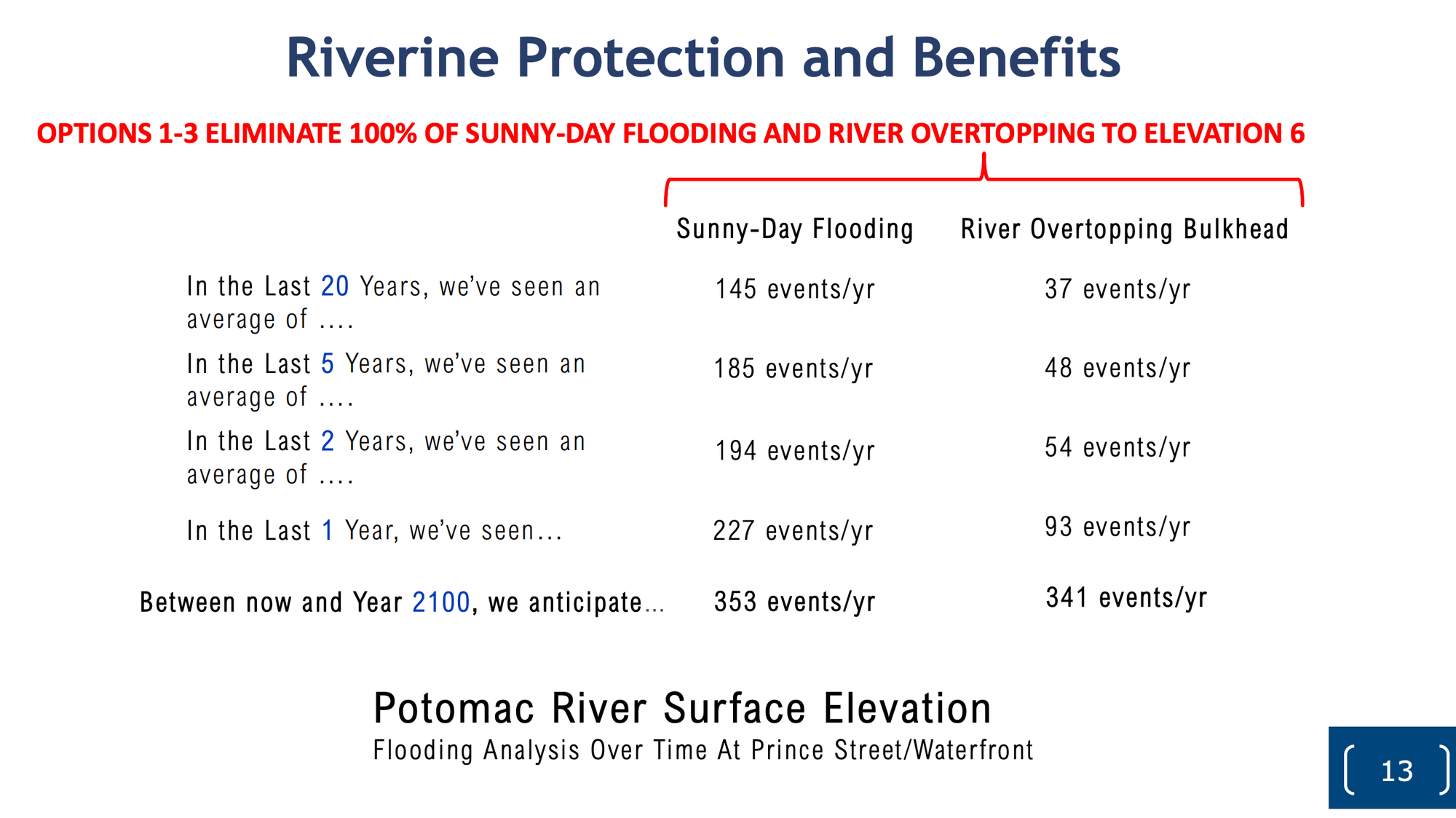
The flooding problem the project is designed to address is already acute and worsening. City data shows the waterfront experienced 227 sunny-day flooding events at Prince Street level in the past year, up from a 20-year average of 145. River overtopping events have reached 93 per year, up from a 20-year average of 37. By 2100, the city projects 353 sunny-day flooding events and 341 river overtopping events annually.
Council discussion: Leaning toward Option 3
Vice Mayor Sarah Bagley signaled support for Option 3, making the case that it was the only fiscally realistic path that also preserved future flexibility. "Option 3 doesn't foreclose a future pump station that could work in conjunction with option 3," she said. "I prefer much more the option we can currently afford that doesn't preclude a pump station rather than option 1B, which we cannot afford."
Councilman Abdel Elnoubi pressed Landes to model what a future pump station would ultimately cost so council could compare the long-term cost of Option 3 plus a future pump station against proceeding directly with Option 1B. "Maybe we look at it and it's like, probably cost the same as just doing 1B right off the bat," Elnoubi said. He also asked whether portable pumps could serve as a backup for riverine flood events under Option 3. Landes called it a plausible option but noted safety risks associated with deploying equipment into significant standing water, and said staff would continue to evaluate it.
Elnoubi said he was leaning toward Option 3 given current budget constraints, but wanted the cost comparison data before a final decision. "We have a problem we need to solve," he said.
Gaskins pushed back firmly on calls — raised in public emails to the council — for a new stakeholder task force to study the options further. "I feel like we've been discussing this for nearly 20 years, even before my time," she said. She pointed to the Waterfront Commission's existing role as a working group and noted that most alternative ideas raised in recent public comment had already been thoroughly studied. "I hope that gives you guys the guidance you need from the council to move forward with option three."
What comes next
Staff is expected to return to the council with a formal scope concurrence request in approximately June. That will be followed by design development, a development review process, contractor engagement, and the development of a guaranteed maximum price.
In the near term, Landes said stakeholder outreach will include engagement with representatives of the 1 Prince St. building, the Alexandria Waterfront Alliance and Old Dominion Boat Club, the Old Town Civic Association, the Waterfront, Parks and Recreation, and Environmental Policy commissions, neighboring businesses, and a broader community meeting.
Gaskins asked staff to flag as early as possible whether any capital improvement plan funding could be redirected in the current budget cycle given that the city is already in budget deliberations. "The earlier we could know that would be helpful," she said.