Table of Contents
This story was originally published at 8:25 a.m. on June 24. It was updated at 9:55 a.m. with a clarification on how many members will serve on the body.
ALEXANDRIA, Va. — The Alexandria City Council voted Tuesday to create a joint committee with the Alexandria City Public Schools School Board to study changes to how and when board members are elected, with Councilman John Chapman casting the lone dissenting vote and warning that the effort risks opening the city charter in Richmond without a clear connection to better outcomes for students.
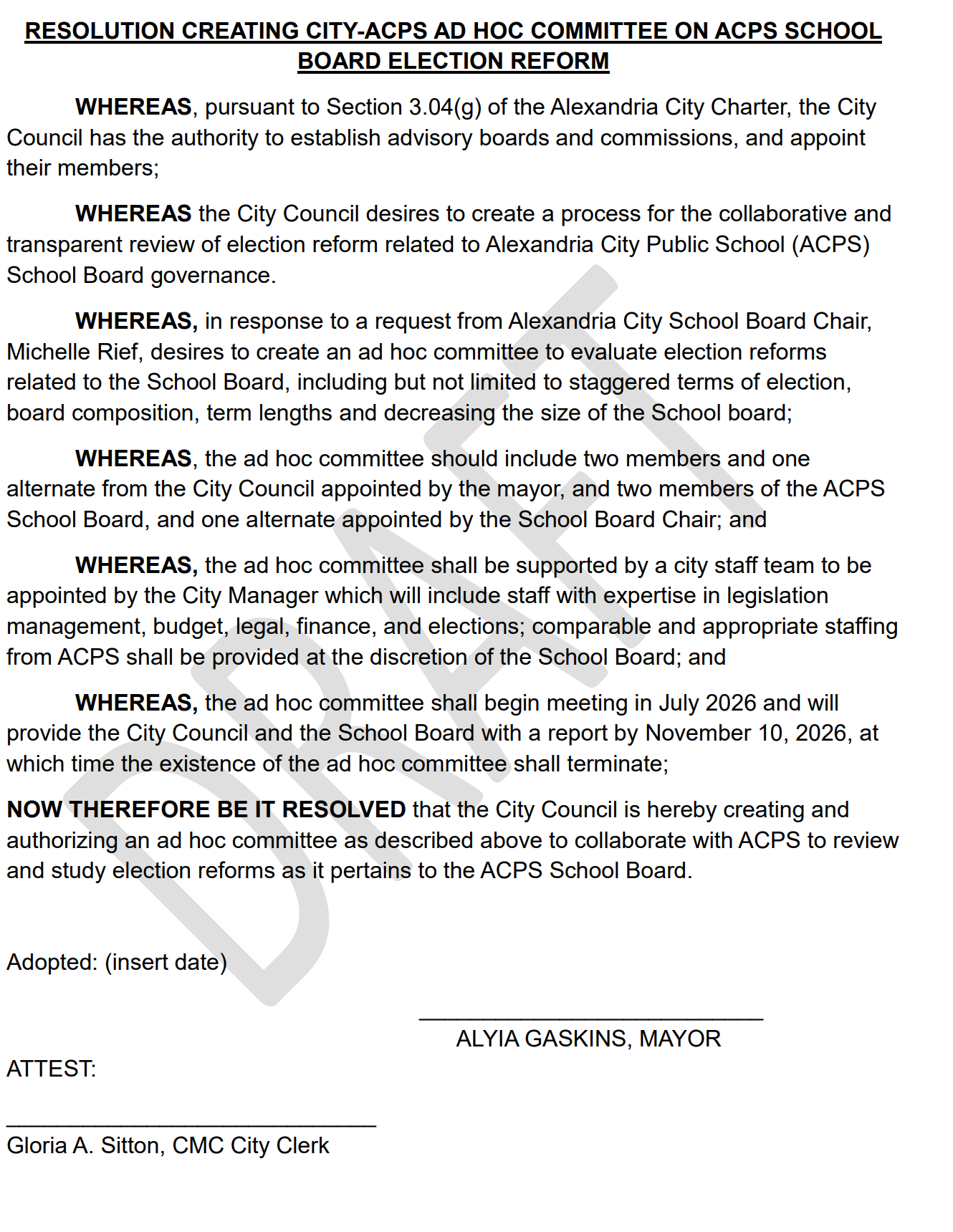
The resolution, approved at the June 23 legislative meeting, creates a four-member body: two council members and one alternate appointed by Mayor Alyia Gaskins, and two school board members and one alternate appointed by Board Chair Dr. Michelle Rief. The committee is directed to begin meeting in July and deliver a report to both bodies by November 10, at which point it dissolves. Gaskins announced that Councilman Canek Aguirre and Councilwoman Sandy Marks will serve as the council's two representatives, with Councilman Abdel Elnoubi as the alternate.
The vote was the formal culmination of a process the council first moved on in May and that the school board has been pressing since late 2024. The nearly hour-long debate that preceded it made clear the committee's work will be contentious from the start.
Clarification: This story originally described the ad hoc committee as a five-member body. The adopted resolution specifies two voting members from the City Council and two voting members from the ACPS School Board, with one alternate from each side — four voting members in total. At the meeting, Mayor Gaskins announced three council appointments: Councilman Canek Aguirre and Councilwoman Sandy Marks as voting members and Councilman Abdel-Rahman Elnoubi as alternate. The two school board voting members and one school board alternate will be named by Board Chair Dr. Michelle Rief. The Alexandria Brief has reached out to the city for clarification on the discrepancy between the five-member description used at the meeting and the four-member structure in the resolution.
What the committee must study — and one member's hard line
The resolution directs the committee to evaluate staggered terms, term lengths, board composition and decreasing the size of the board. The first two reflect the school board's own November 2024 request; the latter two reflect council's stated interest in going further.
Marks sought clarification on whether "board composition" and "decreasing the size of the school board" were redundant. City Attorney Cheran Ivery explained that composition was intended to address questions of representation — such as district versus at-large elections — while size referred specifically to the number of members. Marks said she had been the one to recommend removing the board-size language from the resolution, hoping to give the committee a fresh collaborative start rather than arriving with a mandate. But she accepted it once Gaskins clarified that the "including but not limited to" framing requires those four topics to be on the table without foreclosing others. The committee's first meeting, Gaskins said, would be devoted to setting its own agenda.
Elnoubi, a former school board member, made his position unambiguous. "I'm going to be very clear: if I support this resolution, any recommendation that comes from the subcommittee that does not include reducing the size, I will not support," he said. "I will not vote for it."
He cited a parent petition that had gathered nearly 600 signatures calling specifically for a smaller board — more than the roughly 450 responses the school board received when it surveyed the community about staggered terms using the full institutional weight of the division. He also offered a regional comparison: Alexandria has nine board members for roughly 16,000 students, while Arlington has five for nearly 28,000 and Fairfax has 12 for a district roughly 12 times Alexandria's size. "We are by far the most overrepresented school board as compared to school boards around us," he said. He also pushed back on the urgency of the November deadline, arguing that even if the General Assembly approved a charter change in its 2027 session, any new structure would not take effect until 2030. "So why the rush?" he said.
Chapman: show me the student outcomes
Chapman voted no after raising two substantive objections.
The first was on outcomes. He said he had seen little outside research connecting staggered terms or a smaller board to better results for students. The school board's case, he argued, centers on electoral dynamics and governance stability — not on a demonstrated link to what happens in classrooms. "That to me does not fool me enough to say I'm willing to open the city charter to talk about a politician's career," he said.
The second was on process. The city currently has no legislative director, he noted, meaning whoever is hired would be navigating their first year in the role at exactly the moment a charter amendment — among the most consequential actions a locality can bring to Richmond — would need to be managed through the General Assembly. "Once that charter is opened up in Richmond, there are many things that can happen with it," he said, noting that a sitting state senator had recently moved against his own locality on a charter matter. He did not name the senator, but said everyone on the dais knew the reference.
Chapman also said the situation reflected a broader dynamic he found troubling. "We need to lead this conversation, not somebody tell us, hey, you need to get some stuff done for us — and while you're there, you can play around with it too," he said. "There is no respect for how this is supposed to be done."
The risk of going to Richmond
Gaskins said she shared those concerns and signaled she expects staff to prepare a parallel memo on what other charter changes council itself might want to pursue — so that if the city goes to Richmond, it goes with a complete picture of its own needs alongside the school board's. City Manager James Parajon said the memo was 30 to 60 days out.
Bagley, in making the motion, moved to separate the committee's work from any obligation to act on a specific timeline. Whatever the committee recommends in November, she said, the resolution does not bind council to pursue a General Assembly charter amendment in the 2027 session. Council members also noted that even if the General Assembly acted in its 2027 session, a new election structure could not take effect until 2030 — raising questions about the urgency behind the November deadline.
Even if the committee delivers its report on time and council moves quickly, it remains unclear how soon any approved changes could take effect — a question members said needs to be resolved as the committee's work gets underway.
Moving forward
Marks said the debate, whatever its tensions, pointed to something the community needs to see. "As a parent in this school system for a decade, with four years in front of me — what my friends and community members in the public school parent community want to see is our government working for them and working together," she said. "I think this is a small smoke signal to send up to show our community that we can do that."
Elnoubi, before the vote, pushed back on any suggestion that the friction between the two bodies reflects a failure to collaborate. He recalled a joint transportation proposal council brought to the City-Schools subcommittee last year that the school board declined to engage before the two full bodies could even discuss it. "We walked to the meeting and the conversation got shot down in minute one," he said. "That's not collaboration."
The committee is expected to hold its first meeting in July.
Related coverage
 Ryan Belmore
 Ryan Belmore
If this reporting is valuable to you, consider supporting our work.