ALEXANDRIA, Va. - A presentation meant to showcase Alexandria City Public Schools' community partnerships turned, briefly, into a defense of the central office staff who manage them — and a rebuttal to one of the loudest refrains of this year's budget season.
The June 11 update was an information item, not a vote. Staff walked the School Board through a portfolio of more than 200 partner organizations — nonprofits, city agencies, businesses and universities providing tutoring, mentoring, soccer, dance, career training and family support, much of it at no cost to the division. Then board member Tim Beaty asked how many people it takes to run all of it.
The answer: not many. Taneika Taylor Tukan, ACPS's executive director of community partnerships and engagement, told the board she has one additional team member, Dr. Greg Tardieu, the grants and partnerships manager, whose responsibilities are split across grants, donations and partnerships. Two staff, in other words, oversee more than 200 active agreements.
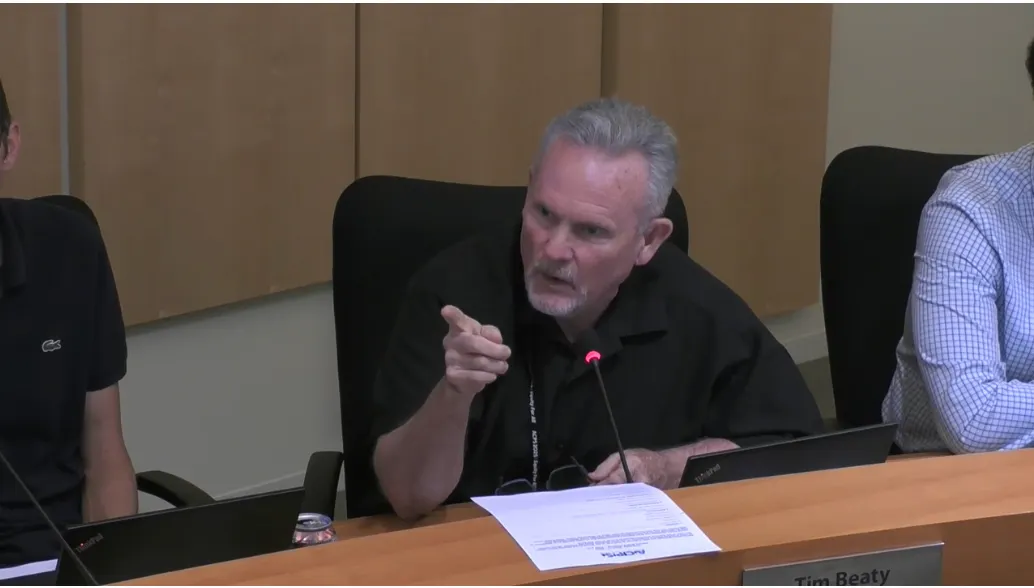
That figure set up Beaty's statement. It burns him, he said, to hear community members argue that central office employees aren't doing anything and that the division should get rid of them. The presentation, he said, was itself a rebuttal — proof of work that makes classroom programming possible but rarely gets seen.
He pointed to that night's consent calendar, where four federal grant applications, for Title I through Title IV, sat among the routine items. Together the applications seek about $5.75 million for the coming school year — roughly $4.1 million in Title I funds for nine designated schools, plus Title II money for teacher development, Title III support for English learners and Title IV funding for STEM and enrichment. Those applications are long and onerous, Beaty said, and they fund programs the schools would otherwise go without. The work of writing and executing them happens in the central office, he argued, and the assumption that schools could simply absorb it if the central office were cut is, in his words, not true.
"What we do in the central office is how we enable what happens inside the schools every day," Beaty said, adding that he wished the public understood it better. The grant applications he cited were among the items on the consent calendar he had moved to approve earlier in the meeting, which passed unanimously.
The remarks landed against a pointed backdrop, and a fresh one. Earlier the same night, the board had adopted a fiscal 2027 budget that eliminated or reduced 56 positions to help close a gap of more than $13 million. Throughout the budget season, residents repeatedly urged the board to protect front-line school staff by cutting administrators instead — a theme that surfaced sharply in public comment at the start of the same June 11 meeting. One speaker faulted "the ease with which central office remained unaffected" while educators absorbed reductions. Another argued that ACPS posts worse financial results than neighboring Fairfax County "despite our financial department being twice the size," and pledged to file public-records requests and take his findings to the City Council. Beaty's defense came barely an hour after the budget votes.
 Ryan Belmore
The board also approved, as part of the budget process, an independent study benchmarking ACPS central office staffing against comparable divisions — a review some members framed as a way to answer exactly the questions Beaty's comments raised, and to inform the incoming superintendent. Beaty's statement, in effect, offered the counterargument to the premise behind that study.
His comments drew agreement from colleague Ryan Reyna, who said he had been reluctant to follow such a statement but wanted to build on it. Reyna praised the partnership work and pressed staff on a related point: how the division ensures coordination among the roughly one in four partners that provide one-on-one or small-group mentoring, so that students in multiple programs receive coherent support and so mentorship connects back to classroom teaching. Taylor Tukan pointed to the city-coordinated Alexandria Mentoring Partnership and to a staff member working across the division on mentoring alignment.
Taylor Tukan said the office is developing a tiered system to classify partnerships and focus attention on the highest-impact ones, along with a division-wide audit to map partner offerings against each school's needs and a streamlined onboarding process. Outcomes are currently tracked through goals written into each partnership agreement, with plans to add annual partner surveys to build a fuller picture of impact across the portfolio.
For Beaty, the through-line was simple. The partnerships the board had just spent an hour celebrating, the federal grants that fund programs across nine schools, the agreements that bring tutors, mentors and dance instructors into classrooms — none of it runs itself. It runs, he argued, on the central office staff the public had spent the budget season asking the board to cut.
The Alexandria Brief
Alexandria, Va., news and information you won't find anywhere else.
The Alexandria Brief has no ads, no paywall, and no corporate owner. Support this work with a monthly or annual subscription, or a one-time contribution.
Publisher: Ryan Belmore, an Alexandria resident and journalist. Send feedback, story ideas, news, and tips to ryan@alexandriabrief.com.
Copyright 2026 Alexandria News LLC/The Alexandria Brief. All rights reserved. This material may not be published, broadcast, rewritten, or redistributed without express written permission.