Table of Contents
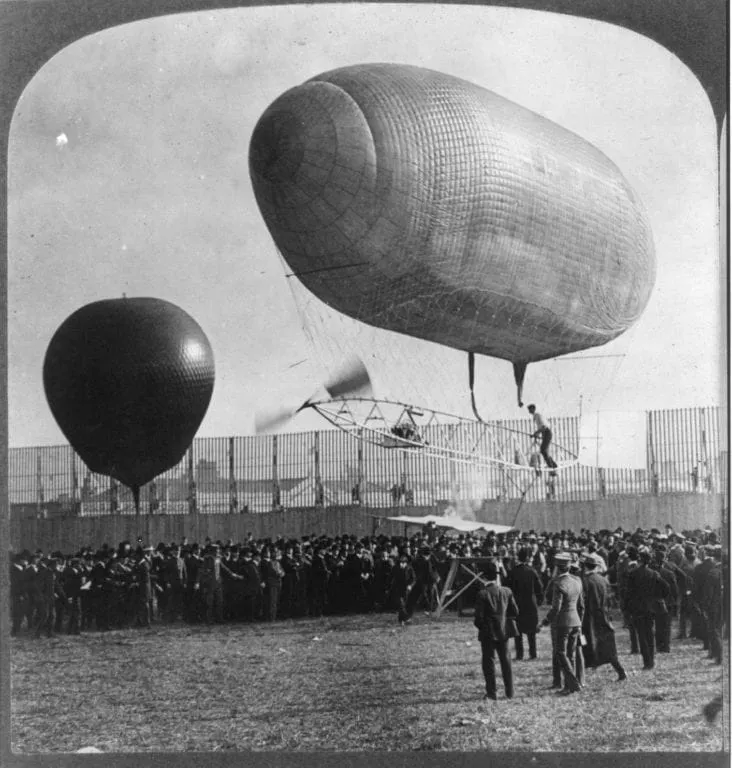
ALEXANDRIA, Va. — On the morning of June 14, 1906, a young Californian named Lincoln Beachey climbed into an airship at Luna Park, an amusement park in what was then Alexandria County, and lifted off into the sky.
Within the hour, he had crossed the Potomac, made two complete trips around the Washington Monument at about 400 feet, and emptied the U.S. Capitol of senators and congressmen, who left their committee meetings and crowded onto balconies and terraces to watch. The next day's Washington Post called the trip "the most successful flight in the history of aerial navigation."
It was the first airship anyone in the nation's capital had ever seen.
Luna Park and the airship
Luna Park, located at the north end of Alexandria County in what is today the Four Mile Run area of Arlington, had opened to the public just one month earlier, in May 1906. Built for $500,000 in three months by the Washington, Alexandria, and Mount Vernon Electric Railway, the park was modeled on Coney Island in New York and had quickly become the region's premier amusement destination — drawing more than 30,000 visitors on Memorial Day.
The airship Beachey flew that morning had been built by A. Roy Knabenshue, an Ohio-born aeronautical engineer who two years earlier had won the airship competition at the 1904 St. Louis World's Fair. Knabenshue had contracted with Luna Park to make the airship the centerpiece of the new park's summer programming. A Washington Post advertisement on June 7, 1906, urged readers to "KEEP YOUR EYE ON KNABENSHUE'S AIRSHIP June 12 to 18."
Beachey — only 19, nicknamed "The Man Who Owns the Sky" — was Knabenshue's pilot. In the weeks leading up to the flight, Beachey told reporters he was thinking about flying across the Potomac, landing on the White House roof, and personally delivering a message to President Theodore Roosevelt. Most observers scoffed. No airship had ever flown into Washington.
The flight
On Thursday morning, June 14, 1906, Beachey lifted off from Luna Park. He climbed to about 400 feet and steered the airship east, across the Potomac River. By 11 a.m., he had reached the city, drawing crowds of pedestrians on sidewalks, balconies and rooftops across the capital.
He flew over and alongside landmark buildings, eventually reaching the Washington Monument, which he circled twice. From the U.S. Capitol, senators and congressmen left their committee meetings and pressed against the balcony railings to watch. The Washington Post the next day described "every available space" at the Capitol crowded with onlookers, with offices emptied and even Cabinet meetings interrupted.
Beachey then turned back, recrossed the Potomac, and returned to Luna Park, completing the round trip in about an hour.
The aftermath
Whether Beachey landed on the White House lawn that day or whether the story has grown in the telling depends on which source you consult. Several contemporary accounts say he set the airship down on the lawn and asked to see Theodore Roosevelt, who was not at home. Other accounts describe the trip as a flyover only. What's certain is that the flight made national news and established Beachey as one of the country's most famous early aviators.
Beachey continued performing at Luna Park through the summer. In July, he became the first American to fly an airship in Canada, taking it to Dominion Park in Montreal. By 1907, he was flying at the Jamestown Exposition in Virginia, at Mexico City, and across the country. He would go on to become the dominant stunt pilot of the pre-World War I era.
His career ended on March 14, 1915, when his monoplane broke apart over San Francisco Bay during a demonstration flight at the Panama-Pacific International Exposition. Beachey, 28, drowned trapped in the wreckage at the bottom of the bay. The crash was witnessed by a crowd of about 50,000.
What's left
Luna Park lasted less than a decade. By 1915, the park had closed, a victim of competition from newer attractions and declining streetcar ridership. The land was later subdivided for housing, and Alexandria County itself was renamed Arlington County in 1920 to avoid confusion with the city of Alexandria — meaning the airfield where Beachey's flight began is now within Arlington's borders, not Alexandria's.
Today, the Four Mile Run area sits at the boundary between Alexandria and Arlington, near where Luna Park's gates once stood. The trolley line that built it is gone. The airship is gone. But on the morning of June 14, 1906, this stretch of ground produced one of the most consequential flights in early American aviation history.
Information via the City of Alexandria's Office of Historic Alexandria, the Library of Congress, Transportation History, HistoryNet, Disciples of Flight, and contemporary accounts in The Washington Post.