Table of Contents
ALEXANDRIA, Va. — Two anniversaries on the same date link Alexandria's print history to the dramatic loss of one of the city's most imposing waterfront landmarks.
A new voice in Alexandria journalism (1811)
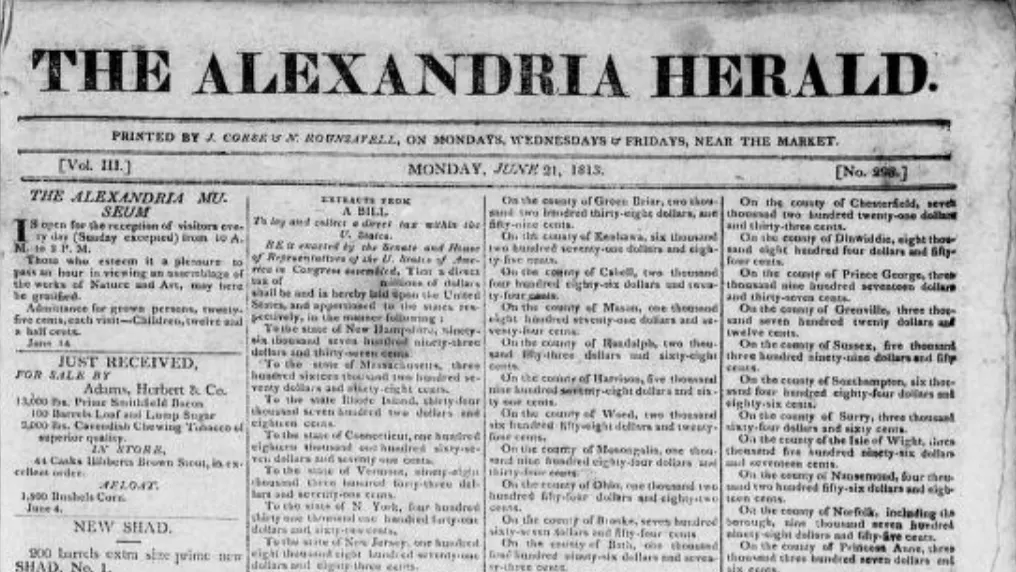
On June 3, 1811, John Corse and Nathaniel Rounsavell published the first edition of The Alexandria Herald, a semiweekly newspaper that would chronicle Alexandria's commercial and civic life for the next 15 years and circulate national news, including some of President James Madison's addresses on the War of 1812.
Published from offices in what was then the federal District of Columbia, The Herald served a city whose press dated to at least 1784, when George Richards & Company began producing the Virginia Journal and Alexandria Advertiser, Northern Virginia's first newspaper and a forerunner of the Alexandria Gazette. Over its run, The Herald changed hands twice — Rounsavell took on a partner, the paper became Rounsavell & Pittman through July 1822, and Henry Pittman then operated it as sole publisher through about 1825. For a brief stretch from May to December 1825, the paper added the word "Columbia" above its masthead. The Herald's final issue appeared on Nov. 15, 1826, the same year as Rounsavell's death.
Bound volumes of The Alexandria Herald are now preserved digitally through the Library of Congress's Chronicling America project, digitized by the Library of Virginia as part of the National Digital Newspaper Program.
The Great Strand Fire (1897)
Eighty-six years later, just after midnight on June 3, 1897, a fire broke out at Herbert Bryant's fertilizer mill on the Strand, Alexandria's working waterfront. The flames spread fast. By the time they were brought under control, the fire had consumed Bryant's warehouse, the Old Dominion Boat Club, multiple wharves and warehouses, and the towering structure that had defined the Alexandria skyline for more than four decades: Pioneer Mills.
Built in 1854 for the American Steam Power Company and considered virtually fireproof at the time, Pioneer Mills was a brick-and-slate behemoth, more than six stories tall, with its roof rising 77 feet above the first floor. The mill was a feat of industrial-era engineering: it could produce 800 barrels of flour a day, grinding more than 4,000 bushels of wheat through 12 sets of "run-of-burr" millstones. The damage from the June 3 fire was so complete that the building was destroyed entirely.
The fire reshaped the Alexandria waterfront from Duke Street to Prince Street, erasing some of the city's most prominent industrial-era structures and effectively ending Alexandria's run as a major flour-milling center.
Information via Historic Alexandria's "This Day in History" and the Library of Congress.